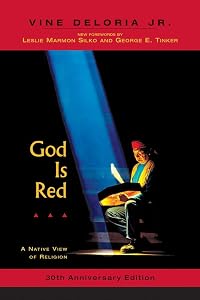
God Is Red: A Native View of Religion
by Jr. Vine Deloria
On This Page
Description
First published in 1973, Vine Deloria, Jr.' s "God Is Red" remains the seminal work on Native American religious views, asking the reader to think about our species and our ultimate fate in novel ways. Celebrating five decades of publication with this new edition, Deloria' s classic work reminds us to understand " that we are a part of nature, not a transcendent species with no responsibilities to the natural world." It is time again to listen to Vine Deloria, Jr.' s powerful voice, show more informing us about a spiritual life that is independent of Western religion and that reveres the interconnectedness of all living things. This new edition includes critical essays engaging with the original material by well-known Indigenous thinkers-Philip Deloria, Suzan Shown Harjo, Daniel Wildcat, and David E. Wilkins. Inside, the book covers a wide variety of topics including: The problem of creation The origin of religion Death and religion Human personality. show lessTags
Recommendations
Member Recommendations
Member Reviews
I serve as the pastor of a Christian church within the Reformed tradition that has been on a Native American reservation for a bit over 100 years. I've served here three years and in that time I have continually tried to learn and understand Native American spirituality in general terms, and more specifically to answer this question: how does Native American spirituality understand and relate to God? As I have sought an answer one thing I have learned is that there does not appear to be a uniform and/or coherent understanding of Native American spirituality, either within my particular setting or more broadly through the larger Native American community. So I was excited and encouraged when I stumbled across God is Red, by Vine Deloria, show more who intended to present a Native view of religion.
Deloria was legendary as a voice for Native Americans, particularly as he was an academic and had both access to and credibility with the powers that be politically and culturally. Son and grandson of Episcopal priest and possessing a graduate degree from a Lutheran seminary he had at one time intended on entering vocational Christian ministry himself. With these credentials perhaps my expectations were too high, for ultimately God is Red was unable to answer those questions that I find to be fundamental for understanding Native American spirituality.

What I did learn is that Deloria appears to have an axe to grind with Christianity. He purports to present both sides of a number of spiritual issues, i.e. a Native side and a Christian side. Time and again the Native side is held out as superior, although with little actual substance as to why. And the Christian side, seen from my particular vantage point, is misrepresented. For a man of Deloria's background in Christianity, i.e. growing up in a Christian home and obtaining a graduate theological degree, he demonstrates a poor and circumscribed understanding of Christian theology and doctrine.
While he doesn't explicitly say so it would appear from his writing that he rejected Christianity as his own spiritual position. As a pastor I would love to know why that happened and to understand what he replaced it with. If he had written a spiritual memoir perhaps I would have gained the understanding I am still looking for: How do people following tradition Native practices understand and relate to God? In the end God is Red is not so much "A Native view of religion" as it is Deloria's conclusions about Christianity. show less
Deloria was legendary as a voice for Native Americans, particularly as he was an academic and had both access to and credibility with the powers that be politically and culturally. Son and grandson of Episcopal priest and possessing a graduate degree from a Lutheran seminary he had at one time intended on entering vocational Christian ministry himself. With these credentials perhaps my expectations were too high, for ultimately God is Red was unable to answer those questions that I find to be fundamental for understanding Native American spirituality.
What I did learn is that Deloria appears to have an axe to grind with Christianity. He purports to present both sides of a number of spiritual issues, i.e. a Native side and a Christian side. Time and again the Native side is held out as superior, although with little actual substance as to why. And the Christian side, seen from my particular vantage point, is misrepresented. For a man of Deloria's background in Christianity, i.e. growing up in a Christian home and obtaining a graduate theological degree, he demonstrates a poor and circumscribed understanding of Christian theology and doctrine.
While he doesn't explicitly say so it would appear from his writing that he rejected Christianity as his own spiritual position. As a pastor I would love to know why that happened and to understand what he replaced it with. If he had written a spiritual memoir perhaps I would have gained the understanding I am still looking for: How do people following tradition Native practices understand and relate to God? In the end God is Red is not so much "A Native view of religion" as it is Deloria's conclusions about Christianity. show less
A thought-provoking book that provides some good insight into Native Indian perspectives and opinions. However, I don't like his double-standard of Christianity and native religions--that Native religions CAN=culture, while it's a failure of Christianity if IT doesn't reflect culture? He also accuses many non-Indians of idealizing about historical Indian society, but then he does the very same thing!! In talking about Native American religion, he waxes romantic about how things used to be, even though, now, their religious communities have deteriorated too. Thirdly, he maintains that whites, or non-Indians, can't understand what it's like to feel tied to the land ... but many families in the U.S. DO stay in one place, DO feel very show more connected to, responsible for, and connected with the land they've lived on for generations. To keep this short, he's guilty of the same ego-centrism and nostalgia that he criticizes Christians for.
Not that I'm Christian. In fact, I liked his critique of American Christian society, I truly did. He was right on target, obviously knows what he's talking about. I wish more people would read this book who needed to--I didn't. show less
It helped that I read this while visiting the west and native American cultural centers! Great explanation of native American spirituality, how they believe you cannot have a religion without a shared culture. Gives understanding and credibility to the Mormons and the Jewish cultures. Also describes their religion as circular as opposed to vertical as Christianity is. I would love to have read this for discussion.
This was an interesting and insightful book. It raised a lot of intriguing questions, even if I didn't always agree with his conclusions. However, I found the book very dense which made it a struggle to get through at times. Overall, I would recommend it to anyone interested in religion or philosophy.
This author does an excellent job at analyzing the fundamental differences of "tribal vs. christianity". I enjoyed how he made his observations based on viewing both philosophies from a cultural perspective, rather than a question of "doctrinal validity". Because let's face it, if your not in either religion, then the "validity" doesn't matter. That's the whole point.....
Deloria tries to convey the basic differences in religious outlook between native beliefs and practices and those of Christianity.
“God is Red: A Native View of Religion” by Vine Deloria
BIBLIOGRAPHIC DETAILS
--PRINT: © 1973; 9780448021683; Grosset & Dunlap; PP: 376 (Info from WLAC catalog).
--(I read from the print and this one, but primarily, this.)*--DIGITAL: © (1973, 1992) 2003; 1555914985; Putnum Publishing Group; PP: 326 (Info from ProQuest Central online version).
AUDIO: © Non-existent
--FILM: No
SUMMARY/ EVALUATION:
--SELECTED: A friend of mine who is very sympathetic towards America’s treatment historically of Native Americans, suggested I read this.
--ABOUT: Describes contrasts and conflicts between Native American religions and Christianity, condemning Christianity for its intolerance and its attempts at overwriting the former with the later. show more
--OVERALL OPINION: There’s a plethora of good historical information on society, Christianity and Native American culture, but it’s liberally peppered with generalizations and suppositions, and in the midst of historical events I couldn’t always tell what point was trying to be made. The case seems to be asserted that Chrisitanity was the cause of all the trouble for the Native Americans and that Christians are incapable of understanding the nature and complete integration with daily life of Native American religion.
I don’t argue that the relocation of Native Americans to reservations was horrific for them, nor that Christianity at that time, as it sought to root out the culture of Native Americans and replace it with their own, was (and, yes, to a good extent, still is) dogmatic, superstitious, and domineering, but I felt there was a great deal of hero worship of all Native Americans in general and I wanted more objectivity.
AUTHOR: (From Wikipedia)
Vine Deloria:
“Vine Deloria Jr. was born in 1933, in Martin, South Dakota, near the Oglala Lakota Pine Ridge Indian Reservation.[4] He was the son of Barbara Sloat (née Eastburn) and Vine Victor Deloria Sr. (1901–1990). His father studied English and Christian theology and became an Episcopal archdeacon and missionary on the Standing Rock Indian Reservation.[5] His father transferred his and his children's tribal membership from the Yankton Sioux to Standing Rock. Vine Sr.'s sister Ella Deloria (1881–1971) was an anthropologist.[6] Vine Jr.'s paternal grandfather was Tipi Sapa (Black Lodge), also known as the Rev. Philip Joseph Deloria, an Episcopal priest and a leader of the Yankton band of the Dakota Nation. His paternal grandmother was Mary Sully, daughter of Alfred Sully, a general in the American Civil War and Indian Wars, and his French-Yankton wife; and granddaughter of painter Thomas Sully.
Deloria was first educated at reservation schools, then graduated from Kent School in 1951. He graduated from Iowa State University in 1958 with a degree in general science.[7] Deloria served in the United States Marines from 1954 through 1956.[8]
Originally planning to be a minister like his father, Deloria in 1963 earned a theology degree from the Lutheran School of Theology at Chicago, then located in Rock Island, Illinois.[7] In the late 1960s, he returned to graduate study and earned a J.D. degree from University of Colorado Law School in 1970.[2]”
NARRATOR(S):
Not in audio format
GENRE:
Nonfiction; Religion; Native Americans
TABLE OF CONTENTS:
The Indian movement -- America loves Indians--and all that -- Indians of America -- The religious question -- Thinking in time and space -- The problem of creation -- The concept of history -- The spatial problem of history -- Origin of religion -- Death and religion -- Human personality -- The group -- Christianity and contemporary American culture -- Tribal religions and contemporary American culture -- The aboriginal world and Christian history -- Religion today.
SUBJECTS (Not comprehensive):
Christianity -- Controversial literature; Indians – Religion; Civil Rights; History; Theology; Race; Spirituality; Philosophy
EXCERPT
From Chapter 3: “The Religious Challenge”
“INDIAN ACTIVISTS HOLDING RELIGIOUS CEREMONIES in the BIA building
concluding their stay by looting the building seems incongruous and
ridiculous, unless we probe deeper into the nature of the relationship
between Indians and whites. Indian activists accused of fomenting the
destruction made a rather weak reply. What about the rape of the North
American continent, the destruction of tribal cultures, the wasteful use of
human beings, the deprivation of rights to a helpless minority? Do not these
crimes make the destruction of a building pale in significance, they asked.
Do they?
In one sense the capture and destruction of the BIA headquarters was
a historic anachronism. Watts burned in 1965, the urban areas seethed and
burned following the death of Martin Luther King, Jr., in 1968. Was not
the Indian occupation of a federal building in the nation’s capital an event
dreadfully out of time? Was not the sacking of the BIA headquarters and
the occupation of Wounded Knee the final spasm of the rugged 1960s
when any type of change was considered beneficial, and the institutions of
society were considered not only obsolete but malignant? Perhaps it was
the last hurrah of an era when people could thumb their noses at established
authority without fear of painful reprisal. But the Indian incidents
must also be seen within the context of the Indian experience in this
nation’s history and in that context the Indian movement raised an
entirely different kind of question—that of religion rather than the equal
enforcement of the law.
There certainly was an aspect in which the Indian protests were events
of the 1960s, although occurring in 1972 and 1973. Since 1968, the major
Christian denominations had been pouring funds into social movements
of all kinds. They believed deeply in the militant interpretation of black
power as continuous confrontations, and grants were made to organizations
within the respective minority groups that they were sure would
produce the desired protests. A group that snapped and snarled about its
social problems stood a much better chance of receiving funds from the
churches than did a group that calmly and carefully articulated a problem
that they hoped to solve.
Church officials often gauged their relevancy in proportion to the violence
of the groups they were funding. Any church not receiving its share
of frothing-at-the-mouth demands for money felt isolated from the great
events of the American social movement. Thus, it was that when AIM captured
a dormitory at Augustana College in Sioux Falls and presented a set
of demands carefully worked out by sympathetic Lutherans in secret sessions,
the Lutheran churches eagerly embraced the Indian cause. While
they had not been overly enthusiastic about helping the blacks during the
Civil Rights movement, some church officials felt that they could get the
same kind of action from the Indians without taking a position on a social
movement that would antagonize their church members.
Many Lutherans were ecstatic when informed by Indians that they
were guilty of America’s sins against the Indians, and they embarked on a
massive program of fund-raising to pay for their alleged sins. But they were
not the only victims. Because the Presbyterians, Episcopalians, and
Congregationalists all gleefully responded to the accusation that they had
been responsible for nearly all of the problems of American Indians, they
also decided that they could purchase indulgences for these sins by funding
the Indian activists to do whatever they felt necessary to correct the
situation. By early 1971, almost every major Christian church had set up
crisis funds to buy off whichever Indian protesters they might arrange to
have visit them. Confrontations escalated as each group sought to become
more relevant than its competitors, and the path toward destruction was
clearly visible to everyone. In a real sense, Christian churches bought and
paid for the Indian movement and its climactic destruction of the BIA
headquarters as surely as if they had written out specific orders to sack
the BIA on a contractual basis.
Not every Indian protest, however, was inspired by the financial rewards
to be gained from the churches by playing the protest game. Many of the
incidents were valid protests by a people who had suffered too much for too
long. Even more, younger Indians had seen in the Civil Rights movement
that the institutions of this country respond only when there is a threat to
their property, or when disorder in their lives forces them to confront problems
that have not been solved for generations. Yet the Civil Rights issue was
peripheral at best when understood in the Indian context. The different tribal
groups suffered discrimination and prejudice generally, but more specifically
the broken treaties meant immediate hardship for the different communities.
Could young Indians enter a Civil Rights movement and press for removal
of discriminatory hiring practices while enjoying preference under federal law
for employment in tribal programs based on treaties and agreements? Major
institutional differences really did exist among American racial minorities.
Few Indians ever accepted the premises of the Civil Rights movement.
If the tribal chairmen demanded the prosecution of the Indian militants
following the departure from the destroyed BIA building, it was a weak
response compared to tribal reactions on being asked to join in the Civil
Rights movement and marches half a decade earlier. That the basic goals of
the Civil Rights movement could not attract more than a handful of
Indians at any one time should give pause to everyone. What was it that
turned Indians off other than the fear that they might be identified with
blacks as a minority group?
American history gives us a partial answer and allows us to raise certain
questions that must be asked. The Civil Rights movement was probably the
last full-scale effort to realize the avowed goals of the Christian religion. For
more than a century, the American political system had proclaimed the
brotherhood of man as seen politically in the concepts of equality of opportunity
and justice equally administered under the law. Equality under the law,
however, was a secularized and generalized interpretation of the Christian
brotherhood of man—the universal appeal of individuals standing equally
before God now seen as people standing equally before the law and secular
institutions. While the National Association for the Advancement of Colored
Persons (NAACP) Legal Defense and Education Fund fought a series of
brilliant court battles leading up to the great Supreme Court decisions, in the
background certainly lurked the great Christian message of the brotherhood
of man. A majority of Americans rejected this secular version of brotherhood
and sought to prevent its realization because of long-standing attitudes that
people of color were necessarily inferior.
When the struggle in the South reached the point of open boycotts and
nonviolent protests, it was the black Christian church leaders such as Martin
Luther King, Jr., Ralph Abernathy, and Andrew Young who spearheaded the
movement by translating Christian doctrines into political tools of resistance
and eventually conquest. In large measure, the Civil Rights movement was a
movement that found its ideology, strategy, and meaning in Christian religious
doctrines. King’s famous letter from jail in Birmingham was not addressed to
the political leaders of the South or to liberals of the North, but to the
Christian church leaders of the South, who were intent on reducing the
Christian religion to a comforting and spineless recital of creeds.
There had to be a point in Western history at which the avowed beliefs
of the Christian religion were placed on the agenda to discover if they could
become a reality. Could Western Christianity practice the tenets that all people
are created equal and that “thou shalt not kill”? The Civil Rights
movement became the acid test in the field of domestic relations. Before the
Civil Rights movement, however, one must look at the Nuremberg Trials as
the moment of history in which Western Christianity achieved its greatest
influence. In those trials the victorious Allied nations presumed to speak for
all of civilization and judged the Nazi leaders not as losers but as those who
had violated the basic tenets of civilized and religious existence. In setting
themselves up as judges, the Western nations had first to overlook the atrocities
of their Russian allies and secondly affirm before all societies that they
themselves stood sinless before all and before history and were fit to judge.
After the Nuremberg Trials it became more or less inevitable that the
Western nations would fall victim to the moral and intellectual weaknesses
in their own societies. Could one really judge Nazi leaders when in one’s
own nation captured German prisoners of war received better treatment than the black soldiers who had captured them? No, the Civil Rights movement
was inevitable once the Nuremberg Trials had taken place. The logic
of national identity called for an effort to realize the reality of the Christian
religion on a political basis. America had no choice but to embark eventually
on a quest for post-Nuremberg meaning. That the Civil Rights
movement began under the benign Eisenhower administration was an indication
of the terrible conflicts in which America and its religious sensitivity
would engage. If nothing else, Eisenhower personified the good citizen, the
American Christian gentleman, the man to whom all good accrues because
of his faithful adherence to the American credo. That Dwight D. Eisenhower
was compelled by the logic of the law to order federal troops to Little
Rock, Arkansas, over the protests of members of his party and the South to
enforce a Supreme Court decree seems ironic yet appropriate for the
unveiling of the American religious question and its resolution.
It was this terrible inconsistency that many Indians sensed as they
approached the Civil Rights movement. In attempting to distinguish Indian
issues from the concerns felt by the black community and understood by
their white allies, many Indians began to discover their own culture. They
began to trace out the reality of their own religious experiences and to distinguish between the technological superiority of the white man and his
moral corruption and the falsity of his religious facade. lt was during the
Eisenhower years that some of the religious ceremonies of the tribes were
first openly performed after many decades of suppression.
Through the 1960s the Civil Rights movement gained power and
strength, calling millions of people to commitments that many had never
considered making. One cannot but review the many martyrs of the Civil
Rights movement, black and white, to understand the violence of the time
and many religious people’s depth of commitment. From the era came
writers such as Malcolm Boyd and Harvey Cox, who in retrospect appear
as valiant pioneers discerning a break in the ecclesiastical curtain, yet committed
and powerless to break out of the deteriorating situation. Their
books show a desperate effort to leapfrog American domestic theology and
make it speak to the times that were unfolding. The Secular City, for example,
tries to impress upon the mainstream religious community the fact that
secularization has all but overtaken them in a tidal wave of change.
Perhaps the Civil Rights movement held too much promise of a better
society. The fervor it inspired in people could not be maintained in the face
of exhausting sacrifices for a few intangible accomplishments. Within it was
the implicit promise that a better society was but a short distance into the
future, and the reality of that society became a means of sustaining the broken
heads and broken spirits of the movement. For many young people not
in the social movements, the goal of discovering a reality to existence took
a different track. The middle 1960s also saw in the rise of the drug culture
an immediate release from the complexities of modern life. Timothy Leary’s
admonition to “drop out, turn on, and tune in” spoke of the same stability
of reality in the religious field as did King’s dream of a just society, but it was
predicated on the idea of individual isolation and a refusal to accept citizenship
responsibilities. As the two movements began to intertwine, the
formation of a “counterculture” was suggested as a means of explaining the
apparent alienation between the two general modes of American existence.”
RATING: 3 stars.
STARTED-FINISHED
3/5/2024 – 8/22/2024 show less
BIBLIOGRAPHIC DETAILS
--PRINT: © 1973; 9780448021683; Grosset & Dunlap; PP: 376 (Info from WLAC catalog).
--(I read from the print and this one, but primarily, this.)*--DIGITAL: © (1973, 1992) 2003; 1555914985; Putnum Publishing Group; PP: 326 (Info from ProQuest Central online version).
AUDIO: © Non-existent
--FILM: No
SUMMARY/ EVALUATION:
--SELECTED: A friend of mine who is very sympathetic towards America’s treatment historically of Native Americans, suggested I read this.
--ABOUT: Describes contrasts and conflicts between Native American religions and Christianity, condemning Christianity for its intolerance and its attempts at overwriting the former with the later. show more
--OVERALL OPINION: There’s a plethora of good historical information on society, Christianity and Native American culture, but it’s liberally peppered with generalizations and suppositions, and in the midst of historical events I couldn’t always tell what point was trying to be made. The case seems to be asserted that Chrisitanity was the cause of all the trouble for the Native Americans and that Christians are incapable of understanding the nature and complete integration with daily life of Native American religion.
I don’t argue that the relocation of Native Americans to reservations was horrific for them, nor that Christianity at that time, as it sought to root out the culture of Native Americans and replace it with their own, was (and, yes, to a good extent, still is) dogmatic, superstitious, and domineering, but I felt there was a great deal of hero worship of all Native Americans in general and I wanted more objectivity.
AUTHOR: (From Wikipedia)
Vine Deloria:
“Vine Deloria Jr. was born in 1933, in Martin, South Dakota, near the Oglala Lakota Pine Ridge Indian Reservation.[4] He was the son of Barbara Sloat (née Eastburn) and Vine Victor Deloria Sr. (1901–1990). His father studied English and Christian theology and became an Episcopal archdeacon and missionary on the Standing Rock Indian Reservation.[5] His father transferred his and his children's tribal membership from the Yankton Sioux to Standing Rock. Vine Sr.'s sister Ella Deloria (1881–1971) was an anthropologist.[6] Vine Jr.'s paternal grandfather was Tipi Sapa (Black Lodge), also known as the Rev. Philip Joseph Deloria, an Episcopal priest and a leader of the Yankton band of the Dakota Nation. His paternal grandmother was Mary Sully, daughter of Alfred Sully, a general in the American Civil War and Indian Wars, and his French-Yankton wife; and granddaughter of painter Thomas Sully.
Deloria was first educated at reservation schools, then graduated from Kent School in 1951. He graduated from Iowa State University in 1958 with a degree in general science.[7] Deloria served in the United States Marines from 1954 through 1956.[8]
Originally planning to be a minister like his father, Deloria in 1963 earned a theology degree from the Lutheran School of Theology at Chicago, then located in Rock Island, Illinois.[7] In the late 1960s, he returned to graduate study and earned a J.D. degree from University of Colorado Law School in 1970.[2]”
NARRATOR(S):
Not in audio format
GENRE:
Nonfiction; Religion; Native Americans
TABLE OF CONTENTS:
The Indian movement -- America loves Indians--and all that -- Indians of America -- The religious question -- Thinking in time and space -- The problem of creation -- The concept of history -- The spatial problem of history -- Origin of religion -- Death and religion -- Human personality -- The group -- Christianity and contemporary American culture -- Tribal religions and contemporary American culture -- The aboriginal world and Christian history -- Religion today.
SUBJECTS (Not comprehensive):
Christianity -- Controversial literature; Indians – Religion; Civil Rights; History; Theology; Race; Spirituality; Philosophy
EXCERPT
From Chapter 3: “The Religious Challenge”
“INDIAN ACTIVISTS HOLDING RELIGIOUS CEREMONIES in the BIA building
concluding their stay by looting the building seems incongruous and
ridiculous, unless we probe deeper into the nature of the relationship
between Indians and whites. Indian activists accused of fomenting the
destruction made a rather weak reply. What about the rape of the North
American continent, the destruction of tribal cultures, the wasteful use of
human beings, the deprivation of rights to a helpless minority? Do not these
crimes make the destruction of a building pale in significance, they asked.
Do they?
In one sense the capture and destruction of the BIA headquarters was
a historic anachronism. Watts burned in 1965, the urban areas seethed and
burned following the death of Martin Luther King, Jr., in 1968. Was not
the Indian occupation of a federal building in the nation’s capital an event
dreadfully out of time? Was not the sacking of the BIA headquarters and
the occupation of Wounded Knee the final spasm of the rugged 1960s
when any type of change was considered beneficial, and the institutions of
society were considered not only obsolete but malignant? Perhaps it was
the last hurrah of an era when people could thumb their noses at established
authority without fear of painful reprisal. But the Indian incidents
must also be seen within the context of the Indian experience in this
nation’s history and in that context the Indian movement raised an
entirely different kind of question—that of religion rather than the equal
enforcement of the law.
There certainly was an aspect in which the Indian protests were events
of the 1960s, although occurring in 1972 and 1973. Since 1968, the major
Christian denominations had been pouring funds into social movements
of all kinds. They believed deeply in the militant interpretation of black
power as continuous confrontations, and grants were made to organizations
within the respective minority groups that they were sure would
produce the desired protests. A group that snapped and snarled about its
social problems stood a much better chance of receiving funds from the
churches than did a group that calmly and carefully articulated a problem
that they hoped to solve.
Church officials often gauged their relevancy in proportion to the violence
of the groups they were funding. Any church not receiving its share
of frothing-at-the-mouth demands for money felt isolated from the great
events of the American social movement. Thus, it was that when AIM captured
a dormitory at Augustana College in Sioux Falls and presented a set
of demands carefully worked out by sympathetic Lutherans in secret sessions,
the Lutheran churches eagerly embraced the Indian cause. While
they had not been overly enthusiastic about helping the blacks during the
Civil Rights movement, some church officials felt that they could get the
same kind of action from the Indians without taking a position on a social
movement that would antagonize their church members.
Many Lutherans were ecstatic when informed by Indians that they
were guilty of America’s sins against the Indians, and they embarked on a
massive program of fund-raising to pay for their alleged sins. But they were
not the only victims. Because the Presbyterians, Episcopalians, and
Congregationalists all gleefully responded to the accusation that they had
been responsible for nearly all of the problems of American Indians, they
also decided that they could purchase indulgences for these sins by funding
the Indian activists to do whatever they felt necessary to correct the
situation. By early 1971, almost every major Christian church had set up
crisis funds to buy off whichever Indian protesters they might arrange to
have visit them. Confrontations escalated as each group sought to become
more relevant than its competitors, and the path toward destruction was
clearly visible to everyone. In a real sense, Christian churches bought and
paid for the Indian movement and its climactic destruction of the BIA
headquarters as surely as if they had written out specific orders to sack
the BIA on a contractual basis.
Not every Indian protest, however, was inspired by the financial rewards
to be gained from the churches by playing the protest game. Many of the
incidents were valid protests by a people who had suffered too much for too
long. Even more, younger Indians had seen in the Civil Rights movement
that the institutions of this country respond only when there is a threat to
their property, or when disorder in their lives forces them to confront problems
that have not been solved for generations. Yet the Civil Rights issue was
peripheral at best when understood in the Indian context. The different tribal
groups suffered discrimination and prejudice generally, but more specifically
the broken treaties meant immediate hardship for the different communities.
Could young Indians enter a Civil Rights movement and press for removal
of discriminatory hiring practices while enjoying preference under federal law
for employment in tribal programs based on treaties and agreements? Major
institutional differences really did exist among American racial minorities.
Few Indians ever accepted the premises of the Civil Rights movement.
If the tribal chairmen demanded the prosecution of the Indian militants
following the departure from the destroyed BIA building, it was a weak
response compared to tribal reactions on being asked to join in the Civil
Rights movement and marches half a decade earlier. That the basic goals of
the Civil Rights movement could not attract more than a handful of
Indians at any one time should give pause to everyone. What was it that
turned Indians off other than the fear that they might be identified with
blacks as a minority group?
American history gives us a partial answer and allows us to raise certain
questions that must be asked. The Civil Rights movement was probably the
last full-scale effort to realize the avowed goals of the Christian religion. For
more than a century, the American political system had proclaimed the
brotherhood of man as seen politically in the concepts of equality of opportunity
and justice equally administered under the law. Equality under the law,
however, was a secularized and generalized interpretation of the Christian
brotherhood of man—the universal appeal of individuals standing equally
before God now seen as people standing equally before the law and secular
institutions. While the National Association for the Advancement of Colored
Persons (NAACP) Legal Defense and Education Fund fought a series of
brilliant court battles leading up to the great Supreme Court decisions, in the
background certainly lurked the great Christian message of the brotherhood
of man. A majority of Americans rejected this secular version of brotherhood
and sought to prevent its realization because of long-standing attitudes that
people of color were necessarily inferior.
When the struggle in the South reached the point of open boycotts and
nonviolent protests, it was the black Christian church leaders such as Martin
Luther King, Jr., Ralph Abernathy, and Andrew Young who spearheaded the
movement by translating Christian doctrines into political tools of resistance
and eventually conquest. In large measure, the Civil Rights movement was a
movement that found its ideology, strategy, and meaning in Christian religious
doctrines. King’s famous letter from jail in Birmingham was not addressed to
the political leaders of the South or to liberals of the North, but to the
Christian church leaders of the South, who were intent on reducing the
Christian religion to a comforting and spineless recital of creeds.
There had to be a point in Western history at which the avowed beliefs
of the Christian religion were placed on the agenda to discover if they could
become a reality. Could Western Christianity practice the tenets that all people
are created equal and that “thou shalt not kill”? The Civil Rights
movement became the acid test in the field of domestic relations. Before the
Civil Rights movement, however, one must look at the Nuremberg Trials as
the moment of history in which Western Christianity achieved its greatest
influence. In those trials the victorious Allied nations presumed to speak for
all of civilization and judged the Nazi leaders not as losers but as those who
had violated the basic tenets of civilized and religious existence. In setting
themselves up as judges, the Western nations had first to overlook the atrocities
of their Russian allies and secondly affirm before all societies that they
themselves stood sinless before all and before history and were fit to judge.
After the Nuremberg Trials it became more or less inevitable that the
Western nations would fall victim to the moral and intellectual weaknesses
in their own societies. Could one really judge Nazi leaders when in one’s
own nation captured German prisoners of war received better treatment than the black soldiers who had captured them? No, the Civil Rights movement
was inevitable once the Nuremberg Trials had taken place. The logic
of national identity called for an effort to realize the reality of the Christian
religion on a political basis. America had no choice but to embark eventually
on a quest for post-Nuremberg meaning. That the Civil Rights
movement began under the benign Eisenhower administration was an indication
of the terrible conflicts in which America and its religious sensitivity
would engage. If nothing else, Eisenhower personified the good citizen, the
American Christian gentleman, the man to whom all good accrues because
of his faithful adherence to the American credo. That Dwight D. Eisenhower
was compelled by the logic of the law to order federal troops to Little
Rock, Arkansas, over the protests of members of his party and the South to
enforce a Supreme Court decree seems ironic yet appropriate for the
unveiling of the American religious question and its resolution.
It was this terrible inconsistency that many Indians sensed as they
approached the Civil Rights movement. In attempting to distinguish Indian
issues from the concerns felt by the black community and understood by
their white allies, many Indians began to discover their own culture. They
began to trace out the reality of their own religious experiences and to distinguish between the technological superiority of the white man and his
moral corruption and the falsity of his religious facade. lt was during the
Eisenhower years that some of the religious ceremonies of the tribes were
first openly performed after many decades of suppression.
Through the 1960s the Civil Rights movement gained power and
strength, calling millions of people to commitments that many had never
considered making. One cannot but review the many martyrs of the Civil
Rights movement, black and white, to understand the violence of the time
and many religious people’s depth of commitment. From the era came
writers such as Malcolm Boyd and Harvey Cox, who in retrospect appear
as valiant pioneers discerning a break in the ecclesiastical curtain, yet committed
and powerless to break out of the deteriorating situation. Their
books show a desperate effort to leapfrog American domestic theology and
make it speak to the times that were unfolding. The Secular City, for example,
tries to impress upon the mainstream religious community the fact that
secularization has all but overtaken them in a tidal wave of change.
Perhaps the Civil Rights movement held too much promise of a better
society. The fervor it inspired in people could not be maintained in the face
of exhausting sacrifices for a few intangible accomplishments. Within it was
the implicit promise that a better society was but a short distance into the
future, and the reality of that society became a means of sustaining the broken
heads and broken spirits of the movement. For many young people not
in the social movements, the goal of discovering a reality to existence took
a different track. The middle 1960s also saw in the rise of the drug culture
an immediate release from the complexities of modern life. Timothy Leary’s
admonition to “drop out, turn on, and tune in” spoke of the same stability
of reality in the religious field as did King’s dream of a just society, but it was
predicated on the idea of individual isolation and a refusal to accept citizenship
responsibilities. As the two movements began to intertwine, the
formation of a “counterculture” was suggested as a means of explaining the
apparent alienation between the two general modes of American existence.”
RATING: 3 stars.
STARTED-FINISHED
3/5/2024 – 8/22/2024 show less
Members
- Recently Added By
Lists
Indigenous America Reader
145 works; 12 members
Diverse Reading Challenge 2020
31 works; 1 member
GraceCollection TBR/To Buy List
106 works; 1 member
Author Information

39+ Works 4,616 Members
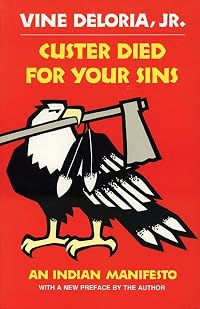
Vine Deloria, Jr. (1933-2005) was born and raised in South Dakota, the son and grandson of Dakota Sioux Indian leaders. In 1965, he began serving as the Executive Director of the National Congress of American Indians, and worked tirelessly to mobilize Indian people toward effective participation in the American political process. A noted scholar show more of American Indian legal, political and religious studies, he is the author of numerous works, including the 1969 bestseller Custer Died for Your Sins: An Indian Manifesto, God is Red (1973) and The Metaphysics of Modern Existence (1979). show less
Some Editions
Work Relationships
Has as a student's study guide
Common Knowledge
- Canonical title
- God Is Red: A Native View of Religion
- Original title
- God Is Red
- Original publication date
- 1973
- First words
- Until 1890, American Indians played a critically important role in American domestic affairs, symbolizing the vast wilderness and frontier that Americans wished to tame. From the 1890s until the 1960s Indians were truly the ... (show all)“Vanishing Americans” and most people believed that the tribes had largely been exterminated. There were token Indians present at Columbus Day and Thanksgiving celebrations and some Indian women sitting at the Santa Fe railroad stations selling pottery, but for most Americans Indians had ceased to exist.
- Last words
- (Click to show. Warning: May contain spoilers.)Who will find peace with the lands? The future of humankind lies waiting for those who will come to understand their lives and take up their responsibilities to all living things. Who will listen to the trees, the animals and birds, the voices of the places of the land? As the long-forgotten peoples of the respective continents rise and begin to reclaim their ancient heritage, they will discover the meaning of the lands of their ancestors. That is when the invaders of the North American continent will finally discover that for this land, God is red.
Classifications
- Genres
- Religion & Spirituality, Nonfiction, General Nonfiction, History, Philosophy
- DDC/MDS
- 299.7 — Religion Other religions Religions not provided for elsewhere Of North American Origin
- LCC
- BL2776 .D44 — Philosophy, Psychology and Religion Religions. Mythology. Rationalism Religions. Mythology. Rationalism Rationalism
- BISAC
Statistics
- Members
- 1,142
- Popularity
- 21,933
- Reviews
- 14
- Rating
- (3.96)
- Languages
- English, German
- Media
- Paper, Audiobook, Ebook
- ISBNs
- 19
- UPCs
- 1
- ASINs
- 14