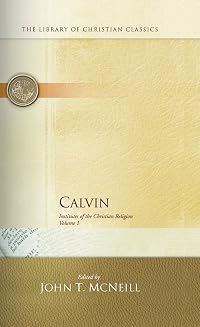
Institutes of the Christian Religion
by John Calvin, John T. McNeill (Editor)
On This Page
Description
Institutes of the Christian Religion is John Calvin's seminal work on Protestant systematic theology. Highly influential in the Western world and still widely read by theological students today, it was published in Latin in 1536 and in his native French in 1541. The book serves as an introductory textbook on the Protestant faith for those with some previous knowledge of theology and covers a broad range of theological topics from the doctrines of church and sacraments to justification by show more faith alone and Christian liberty. It vigorously attacks teachings which Calvin considered unorthodox, particularly Roman Catholicism to which Calvin says he had been "strongly devoted" before his conversion to Protestantism. The overarching theme of the book-and Calvin's greatest theological legacy-is the idea of God's total sovereignty, particularly in salvation and election. Institutes of the Christian Religion is highly-regarded as a secondary reference for the system of doctrine adopted by the Reformed churches, which is commonly referred to as Calvinism. show lessTags
Recommendations



Member Reviews
Finishing Calvin's Institutes felt like eating Bran Flakes. You know it's supposed to be good for you, but when given the option to have Lucky Charms, you'll choose the Leprechaun every time.
When I started reading the Institutes I was fresh out of Seminary. I didn't have the opportunity to take a course on Calvin, so I thought that this would round out my education. Another reason I tackled Calvin was my (former) love for systematic theology. I thought that there was nothing more sublime than a cohesive logical understanding of scripture.
The more I pastored and studied scripture for myself, the more I became disillusioned with systematic theology. No matter whose system you chose, the emphasizing of some passages over others always felt show more arbitrary.
Take the Calvinist/Arminianist debate with respect to Philippians 2:12-13. It's all a matter of which side you emphasize: "Work out your own salvation with fear and trembling" (Calvinism) "for it is God who works in you" (Arminianism) (ESV).
Systematic theology is like a bit-mapped picture. If you have a sufficiently detailed resolution (or nuanced systematic method), you can reproduce a pretty accurate picture of the original. But why not just enjoy the original? Scripture is the story of God's relationship with his people. There is a reason love letters don't look like bullet lists in a PowerPoint presentation. Narrative trumps systems. Every time.
The logic of Calvin's systematic theology is highly nuanced and quite brilliant. I learned a tremendous amount from his encyclopedic knowledge of scripture. (This 1,700 page edition of the Institutes is rather small compared to his Commentary on the entire Bible!) When he speaks about the role of faith in the believer's life and the nature of prayer, his work is inspiring. The problem comes when he follows the logic of his system to the end and is left with with double predestination, for example. (If scripture says that God predestined believers for glory, then logically, He must have predestined souls for hell, right?)
Here is where systems fail and narrative comes to our rescue. The Bible is more of a library than a book. Each author has his own understanding of scripture, as inspired by the Spirit of God. True, the books and stories fit together in amazing ways, but that doesn't take away from their own character. Read Ecclesiastes beside Song of Songs and you'll see what I mean.
I started the Institutes as a systematist. While I still appreciate and respect this discipline, I am now wholeheartedly a Biblical theologian. For example, I would much rather work at bringing out what John meant in his Gospel than spend my time trying to reconcile the date of the crucifixion with Mark's account.
Let scripture speak in all of its sundry glory. show less
When I started reading the Institutes I was fresh out of Seminary. I didn't have the opportunity to take a course on Calvin, so I thought that this would round out my education. Another reason I tackled Calvin was my (former) love for systematic theology. I thought that there was nothing more sublime than a cohesive logical understanding of scripture.
The more I pastored and studied scripture for myself, the more I became disillusioned with systematic theology. No matter whose system you chose, the emphasizing of some passages over others always felt show more arbitrary.
Take the Calvinist/Arminianist debate with respect to Philippians 2:12-13. It's all a matter of which side you emphasize: "Work out your own salvation with fear and trembling" (Calvinism) "for it is God who works in you" (Arminianism) (ESV).
Systematic theology is like a bit-mapped picture. If you have a sufficiently detailed resolution (or nuanced systematic method), you can reproduce a pretty accurate picture of the original. But why not just enjoy the original? Scripture is the story of God's relationship with his people. There is a reason love letters don't look like bullet lists in a PowerPoint presentation. Narrative trumps systems. Every time.
The logic of Calvin's systematic theology is highly nuanced and quite brilliant. I learned a tremendous amount from his encyclopedic knowledge of scripture. (This 1,700 page edition of the Institutes is rather small compared to his Commentary on the entire Bible!) When he speaks about the role of faith in the believer's life and the nature of prayer, his work is inspiring. The problem comes when he follows the logic of his system to the end and is left with with double predestination, for example. (If scripture says that God predestined believers for glory, then logically, He must have predestined souls for hell, right?)
Here is where systems fail and narrative comes to our rescue. The Bible is more of a library than a book. Each author has his own understanding of scripture, as inspired by the Spirit of God. True, the books and stories fit together in amazing ways, but that doesn't take away from their own character. Read Ecclesiastes beside Song of Songs and you'll see what I mean.
I started the Institutes as a systematist. While I still appreciate and respect this discipline, I am now wholeheartedly a Biblical theologian. For example, I would much rather work at bringing out what John meant in his Gospel than spend my time trying to reconcile the date of the crucifixion with Mark's account.
Let scripture speak in all of its sundry glory. show less
5 star because of the impact of this book (actually 4 books/volumes) on Protestant Christianity and what it attempted to accomplish. This book is meant as a survey of the Christian faith for those in the Reformed tradition during the 16th century. It would not pass as an academic work today, but nor was intended to do this. For that reason, one needs to look past the ad hominem arguments and generally proof-texting of Scripture. Calvin dealt with the exegesis in his commentaries, and so more detail should be expected there. The reader should also appreciate the context. Calvin is writing to guide Protestant Christians who must have answers for why they reject Roman Catholicism. So, much of Calvin's attention, especially in book 4, is show more given to critique (to put it mildly) of the papacy and RC system, with regard to soteriology, sacraments, the priesthood, and just about anything else one can think of.
While citing the church fathers from time to time, Calvin leans heavily on Augustine as his primary ancient authority. This comes with strengths and weaknesses. A major weakness, from my perspective, is an embrace of an exhaustive, meticulous view of God's sovereignty. This leads Calvin to assert (and in this regard he does more asserting than arguing) not only that God is the cause, directly or indirectly, of everything that happens in creation history (both good and evil), but also that God has two wills, one revealed and one secret. This latter assertion is especially problematic, since, as others have pointed out, it locates God's goodness in his will (i.e., whatever God wills is "good" because God willed it), rather than his moral character. This means that God ends up ordaining sin and evil (although Calvinists would likely appeal to mystery and a compatibilist view of human free will in articulating this). A dual-willed God is a serious theological dilemma. But that aside, the use of Scripture to support Calvin's view of divine determinism is weak, and again, he tends on these issues to assert rather than argue (relevant texts are Rom 9, John 6, Eph 1, etc.). He seems, for example, to assume individual soteriology when context would more naturally lead to corporate and missional applications.
I was expecting Calvin's arguments for his soteriology, including his definitions of predestination and election to be stronger, but I realized he was more or less outlining these almost for advanced catechism purposes and not to make theological arguments that would stand scrutiny, especially recent arguments. It is notable that Calvin departs significantly from the first three centuries of Christian theology, as did Augustine, regarding his view of human free will and responsibility. And Calvin identifies several times that he is confused at the lack of coherence he interprets in the writings of the early church fathers before Augustine. I think more accurately, Calvin just doesn't like what they stated.
I was initially going to give this a 4 star rating due to the weak argumentation for his view of sovereignty (not simply that I disagree with it, but that he doesn't argue it well). But I changed my mind to give Calvin 5 stars for the reasons I noted at the outset. It also needs to be noted that Calvin does very good work in many other areas of explaining his theology. His section on the Lord's Supper as "real presence" is compelling and well argued. He also inserts pastoral exhortations at various places throughout, almost as expressions of praise (sermon-like style). There's lots to like in this very famous work of Calvin's and I'm glad I took the time to read it. show less
While citing the church fathers from time to time, Calvin leans heavily on Augustine as his primary ancient authority. This comes with strengths and weaknesses. A major weakness, from my perspective, is an embrace of an exhaustive, meticulous view of God's sovereignty. This leads Calvin to assert (and in this regard he does more asserting than arguing) not only that God is the cause, directly or indirectly, of everything that happens in creation history (both good and evil), but also that God has two wills, one revealed and one secret. This latter assertion is especially problematic, since, as others have pointed out, it locates God's goodness in his will (i.e., whatever God wills is "good" because God willed it), rather than his moral character. This means that God ends up ordaining sin and evil (although Calvinists would likely appeal to mystery and a compatibilist view of human free will in articulating this). A dual-willed God is a serious theological dilemma. But that aside, the use of Scripture to support Calvin's view of divine determinism is weak, and again, he tends on these issues to assert rather than argue (relevant texts are Rom 9, John 6, Eph 1, etc.). He seems, for example, to assume individual soteriology when context would more naturally lead to corporate and missional applications.
I was expecting Calvin's arguments for his soteriology, including his definitions of predestination and election to be stronger, but I realized he was more or less outlining these almost for advanced catechism purposes and not to make theological arguments that would stand scrutiny, especially recent arguments. It is notable that Calvin departs significantly from the first three centuries of Christian theology, as did Augustine, regarding his view of human free will and responsibility. And Calvin identifies several times that he is confused at the lack of coherence he interprets in the writings of the early church fathers before Augustine. I think more accurately, Calvin just doesn't like what they stated.
I was initially going to give this a 4 star rating due to the weak argumentation for his view of sovereignty (not simply that I disagree with it, but that he doesn't argue it well). But I changed my mind to give Calvin 5 stars for the reasons I noted at the outset. It also needs to be noted that Calvin does very good work in many other areas of explaining his theology. His section on the Lord's Supper as "real presence" is compelling and well argued. He also inserts pastoral exhortations at various places throughout, almost as expressions of praise (sermon-like style). There's lots to like in this very famous work of Calvin's and I'm glad I took the time to read it. show less
Calvin's Institutes of the Christian Religion is a masterfully written systematic summary and defense of the basic tenets of Christianity. It is exegetical in substance, Christ-centered in focus, worshipful in tone, and polemical in style.
Exegetical in substance - Calvin has been called the "father of modern exegesis" and rightly so. He pioneered the literal-historical-grammatical method of exegesis. This is especially true of his excellent commentaries, but also reflected in the Institutes. The final court of appeal for Calvin is Scripture. His arguments are laced with quotations from the Bible and one senses that Calvin was very hesitant to go further than Scripture in his surmizings.
Christ-centered in focus - This has really struck show more me in my reading Calvin (I'm now in volume 2 of this edition). Calvin's Christology was robust and it pervades virtually every page of the Institutes. This is especially true in Book III, which is especially rich.
Worshipful in tone - Despite what some people may think, Calvin is not a dry theologian. Some Calvinists could benefit from soaking in their fore-father - perhaps picking up some of his reverence and humility. Seriously, this book lifts my gaze to God. That's good enough reason to recommend it.
Polemical in style - Along with everything above, Calvin was a polemicist, no doubt about it. This book is saucy! Calvin didn't hesitate to call his adversaries by name AND call them names. That may seem harsh to modern readers and leave a sour taste in some mouths. But even Jesus could call the Pharisees vipers and Calvin doesn't stray too far from his master in this regard. We should also remember the turbulent times in which Calvin wrote. He says in his preface that one of the reasons he wrote the Institutes was to make clear what young French pastors who were being martyred were dying for. Remember that his friends were being killed for their convictions before getting too critical of Calvin's language.
This edition is probably the best available with helpful notes and an excellent team of scholars under J. T. McNeil behind the text. Calvin's quotations are documented and the text is keyed with symbols showing the development of the Institutes from its initial version in 1536 through its five reprints (the final in 1559).
An excellent read for anyone interested in Reformed theology, historical theology, systematic theology or . . . just theology! show less
Exegetical in substance - Calvin has been called the "father of modern exegesis" and rightly so. He pioneered the literal-historical-grammatical method of exegesis. This is especially true of his excellent commentaries, but also reflected in the Institutes. The final court of appeal for Calvin is Scripture. His arguments are laced with quotations from the Bible and one senses that Calvin was very hesitant to go further than Scripture in his surmizings.
Christ-centered in focus - This has really struck show more me in my reading Calvin (I'm now in volume 2 of this edition). Calvin's Christology was robust and it pervades virtually every page of the Institutes. This is especially true in Book III, which is especially rich.
Worshipful in tone - Despite what some people may think, Calvin is not a dry theologian. Some Calvinists could benefit from soaking in their fore-father - perhaps picking up some of his reverence and humility. Seriously, this book lifts my gaze to God. That's good enough reason to recommend it.
Polemical in style - Along with everything above, Calvin was a polemicist, no doubt about it. This book is saucy! Calvin didn't hesitate to call his adversaries by name AND call them names. That may seem harsh to modern readers and leave a sour taste in some mouths. But even Jesus could call the Pharisees vipers and Calvin doesn't stray too far from his master in this regard. We should also remember the turbulent times in which Calvin wrote. He says in his preface that one of the reasons he wrote the Institutes was to make clear what young French pastors who were being martyred were dying for. Remember that his friends were being killed for their convictions before getting too critical of Calvin's language.
This edition is probably the best available with helpful notes and an excellent team of scholars under J. T. McNeil behind the text. Calvin's quotations are documented and the text is keyed with symbols showing the development of the Institutes from its initial version in 1536 through its five reprints (the final in 1559).
An excellent read for anyone interested in Reformed theology, historical theology, systematic theology or . . . just theology! show less
Calvin has this wonderful skill of making the most meaty theologies easy to understand and digest. The Institutes are legendary amongst Christians, to almost the level of Augustine's Confessions or the 95 Theses. And it is deserving of such an honor. Even in this abridged version, we can see the wonder and glory of God coming through as Calvin seeks to explain what he has seen in the Bible.
It is not inspired, of course. There are many places where I would part company with Calvin. That doesn't mean that we cannot learn from his insights and wisdom, especially because he is so rooted in the Scripture as he writes about them. I would recommend this book to any Christian who is serious about following his Lord.
It is not inspired, of course. There are many places where I would part company with Calvin. That doesn't mean that we cannot learn from his insights and wisdom, especially because he is so rooted in the Scripture as he writes about them. I would recommend this book to any Christian who is serious about following his Lord.
This is the definitive English-language edition of one of the monumental works of the Christian church. All previous editions--in Latin, French, German, and English--have been collated; references and notes have been verified, corrected, and expanded; and new bibliographies have been added. The translation preserves the rugged strength and vividness of Calvin's writing, but also conforms to modern English and renders heavy theological terms in simple language. The result is a translation that achieves a high degree of accuracy and at the same time is eminently readable. Long recognized for the quality of its translations, introductions, explanatory notes, and indexes, the Library of Christian Classics provides scholars and students with show more modern English translations of some of the most significant Christian theological texts in history. Through these works--each written prior to the end of the sixteenth century--contemporary readers are able to engage the ideas that have shaped Christian theology and the church through the centuries. show less
Much has been said and hated about John Calvin, but I fear too little of Calvin has been read. "Institutes" is about much more than election, but rather presents an entire worldview through with we can understand God, ourselves, and the world God has created. He does this primarily through Scripture but also is well-equipped to argue through natural revelation and human authors.
Despite the many weighty topics Calvin addresses, he writes with a deeply devotional style. He is witty and clever, and to his opponents, acerbic. Calvin reserves little patience for those who blaspheme God through human traditionalism or faulty reasoning.
The only difficulty one would encounter when reading Calvin is his references to his contemporary events, show more but this should not deter any reader. show less
Despite the many weighty topics Calvin addresses, he writes with a deeply devotional style. He is witty and clever, and to his opponents, acerbic. Calvin reserves little patience for those who blaspheme God through human traditionalism or faulty reasoning.
The only difficulty one would encounter when reading Calvin is his references to his contemporary events, show more but this should not deter any reader. show less
I love the sections on the Christian life, prayer, and the sacraments. I also appreciate Calvin's teaching on tolerance with those who differ doctrinally to maintain the unity of the Church. Unfortunately, he did not listen to his own teaching. Finally, I enjoyed this abridged version; however, I wish it would have included Calvin's address to the king of France.
Members
- Recently Added By
Lists

Sycamore Baptist Church Book Study Reading List
156 works; 5 members
Christianity Books You've Read
179 works; 19 members

25 Books Every Christian Should Read
27 works; 4 members
Trinity Norman Recommended Christian Readings
170 works; 5 members
GreatBooks Worldview Academy Lists
133 works; 4 members

CCE 100 Great Books List
145 works; 8 members

How to Read a Book's Recommended Reading List
309 works; 10 members

Western Canon
206 works; 2 members

Greatest Books, allegedly
484 works; 9 members

Christian Classics (Old and Modern)
53 works; 3 members
Talk Discussions
Past Discussions
Reading the Institutes in Reformed Theology (December 2010)
Author Information

1,041+ Works 36,102 Members
Born Jean Cauvin in Noyon, Picardy, France, John Calvin was only a boy when Martin Luther first raised his challenge concerning indulgences. Calvin was enrolled at the age of 14 at the University of Paris, where he received preliminary training in theology and became an elegant Latinist. However, following the dictates of his father, he left Paris show more at the age of 19 and went to study law, first at Orleans, then at Bourges, in both of which centers the ideas of Luther were already creating a stir. On his father's death, Calvin returned to Paris, began to study Greek, the language of the New Testament, and decided to devote his life to scholarship. In 1532 he published a commentary on Seneca's De Clementia, but the following year, after experiencing what was considered a sudden conversion, he was forced to flee Paris for his religious views. The next year was given to the study of Hebrew in Basel and to writing the first version of his famous Institutes of the Christian Religion, which he gave to the printer in 1535. The rest of his life-except for a forced exile of three years-he spent in Geneva, where he became chief pastor, without ever being ordained. When he died, the city was solidly on his side, having almost become what one critic called a "theocracy." By then the fourth and much-revised edition of his Institutes had been published in Latin and French, commentaries had appeared on almost the whole Bible, treatises had been written on the Lord's Supper, on the Anabaptists, and on secret Protestants under persecution in France. Thousands of refugees had come to Geneva, and the city-energized by religious fervor-had found room and work for them. Though Calvin was sometimes bitter in his denunciation of those who disagreed with him, intolerant of other points of view, and absolutely sure he was right on the matter of predestination, he was nonetheless one of the great expounders of the faith. From his work the Reformed tradition had its genesis, and from his genius continues to refresh itself. (Bowker Author Biography) show less
Some Editions
Awards and Honors
Work Relationships
Contains
Is abridged in
Is replied to in
Common Knowledge
- Canonical title
- Institutes of the Christian Religion
- Original title
- Institutio Christianae Religionis
- Alternate titles
- 基督教要義. English
- Original publication date
- 1536 (Latin) (Latin); 1541 (French) (French); 1559 (Latin ∙ definitive edition) (Latin ∙ definitive edition); 1560 (French ∙ definitive edition) (French ∙ definitive edition)
- People/Characters
- John Calvin (1509-1564)
- Important places
- Geneva, Geneva, Switzerland
- First words
- [Preface to the Hendrickson Edition] The Protestant Reformation boasts a constellation of star players: Martin Luther, John Wycliffe, Jan Hus, Ulrich Zwingli, John Calvin, John Knox, Thomas Cranmer.
[Original Translator's Preface(1581)] T[homas] N[orton], the Translator; to the Reader.
Good reader, here is no offered you, the fourth time printed in English, Mr. Calvin's book of the Institutes of Christian Reli... (show all)gion; a book of great labor to the author, and of great profit to the church of God.
[Prefatory Address by John Calvin to Francis I, King of France (1536)] Sire--When I first engaged in this work, nothing was farther from my thoughts than to write what should afterward be presented to you Majesty.
[Epistle to the Reader (Calvin, 1539)]
Prefixed to the second edition, published at Strasburg in 1539.
In the first edition of this work, having no expectation of the success which God has, in his goodnes... (show all)s, been pleased to give it, I had, for the greater part, performed my office perfunctorily, as is usual in trivial undertakings.
[Subject of the Present Work (Calvin, 1545)
Prefixed to the French edition, published at Geneva in 1545]
In order that my readers may be the better able to profit by the present work, I am desirous briefly to... (show all) point out the advantage which they may derive from it.
[Epistle to the Reader (Calvin, 1559)
Prefixed to the last edition, revised by the author.]
In the first edition of this work, having not the least expectation of the success which God, in his boundless goodn... (show all)ess, has been pleased to give it, I had, for the greater par, performed my task in a perfunctory manner (as is usual in trivial undertakings); but when I understood that is had been received, by almost all the pious, with a favor which I had never dared to ask, far less to hope for, the more I was sincerely conscious that the reception was beyond my deserts, the greater I though my ingratitude would be, if, to the very kind wishes which had been expressed toward me, and which seemed of their own accord to invite me to diligence, I did not endeavor to respond, at least according to my humble ability.
[Method and Arrangement, or Subject of the Whole Work
From an Epitome of the Institutions, by Gaspar Olevian
The subject handled by the author of these Christian Institutes is twofold: the former, the... (show all) knowledge of God, which leads to a blessed immortality; and the latter(which is subordinate to the former), the knowledge of ourselves.
The first book treats of the knowledge of God the Creator. - Last words
- (Click to show. Warning: May contain spoilers.)[Preface to the Hendrickson Edition] We suggest you read the work itself. Consider its context, in sixteenth-century Reformation Europe, and judge it on its own merits.
Turn the page, and let Calvin speak.
(Click to show. Warning: May contain spoilers.)[Original Translator's Preface (1581)]
I confess, indeed, it is not finely and pleasantly written nor carries with it such delightful grace of speech as some great wise men have bestowed upon some foolisher things, yet it contains sound truth set forth with faithful plainness, without wrong done to the author's meaning; and so, if you accept and use it, you shall not fail to have great profit thereby, and I shall think my labor very well employed.
(Click to show. Warning: May contain spoilers.)[Prefatory Address by John Calvin to Francis I, King of France (1536)]
Most illustrious King, may the Lord, the King of kings, establish your throne in righteousness and your scepter in equity.
Basel, 1st August 1536
(Click to show. Warning: May contain spoilers.)[Epistle to the Reader (Calvin, 1539)]
Farewell, dear reader, and if you derive any fruit from my labors, give me the benefit of your prayers to the Lord.
Strasburg, 1st August 1539
(Click to show. Warning: May contain spoilers.)[Subject of the Present Work (Calvin, 1545)
Prefixed to the French edition, published at Geneva in 1545]
Above all things, I would recommend that recourse be had to Scripture in considering the proofs which I adduce from it.
(Click to show. Warning: May contain spoilers.)[Epistle to the Reader (Calvin, 1559)
Prefixed to the last edition, revised by the author.]
Farewell, kind reader: i you derive any benefit from my labors, aid me with your prayers to our heavenly Father.
Geneva, 1st August 1559
The zeal of those whose cause I undertook,
Has swelled a short defense into a book.
"I profess to be one of those who, by profiting, write, and by writing profit."
--Agistome. Epist. 7.
(Click to show. Warning: May contain spoilers.)[Method and Arrangement, or Subject of the Whole Work
From an Epitome of the Institutions, by Gaspar Olevian
Such is the arrangement of the Institutes which may be thus summed up: Man being at first created upright, but afterward being not partially but totally ruined, finds his entire salvation out of himself in Christ, to whom being united by the Holy Spirit freely given without any foresight of future works, he thereby obtains a double blessing, i.e., full imputation of righteousness, which goes along with us eve to the grave, and the commencement of sanctification, which daily advances till at length it is perfected in the day of regeneration or resurrection of the body, and this, in order that the great mercy of God may be celebrated in the heavenly mansions throughout eternity.
(Click to show. Warning: May contain spoilers.)And that our courage may not fail, Paul stimulates us by the additional consideration (1 Cor 7:23), that we were redeemed by Christ at the great price which our redemption cost him, in order that we might not yield a slavish obedience to the depraved wishes of men, far less do homage to their impiety. - Disambiguation notice
- Individual volumes should not be combined with the complete set or different volumes of the same set.
Classifications
- Genres
- Religion & Spirituality, Nonfiction, History
- DDC/MDS
- 230.42 — Religion Christianity Christianity Protestant churches
- LCC
- BX9420 .I65 — Philosophy, Psychology and Religion Christian Denominations Christian Denominations Protestantism Other Protestant denominations Reformed or Calvinistic Churches
- BISAC
Statistics
- Members
- 8,490
- Popularity
- 1,307
- Reviews
- 34
- Rating
- (4.49)
- Languages
- 14 — Catalan, Chinese, Dutch, English, French, German, Hebrew, Indonesian, Italian, Latin, Farsi/Persian, Romanian, Spanish, Portuguese (Portugal)
- Media
- Paper, Audiobook, Ebook
- ISBNs
- 99
- UPCs
- 2
- ASINs
- 113
