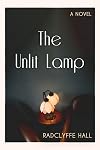
The Unlit Lamp
by Radclyffe Hall
On This Page
Description
The Unlit Lamp (1924) is a novel by Radclyffe Hall. After publishing several collections of poems, Hall turned to fiction in 1924 with two successful novels. The Unlit Lamp is the story of a young woman with an unhappy home life who falls in love with an older teacher and dreams of moving to London to become a doctor. Despite her independent spirit, Joan struggles to escape the clutches of her controlling mother. "Mrs. Ogden put her hand up to her head wearily, glancing at Joan as she did show more so. Joan was so quick to respond to the appeal of illness. Mrs. Ogden would not have admitted to herself how much she longed for this quick response and sympathy. [...] There were times, growing more frequent of late, when she longed, yes, longed to break down utterly, to become bedridden, to be waited upon hand and foot, to have arresting symptoms of her own, any number of them." Unhappily married to the Colonel, a cold and distant man, Mrs. Ogden depends on her daughters for emotional support. As Joan and Milly draw closer the age of independence, however, their mother begins thinking up ways to keep them at home, stifling their personal interests and desires. When Elizabeth Rodney, a governess, arrives to teach the sisters, Joan develops not only an attraction to the older woman, but a desire to move with her to London, where she dreams of becoming a doctor. Tragic and psychologically piercing, The Unlit Lamp is a story of friendship, family, and desire that continues to be recognized as a groundbreaking work of lesbian literature. With a beautifully designed cover and professionally typeset manuscript, this edition of Radclyffe Hall's The Unlit Lamp is a classic work of British literature reimagined for modern readers. show lessTags
Recommendations











Member Reviews
This is a book to give rise to mixed emotions. On the one hand, it makes you feel angry that Joan feels she has no other option but care for his mother, despite her ambitions and the support she has from Elizabeth. And angry at Mrs Ogden for being to too clingy. On the other, there's the relationship between Elizabeth and Joan that pushes both of them forward, until Joan disapppoints Elizabeth one final time. Radclyffe Hall didn't write this novel as her great lesbian love story, but that's how it reads, and in many ways it was more compelling than Stephen and Mary in The Well of Loneliness.
What a sad book. I expected a happy ending, although with hindsight I'm not sure why. So I read right to the end expecting the cavalry to come over the hill and save the day and make Joan happy, and was very blindsided when they didn't.
It is interesting that the Well of Loneliness is thought of as the first lesbian novel, as this earlier novel is about Joan, who wants to leave her family home to go and live with Elizabeth, who she loves. There is no explicit nature to their love, but their strong feeling for each other is clear, and it is odd reading this as a modern reader trying to squeeze their relationship into my boxes and stereotypes. Joan is hindered by the strong sense of responsibility she feels for her aging mother, and by her show more own fears. I assumed it would be a book about how Joan eventually grew up and found herself and became happy, but instead it is a book about how Elizabeth gets bored of waiting, and Joan is miserable and stifled for the rest of her life.
I wonder if it is a self-justifying novel? 'Oh, I had to leave my family, because wouldn't it be unbearable to end up like this'?
The relationship between Joan and Elizabeth is uncomfortable as well. They meet when Joan is small (11ish?) and Elizabeth is her governess, and the progression of their relationship is surprisingly ikky when this fact is kept in mind. Joan is young and vulnerable, and it is oddly easy to frame Elizabeth's actions almost as 'grooming'.
Oh but how I wanted Elizabeth to come back to her and save the day, and they could go off to Cambridge together and learn so much about the world and be happy! It was a heartbreaking book in so many ways. show less
It is interesting that the Well of Loneliness is thought of as the first lesbian novel, as this earlier novel is about Joan, who wants to leave her family home to go and live with Elizabeth, who she loves. There is no explicit nature to their love, but their strong feeling for each other is clear, and it is odd reading this as a modern reader trying to squeeze their relationship into my boxes and stereotypes. Joan is hindered by the strong sense of responsibility she feels for her aging mother, and by her show more own fears. I assumed it would be a book about how Joan eventually grew up and found herself and became happy, but instead it is a book about how Elizabeth gets bored of waiting, and Joan is miserable and stifled for the rest of her life.
I wonder if it is a self-justifying novel? 'Oh, I had to leave my family, because wouldn't it be unbearable to end up like this'?
The relationship between Joan and Elizabeth is uncomfortable as well. They meet when Joan is small (11ish?) and Elizabeth is her governess, and the progression of their relationship is surprisingly ikky when this fact is kept in mind. Joan is young and vulnerable, and it is oddly easy to frame Elizabeth's actions almost as 'grooming'.
Oh but how I wanted Elizabeth to come back to her and save the day, and they could go off to Cambridge together and learn so much about the world and be happy! It was a heartbreaking book in so many ways. show less
The Unlit Lamp, the story of Joan Ogden, a young girl who dreams of setting up a flat in London with her friend Elizabeth (a so-called Boston marriage) and studying to become a doctor, but feels trapped by her manipulative mother's emotional dependence on her. It's grim, you want to shake Joan so much, but Radclyffe Hall writes the story not just for this one character but for all women whose lives are lived in quiet desperation submitting to the will of others. A powerful story to make anyone hesitant to jump at the chances life offers us.
‘Joan! I don’t know you awfully well , and of course you’re only a kid as yet, but Elizabeth says you’re clever— and don’t you let yourself be bottled.’
‘Bottled?’ she queried.
‘Don’t you get all cramped up and fuggy, like one does when one sits over a fire all day. I know what I mean, it sounds all rot, only it isn’t rot. You look out! I have a presentiment that they mean to bottle you.’
I figured I would The Unlit Lamp before attempting Radclyffe Hall's more famous (or infamous) work The Well of Loneliness - simply because I wanted to see where her writing was coming from without having any expectations.
Radclyffe Hall doesn't quite manage to impress with her writing - there is a lot of telling rather than show more showing going on and a lot of repetition - but, to my surprise, I really liked The Unlit Lamp for being such an anti-hero of a book.
It is as depressing as any Hardy novel I have read, and even when read as a kind of cautionary tale about wasted lives, selfishness, responsibility, and infuriating parental manipulation, the story kept its pace until the very last.
Now I am still not sure who I want to slap more - Elizabeth or her mother. show less
‘Bottled?’ she queried.
‘Don’t you get all cramped up and fuggy, like one does when one sits over a fire all day. I know what I mean, it sounds all rot, only it isn’t rot. You look out! I have a presentiment that they mean to bottle you.’
I figured I would The Unlit Lamp before attempting Radclyffe Hall's more famous (or infamous) work The Well of Loneliness - simply because I wanted to see where her writing was coming from without having any expectations.
Radclyffe Hall doesn't quite manage to impress with her writing - there is a lot of telling rather than show more showing going on and a lot of repetition - but, to my surprise, I really liked The Unlit Lamp for being such an anti-hero of a book.
It is as depressing as any Hardy novel I have read, and even when read as a kind of cautionary tale about wasted lives, selfishness, responsibility, and infuriating parental manipulation, the story kept its pace until the very last.
Now I am still not sure who I want to slap more - Elizabeth or her mother. show less
Gloomy novel about carachters who die a lot and don't live very much when they're alive. More readable than the well of loneliness though.
Ratings
Members
- Recently Added By
Lists

Best Lesbian Fiction (And Narrative Non-Fiction)
155 works; 36 members

Pre-1969 LGBTQ Literature
184 works; 70 members

Books referenced in A Very Great Profession: The Woman's Novel 1914-39
199 works; 6 members
Author Information

25+ Works 3,931 Members
Born Marguerite Radclyffe Hall, the writer called herself John as an adult. Educated at King's College, London, Hall began her career writing poetry set to music and performed prominently before World War I. Under the influence of the socialite Mabel Batten, Hall became devoutly Roman Catholic and met Una, Lady Troubridge, who was to become Hall's show more lifelong companion. The Well of Loneliness (1928), a frank and touching portrayal of lesbian sensibilities, was banned in Britain and America (despite George Bernard Shaw's comment that the novel told of things people should know about), nearly ruining her literary career. Copies of the book were widely confiscated; censors expressed moral outrage, especially because Hall's characters showed no contrition for their "vices" and were portrayed sympathetically. Despite aggressive attempts at censorship, though, audiences clamored for the novel, which attained a strong popularity. Hall wrote of lesbianism as natural and pleaded for tolerance, yet her writing manifests a degree of guilt that in some way affirms her society's widespread prejudice that homosexuality was a deformity. Despite her fierce defense of The Well of Loneliness, none of Hall's later writing explicitly deals with homosexual themes. Still, though Hall was less self-accepting than contemporary gay writers, The Well of Loneliness endures as a relatively rare and valuable documentation of lesbian lives and aesthetics in the early twentieth century. (Bowker Author Biography) show less
Some Editions
Series
Belongs to Publisher Series
Florin Books (51)
Common Knowledge
- Canonical title
- The Unlit Lamp
- Original title
- The Unlit Lamp
- Original publication date
- 1924
- People/Characters
- Joan Ogden; Richard Benson; Millie Ogden
- Important places
- Bournemouth, Dorset, England, UK
- Epigraph
- And the sin I impute to each frustrate ghost
Is - the unlit lamp and the ungirt loin.
Browning - the statue and the bust - Dedication
- To
Mabel Veronica Batten
in deep affection, gratitude
and respect - First words
- The dining room at Leaside was also Colonel Ogden's study.
The Unlit Lamp is the story of Joan Ogden who grows up and grows old in Seabourne, a stuffy little town on the South Coast of England, at the turn of the century. (Introduction) - Last words
- (Click to show. Warning: May contain spoilers.)Oh I shall soon get into it all I expect. I'm used to invalids you see.
(Click to show. Warning: May contain spoilers.)It is probably inevitable that she is remembered mainly for The Well of Loneliness, because of the sensation it caused and its courageous purpose; nevertheless, it is worth considering The Unlit Lamp as a contribution to the same cause of sexual understanding...it is also a haunting, moving, provocative novel. (Introduction)
Classifications
Statistics
- Members
- 291
- Popularity
- 111,178
- Reviews
- 5
- Rating
- (3.64)
- Languages
- English, French, Spanish
- Media
- Paper, Ebook
- ISBNs
- 16
- ASINs
- 10