The Last Days
by Raymond Queneau
On This Page
Description
The Last Days is Raymond Queneau's autobiographical novel of Parisian student life in the 1920s: Vincent Tuquedenne tries to reconcile his love for reading with the sterility of studying as he hopes to study his way out of the petite bourgeoisie to which he belongs. Vincent and his generation are contrasted with an older generation of retired teachers and petty crooks, and both generations come under the bemused gaze of the waiter Alfred, whose infallible method of predicting the future show more mocks prevailing scientific models. Similarly, Queneau's literary universe operates under its own laws, joining rigorous artistry with a warm evocation of the last days of a bygone world. show lessTags
Recommendations























Member Reviews
Americans who have spent time in Paris all become very boring people. They won't shut up about how much they love the place, certainly not after a martini or two. Time was I scoffed at such people. How they all talked down about America afterwards. How they would go on and on about the bread and some little bookstall they found along the Seine or that one afternoon they spent huddled under the awning of a cafe in the Latin Quarter waiting for the rain to stop.
Then my husband C.J. and I spent a month in Paris and....well... you've been warned.
The Last Days, Raymond Queneau's autobiographical novel based on his student days in Paris's Latin Quarter, is a wonderful book for those of us who cannot get over our love of Paris. While it may show more not present the Latin Quarter we experienced, it does present the Latin Quarter we want to remember: a youth misspent in cafes, playing billiards, arguing about the professors at the Sorbonne; frequenting places one should probably not frequent; on the run from our bourgeoise families; trying to win the favor of Alfred, the head waiter; impressed to have met someone who knew friends of Paul Verlaine.
The Last Days is the story of two circles of friends. The first is a group of students, young men trying to find the time to study for the exams they must pass to complete their degrees, and largely failing to escape the pull of their parents' expectations. They spend their days in cafes arguing points of philosophy and art and trying to avoid the influence of their teachers who form the second group of friends. The professors are all older, near retirement, regretting the course their lives have taken to some degree. Between the two groups is Alfred, the head waiter at the cafe both circles frequent. Alfred watches their behavior with bemused detachment. He has been around long enough to see that every new group of students is essentailly the same, their professors an exstension of them. Alfred is developing a system that will make it possible to win back the money his father lost at the race track. In the meantime, he acts as the novel's insider guide, providing all the backstory and details the reader needs.
But, honestly, I didn't care about the plot. The Last Days does have a plot, quite a bit for a slice-of-life novel, but that's not where I found pleasure in reading it. The Last Days provides vicarious travel in both space and time, across the Atlantic to 1920's Paris. It doesn't really matter what happens when the reader gets there. Being there is enough.
A favorite passage: He didn't stay long in his atticky little room and embarked on the Nord-Sud metro line to go to the Latin Quarter. He made a mistake in getting off at Rennes, thinking he could change there for Saint-Michel, but was nevertheless amazed that he was coping so well.
He should have stayed on the train and transferred at Montparnasse. The Number 4 Porte de Clignancourt goes right to Saint-Michel. Or he could have taken the number three Gallieni and changed trains at Reaumur Sebastopol to the Number 4 Porte d'Orlean's. Reading a novel simply to enjoy the frequent references to Metro stops, particular streets and certain cafes is a very self-indulgent form of reading, but one I enjoyed very much. show less
Then my husband C.J. and I spent a month in Paris and....well... you've been warned.
The Last Days, Raymond Queneau's autobiographical novel based on his student days in Paris's Latin Quarter, is a wonderful book for those of us who cannot get over our love of Paris. While it may show more not present the Latin Quarter we experienced, it does present the Latin Quarter we want to remember: a youth misspent in cafes, playing billiards, arguing about the professors at the Sorbonne; frequenting places one should probably not frequent; on the run from our bourgeoise families; trying to win the favor of Alfred, the head waiter; impressed to have met someone who knew friends of Paul Verlaine.
The Last Days is the story of two circles of friends. The first is a group of students, young men trying to find the time to study for the exams they must pass to complete their degrees, and largely failing to escape the pull of their parents' expectations. They spend their days in cafes arguing points of philosophy and art and trying to avoid the influence of their teachers who form the second group of friends. The professors are all older, near retirement, regretting the course their lives have taken to some degree. Between the two groups is Alfred, the head waiter at the cafe both circles frequent. Alfred watches their behavior with bemused detachment. He has been around long enough to see that every new group of students is essentailly the same, their professors an exstension of them. Alfred is developing a system that will make it possible to win back the money his father lost at the race track. In the meantime, he acts as the novel's insider guide, providing all the backstory and details the reader needs.
But, honestly, I didn't care about the plot. The Last Days does have a plot, quite a bit for a slice-of-life novel, but that's not where I found pleasure in reading it. The Last Days provides vicarious travel in both space and time, across the Atlantic to 1920's Paris. It doesn't really matter what happens when the reader gets there. Being there is enough.
A favorite passage: He didn't stay long in his atticky little room and embarked on the Nord-Sud metro line to go to the Latin Quarter. He made a mistake in getting off at Rennes, thinking he could change there for Saint-Michel, but was nevertheless amazed that he was coping so well.
He should have stayed on the train and transferred at Montparnasse. The Number 4 Porte de Clignancourt goes right to Saint-Michel. Or he could have taken the number three Gallieni and changed trains at Reaumur Sebastopol to the Number 4 Porte d'Orlean's. Reading a novel simply to enjoy the frequent references to Metro stops, particular streets and certain cafes is a very self-indulgent form of reading, but one I enjoyed very much. show less
Coming-of-age with Queneau! Funny and punny with a dash of angst.
Premier d'une série de trois romans en bonne partie autobiographiques publiés entre 1936 et 1938 (cf. Odile et Les enfants du limon). L'oeuvre entre philosophie et parodie, causticité et cocasserie a pour thèmes principaux la désillusion et la mort.
Ratings
Members
- Recently Added By
Author Information

175+ Works 9,905 Members
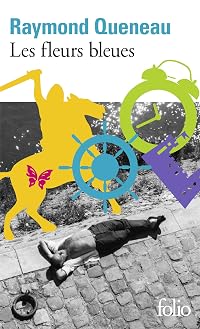
This French author of treatises on mathematics and other scholarly works has made his reputation writing comic novels. Raymond Queneau (through one of his characters) once defined humor as "an attempt to purge lofty feelings of all the baloney." Roger Shattuck interprets his philosophy: "Life is of course absurd and it is ludicrous to take it show more seriously; only the comic is serious." Life is so serious to Queneau that only laughter makes it bearable. He has written a play, screenplays, poetry, numerous articles, and many novels, the first of which, Le Chiendent (The Bark Tree), was published in 1933. In Exercises in Style (1947) he tells a simple anecdote 99 different ways. According to some critics, The Blue Flowers (1965) represents Queneau at his best. Its jokes, puns, double-entendres, deceptions, wild events, tricky correspondences, and bawdy language make it a feast of comic riches. The influence of Charlie Chaplin, as well as James Joyce is detectable in Queneau's fiction. (Bowker Author Biography) show less
Series
Belongs to Publisher Series
レーモン・クノー・コレクション (2)
Gallimard, Folio (3019)
Common Knowledge
- Canonical title
- The Last Days
- Original title
- Les derniers jours
- Alternate titles*
- The Last Days
- Original publication date
- 1936
- Original language*
- Français
*Some information comes from Common Knowledge in other languages. Click "Edit" for more information.
Classifications
Statistics
- Members
- 224
- Popularity
- 146,201
- Reviews
- 3
- Rating
- (3.72)
- Languages
- 5 — English, French, Italian, Japanese, Spanish
- Media
- Paper, Ebook
- ISBNs
- 11
- ASINs
- 3