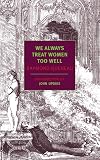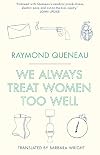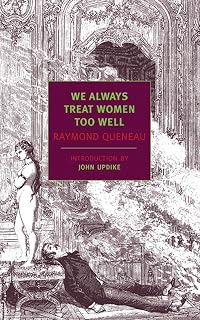
We Always Treat Women Too Well
by Raymond Queneau
On This Page
Description
Set in Dublin during the 1916 Easter Rising, this title tells the story of the siege of a small post office by a group of rebels, who discover to their embarrassment that a female postal clerk, Gertie Girdle, is still in the lavatory some time after they have shot or expelled the rest of the staff..
Tags
Recommendations

































Member Reviews
We Always Treat Women Too Well is a parody of No Orchids for Miss Blandish, a best-selling 1939 crime novel in which a passive, drug-addicted, suicidal young woman is raped and degraded by the depraved gangster who has abducted her. Queneau is not alone in his disgust, as this article by George Orwell shows.
Queneau transposes the action to Dublin in 1916, the Easter Rising, where a group of amateurish rebels has occupied the Post Office. They've cleared out most of the British workers unharmed, have shot two, and are settled in to return fire with the British and die nobly for their cause - an Ireland free of British rule - when they discover Gertie Girdle, who'd been hiding in the lavatory. Some of the rebels want to kill Gertie, but show more their leader thinks that brutalising an innocent female postal worker would tarnish their reputations, and that Gertie must remain alive and unsullied. After she is raped by one of the rebels, Gertie manages to ensure her survival by seduction, and she is hard to resist. She's the antithesis of Miss Blandish.
We Always Treat Women Too Well shouldn't be funny. The Easter Rising isn't funny; the violence is gruesome; Gertie is raped many times; there's even an instance of necrophilia. Perhaps it's the exuberance of the violence that makes it impossible to take seriously, plus the awareness that the bad taste is the point. The absurdity piles on: the ineptitude of the rebels with their catch-cry of "Finnegan's Wake!"; the fact that the Irish names and places all came from Ulysses; the British officer named Mountcatten.
We Always Treat Women Too Well was an entertaining read, but as an introduction to Raymond Queneau it probably isn't the best choice, so I'm planning to follow up with The Sunday of Life. show less
Queneau transposes the action to Dublin in 1916, the Easter Rising, where a group of amateurish rebels has occupied the Post Office. They've cleared out most of the British workers unharmed, have shot two, and are settled in to return fire with the British and die nobly for their cause - an Ireland free of British rule - when they discover Gertie Girdle, who'd been hiding in the lavatory. Some of the rebels want to kill Gertie, but show more their leader thinks that brutalising an innocent female postal worker would tarnish their reputations, and that Gertie must remain alive and unsullied. After she is raped by one of the rebels, Gertie manages to ensure her survival by seduction, and she is hard to resist. She's the antithesis of Miss Blandish.
We Always Treat Women Too Well shouldn't be funny. The Easter Rising isn't funny; the violence is gruesome; Gertie is raped many times; there's even an instance of necrophilia. Perhaps it's the exuberance of the violence that makes it impossible to take seriously, plus the awareness that the bad taste is the point. The absurdity piles on: the ineptitude of the rebels with their catch-cry of "Finnegan's Wake!"; the fact that the Irish names and places all came from Ulysses; the British officer named Mountcatten.
We Always Treat Women Too Well was an entertaining read, but as an introduction to Raymond Queneau it probably isn't the best choice, so I'm planning to follow up with The Sunday of Life. show less
Probably my second favorite Queneau novel after Children of Clay. Here Raymond takes his characters from James Joyce's landmark novel 'Ulysses' and plops them down 12 years later in the middle of the 1916 Easter rebellion in Dublin Ireland. The prose is witty and acerbic and the charachterization of Joyce's protagonists is right on target. It's as if they walked back on stage 12 years later. Very funny and easy to read.
Hilarious.
Hilarious.
Un capolavoro umoristico. La purezza rivoluzionaria e quella borghese fatte a pezzi.
Dec 28, 2023Italian
Het boek heb ik in de bus gelezen (woon-werkverkeer). Wat vond ik het jammer dat de busreis weer voorbij was. Me zeer vermaakt met de zoveelste geslaagde Queneau!
Feb 11, 2011Dutch
1
Ratings
Members
- Recently Added By
Author Information

175+ Works 9,873 Members
This French author of treatises on mathematics and other scholarly works has made his reputation writing comic novels. Raymond Queneau (through one of his characters) once defined humor as "an attempt to purge lofty feelings of all the baloney." Roger Shattuck interprets his philosophy: "Life is of course absurd and it is ludicrous to take it show more seriously; only the comic is serious." Life is so serious to Queneau that only laughter makes it bearable. He has written a play, screenplays, poetry, numerous articles, and many novels, the first of which, Le Chiendent (The Bark Tree), was published in 1933. In Exercises in Style (1947) he tells a simple anecdote 99 different ways. According to some critics, The Blue Flowers (1965) represents Queneau at his best. Its jokes, puns, double-entendres, deceptions, wild events, tricky correspondences, and bawdy language make it a feast of comic riches. The influence of Charlie Chaplin, as well as James Joyce is detectable in Queneau's fiction. (Bowker Author Biography) show less
Some Editions
Series
Belongs to Publisher Series
Work Relationships
Is contained in
Is a (non-series) sequel to
Common Knowledge
- Canonical title
- We Always Treat Women Too Well
- Original title
- On est toujours trop bon avec les femmes
- Original publication date
- 1947
- Important places*
- Le Havre, Normandië, Frankrijk; Normandië, Frankrijk
- Original language
- French
*Some information comes from Common Knowledge in other languages. Click "Edit" for more information.
Classifications
Statistics
- Members
- 420
- Popularity
- 73,804
- Reviews
- 6
- Rating
- (3.42)
- Languages
- 11 — Catalan, Czech, Dutch, English, French, German, Greek, Italian, Portuguese, Russian, Spanish
- Media
- Paper, Audiobook, Ebook
- ISBNs
- 27
- ASINs
- 4