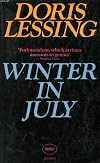
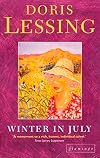
Winter in July
by Doris Lessing
On This Page
Description
Winner of the Nobel Prize for Literature 2007, Doris Lessing grew up in Africa – and returns to that troubled, misunderstood continent in this searing collection of short stories. ‘I believe that the chief gift from Africa to writers, white and black, is the continent itself, its presence which for some people is like an old fever, latent always in their blood; or like an old wound throbbing in the bones as the air changes. … Africa gives you the knowledge that man is a small creature, show more among other creatures, in a large landscape.’ Written with all the angry compassion of first-hand knowledge, these stores reveal Africa in the raw – an Africa unknown to the vast majority of Europeans. Here is a vivid, unforgettable evocation of its sounds and smells, its stark power and savage grandeur, its agony and ultimate tragedy. show lessTags
Recommendations


















Member Reviews
This is a collection of seven short stories all set in Southern Rhodesia (Zimbabwe) where Doris Lessing spent most of the first 30 years of her life. They were originally published in 1964 while she was writing her Children of Violence novels also set in Southern Africa and so her writing mind was steeped in her memories of her early life in a fiercely colonial country. They are bleak in a way that only a certain displacement; at times verging on hostility can make people feel who are caught in the wrong time and in the wrong place. That wrong time and wrong place was Southern Rhodesia where an increasingly nationalistic white minority government was holding sway over a cowed and silent black majority.
All the stories are set in the show more Veld; the wide open rural landscapes of Southern Africa and they feature white settlers living in small isolated communities struggling to tame an environment that can be unforgiving. Mostly they take the point of view of the females, wives, girlfriends, lovers who feel the isolation much more keenly than their male counterparts. The men can get on with running the huge farms, while the women are left to their own devices, managing their children and the native servants; divorced from much of society and increasingly divorced from their men who live in their man’s world on the farm. The sights sounds smells of a wild and largely untamed countryside seep through the stories providing a backdrop that shapes the lives of Lessing’s protagonists. The rural native black population who provide the manpower that supports the lives of the white settlers has been wrenched out of their village life to reside in Kraals or compounds and are misunderstood at best and castigated and punished at worst by their white masters.
Nobody wins in these stories. The white farmers who take a more sympathetic line with their black labourers are undone by their failure to understand the way the natives see their world and by an unsympathetic government who frown on any leniency. The Afrikaners (white Dutch Settlers) who in these stories are the ‘poor whites’ and are particularly abusive and violent, suffer as a result. The women who try and make a life for themselves on the farms are open to petty jealousies or hostilities from their peers while facing a conflict with their black servants and incomprehension of their issues from their male partners.
Lessing’s view of her past life is accurately recorded in these stories, it is a jaundiced view of the white community, but one that is imbued by the love of rural Southern Africa. They are vivid well written stories that never fail to portray a world that remained hidden from most of her contemporary readers and because of the milieu that Lessing has chosen for all the stories they work together in painting a picture of a society doomed to fail. They are available in two volumes of her collected African Short stories, but if you want to dip into a selection this collection is as good as any. 4 Stars. show less
All the stories are set in the show more Veld; the wide open rural landscapes of Southern Africa and they feature white settlers living in small isolated communities struggling to tame an environment that can be unforgiving. Mostly they take the point of view of the females, wives, girlfriends, lovers who feel the isolation much more keenly than their male counterparts. The men can get on with running the huge farms, while the women are left to their own devices, managing their children and the native servants; divorced from much of society and increasingly divorced from their men who live in their man’s world on the farm. The sights sounds smells of a wild and largely untamed countryside seep through the stories providing a backdrop that shapes the lives of Lessing’s protagonists. The rural native black population who provide the manpower that supports the lives of the white settlers has been wrenched out of their village life to reside in Kraals or compounds and are misunderstood at best and castigated and punished at worst by their white masters.
Nobody wins in these stories. The white farmers who take a more sympathetic line with their black labourers are undone by their failure to understand the way the natives see their world and by an unsympathetic government who frown on any leniency. The Afrikaners (white Dutch Settlers) who in these stories are the ‘poor whites’ and are particularly abusive and violent, suffer as a result. The women who try and make a life for themselves on the farms are open to petty jealousies or hostilities from their peers while facing a conflict with their black servants and incomprehension of their issues from their male partners.
Lessing’s view of her past life is accurately recorded in these stories, it is a jaundiced view of the white community, but one that is imbued by the love of rural Southern Africa. They are vivid well written stories that never fail to portray a world that remained hidden from most of her contemporary readers and because of the milieu that Lessing has chosen for all the stories they work together in painting a picture of a society doomed to fail. They are available in two volumes of her collected African Short stories, but if you want to dip into a selection this collection is as good as any. 4 Stars. show less
Ratings
Members
- Recently Added By
Author Information

260+ Works 36,994 Members
Doris Lessing was born in Kermanshah, Persia (later Iran) on October 22, 1919 and grew up in Rhodesia (the present-day Zimbabwe). During her two marriages, she submitted short fiction and poetry for publication. After moving to London in 1949, she published her first novel, The Grass Is Singing, in 1950. She is best known for her 1954 Somerset show more Maugham Award-winning experimental novel The Golden Notebook. Her other works include This Was the Old Chief's Country, the Children of Violence series, the Canopus in Argos - Archives series, and Alfred and Emily. She has received numerous awards for her work including the 2001 Prince of Asturias Prize in Literature, the David Cohen British Literature Prize, and the 2007 Nobel Prize for Literature. She died on November 17, 2013 at the age of 94. (Bowker Author Biography) show less
Series
Belongs to Publisher Series
Work Relationships
Common Knowledge
- Canonical title*
- Winter im Juli : Erzählung
- Original title
- Winter in July
- Original publication date
- 1951
*Some information comes from Common Knowledge in other languages. Click "Edit" for more information.
Classifications
Statistics
- Members
- 110
- Popularity
- 291,323
- Reviews
- 1
- Rating
- (3.95)
- Languages
- English, French, German
- Media
- Paper, Ebook
- ISBNs
- 6
- ASINs
- 6