On This Page
Description
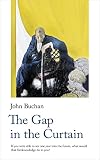
What begins as a straightforward holiday weekend for Sir Edward Leithen in a splendid stately home in the Cotswolds soon turns into something altogether different when one of Lady Flambard's other guests, the enigmatic Professor Moe, enlists the help of Leithen and his companions in a bizarre experiment to glimpse the future. For those who take part, the consequences are dramatic and Leithen's formidable powers of reasoning are brought to the fore.Tags
Recommendations

















Member Reviews
Alfred Hitchcock’s version of The Thirty-Nine Steps (1935) is a classic of 1930s filmmaking. It gave the 1915 story by John Buchan concision, action, sex appeal, and humor that Buchan’s novel could not match. Sadly, no filmmaker has seen fit to breathe life into Buchan’s The Gap in the Curtain (1932). Gap poses this question, what would you do if you could read a newspaper article about yourself written one year in the future? A mad scientist gives several men at a country house party the chance to read about themselves in next year’s Times. The man who sees only a blank page is the only one whose fate you could envy. Buchan, who was a staunch Calvinist, tells us that neither predestination nor precognition relieves us of the show more responsibility of making the decisions that shape our lives.
The Gap in the Curtain is not the best British science fiction novel (if it can be called science fiction) of 1932. That honor must go to Aldus Huxley’s Brave New World. It is not the best suspense novel either—I would give the nod to Dorothy Sayers for Have His Carcass. The best one can say about Buchan’s characters and prose is that they are both workmanlike and stodgy. Note: The introduction by Stuart Kelly in the 2012 Polygon edition is excellent. 3 stars. show less
The Gap in the Curtain is not the best British science fiction novel (if it can be called science fiction) of 1932. That honor must go to Aldus Huxley’s Brave New World. It is not the best suspense novel either—I would give the nod to Dorothy Sayers for Have His Carcass. The best one can say about Buchan’s characters and prose is that they are both workmanlike and stodgy. Note: The introduction by Stuart Kelly in the 2012 Polygon edition is excellent. 3 stars. show less
2.5*
As in the previous book, this 4th book in the Leithen series had a mystic aspect. Sadly for me, instead of the adventures of my favorite Buchan books, the plot was focused on the psychological effects of the mystic experience on each of a group of people. In another mood, I might have enjoyed this more... However I still plan to read the final book in this series; fingers crossed that it will be more similar to the earlier books!
As in the previous book, this 4th book in the Leithen series had a mystic aspect. Sadly for me, instead of the adventures of my favorite Buchan books, the plot was focused on the psychological effects of the mystic experience on each of a group of people. In another mood, I might have enjoyed this more... However I still plan to read the final book in this series; fingers crossed that it will be more similar to the earlier books!
Now I have to come clean and declare a prejudice here. For me John Buchan can do no wrong ! Whether it is writing his adventure,gung-ho type fiction,his historical novels or indeed his more serious non-fiction of various types,he is so good.
Likewise with his under-rated supernatural stories of which this is the best I think. Very understated,it tells of a group of guests at a rather select party who are invited to 'look into the future' in an experiment which involves each person studying a different section of 'The Times' newspaper and attempting to see that section in the future--the leader page,the city page,the court page and the deaths.In this latter their own death is seen printed out in front of them.
Highly recommended.
Likewise with his under-rated supernatural stories of which this is the best I think. Very understated,it tells of a group of guests at a rather select party who are invited to 'look into the future' in an experiment which involves each person studying a different section of 'The Times' newspaper and attempting to see that section in the future--the leader page,the city page,the court page and the deaths.In this latter their own death is seen printed out in front of them.
Highly recommended.
Seven guests at a country house party are selected for a scientific experiment. Five succeed and are granted a brief glimpse of their future. A sixth tells of what they did with that foreknowledge. Buchan at his most metaphysical.
Ratings
Members
- Recently Added By
Author Information

280+ Works 17,557 Members
John Buchan was born in Perth on 26th August, 1875. Educated at Glasgow University and Brasenose College, Oxford, in 1898 Buchan won the Newdigate Prize for poetry. Although trained as a lawyer, Buchan became private secretary to Lord Alfred Milner, high commissioner for South Africa. In 1903 he returned to England where he became a director of show more the publishing company, Thomas Nelson & Sons. In 1910 Buchan had his first novel, Prester John, published. In July 1914, Blackwood's Magazine began serializing Buchan's The Thirty-Nine Steps. With Britain on the verge of war, the nation was obsessed with German spy fever and its subject matter made it an immediate success. When it was published in book form, it sold over 25,000 copies in three months. Charles Masterman, the journalist, was appointed head of the government's War Propaganda Bureau. Masterman recruited Buchan and asked him to organise the publication of a history of the war in the form of a monthly magazine. Published by his own company, the first installment of the Nelson's History of the War appeared in February, 1915. A further twenty-three appeared at regular intervals throughout the war. In the spring of 1915, Buchan agreed to become one of the five journalists attached to the British Army. He was given responsibility for providing articles for The Times and the Daily News. In June 1916, Buchan was recruited by the British Army to draft communiqués for Sir Douglas Haig and other members of the General Headquarters Staff. Given the rank of Second Lieutenant in the Intelligence Corps, Buchan was also provided with the documents needed to write the Nelson's History of the War. Buchan's History of the War provided the public with a completely false impression of what was going on the Western Front. Buchan also wrote a series of propoganda pamphlets published by Oxford University Press. In February, 1917, the government established a Department of Information. Given the rank Lieutenant Colonel, Buchan was put in charge on the department on an annual salary of £1,000 a year. After the war Buchan continued to write adventures stories such as Huntingtower, The Three Hostages, and Witch Wood (1927). He also became involved in politics and in 1927 was elected Conservative MP for the Scottish Universities. Buchan held the seat until granted the title Baron Tweedsmuir in 1935. Buchan was president of the Scottish History Society from 1929 to 1932, and wrote biographies of Montrose and Sir Walter Scott. Buchan also served as governor-general of Canada from 1935 to 1937 and chancellor of Edinburgh University from 1937 to 1940. John Buchan died on 12th February, 1940. (Bowker Author Biography) show less
Some Editions
Series

Belongs to Publisher Series
Work Relationships
Common Knowledge
- Original publication date
- 1932
- People/Characters
- Edward Leithen; Charles Lamancha; Mildred Lamancha; George Lamington; Anthony Hurrell; Sally Flambard (show all 10); Folliot; Dolly Brune; Lady Pamela Brune; Bronson Jane
- Epigraph
- "Si la conscience qui sommeille dans P'instinct se reveillait, s'il s'interiorisait en connaissance au lieu de s'exterioriser en action. si nous savions l'interroger et s'il pouvait repondre, il nous livrerait les secrets de ... (show all)la vie." - Bergson, L'Evolution Creatrice.
"But no!" cried Mr Mantalini. "It is a demn'd horrid dream. It is not reality. No!" - Nicholas Nickleby. - Dedication
- To Sybil and Lambert Middleton
- First words
- As I took my place at the dinner-table I realised that I was not the only tired mortal in Lady Flambard's Whitsuntide party.
- Last words
- (Click to show. Warning: May contain spoilers.)"He lived in a villa at Cheltenham, which he had christened Marlcote, after the family place."
Classifications
Statistics
- Members
- 205
- Popularity
- 158,121
- Reviews
- 4
- Rating
- (3.33)
- Languages
- English
- Media
- Paper, Ebook
- ISBNs
- 20
- ASINs
- 23