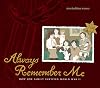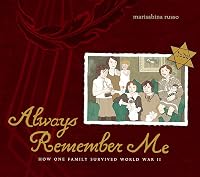
Always Remember Me: How One Family Survived World War II
by Marisabina Russo
On This Page
Description
After many years during which her grandmother skirted the issue, a young girl finally hears the story of how several of her female relatives survived the Holocaust. Rachel's Oma (her grandmother) has two picture albums. In one the photographs show only happy times -- from after World War II, when she and her daughters had come to America. But the other album includes much sadder times from before -- when their life in Germany was destroyed by the Nazis' rise to power. For as long as Rachel show more can remember, Oma has closed the other album when she's gotten to the sad part. But today Oma will share it all. Today Rachel will hear about what her grandmother, her mother, and her aunts endured. And she'll see how the power of this Jewish family's love for one another gave them the strength to survive. Marisabina Russo illuminates a difficult subject for young readers with great sensitivity. Based on the author's own family history, Always Remember Me is a heartbreaking -- and inspiring -- book sure to touch anyone who reads it. show lessTags
Recommendations



Member Reviews
While of course sad, this book is also hopeful and thankful for family and life. This does a good job personalizing the Holocaust and introducing the sadness of it without graphic horror. The included of family pictures is a poignant addition.
I absolutely loved reading this book! The illustrations, the inclusion of real family photos and the story overall were extremely captivating and engaging! I feel that this story would be great as a read-aloud for a 4th or 5th grade class because of the historical aspect and the “real story” aspect as well! Although this story does have a “darker” side to it with the inclusion of the stories and discussions of concentration camps and the hardships that the Jews had to endure, the story of survival is extremely fascinating and will keep the students’ attention! The illustrations and the real family photos are the main reason why I enjoyed this book so much! The variety in having one picture to multiple pictures on each page show more accompanying text as well as the comparison between the illustrations and the real photos allow the students/readers to be engaged with the story and comprehend what it was like to live during the time of World War II and the Holocaust. For example on one page, there are multiple illustrations of post cards and “papers” that allowed the character “Oma” and her family to leave Germany and go to other countries. The students can see how much needed to be done in order for Jewish people to escape Germany and other countries where the Nazis were in control. They can then compare to how people travel from country to country today. Finally, the story itself was enthralling and held my interest and attention the entire time I was reading it. The personal and family aspect drew me in and kept me reading all the way to the end! I am definitely going to have this as part of my classroom library so my older students can access it and enjoy it as much as I did! show less
Rachel's Oma, or grandmother, finally tells her the story of the pictures in the back of the photo album she always skips over. It is the story of how she and her three daughters, including Rachel's mother, survived World War II in Poland as a Jewish Family. Oma survived being sent to Auschwitz, while one of her daughter's fled to America, another to Italy, and the third stayed to be married to a man who could not get papers to leave. Through losing their home and being separated, the three women all survived and reunited to settle in America.
In this story, author Marisabina Russo recalls her familys difficult time during the Holocaust. The story is a biography of Russo's mother, grandmother, and two aunts. The story begins with a grandmother explaining to her granddaughter how she came to live in Germany. The grandmother then goes into deeper discussion of how the Nazis came into Germany and tried to destroy the Jewish population. The grandmother and her three daughters were sepereated. Love is what kept the four women going and what they believe is what led them back to each other. In the afterword part of the book readers learn that this was based on true events that happened in Russo's familys lives. This would be a good story to read to students to show that death show more wasn't always the case for Jewish people during the Holocaust. Some families were fortunate enough to overcome that terrible time. show less
Marisabina Russo tells of the story of her grandmother, mother and 2 aunts during WWII. It begins with the history how her grandmother's parents and her moved to Germany. They were Jews living in Germany when WWII began. Oma, her grandmother, was given a gold heart necklace from her grandmother when her family left Poland. Oma told how her husband died suddenly after WWI and how it was difficult to provide for her 3 daughters. She tells of the discrimination towards Jews and how Rachel's mother moved to Italy so she could finish school and married there. Oma told of identity cards that all Jews had to have and eventually wearing the yellow Star of David to let all know they were Jewish. Oma tells of the long process to get papers to go show more to America where her cousins lived. She told how Emmi went to America by herself because Oma felt she needed to stay behind with Anni. She tells about all three daughters getting married and how each had lost their husband during the war, two in concentration camps and one being shot. Eventually they would all make it to America. As Oma's story ends she gives her gold heart necklace to her granddaughter Rachel. The Afterward is important because it further explains the history leading up to WWII and more about the War. There are actual pictures of the family on the inside covers of the book. The illustrations show as if they are pictures of the family. This book gently tells of a family's survival and the atrocities of the War. The story of the necklace is the thread of hope for this family. This is a good book to read to students. The accuracy is direct because she heard it from her grandmother. There isn't a bibliography. It is organized in a narrative structure and chronological order. It tells the story of the necklace and how "lucky" Oma is. The story tells of the events that lead up to WWII and afterwards until the family was reunited. There is clarity as the ideas are logically ordered and the language is appropriate for this age group. The Afterward provides further clarity of what occurred in history. There language is straight forward but there is also precise language, such as using "dismal" in, "I survived the dismal years." There aren't provocative questions. The tone is conversational as Oma is telling the story to Rachel. This is a thoughtful story about hope during a time of sadness and despair. show less
Russo relates the experiences of her own family, and how love helped them survive the Holocaust.
This story was a refreshing story about the Holocaust. It actually had a happy ending where everyone made it out alive. It was a very good story.
Members
- Recently Added By
Lists

Children's Books about World War II (1939-1945)
143 works; 12 members
Author Information

29+ Works 1,282 Members
Marisabina Russo is a children's book author and illustrator. She has written and illustrated over twenty books for children and young adults. Her most notable books include The Line Up Book (winner of the IRA Children¿s Book Award) and Always Remember Me (an ALA Notable Book). She was born in New York, New York and graduated from Mount Holyoke show more College with BA in Studio Art in 1971. She began her career as a freelance illustrator. Her work appeared frequently in The New Yorker and included several covers. She then went on to illustrate a book of poetry for children, Vacation Time by Nikki Giovanni. She started publishing her own stories with Greenwillow Books in 1986. Russo¿s books come from her childhood memories and her experiences as a mother. Her illustrations, painted in gouache, are colorful and two-dimensional, reminiscent of folk art. Ms. Russo has also written young adult novels. (Bowker Author Biography) show less
Awards and Honors
Awards
Distinctions
Notable Lists
Common Knowledge
- Important places
- Germany
- Important events
- World War II (1939 | 1945); Holocaust
- Dedication
- LJCRS Book Fair Selection 5766
Classifications
Statistics
- Members
- 152
- Popularity
- 214,950
- Reviews
- 9
- Rating
- (3.96)
- Languages
- English
- Media
- Paper
- ISBNs
- 1