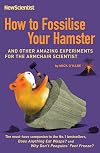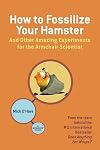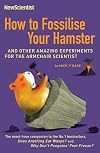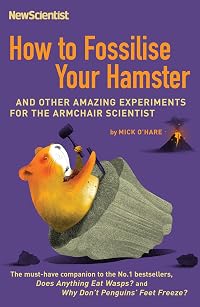
How to Fossilise Your Hamster: And Other Amazing Experiments For The Armchair Scientist
by Mick O'Hare
New Scientist's readers (3), New Scientist: The Last Word (5)
On This Page
Description
How can you measure the speed of light with chocolate and a microwave? Why do yo-yos yo-yo? Why does urine smell so peculiar after eating asparagus (includes helpful recipe)? How long does it take to digest different types of food? What is going on when you drop mentos in to cola? 100 wonderful, intriguing and entertaining scientific experiments which show scientific principles first hand - this is science at its most popular.Tags
Recommendations













Member Reviews
Who knew science could be so much fun? This book of simple do-it-yourself experiments, using common household items, demonstrates and explains scientific principles – and all without the caveat ‘don’t try this at home’.
The experiments are arranged in order of the household room most suitable for their performance: the Living Room, the Kitchen, the Study, the Bathroom, the Garage and the garden.
Best of all, most experiments have an entirely practical application – no messing around with keys and kites in a thunderstorm: not so much The Dangerous Book for Boys as The Book for Dangerous Dads. What better way for example to show solutal convection than to use a wide-bottomed glass of Tia Maria replete with a thin layer of single show more cream, which will form rapidly circulating and swirling patterns?
Nucleation is demonstrated by pouring beer or sparkling wine into a wet glass, while terpenes are responsible for the milky-looking solution formed when water is added to Ouza or Sambuca.
The difference between a shaken and stirred martini is also explained – although being a smoker it is unlikely that James bond would have been able to discern the slightly difference in taste – and a recipe for the perfect vodka martini is included.
Not all the experiments involve alcohol, just the most palatable ones, and if we move from the Living Room to the Kitchen we tackle the question “If a strand of dried spaghetti is held at both ends and bent, why does it always break into three pieces?”
Ponder this next time you make Spaghetti Bolognaise, and while you’re about it consider “What’s the best way to get tomato ketchup out of a bottle without breaking the bottle or splattering the sauce?”
There are several suggestions for this universal problem, but everyone agrees – do NOT hold the bottle upside down, banging the bottom. Rather remove the lid and give the stuff a 15 second blast in the microwave.
Better yet, seal the bottle, grip it at the base, and swirl your arm around – “Whether you can use such a flamboyant technique in a posh chippy is open to question” – this method might require space, but it does work.
Moving to the Study we ponder the age-old question of why rubber bands seem to melt and turn into a sticky mess, and how to create a lava lamp using effervescent anti-acid tablets.
In the bathroom, you can extract your very own DNA using only water, salt, washing up liquid and alcohol, and you can also prove that no matter what colour fluid you have imbibed, your urine is always yellowish.
The Garage is the place to test if hot water really does freeze faster than cold, and to discover why cola cleans certain alloys so well: the really cool experiments though are reserved for the garden.
First off, fossilizing a pet – whether Hamster or Horse – is not easy because it requires the right environmental conditions, so rather than trying that, make paper ‘planes, fizzy drink volcanoes, and sandcastles.
Big Bangs are always fun, and ‘the extraordinary explosive reaction which occurs when Mentos sweets are mixed with fizzy drink’ is apparently a real blast, with frothy soda shooting up in a five metre spurt!
Safe for children, practical for dads, and all with explanations and insight into the world around us provided by the estimable ‘New Scientist’ team, How to Fossilise your Hamster’ is a grand book for all ages. show less
The experiments are arranged in order of the household room most suitable for their performance: the Living Room, the Kitchen, the Study, the Bathroom, the Garage and the garden.
Best of all, most experiments have an entirely practical application – no messing around with keys and kites in a thunderstorm: not so much The Dangerous Book for Boys as The Book for Dangerous Dads. What better way for example to show solutal convection than to use a wide-bottomed glass of Tia Maria replete with a thin layer of single show more cream, which will form rapidly circulating and swirling patterns?
Nucleation is demonstrated by pouring beer or sparkling wine into a wet glass, while terpenes are responsible for the milky-looking solution formed when water is added to Ouza or Sambuca.
The difference between a shaken and stirred martini is also explained – although being a smoker it is unlikely that James bond would have been able to discern the slightly difference in taste – and a recipe for the perfect vodka martini is included.
Not all the experiments involve alcohol, just the most palatable ones, and if we move from the Living Room to the Kitchen we tackle the question “If a strand of dried spaghetti is held at both ends and bent, why does it always break into three pieces?”
Ponder this next time you make Spaghetti Bolognaise, and while you’re about it consider “What’s the best way to get tomato ketchup out of a bottle without breaking the bottle or splattering the sauce?”
There are several suggestions for this universal problem, but everyone agrees – do NOT hold the bottle upside down, banging the bottom. Rather remove the lid and give the stuff a 15 second blast in the microwave.
Better yet, seal the bottle, grip it at the base, and swirl your arm around – “Whether you can use such a flamboyant technique in a posh chippy is open to question” – this method might require space, but it does work.
Moving to the Study we ponder the age-old question of why rubber bands seem to melt and turn into a sticky mess, and how to create a lava lamp using effervescent anti-acid tablets.
In the bathroom, you can extract your very own DNA using only water, salt, washing up liquid and alcohol, and you can also prove that no matter what colour fluid you have imbibed, your urine is always yellowish.
The Garage is the place to test if hot water really does freeze faster than cold, and to discover why cola cleans certain alloys so well: the really cool experiments though are reserved for the garden.
First off, fossilizing a pet – whether Hamster or Horse – is not easy because it requires the right environmental conditions, so rather than trying that, make paper ‘planes, fizzy drink volcanoes, and sandcastles.
Big Bangs are always fun, and ‘the extraordinary explosive reaction which occurs when Mentos sweets are mixed with fizzy drink’ is apparently a real blast, with frothy soda shooting up in a five metre spurt!
Safe for children, practical for dads, and all with explanations and insight into the world around us provided by the estimable ‘New Scientist’ team, How to Fossilise your Hamster’ is a grand book for all ages. show less
A collection of experiments to do at home, as a means of exploring both the scientific method and the world around you.
Loosely divided into rooms about the house the experiments cover a wide range of physics, chemistry and even biology without ever being dull or boring. Just like real science they are precisely focused and don't lead to much extrapolation of the world around them.
The details are clear, and the explanations provided coherent - if your results don't match the expected values then the explanation could be at fault. Be sure to repeat as suggested a few times.
The best feature of this book is definitely the insight into real science - repetition and testing of hypotheses which demonstrates the correctness of one theory over show more another.
All the experiments can be done very simply with commonly available materials, which you will either have to hand or are readily and cheaply bought - no particle accelerators! Most can be completed very quickly certainly within an hour or so.
The only experiment I've noticed from skimming through that isn't practical is unfortunately the title experiment - fossils form over 10000s of years and there isn't a nifty way to shortcut this.
Plenty of fun for supervised children, inquisitive teenagers and even adults still experiencing the wonder of the world around them.
Note: I've not actually conducted any of the experiments (yet) so I can't comment on whether they work as advertised, but the instructions seem clear. show less
Loosely divided into rooms about the house the experiments cover a wide range of physics, chemistry and even biology without ever being dull or boring. Just like real science they are precisely focused and don't lead to much extrapolation of the world around them.
The details are clear, and the explanations provided coherent - if your results don't match the expected values then the explanation could be at fault. Be sure to repeat as suggested a few times.
The best feature of this book is definitely the insight into real science - repetition and testing of hypotheses which demonstrates the correctness of one theory over show more another.
All the experiments can be done very simply with commonly available materials, which you will either have to hand or are readily and cheaply bought - no particle accelerators! Most can be completed very quickly certainly within an hour or so.
The only experiment I've noticed from skimming through that isn't practical is unfortunately the title experiment - fossils form over 10000s of years and there isn't a nifty way to shortcut this.
Plenty of fun for supervised children, inquisitive teenagers and even adults still experiencing the wonder of the world around them.
Note: I've not actually conducted any of the experiments (yet) so I can't comment on whether they work as advertised, but the instructions seem clear. show less
No fluff or unnecessary fanfare here. How to Fossilize Your Hamster by Mick O'Hare takes you straight to the experiments—here's what you need, here's what to do and here's what to expect. The whole book is themed around a household so each experiment (e.g. Green Eggs and Cabbage) is meant for a specific location (e.g. The Kitchen).
It might be a while before I get around to trying ALL of them, but I'm already enjoying the few experiments I have done.
It might be a while before I get around to trying ALL of them, but I'm already enjoying the few experiments I have done.
This is a book of very simple, accessible activities that answer questions or demonstrate basic scientific principles using mostly items that the reader would have around the house. This would be a great book for a family that home schools. The experiments are described and explained so clearly that it is not really necessary even to do the activities. I didn't do any of them, just read the book, and I still think I learned some things.
About: New Scientist writer O'Hare provides instructions explains a multitude of science experiments that can easily be done at home.
Pros: Very interesting, varied topics and experiments. Written in easy-to-understand language. My favorite topics included the best ways to get ketchup out of a bottle, how to test if talking on a cell phone affects your reaction time (it does), why hot water freezes faster than cold water, why your vision is blurry underwater, how to extract iron from cereal and DNA from yourself. Apparently, Alka-Seltzer can be used for several cool experiments.
Cons: No sources cited. A further reading section would've been nice
Pros: Very interesting, varied topics and experiments. Written in easy-to-understand language. My favorite topics included the best ways to get ketchup out of a bottle, how to test if talking on a cell phone affects your reaction time (it does), why hot water freezes faster than cold water, why your vision is blurry underwater, how to extract iron from cereal and DNA from yourself. Apparently, Alka-Seltzer can be used for several cool experiments.
Cons: No sources cited. A further reading section would've been nice
A nice bit of fun with real science sneaked in.
Plenty of material to entertain the kids, of any age.
Will be trying the others in the series.
Plenty of material to entertain the kids, of any age.
Will be trying the others in the series.
Ratings
Members
- Recently Added By
Author Information

18+ Works 3,680 Members
Some Editions
Series


Work Relationships
Common Knowledge
- Original publication date
- 2007
- Original language
- English
Classifications
Statistics
- Members
- 485
- Popularity
- 62,855
- Reviews
- 6
- Rating
- (3.58)
- Languages
- 5 — Dutch, English, French, German, Spanish
- Media
- Paper, Ebook
- ISBNs
- 14
- ASINs
- 5