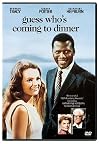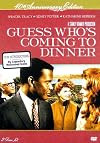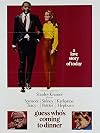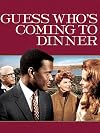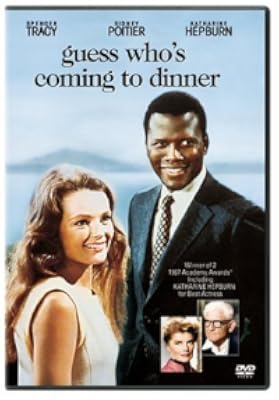
Guess Who's Coming to Dinner [1967 film]
by Stanley Kramer (Director), William Rose (Screenwriter)
On This Page
Description
Crusading newspaper publisher Matt Drayton's liberal principles are put to the test when his daughter, Joey, announces her engagement to John Prentice, an internationally renowned African-American physician. While Matt's wife, Christina, readily accepts Joey's decision, Matt intends to withhold his consent, forgetting that when it comes to matters of the heart, true love is colorblind.Tags
Recommendations














Member Reviews
There’s not a great deal of plot in this film, which takes place in the course of just one day. I imagine it was quite eye-opening fifty years ago, inviting viewers to examine their own hearts, to see whether their beliefs and principles would extend to their own children marrying someone with a different coloured skin.
There’s some humour in the situations, some irony, and much that was very serious back in the 1960s in the United States. Inevitably the style of the film is dated, but that isn’t a problem, even if some of the backdrops look rather fake. We had to suspend belief a little at the way everything happened, just in conversation and discussion. At times, towards the end, the film felt a bit like a play with different show more scenes involving groups of actors talking... but overall we liked the film very much and would recommend it to anyone. show less
There’s some humour in the situations, some irony, and much that was very serious back in the 1960s in the United States. Inevitably the style of the film is dated, but that isn’t a problem, even if some of the backdrops look rather fake. We had to suspend belief a little at the way everything happened, just in conversation and discussion. At times, towards the end, the film felt a bit like a play with different show more scenes involving groups of actors talking... but overall we liked the film very much and would recommend it to anyone. show less
Certainly a bit dated, but the denoument is done nicely and the small cast of characters feel real and worthy of emotional investment.
Joanna, la hija de un prestigioso editor y de su elegante esposa, llega a a casa con su prometido, un distinguido médico de color. Christina acepta la decisión de su hija de casarse, pero Mathew y la familia de John no son capaces de evitar los prejuicios sociales que supone la relación.
Jul 19, 2017Spanish
Ratings
Members
- Recently Added By
Published Reviews
“Guess Who’s Coming to Dinner” has retained a central and deeply complex position in the culture. Its title remains a catchphrase; its narrative informed Jordan Peele’s movie “Get Out,” a film that feels very much in conversation with its predecessor....“Anybody who’s ever been involved in an interracial marriage of any sort, or even a gay relationship, any kind of relationship show more that’s not approved of, that movie became a metaphor for those kinds of situations,” Katharine Houghton told King....It’s still a story for white people, because the fear in the narrative mostly belongs to Joanne’s empathetic parents, stand-ins for the audience. Therein lies what makes “Get Out” such a fascinating and crucial piece of revisionism. It featured the same scenario — a young, upper-middle-class white woman brings home an African-American boyfriend to meet her parents — but the fear and tension that motivates the story does not reside in the older white generation. It is felt by the black guy coming to the house with his white girlfriend, entering partly into the unknown and partly into hundreds of years of agonizing history. show less
added by Lemeritus
Entertainment, I think, is the key word here. Kramer has taken a controversial subject (interracial marriage) and insulated it with every trick in the Hollywood bag. There are glamorous star performances by Katharine Hepburn and Spencer Tracy made more poignant by his death. There is shameless schmaltz (the title song, so help me, advises folks to give a little, take a little, let your poor show more heart break a little, etc.). The minor roles are filled with crashing stereotypes, like a Negro maid who must be Rochester's sister and an Irish monsignor with a brogue so fey and eyes so twinkling he makes Bing Crosby look like a Protestant....It is easy to ridicule this deadline as contrived and artificial: and it is easy to argue that Poitier's character is too perfect to be convincing. But neither of these aspects bothered me. The artificial deadline is a convention of drawing room comedies. It provides automatic suspense and keeps the action within a short span of time. And Poitier's "perfect Negro" is no more perfect than Miss Houghton's perfect liberal daughter, Miss Hepburn's perfect Rock of Gibraltar mother and Tracy's perfect Spencer Tracy. show less
added by Lemeritus
If one were taking this cheerful disquisition on the problems of mixed marriage seriously, there are several observations and pointed questions that would have to be raised. Is this a normal conjunction of a white girl and a Negro man that Stanley Kramer, the producer-director and his scriptwriter, William Rose, have arranged? Is the poison of bigotry and bias conceivable in the attitudes of show more intelligent, liberal parents towards their daughter when she wants to wed a brilliant, charming Negro who is a candidate for a Nobel Prize? Is a sudden, powerful romance likely between an eminent man of this sort and the starry-eyed college senior Miss Houghton rapturously plays? Let's not pursue those questions, for they will only tend to disturb the euphoria and likely enjoyment of this witty and glistening film. Mr. Rose has written a deliciously swift and pithy script, and Mr. Kramer has made it spin brightly in a stylish ambience of social comedy. Mr. Tracy and Miss Hepburn are superior—he the crusty, sardonic old boy who speaks from a store of flinty wisdom but whose heart overflows with tender love; and she the seemingly airy patrician whose eyes often well with compassionate tears. Mr. Poitier is also splendid within the strictures of a rather stuffy type that might also be questioned, if one were dissecting this film, and Beah Richards is deeply touching as his mother, which is the most profound and dignified role. Isabelle Sanford gets off some nifties, in a somewhat Dick Gregoryish vein, as the family's Negro maid who has the strongest bias against mixed marriages. "Civil rights is one thing but this here is something else," she sniffs in a burst of incisive recognition that might also characterize the blue-chip film. One might add that it has the further value of strong personal sentiment, in that it offers Mr. Tracy so graciously in the last role he played before his death. show less
added by Lemeritus
Lists

al.vick-wishlist-movies
165 works; 1 member
Author Information


All Editions
Awards and Honors
Awards
Work Relationships
Is contained in
Common Knowledge
- Canonical title
- Guess Who's Coming to Dinner [1967 film]
- Original title
- Guess Who's Coming to Dinner
- Original publication date
- 1967-12-11
- People/Characters
- Matt Drayton (Spencer Tracy); John Prentice (Sidney Poitier); Christina Drayton (Katharine Hepburn); Joey Drayton (Katharine Houghton)
- Important places
- San Francisco, California, USA; California, USA
- Related movies
- Guess Who's Coming to Dinner (1967 | IMDb)
- Original language
- English
- Canonical DDC/MDS
- 791.4372
- Canonical LCC
- PN1997
Classifications
- DDC/MDS
- 791.4372 — Arts & recreation Recreation, sports, and performing arts Public performances Motion pictures, radio, television, podcasting Motion pictures Films; screenplays Single films
- LCC
- PN1997 — Language and Literature Literature (General) Literature (General) Drama Motion pictures Plays, scenarios, etc.
Statistics
- Members
- 203
- Popularity
- 161,517
- Reviews
- 4
- Rating
- (4.07)
- Languages
- English, French, German, Spanish
- ISBNs
- 7
- UPCs
- 6
- ASINs
- 16