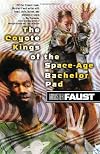
The Coyote Kings of the Space-Age Bachelor Pad
by Minister Faust
On This Page
Description
Hamza and Yehat are The Coyote Kings–best friends, one a disgruntled dishwasher and the other a video store clerk, but each brilliant in his own right. Yehat builds prototypes of space-age inventions in his spare time, while Hamza, a former English honors student who was kicked out of the university, writes lush, lyrical poems when he’s not blocked–which, these days, is nearly always.When the gorgeous, mysterious Sherem shows up in E-Town decked out in desert finery, Hamza’s creative show more spark is ignited. Who is this sophisticated woman that speaks arcane African tongues, quotes from obscure comics andStar Warsmovies, yet seems somehow too ethereal for the world Hamza inhabits? And what is the lost artifact that she and a cast of coiffed collectors and criminal cultists so desperately seek? As Hamza falls blindly in love with Sherem, little does he know that he and Yehat play the biggest part of all in the recovery of the ancient relic–and in the future of all living beings. . . . show lessTags
Recommendations

















Member Reviews
Afro-Canadian political activist, poet, and playwright Minister Faust's first novel, The Coyote Kings of the Space Age Bachelor Pad, begins at the end. Protagonist Hamza Achmed Qebhsennuf Senesert, a disenfranchised twentysomething living in 1995 Edmonton (E-Town as he calls it), freely admits, "In advance, shut up. I know epilogues go at the end." The opening is the most conventional piece of this nonlinear novel.
Hamza and his best friend/roommate Yeh (Yehat Bartholomew Gerbles) are the Coyote Kings. Steeped in the world of pop culture, the Coyotes see everything within those terms. Comic books, Star Trek, science fiction movies, Philip K. Dick, and much more obscure references litter the prose.
Faust's humorous novel is not merely a show more collection of cultural trivia. He has produced a well-conceived story about redemption, friendship, and the possible end of the world with heaping samples of politics and religion thrown in. For the most part, the characters are divided into amusing protagonists and singular antagonists. The Fanboys, a collection of five geeks, are the extreme revenge for anyone who was ever picked on as a child for being different. Their employer, an ex-jock and successful entrepreneur, devises a plan for metaphysical Armageddon. Hamza's girlfriend – an enigma who worships Alan Moore, can accurately and appropriately quote Star Wars, and is given to erratic and sometimes dangerous behavior – is the one person who can stop the diabolical scheme.
With an attention to detail and an eye for the absurd, it is as if Faust channeled Mark Twain to write a Neal Stephenson novel. Although flawed – the plot unveils too slowly, and there are too many viewpoints – The Coyote Kings of the Space Age Bachelor Pad explodes off the page as an intelligent, fun-filled pop-culture adventure.
(This review originally appeared in The Austin Chronicle, August 20, 2004.)
Link: [http://www.austinchronicle.com/gyrobase/Issue/review?oid=oid:225323] show less
Hamza and his best friend/roommate Yeh (Yehat Bartholomew Gerbles) are the Coyote Kings. Steeped in the world of pop culture, the Coyotes see everything within those terms. Comic books, Star Trek, science fiction movies, Philip K. Dick, and much more obscure references litter the prose.
Faust's humorous novel is not merely a show more collection of cultural trivia. He has produced a well-conceived story about redemption, friendship, and the possible end of the world with heaping samples of politics and religion thrown in. For the most part, the characters are divided into amusing protagonists and singular antagonists. The Fanboys, a collection of five geeks, are the extreme revenge for anyone who was ever picked on as a child for being different. Their employer, an ex-jock and successful entrepreneur, devises a plan for metaphysical Armageddon. Hamza's girlfriend – an enigma who worships Alan Moore, can accurately and appropriately quote Star Wars, and is given to erratic and sometimes dangerous behavior – is the one person who can stop the diabolical scheme.
With an attention to detail and an eye for the absurd, it is as if Faust channeled Mark Twain to write a Neal Stephenson novel. Although flawed – the plot unveils too slowly, and there are too many viewpoints – The Coyote Kings of the Space Age Bachelor Pad explodes off the page as an intelligent, fun-filled pop-culture adventure.
(This review originally appeared in The Austin Chronicle, August 20, 2004.)
Link: [http://www.austinchronicle.com/gyrobase/Issue/review?oid=oid:225323] show less
Kot-tam, this was a hell of an adventure. Rich cultural interplay, delicious language play -- I'm not at all surprised that Faust is a poet, among his other talents; it's clear that he loves (and is great at) making words do tricks -- thrilling adventures, delicious use of mythology, and a wonderful, heart-of-hearts bedrock-solid friendship as the emotional core of the story.
My one major caveat is that it's a total boys' club of a novel: there's only one female character who has an agency, and she's the Beautiful And Mysterious Plot Instigator; in the meantime, several of the minor-character POVs are misogynist in varying levels of explicitness. Still, it didn't do as badly on that front as it could have, and there was so much good show more stuff going on that the lady problems didn't ruin it for me. show less
My one major caveat is that it's a total boys' club of a novel: there's only one female character who has an agency, and she's the Beautiful And Mysterious Plot Instigator; in the meantime, several of the minor-character POVs are misogynist in varying levels of explicitness. Still, it didn't do as badly on that front as it could have, and there was so much good show more stuff going on that the lady problems didn't ruin it for me. show less
I gotta say here, what grabbed me was the title. It’s a pretty spectacular title, and while I wouldn’t necessarily want to live in a world where the events in the novel are true, I would not mind sitting around a table of food with some friends and these guys. Truly.
The novel follows the adventures in a week of the lives of Hamza Senesert and Yehat Gerbles specifically (Coyote Kings to you and me), although there are about 10 other meaningful characters with whom the guys interact. Hamza meets a woman, one of the Impossible variety of the species Woman: beautiful, mysterious (as in disappears constantly, has no phone, speaks too many dead languages to be trusted), oh, and she’s on a quest that she can’t talk about that may just show more involve drugs, cannibalism and a picnic. It is a novel that moves quickly, but I never got the sense of vertigo that I have from novels that don’t seem to care about a story, only the scene changes.
The biggest strength of this book is that Minister Faust has created friends in fiction who are as friends are in life (in my experience), and that is a huge plus in my book. They are flawed, they have history, they know each other’s history, support each other and have an enormous amount of love that is almost never expressed verbally, though it is palpable. Faust uses a technique wherein the voice of the speaker changes from chapter to chapter and while that can be a drawback in a less accomplished or confident writer, he makes it work. He is also kind and only includes a couple of chapters of the thoughts of a few of the more challenging speakers; it’s almost a nod to commitment, but with the side note of understanding (yes, you do need to take this character seriously, but no, you don’t have to read too much more of this, I promise.)
The adventures in conversation and time and mythology are engaging and not a little horrifying. What do you expect when one of the characters is an incarnation of Satan? I appreciate that much of the horror is told second hand, rather than from the first person, and when it is discussed or seen, it is always portrayed as something not right, not good and not to be enjoyed. I refuse to say that it is not the writer’s intent to perpetuate myths about violence and gore, but I do not feel that my brain has been violated in the reading of this novel.
Hamza and Yehat are easily two of the most engaging, thoughtful, creative and proactive characters I’ve encountered in a very long time. They are young men who are definitely not living up to their utmost potential, but they are also not sitting around staring at their navels. They work, they play; they know their neighborhood and their neighborhood knows them, and it is mostly a positive relationship. As the story mostly follows Hamza and how he gets over himself and into the world, I’m left wanting to know more about Yehat, but not to the point that he’s not well-written and believable. Because, believe me, in a tale about a coupla guys who build robot suits and can find anything running around Edmonton dealing with a seven thousand year old quest, drug addicts and a whole array of pop culture references, you need to be able to believe in something.
I will be reading more of this man’s work. Yes. show less
The novel follows the adventures in a week of the lives of Hamza Senesert and Yehat Gerbles specifically (Coyote Kings to you and me), although there are about 10 other meaningful characters with whom the guys interact. Hamza meets a woman, one of the Impossible variety of the species Woman: beautiful, mysterious (as in disappears constantly, has no phone, speaks too many dead languages to be trusted), oh, and she’s on a quest that she can’t talk about that may just show more involve drugs, cannibalism and a picnic. It is a novel that moves quickly, but I never got the sense of vertigo that I have from novels that don’t seem to care about a story, only the scene changes.
The biggest strength of this book is that Minister Faust has created friends in fiction who are as friends are in life (in my experience), and that is a huge plus in my book. They are flawed, they have history, they know each other’s history, support each other and have an enormous amount of love that is almost never expressed verbally, though it is palpable. Faust uses a technique wherein the voice of the speaker changes from chapter to chapter and while that can be a drawback in a less accomplished or confident writer, he makes it work. He is also kind and only includes a couple of chapters of the thoughts of a few of the more challenging speakers; it’s almost a nod to commitment, but with the side note of understanding (yes, you do need to take this character seriously, but no, you don’t have to read too much more of this, I promise.)
The adventures in conversation and time and mythology are engaging and not a little horrifying. What do you expect when one of the characters is an incarnation of Satan? I appreciate that much of the horror is told second hand, rather than from the first person, and when it is discussed or seen, it is always portrayed as something not right, not good and not to be enjoyed. I refuse to say that it is not the writer’s intent to perpetuate myths about violence and gore, but I do not feel that my brain has been violated in the reading of this novel.
Hamza and Yehat are easily two of the most engaging, thoughtful, creative and proactive characters I’ve encountered in a very long time. They are young men who are definitely not living up to their utmost potential, but they are also not sitting around staring at their navels. They work, they play; they know their neighborhood and their neighborhood knows them, and it is mostly a positive relationship. As the story mostly follows Hamza and how he gets over himself and into the world, I’m left wanting to know more about Yehat, but not to the point that he’s not well-written and believable. Because, believe me, in a tale about a coupla guys who build robot suits and can find anything running around Edmonton dealing with a seven thousand year old quest, drug addicts and a whole array of pop culture references, you need to be able to believe in something.
I will be reading more of this man’s work. Yes. show less
“Kot-TAM!” The Coyote Kings are here—or at least they’re in Edmonton, Canada. Minister Faust’s (AKA Malcolm Azania) debut novel is a page-turning metaphysical-cum-science fiction thriller. Or it would be a page-turner if it didn’t have its feet stuck in cold-day molasses. If The Coyote Kings were about a third shorter it would be a page-turner; as it stands, it reads like some strange (“post-modern”) exercise in linguistic ethnography.
The action, such as it is, takes places in Edmonton’s Somali-Sudanese-Ethiopian-Eritrean neighborhood, which Faust calls “the Kush.” (Kush is the ancient name for the Horn of Africa.) Hamza, a smart, good-looking dishwasher who was “white-balled” out of college, and Yehat, a show more video-store clerk who invents outré stuff, are the central characters and the Coyote Kings of the title. This pair of hip young black urbanites supplies a never-ending barrage of cultural trivia that doubles as psychological insight. Sometimes it works, sometimes it’s just trivia. Comics fans (genre geeks in general) will love this pair for their vast knowledge of minutia. The narrative, though, rotates through eleven points of view, all in the first person. If Faust is weak at moving the plot along, he’s brilliant with character. Each narrator has his or her unique voice and charming (or disgusting, depending on whether we’re reading the good guys or the bad guys) peccadilloes. Hamza, for instance, says “Kot-TAM!” whenever he’s surprised or excited: as when he first meets Sherem, the book’s drop-dead (literally, if you cross her) gorgeous dark lady.
Sherem is after a mysterious artifact, but she’s not alone. Most of the novel’s other characters are after this same gizmo, which is described in terms somewhere between William S. Burroughs and Chrétien de Troyes. The question is, at least in Hamza’s mind (and when he stops to think), is she human or is she the sister from another planet? One thing’s for sure, though: she is, in the lingo, a playa. Hamza and Yehat, teamed up with Sherem, tangle with a truly nefarious group of gangsters, a black-white team of effete nerd brothers, delicious-sounding ethnic food and a couple CDs’ worth of underground hip-hop tunes.
All of which is great: what a breath of fresh air to 1) read a science fiction novel set in Canada, and 2) a novel set in Black, immigrant Canada, at that. (Azania-Faust said in an interview he wanted to portray Edmonton because it had never been featured in a novel before his.) And Faust definitely has the gift of tongues: he has a linguist’s knack for putting down dialect in black and white, and a poet’s aptitude for hip, genre-conscious description. One of the band of gangsters, “a coelacanth of sorts,” sports a barely intelligible manner of speaking: “diction and enunciation were not among the components when he was sewn together in Dr. Frankenstein’s discount surgery sweatshop.”
It’s easy enough to get caught up in the milieu of the Kush for a while. But then you realize you’re on the hundredth page—and nothing much has happened. After a while, the constant hip banter issuing from Faust’s pen becomes annoying. The author has the rap-artist’s flow, but he needs the Kot-TAM DJ’s beats to propel us through the rest of the book. It’s not until we’re a couple of hundred pages into the book (in other words, about halfway through) that the action picks up. I hope Faust gets another chance to play the novel game: the guy’s a prolix hip-hop William Blake: visionary and always good for a laugh. But he needs a lesson from the likes of Walter Mosley and Philip Kerr: first thicken the plot, and then season to taste with character.
[Originally published in Curled Up with a Good Book] show less
The action, such as it is, takes places in Edmonton’s Somali-Sudanese-Ethiopian-Eritrean neighborhood, which Faust calls “the Kush.” (Kush is the ancient name for the Horn of Africa.) Hamza, a smart, good-looking dishwasher who was “white-balled” out of college, and Yehat, a show more video-store clerk who invents outré stuff, are the central characters and the Coyote Kings of the title. This pair of hip young black urbanites supplies a never-ending barrage of cultural trivia that doubles as psychological insight. Sometimes it works, sometimes it’s just trivia. Comics fans (genre geeks in general) will love this pair for their vast knowledge of minutia. The narrative, though, rotates through eleven points of view, all in the first person. If Faust is weak at moving the plot along, he’s brilliant with character. Each narrator has his or her unique voice and charming (or disgusting, depending on whether we’re reading the good guys or the bad guys) peccadilloes. Hamza, for instance, says “Kot-TAM!” whenever he’s surprised or excited: as when he first meets Sherem, the book’s drop-dead (literally, if you cross her) gorgeous dark lady.
Sherem is after a mysterious artifact, but she’s not alone. Most of the novel’s other characters are after this same gizmo, which is described in terms somewhere between William S. Burroughs and Chrétien de Troyes. The question is, at least in Hamza’s mind (and when he stops to think), is she human or is she the sister from another planet? One thing’s for sure, though: she is, in the lingo, a playa. Hamza and Yehat, teamed up with Sherem, tangle with a truly nefarious group of gangsters, a black-white team of effete nerd brothers, delicious-sounding ethnic food and a couple CDs’ worth of underground hip-hop tunes.
All of which is great: what a breath of fresh air to 1) read a science fiction novel set in Canada, and 2) a novel set in Black, immigrant Canada, at that. (Azania-Faust said in an interview he wanted to portray Edmonton because it had never been featured in a novel before his.) And Faust definitely has the gift of tongues: he has a linguist’s knack for putting down dialect in black and white, and a poet’s aptitude for hip, genre-conscious description. One of the band of gangsters, “a coelacanth of sorts,” sports a barely intelligible manner of speaking: “diction and enunciation were not among the components when he was sewn together in Dr. Frankenstein’s discount surgery sweatshop.”
It’s easy enough to get caught up in the milieu of the Kush for a while. But then you realize you’re on the hundredth page—and nothing much has happened. After a while, the constant hip banter issuing from Faust’s pen becomes annoying. The author has the rap-artist’s flow, but he needs the Kot-TAM DJ’s beats to propel us through the rest of the book. It’s not until we’re a couple of hundred pages into the book (in other words, about halfway through) that the action picks up. I hope Faust gets another chance to play the novel game: the guy’s a prolix hip-hop William Blake: visionary and always good for a laugh. But he needs a lesson from the likes of Walter Mosley and Philip Kerr: first thicken the plot, and then season to taste with character.
[Originally published in Curled Up with a Good Book] show less
SF by courtesy, this being more a thriller with fantastic elements, I'm not quite buying that this is the literary bombshell some folks are making it out to be. While there's a great deal that IS cool about this novel (language, setting, and the like), the multiple perspectives embedded in very short chapters (which I imagine are there to give the story a staccato quality) just wind up slowing down the action in the end, and isn't "page-turner" the best compliment you can give to a thriller? I suppose that's a polite way of saying that while I like fannish minutia as much as the next person, there was a little too much of it for my taste in this novel.
Current-day sci-fi set in Edmonton, Canada, of all places. Sci-fi fanboys of various stripes mingle with some mythological (Egyptian (the good guys) or Norse (the bad guys)) forces. The actual end-of-the-world consequences are never fully explained, but suffice to say that the story posits a very much more sinister conception of the crack conspiracy theory than most you've heard. Told in a variety of voices, some almost too distinctly in character and others not quite distinct enough--people need to learn not to borrow from Faulkner's toolbox until they really know what they're doing. But the heroes are loveable, and the book does come closer to answering the question "what if ordinary people were caught up in a sci-fi/fantasy show more adventure" than many others I've tried. show less
Occasionally gonzo, occasionally very dark, always well-characterized and cool. And I love how characters are introduced.
Members
- Recently Added By
Lists

Books With the Most Memorable Titles
478 works; 158 members
Author Information

11+ Works 542 Members
Awards and Honors
Awards
Distinctions
Notable Lists
Common Knowledge
- Original publication date
- 2011-06-14
- People/Characters
- Hamza Senesert; Yezat; Kevlar Meaney; Heinz
- Important places
- Edmonton, Alberta, Canada; Alberta, Canada
Classifications
Statistics
- Members
- 278
- Popularity
- 116,044
- Reviews
- 9
- Rating
- (3.71)
- Languages
- English
- Media
- Paper, Ebook
- ISBNs
- 4
- ASINs
- 3