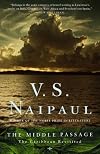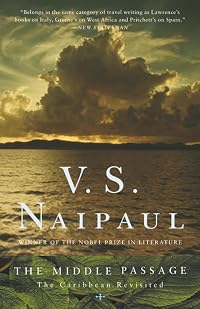
The Middle Passage: The Caribbean Revisited
by V. S. Naipaul
On This Page
Description
In 1960 the government of Trinidad invited V. S. Naipaul to revisit his native country and record his impressions. In this classic of modern travel writing he has created a deft and remarkably prescient portrait of Trinidad and four adjacent Caribbean societies–countries haunted by the legacies of slavery and colonialism and so thoroughly defined by the norms of Empire that they can scarcely believe that the Empire is ending. In The Middle Passage, Naipaul watches a Trinidadian movie show more audience greeting Humphrey Bogart’s appearance with cries of “That is man!” He ventures into a Trinidad slum so insalubrious that the locals call it the Gaza Strip. He follows a racially charged election campaign in British Guiana (now Guyana) and marvels at the Gallic pretension of Martinique society, which maintains the fiction that its roads are extensions of France’s routes nationales. And throughout he relates the ghastly episodes of the region’s colonial past and shows how they continue to inform its language, politics, and values. The result is a work of novelistic vividness and dazzling perspicacity that displays Naipaul at the peak of his powers. show lessTags
Recommendations







































Member Reviews
This wasn't the eye-popping travelogue I was expecting. Maybe it's my miss. I do recognize that the author traveled these islands a half-century ago, and in that respect, there's some history to be gleaned from some of VSN's keen eye for detail. I have become fascinated by these obscure European outposts somehow.
John Gimlette's "The Wild Coast" goes a layer deeper than Naipaul, and brings the material up to date, but to gain a comprehensive overview of British Guiana, Guyana and Suriname, and in the process, delivers a sobering assessment of the British, Dutch and French colonial experience. not a flattering look, but a transformative and comprehensive primer to the pecularities of these below-the-radar entities.
John Gimlette's "The Wild Coast" goes a layer deeper than Naipaul, and brings the material up to date, but to gain a comprehensive overview of British Guiana, Guyana and Suriname, and in the process, delivers a sobering assessment of the British, Dutch and French colonial experience. not a flattering look, but a transformative and comprehensive primer to the pecularities of these below-the-radar entities.
Very well written account of five colonial societies of the West Indies formerly ruled by England, France and Netherlands. Set in the early 60s, these milieu probably gave birth to the term melting pot with every race imaginable trying to co-exist while maintaining a semblance of peace and adhering to a strict pecking order imposed by the Colonists.
Very well written account of five colonial societies of the West Indies formerly ruled by England, France and Netherlands. Set in the early 60s, these milieu probably gave birth to the term melting pot with every race imaginable trying to co-exist while maintaining a semblance of peace and adhering to a strict pecking order imposed by the Colonists.
1.CHARACTERISATION 143-161 description of Winter, the 'American' brilliant description of a fellow traveller who remains mysterious - he describes his behaviour and actions and speech very precisely without conjecture but with a piercing sense of Winter's self-containment and aloofness and absurd unwillingness to conform like everyone else. 164 - "His mosquito net had been taken down and was doubtless in one of his polythene sacks.' The disdain and ridicule comes across quite strongly but by the end of the section they've become friends and a more sympthetic view emerges.
This detached observation is there throughout. He is faithful to his own emotional response to people and situations but this is often expressed indirectly. It makes it show more more powerful when he does give a direct opinion. Staying detached allows him to make judgements without being too fixed to any set of values or preconceptions.
180 - describes how peoples moods change. During the day - singy/chatting > contemplative. Good way of documenting change and fluctuations in people.
183 - describes Albertos as an idiot very deftly through dialogue and action - "carefully he approached a woman at a sewing machine. She took up her sewing and disappeared."
105 - "Gorinsky knew the road, and the whorls of dust from his Land-Rover seemed to express his flamboyant skill." Nice way of portraying talent and virtue by means of a consequential reaction that sheds light of the action, rather than just saying "he drove skillfully."
159 - "Lucio passed his tongue over his top lip." - shows alcoholic thirst craving for whisky.
225 - Mountains "blurred in the evening light, the folds as soft as those on an animals skin." show less
This detached observation is there throughout. He is faithful to his own emotional response to people and situations but this is often expressed indirectly. It makes it show more more powerful when he does give a direct opinion. Staying detached allows him to make judgements without being too fixed to any set of values or preconceptions.
180 - describes how peoples moods change. During the day - singy/chatting > contemplative. Good way of documenting change and fluctuations in people.
183 - describes Albertos as an idiot very deftly through dialogue and action - "carefully he approached a woman at a sewing machine. She took up her sewing and disappeared."
105 - "Gorinsky knew the road, and the whorls of dust from his Land-Rover seemed to express his flamboyant skill." Nice way of portraying talent and virtue by means of a consequential reaction that sheds light of the action, rather than just saying "he drove skillfully."
159 - "Lucio passed his tongue over his top lip." - shows alcoholic thirst craving for whisky.
225 - Mountains "blurred in the evening light, the folds as soft as those on an animals skin." show less
Ratings
Members
- Recently Added By
Published Reviews
ThingScore 100
Mr Naipaul is an 'East' Indian Trinidadian with an exquisite mastery of the English language which should put to shame his British contemporaries. He has shown in his stories - particularly in The Suffrage of Elvira - that he is free of delusion about independence and representative government for his native land. Humour and compassion are the qualities inevitably and most justly predicated of show more him.
In The Middle Passage he has attempted the direct narrative of a journey in the Caribbean such as many writers of other races and religions have attempted. His peculiar position as returning expatriate may be compared to that of Irish and Italian Americans who revisit the homes of their ancestors. There is conflict between the intimacy and sympathy of his origins and the satiric detachment of the foreign observer. It is not surprising that he is at his best when describing other places than Trinidad. show less
In The Middle Passage he has attempted the direct narrative of a journey in the Caribbean such as many writers of other races and religions have attempted. His peculiar position as returning expatriate may be compared to that of Irish and Italian Americans who revisit the homes of their ancestors. There is conflict between the intimacy and sympathy of his origins and the satiric detachment of the foreign observer. It is not surprising that he is at his best when describing other places than Trinidad. show less
added by SnootyBaronet
Lists

Books Set in the Caribbean
18 works; 5 members

AP Lit
363 works; 6 members
Author Information

97+ Works 25,784 Members
Vidiadhar Surajprasad Naipaul was born of Indian ancestry in Chaguanas, Trinidad on August 17, 1932. He was educated at University College, Oxford and lived in Great Britain since 1950. From 1954 to 1956, he edited a radio program on literature for the British Broadcasting Corporation's Caribbean Service. His first novel, The Mystic Masseur, was show more published in 1957. His other novels included A House for Mr. Biswas, A Bend in the River, Guerrillas, and Half a Life. In a Free State won the Booker Prize in 1971. He started writing nonfiction in the 1960s. His first nonfiction book, The Middle Passage, was published in 1962. His other nonfiction works included An Area of Darkness, Among the Believers, Beyond Belief, and A Turn in the South. He was knighted in 1990 and received the Nobel Prize in Literature in 2001. He died on August 11, 2018 at the age of 85. (Bowker Author Biography) show less
Awards and Honors
Notable Lists
Torchlight List (92)
Series
Belongs to Publisher Series
Penguin Books (2920)
Common Knowledge
- Canonical title
- The Middle Passage: The Caribbean Revisited
- Original publication date
- 1962
- Important places
- Jamaica; Trinidad, Trinidad and Tobago; British Guiana; Surinam; Martinique
- Epigraph
- They were valued only for the wealth which they yielded, and society there has never assumed any particularly noble aspect. There has been splendour and luxurious living, and there have been crimes and horrors, and revolts an... (show all)d massacres. There has been romance, but it has been the romance of pirates and outlaws. The natural graces of life do not show themselves under such conditions. There has been no saint in the West Indies since Las Casas, no hero unless philonegro enthusiasm can make one out of Toussaint. There are no people there in the true sense of the word, with a character and purpose of their own.
James Anthony Froude: The English in the West Indies (1887) - First words
- Foreword to this Edition
The Middle Passage was my first travel book.
THERE WAS SUCH a crowd of immigrant-type West Indians on the boat-train platform at Waterloo that I was glad I was travelling first class to the West Indies. - Quotations
- Trinidad considers itself, and is acknowledged by the other West Indian territories to be, modern. It has night clubs, restaurants, air-conditioned bars, supermarkets, soda fountains, drive-in cinemas and a drive-in bank. But... (show all) modernity in Trinidad means a little more. It means a constant alertness, a willingness to change, a readiness to accept anything which films, magazines and comic strips appear to indicate as American.
- Last words
- (Click to show. Warning: May contain spoilers.)My appearance marks me as a heathen. My expression is benign, my manner gentle; and all the way from Kingston to Nassau I received the Christian message.
Classifications
- Genres
- Travel, Nonfiction
- DDC/MDS
- 972.9052 — History & geography History of North America Mexico, Central America, West Indies, Bermuda West Indies (Antilles) and Bermuda; Caribbean West Indies (Antilles) and Bermuda; Caribbean
- LCC
- F1612 .N35 — Local History of the United States, Canada and Latin America Latin America. Spanish America West Indies
- BISAC
Statistics
- Members
- 486
- Popularity
- 62,268
- Reviews
- 4
- Rating
- (3.52)
- Languages
- Dutch, English, French, German
- Media
- Paper, Ebook
- ISBNs
- 18
- UPCs
- 1
- ASINs
- 10