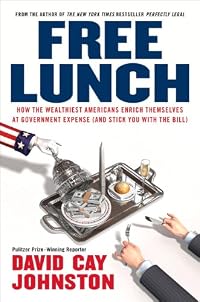
Free Lunch: How the Wealthiest Americans Enrich Themselves at Government Expense (and Stick You with the Bill)
by David Cay Johnston
On This Page
Description
How does a strong and growing economy lend itself to job uncertainty, debt, bankruptcy, and economic fear for a vast number of Americans? This book answers this great economic question, revealing how today's government policies and spending benefit the wealthy. Johnston shows how, under the guise of deregulation, a whole new set of regulations quietly went into effect--thwarting competition, depressing wages, and rewarding misconduct. Revelations include: how we ended up with the most show more expensive yet inefficient health-care system in the world; how homeowners' title insurance became a costly, deceitful, yet almost invisible oligopoly; how our government gives hidden subsidies for posh golf courses; how baseball team owners will collect more than $1.3 billion in public funds. In these instances and more, Johnston shows how the lobbyists and lawyers representing the most powerful 0.1 percent of Americans manipulated our government at the expense of the other 99.9 percent.--From publisher description. show lessTags
Recommendations
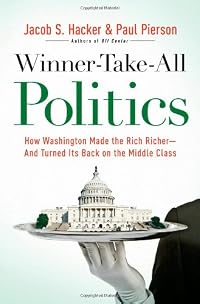
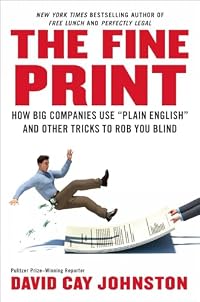
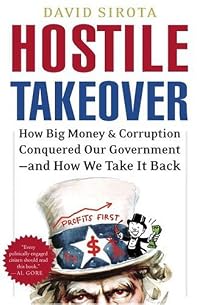
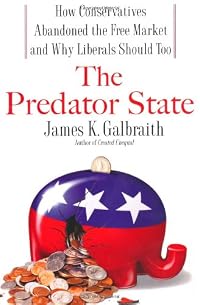


Member Recommendations
Member Reviews
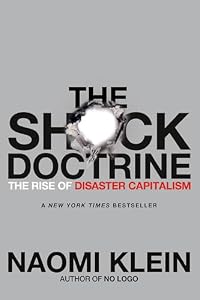
The most important book I've read since I started reviewing books on Library Thing is The Shock Doctrine, by Naomi Klein. Free Lunch may be the second most important book, and both of these are my top picks for books the next President should take to the White House (a concept stolen from the blog for the PBS show Bill Moyers' Journal).
Free Lunch is an expose by a reporter with over 30 years experience, a Pulitzer Prize-winning journalist named David Cay Johnston. He details many of the ways the government has, since 1980, given advantages to the wealthy, especially the super wealthy, at the expense of the rest of us. From the sports team investors and other businesses that get subsidies and tax breaks that destroy the ability of local show more governments to provide services, to the illegality of the government negotiating for the best drug prices, to the deregulation of electric power generation in a way that caused prices to soar while services grew worse, to the horrors of non-profit health care becoming profit-making centers, those with the power to regulate and appropriate have contributed to income inequality as great as it was before the Great Depression.
This book complements well Paul Krugman's Conscience of a Liberal, although that book was a history of the political economy of the U.S. since the Great Depression while this one is on abuses since 1980... yet they overlap in places. In particular, they both tell the same story of the health care industry. Johnston says, "Another study estimated that two-thirds of the administrative costs of for-profit insurers are spent on care denial...Americans spend nearly 6 times the average of what 13 other countries do on health care..." We spend so much on health care so that insurers can REFUSE to pay for health care for those they insure.
If you only read two books this year, my suggestion would be The Shock Doctrine and Free Lunch. show less
Free Lunch is an expose by a reporter with over 30 years experience, a Pulitzer Prize-winning journalist named David Cay Johnston. He details many of the ways the government has, since 1980, given advantages to the wealthy, especially the super wealthy, at the expense of the rest of us. From the sports team investors and other businesses that get subsidies and tax breaks that destroy the ability of local show more governments to provide services, to the illegality of the government negotiating for the best drug prices, to the deregulation of electric power generation in a way that caused prices to soar while services grew worse, to the horrors of non-profit health care becoming profit-making centers, those with the power to regulate and appropriate have contributed to income inequality as great as it was before the Great Depression.
This book complements well Paul Krugman's Conscience of a Liberal, although that book was a history of the political economy of the U.S. since the Great Depression while this one is on abuses since 1980... yet they overlap in places. In particular, they both tell the same story of the health care industry. Johnston says, "Another study estimated that two-thirds of the administrative costs of for-profit insurers are spent on care denial...Americans spend nearly 6 times the average of what 13 other countries do on health care..." We spend so much on health care so that insurers can REFUSE to pay for health care for those they insure.
If you only read two books this year, my suggestion would be The Shock Doctrine and Free Lunch. show less
Johnston packs a lot of eye-opening data into this book, taking on major league sports, eminent domain abuse, health care, the laws touted to taxpayers as “deregulation”, and more. He calls upon both Adam Smith and the Bible to damn both Democrats and Republicans that have forsaken their duty to the people. There are many surprises— for instance, I had no idea that baseball was exempt from antitrust law and that big-league sports were not, overall, profitable without subsidies and tax breaks.
I had thought that I had accumulated enough cynicism in the past 8 years that I was pretty much tapped out on moral outrage, but this book managed to blow oxygen on the few embers I have left. This book makes it abundantly clear that for all show more the talk in Washington of the glories of the free market, we have nothing resembling one here in the United States. show less
I had thought that I had accumulated enough cynicism in the past 8 years that I was pretty much tapped out on moral outrage, but this book managed to blow oxygen on the few embers I have left. This book makes it abundantly clear that for all show more the talk in Washington of the glories of the free market, we have nothing resembling one here in the United States. show less
I need some heavy doses of liver-destroying acetaminophen after reading this. This is a sampling of how the rabble that makes up the lower 90% of our population gets screwed over by big corporations and ultra-rich peeps who have, mainly during the last three decades, figured out the mechanisms to put tax dollars to work for their bank accounts. I was familiar with such aspects as subsidies to big box stores and professional sports franchises and the legalized gambling know as hedge funds. But by no means did I anticipate the sheer magnitude and obscene figures and stats attached such issues – and I’m a pretty cynical bastard at that! Additionally the stories regarding HMOs, deregulation of electrical utilities, and the home security show more companies tend to raise one’s neck hair. I fortunately shaved mine off before reading this, but to be quite frank – this is some fucked-up stuff!
This is quite the page-turner. As the author is a journalist, there’s some of the expected sensationalism and there’s a certain journalistic paucity of supporting notes. Nonetheless, the various figures are apparently documented and where some guesswork is involved, the author makes this clear. It’s all pretty disturbing.
I suppose I’ll no longer respond with a baffled smirk when a friend threatens to move to Canada, believing, as we’re programmed to do, that Canada is not really in the same league as the US. After reading this – as well as some others – I’ll now offer a high five, Montreal restaurant recommendations, and an synopsis of mid-century Toronto architecture as studies and stories revolving around income disparity, health care systems, and various definitions of “opportunity“ show that, indeed Canada is not in our league… Mexico and Russia are. show less
This is quite the page-turner. As the author is a journalist, there’s some of the expected sensationalism and there’s a certain journalistic paucity of supporting notes. Nonetheless, the various figures are apparently documented and where some guesswork is involved, the author makes this clear. It’s all pretty disturbing.
I suppose I’ll no longer respond with a baffled smirk when a friend threatens to move to Canada, believing, as we’re programmed to do, that Canada is not really in the same league as the US. After reading this – as well as some others – I’ll now offer a high five, Montreal restaurant recommendations, and an synopsis of mid-century Toronto architecture as studies and stories revolving around income disparity, health care systems, and various definitions of “opportunity“ show that, indeed Canada is not in our league… Mexico and Russia are. show less
I listened to this audiobook that details the cushy relationship between corporations and politicians that has allowed the rich to become exorbitantly rich at the taxpayer's expense. The book is mostly anectdotes of corporate socialism in action:
This quote from Kel Munger of the Sacramento News & Review sums it up best:
It's a frustrating book, all the more so since in a sense it doesn't reveal any big secrets. Government handouts and legislation in favor of corporations at the expense of the citizens is a well-known fact of modern America that people either feel hopeless at changing or chose to be willfully ignorant (kind of like a Stockholm Syndrome to our corporate captors). I'm not sure if Johnston's chapter on solutions is much help. Among other things he proposed the taxpayer fully subsidizing Congressional representatives to keep them from accepting money from corporate lobbyists. Still, knowledge is power. show less
- A railroad crash that kills passengers is due to negligence of the company that owns the tracks, CSX, yet the corporation has been able to get legal protection from the government if the train damaged belongs to Amtrak and thus the government pays the legal fees.
- The geniuses at Enron convince the governments of several states to lift regulations and allow the free market to bring about more energy at lower prices. Yet neither happens as prices rise and rolling blackouts darken California. Even
- after the accounting scandals bring Enron execs to court they never pay back the money stolen from the public purse and official documents are struck from the public record.
- Cabela's sporting goods store wrangles money from local governments to build superstores with "museums" and ask to pay no taxes and in return put local stores out of business and destroy the local tax base.
- Sports' franchises - with antitrust exemptions that prevent them from needing to compete in the free market - hold cities for ransom and pay for construction of stadiums with public money. Most interesting is the story of the owner of the Texas Rangers who acquired the team, had a new stadium built on a tax increase, and sold the team for a tidy profit without ever investing a cent of his own money. That owner was the man who supported nothing but tax cuts and free markets as president, George W. Bush.
This quote from Kel Munger of the Sacramento News & Review sums it up best:
If taxpayers were only taxed for public services, we'd all be a lot better off. Instead, we're taxed to support business propositions that could never make it in a truly free market economy. The people sucking wage-earners dry are not welfare mothers, illegal immigrants, the disabled, elderly, sick or needy. That giant sucking sound that comes from wage-earners' wallets is made by rich folks with pumps at the end of their straws.
It's a frustrating book, all the more so since in a sense it doesn't reveal any big secrets. Government handouts and legislation in favor of corporations at the expense of the citizens is a well-known fact of modern America that people either feel hopeless at changing or chose to be willfully ignorant (kind of like a Stockholm Syndrome to our corporate captors). I'm not sure if Johnston's chapter on solutions is much help. Among other things he proposed the taxpayer fully subsidizing Congressional representatives to keep them from accepting money from corporate lobbyists. Still, knowledge is power. show less
I think pretty much everyone believes that rich people use power and influence to become richer (at the expense of poorer people, generally). However, I do not think most of us think about this issue very often. It's not until you read a book like this that the real travesty hits home and you realize how bad the issue really is.
It's not about successful people becoming more successful (I don't have a problem with that). It's about successful people taking advantage of taxpaying citizens and our government allowing them to do it for the most part.
Reading a book like this strongly reinforces the need to elect representatives who will fight this kind of injustice and insure that everyone is treated equally under the law.
It's not about successful people becoming more successful (I don't have a problem with that). It's about successful people taking advantage of taxpaying citizens and our government allowing them to do it for the most part.
Reading a book like this strongly reinforces the need to elect representatives who will fight this kind of injustice and insure that everyone is treated equally under the law.
All of us should read David Cay Johnston’s new book before we vote. Not nearly enough of us will.
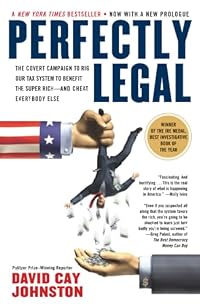
Perfectly Legal: The Covert Campaign to Rig Our Tax System to Benefit the Super Rich—and Cheat Everybody Else, Johnston’s last book, based on his tax reporting for The New York Times, explained how the U.S. tax system is skewed in favor of the wealthy at the expense of the wage-earner. Now, Free Lunch, full of clear narrative, plain language and plenty of sources, addresses the use of subsidies, tax abatements and incentives to transfer money from the taxpayers to private individuals and businesses.
(full review at Sacramento News & Review, 1-31-08: http://www.newsreview.com/sacramento/Content?oid=617588)
Perfectly Legal: The Covert Campaign to Rig Our Tax System to Benefit the Super Rich—and Cheat Everybody Else, Johnston’s last book, based on his tax reporting for The New York Times, explained how the U.S. tax system is skewed in favor of the wealthy at the expense of the wage-earner. Now, Free Lunch, full of clear narrative, plain language and plenty of sources, addresses the use of subsidies, tax abatements and incentives to transfer money from the taxpayers to private individuals and businesses.
(full review at Sacramento News & Review, 1-31-08: http://www.newsreview.com/sacramento/Content?oid=617588)
I think one of the best quotes I read was "America wasn't created so people could get rich". A worthwhile read, no matter which side of the aisle you're on.
Members
- Recently Added By
Author Information

7 Works 1,624 Members
David Cay Johnston was born in San Francisco, California on December 24, 1948. He received his education at San Francisco State University, Michigan State University and the University of Chicago. He is a columnist for The Daily Beast, Investopedia, USA Today, NationalMemo.com, Tax Analysts and the Rochester Democrat & Chronicle. Johnston is also show more Distinguished Visiting Lecturer, Syracuse University College of Law and Whitman School of Management - The property, tax and regulatory law of the ancient world. David is the Past President, Investigative Reporters & Editors (IRE) and Board President, InvestigativePost.com Buffalo, NY. David Cay Johnston is the author of New York Times bestseller The Making of Donald Trump. His other titles include It's Even Worse Than You Think: What the Trump Administration Is Doing to America (2018); The Fine Print: How Big Companies Use "Plain English" to Rob You Blind (2012); Free Lunch: How the Wealthiest Americans Enrich Themselves at Government Expense (and Stick You With the Bill), a 2008 New York Times and Wall Street Journal best seller; Perfectly Legal: The Covert Campaign to Rig Our Tax System to Benefit the Super Rich -- and Cheat Everybody Else which was the 2004 Investigative Book of the Year award winner and a New York Times and Wall Street Journal best seller; Temples of Chance: How America Inc. Bought Out Murder Inc. To Win Control of the Casino Business (1992). David Cay Johnston is the Recipient of the Pulitzer Prize, an IRE Medal and the George Polk Award. (Bowker Author Biography) show less
Awards and Honors
Distinctions
Classifications
- Genres
- Economics, Politics and Government, Nonfiction, General Nonfiction, Business
- DDC/MDS
- 338.97302 — Social sciences Economics Production Economic Development And Growth North America United States
- LCC
- HC110 .S9 .J64 — Social sciences Economic history and conditions Economic history and conditions By region or country
- BISAC
Statistics
- Members
- 471
- Popularity
- 64,366
- Reviews
- 11
- Rating
- (3.98)
- Languages
- English, Korean
- Media
- Paper, Audiobook, Ebook
- ISBNs
- 9
- ASINs
- 5