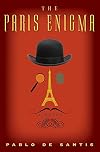
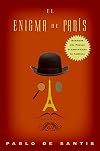
The Paris Enigma
by Pablo De Santis
On This Page
Description
In the tradition of Caleb Carr's The Alienist and Eric Larsen's The Devil in the White City comes The Paris Enigma, a gripping tale of murder and the art of crime solving. Written in a strikingly original voice, and poignantly evoking a world about to lose its innocence forever, The Paris Enigma features two detectives who find themselves in a race against time around glorious fin de siècle Paris, encountering all manner of secret societies and solving philosophical puzzles, while also show more trying to save a dangerously beautiful woman. show lessTags
Recommendations


























Member Reviews
I'll begin by saying that this book was beautifully and imaginatively written---the language is just lovely and so creative. For example:
pg. 134: "Although there were no books in Grialet's house, the house itself was a book. The building, I found out later, had belonged to an editor named Fussel, who had the door and windows built to look like book covers. The spiral staircases crossed through the building like arabesques, unexpected rooms appeared here and there like footnotes, the hallways extended like careless margin notes."
The imagery alone is a good enough reason to read this book.
As for the story, it was predictable---but good. The back cover sensationalizes to make it sound like a riveting, fast-paced thriller when it is, show more instead, a meandering stream of a "mystery". It's really a combination of lots of little stories that come together in the end for a gentle but satisfying conclusion.
Don't be led on by the marketing attempts at making this out to be all about the World's Fair or the building of the Eiffel Tower. These events are mentioned as the backdrop of the story...but that's about it. There is VERY little history of either event and any time they come up it's mainly in relation to how many days until the Fair, etc.
I don't regret reading this, but it definitely took longer than I expected to finish it as I wasn't really engaged in the story line. It didn't really get super interesting or "mysterious" until the last 40 pages or so. show less
pg. 134: "Although there were no books in Grialet's house, the house itself was a book. The building, I found out later, had belonged to an editor named Fussel, who had the door and windows built to look like book covers. The spiral staircases crossed through the building like arabesques, unexpected rooms appeared here and there like footnotes, the hallways extended like careless margin notes."
The imagery alone is a good enough reason to read this book.
As for the story, it was predictable---but good. The back cover sensationalizes to make it sound like a riveting, fast-paced thriller when it is, show more instead, a meandering stream of a "mystery". It's really a combination of lots of little stories that come together in the end for a gentle but satisfying conclusion.
Don't be led on by the marketing attempts at making this out to be all about the World's Fair or the building of the Eiffel Tower. These events are mentioned as the backdrop of the story...but that's about it. There is VERY little history of either event and any time they come up it's mainly in relation to how many days until the Fair, etc.
I don't regret reading this, but it definitely took longer than I expected to finish it as I wasn't really engaged in the story line. It didn't really get super interesting or "mysterious" until the last 40 pages or so. show less
Recipient of the first Premio Planeta - Casa de America de Narrativa prize for best Latin American novel, "The Paris Enigma," composed by the clever and experienced hand of Pablo de Santis, generates little forward momentum but opts instead for a latent upward spiral, giving the impression of a slinky at rest.
de Santis rolls out a large cast of interesting and eccentric characters connected by murky, sometimes bizarre, relationships which play out in a Paris bustling toward the opening of the Grand Exposition of 1889. A conclave of international super-sleuths assembles there to decipher the eponymous Enigma, but neither they nor their acolytes can agree on what it might actually be. A period of hithering, thithering, and dithering show more ensues until, happily, one of their number falls, or is pushed, from a fatal elevation on the Eiffel Tower. That lilting fall becomes an enigmatic bone upon which the remaining Bloodhounds can all agree to gnaw.
The author has set up a stage here upon which mysteries with more snap and thrust might spin out in the future. If one do, I'll read it. show less
de Santis rolls out a large cast of interesting and eccentric characters connected by murky, sometimes bizarre, relationships which play out in a Paris bustling toward the opening of the Grand Exposition of 1889. A conclave of international super-sleuths assembles there to decipher the eponymous Enigma, but neither they nor their acolytes can agree on what it might actually be. A period of hithering, thithering, and dithering show more ensues until, happily, one of their number falls, or is pushed, from a fatal elevation on the Eiffel Tower. That lilting fall becomes an enigmatic bone upon which the remaining Bloodhounds can all agree to gnaw.
The author has set up a stage here upon which mysteries with more snap and thrust might spin out in the future. If one do, I'll read it. show less
The Twelve Detectives – a society of the world’s top sleuths – are meeting at the 1889 Paris World’s Fair. But before the fair opens, a series of murder require their collective expertise.
De Santis studied literature and worked as a journalist and comic-book writer. This latter endeavor is clearly represented in his debut novel. The plot is thinly drawn, but the characters are as vivid (if two-dimensional) as the best Dick Tracy or Batman villains. All we’re missing are the drawings and a few KABOW!s …
It was mildly entertaining, but he spent way too much time setting up the story. There were too many characters, many of whom had no discernible role. The plot did not flow in a way that built suspense; in fact I lost show more interest half way through, put it aside and nearly didn’t finish at all. show less
De Santis studied literature and worked as a journalist and comic-book writer. This latter endeavor is clearly represented in his debut novel. The plot is thinly drawn, but the characters are as vivid (if two-dimensional) as the best Dick Tracy or Batman villains. All we’re missing are the drawings and a few KABOW!s …
It was mildly entertaining, but he spent way too much time setting up the story. There were too many characters, many of whom had no discernible role. The plot did not flow in a way that built suspense; in fact I lost show more interest half way through, put it aside and nearly didn’t finish at all. show less
The Twelve Detectives are a famous group of crime solving individuals - spread throughout the world. In the 1880's their exploits are well known - the magazine The Key to Crime regularly publishes the story of their investigations. Sigmundo Salvatrio works in his father's shoe repair shop, but he doesn't dream of being a cobbler - his dream is to join the ranks of the acolytes of the world famous investigators. It seems a pipe dream as Renato Craig, the only one of the detectives who lives in Buenos Aires has always opposed recruitment of his own acolyte. Sigmundo is therefore astounded when Craig advertises for a group of young people to become his students - to learn all he knows about investigation techniques. He promptly applies and show more becomes one of Craig's enthusiastic students.
Eventually Sigmundo finds himself at the 1889 Paris World Fair a year later, as Craig's representative. Events since the formation of the school have meant that Craig is unable to attend one of the few gatherings of the entire group of Twelve Detectives. But the pleasure (and trepidation) that Sigmundo feels at having this honour bestowed on him is soon lessened when another of the great Detectives - Louis Dabon - is found at the base of the Eiffel Tower. Craig pairs up with the other Paris based member of the Twelve, the Polish Viktor Arzaky, to search for the truth.
THE PARIS ENIGMA is translated from its original Spanish, set in the late 1880's. This combination could provide some explanation for the stylings used, as well as the general pace of the entire story, but it doesn't quite cover why the book seems to wander around a lot. The blurb does seem to indicate that this should be a story about the group The Twelve Detectives, but it is told totally from Sigmundo's point of view, and thus is mostly him, his reactions to the events surrounding him, and his understanding of the investigation into Dabon's death. Whilst he does collaborate to a certain extent with Arzaky - really all the other members of the Detectives - and their acolytes - are bit players at most.
The book also seems to lack a feeling of place - the setting in 1889 World Fair Paris seems to be glossed over - there is some discussion of the Eiffel Tower, in terms of its location for the murder of Dabon, and there are passing references to hotels and furnishings, but really the book could have taken place in any location. The timeframe is interesting because it does provide an opportunity for the investigation elements to be stripped down to the bare essentials - this is obviously a tale that hails from before modern investigative techniques, communications options and procedures. It is probably that sense of time that is best served by the style of story-telling and language that is used.
THE PARIS ENIGMA is not an unpleasant or difficult book to read - it is quite entertaining in some places. The Twelve Detectives hold the cerebral nature of their technique in high regard. They are fond of story-telling, and throughout the book there are sprinklings of tales of many of their famous cases. There are sprinklings of extraneous little puzzles, there's a bit of romance and intrigue, and then there is the reason for their presence at the World Fair - their own exhibition. But most of this is skimmed over, or seems somewhat "stuck" into the middle of the narrative frequently, it seemed, because of the attractiveness of the small vignette. At one point I felt compelled to do a little online research to try to work out if the book had originally been a series of short stories that had been interconnected with a narrative.
Amusing, but definitely not deep, THE PARIS ENIGMA is probably not the book for people who like a beginning, a middle, an end and a firm sense of purpose. If you're looking for a wander around in an 1880's style labyrinth with very little reason for being, it could very well appeal. show less
Eventually Sigmundo finds himself at the 1889 Paris World Fair a year later, as Craig's representative. Events since the formation of the school have meant that Craig is unable to attend one of the few gatherings of the entire group of Twelve Detectives. But the pleasure (and trepidation) that Sigmundo feels at having this honour bestowed on him is soon lessened when another of the great Detectives - Louis Dabon - is found at the base of the Eiffel Tower. Craig pairs up with the other Paris based member of the Twelve, the Polish Viktor Arzaky, to search for the truth.
THE PARIS ENIGMA is translated from its original Spanish, set in the late 1880's. This combination could provide some explanation for the stylings used, as well as the general pace of the entire story, but it doesn't quite cover why the book seems to wander around a lot. The blurb does seem to indicate that this should be a story about the group The Twelve Detectives, but it is told totally from Sigmundo's point of view, and thus is mostly him, his reactions to the events surrounding him, and his understanding of the investigation into Dabon's death. Whilst he does collaborate to a certain extent with Arzaky - really all the other members of the Detectives - and their acolytes - are bit players at most.
The book also seems to lack a feeling of place - the setting in 1889 World Fair Paris seems to be glossed over - there is some discussion of the Eiffel Tower, in terms of its location for the murder of Dabon, and there are passing references to hotels and furnishings, but really the book could have taken place in any location. The timeframe is interesting because it does provide an opportunity for the investigation elements to be stripped down to the bare essentials - this is obviously a tale that hails from before modern investigative techniques, communications options and procedures. It is probably that sense of time that is best served by the style of story-telling and language that is used.
THE PARIS ENIGMA is not an unpleasant or difficult book to read - it is quite entertaining in some places. The Twelve Detectives hold the cerebral nature of their technique in high regard. They are fond of story-telling, and throughout the book there are sprinklings of tales of many of their famous cases. There are sprinklings of extraneous little puzzles, there's a bit of romance and intrigue, and then there is the reason for their presence at the World Fair - their own exhibition. But most of this is skimmed over, or seems somewhat "stuck" into the middle of the narrative frequently, it seemed, because of the attractiveness of the small vignette. At one point I felt compelled to do a little online research to try to work out if the book had originally been a series of short stories that had been interconnected with a narrative.
Amusing, but definitely not deep, THE PARIS ENIGMA is probably not the book for people who like a beginning, a middle, an end and a firm sense of purpose. If you're looking for a wander around in an 1880's style labyrinth with very little reason for being, it could very well appeal. show less
This is a fun novel, looking at crimes and solving them as the detective would. The book is divided into thirds. The first third, introduces us to the narrator of the book, and introduces him to the world of detectives and assistants. He studies under one of the famous twelve - a group of crime solvers from around the world. The book takes place in the 1890's where solving crime was very different than today.
The next third, takes us to the crime and immerses our young apprentice in how a detective thinks and the sacred role of the acolyte. The last third, of course, solves the crime and resolves the lives of those involved.
I found the book to be very interesting, an inside view of how there are different ways that detectives can solve a show more crime. The narrator grows throughout the book, from a star struck fan of the detectives, to himself a true crime solver. He listens, to learn something from each of the twelve. All this interesting theory was an added bonus to the wonderful mystery the story had to solve.
This is a book of, mystery, jealousy, love, regret and a good read. show less
The next third, takes us to the crime and immerses our young apprentice in how a detective thinks and the sacred role of the acolyte. The last third, of course, solves the crime and resolves the lives of those involved.
I found the book to be very interesting, an inside view of how there are different ways that detectives can solve a show more crime. The narrator grows throughout the book, from a star struck fan of the detectives, to himself a true crime solver. He listens, to learn something from each of the twelve. All this interesting theory was an added bonus to the wonderful mystery the story had to solve.
This is a book of, mystery, jealousy, love, regret and a good read. show less
This is an excellent mystery. The premise is 12 detectives from around the world come to Paris for the World's Fair and the Eiffel Tower is near completion. One of the detectives (a French man) is murdered and an apprentice of one of the 12 (from Argentina) is involved in the solving of the crime. He is also the narrator of the stories. A good, fast read. 4 stars out of 5. Paul Floyd Mpls, MN
could be spoilers. Sweet book. Kind of cutesy with clever asides but he makes it work, mostly. The mystery part isn't very compelling.
Members
- Recently Added By
Author Information

53+ Works 920 Members
Awards and Honors
Common Knowledge
- Canonical title
- The Paris Enigma
- Original title
- El enigma de Paris
- Important places
- Paris, France
- Important events
- Paris World's Fair (1889)
- Dedication
- For Ivana
- First words
- My name is Sigmundo Salvatorio.
- Last words
- (Click to show. Warning: May contain spoilers.)The footsteps of Senora Craig, pacing in her insomnia, echo above my head.
Classifications
- Genres
- Fiction and Literature, Mystery, Historical Fiction
- DDC/MDS
- 863.64 — Literature & rhetoric Spanish Literature Spanish fiction 20th Century 1945-2000
- LCC
- PQ7798.29 .A616 .E6513 — Language and Literature French, Italian, Spanish and Portuguese literatures Spanish literature Provincial, local, colonial, etc. Spanish America
- BISAC
Statistics
- Members
- 323
- Popularity
- 97,823
- Reviews
- 16
- Rating
- (3.16)
- Languages
- 9 — Danish, Dutch, English, French, German, Hungarian, Italian, Portuguese, Spanish
- Media
- Paper, Audiobook, Ebook
- ISBNs
- 28
- ASINs
- 4