On This Page
Description
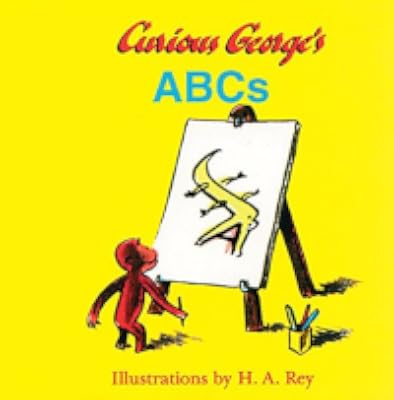
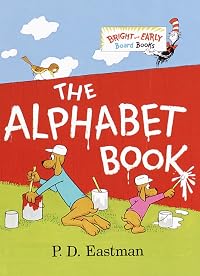
Each letter of the alphabet is used to create an illustration of something that begins with that letter.Tags
Recommendations


Member Reviews
I think I am going to weed this book from Tristan's collection, given that it portrays firefighters and mail carriers as male professions ("F is a Fireman Fighting a Fire," "M is the Mailman who brings the Mail"). (I had entertained the idea of crossing out Fireman and writing in Firefighter with a sharpie, but I just couldn't bring myself to deface a book like that, no matter the stereotypes contained within.) Some may argue that this specific stereotype would be more harmful to girls than to boys, but I think it's just as harmful for boys to grow up thinking that some professions belong only to them. Also, this board book is apparently a revised version of the 1960's edition, so it's odd that even back in the 1990's when this was show more published, they wouldn't change the text to reflect the times.
Getting rid of this book, however, makes me think of two questions:
1. Am I going to censure everything objectionable that comes our way when Tristan is growing up? Probably not, as this is neither feasable nor does it provide good opportunities for conversation and growth. Also, it goes against my instincts as a librarian. I can at most hope to control the types of things he encounters at a young age in his own home. Also, it would make me a hypocrite: many of the books and movies I love deeply have some objectionable content. Peter Pan has a stereotypical portrayal of Native Americans, and The Sound of Music's song "Sixteen Going On Seventeen" is pretty sexist. Will I keep these things from him because of their content? I don't know, but probably not. Instead, we will watch them together and then talk about the objectionable content, accounting for the views of the time period. What makes Curious George's ABCs different? Perhaps because he is too young to have a conversation with, and I don't want one of his first experiences with books to portray a stereotype.
2. If I find content in this book objectionable, should I donate it? Chances are that a lot of people, maybe even most people, would find the use of Firemen and Mailmen in this book pretty benign. And they might be right. I can certainly think of a few worse things to include in a picture book. And otherwise this is a pretty nice alphabet book with good illustrations, and who doesn't love Curious George? On the other hand, if I find it objectionable enough not to keep it in our own library, why would I want to help spread this particular stereotype further? It will fall into the hands of some other little boy or girl who might subconsciously absorb the message that only men can have these professions. But I can't bring myself to throw away an otherwise perfectly good book, and if I did end up throwing it away, then I'm one step closer to the world of Fahrenheit 451.
I am probably overthinking this, and I'm not sure why I thought it was a good idea to spend precious minutes of Tristan's naptime writing this review. But I am delirious with lack of sleep; in fact, I'm not entirely sure that what I'm writing here isn't complete gibberish that only makes sense to my addled brain. But I have been reading a lot of books about gender stereotypes in children lately and I believe that it's never too early to start combating those stereotypes. show less
Getting rid of this book, however, makes me think of two questions:
1. Am I going to censure everything objectionable that comes our way when Tristan is growing up? Probably not, as this is neither feasable nor does it provide good opportunities for conversation and growth. Also, it goes against my instincts as a librarian. I can at most hope to control the types of things he encounters at a young age in his own home. Also, it would make me a hypocrite: many of the books and movies I love deeply have some objectionable content. Peter Pan has a stereotypical portrayal of Native Americans, and The Sound of Music's song "Sixteen Going On Seventeen" is pretty sexist. Will I keep these things from him because of their content? I don't know, but probably not. Instead, we will watch them together and then talk about the objectionable content, accounting for the views of the time period. What makes Curious George's ABCs different? Perhaps because he is too young to have a conversation with, and I don't want one of his first experiences with books to portray a stereotype.
2. If I find content in this book objectionable, should I donate it? Chances are that a lot of people, maybe even most people, would find the use of Firemen and Mailmen in this book pretty benign. And they might be right. I can certainly think of a few worse things to include in a picture book. And otherwise this is a pretty nice alphabet book with good illustrations, and who doesn't love Curious George? On the other hand, if I find it objectionable enough not to keep it in our own library, why would I want to help spread this particular stereotype further? It will fall into the hands of some other little boy or girl who might subconsciously absorb the message that only men can have these professions. But I can't bring myself to throw away an otherwise perfectly good book, and if I did end up throwing it away, then I'm one step closer to the world of Fahrenheit 451.
I am probably overthinking this, and I'm not sure why I thought it was a good idea to spend precious minutes of Tristan's naptime writing this review. But I am delirious with lack of sleep; in fact, I'm not entirely sure that what I'm writing here isn't complete gibberish that only makes sense to my addled brain. But I have been reading a lot of books about gender stereotypes in children lately and I believe that it's never too early to start combating those stereotypes. show less
This book is appropriate for Pre-K and Kindergarten children. The main character Curious George travels through the alphabet sighing each letter and giving it an example. The author capitalizes the letter being referred to. This book could be used to help students with there ABC's as well as basic reading skills
Goes over the alphabet using alliteration and a representation of each letter.
1 book
1 book
Sophia likes this book a lot
Ratings
Members
- Recently Added By
Lists

Best Alphabet Books
47 works; 3 members
Author Information

295+ Works 70,322 Members
Hans Augusto Rey was born on September 16, 1898 in Hamburg, Germany. He escaped to Paris with his wife after the Nazi's invaded. While in Paris, Hans's animal drawings came to the attention of French publisher, who commissioned him to write a children's book. The result, Rafi and the Nine Monkeys, is little remembered today, but one of its show more characters, an adorably impish monkey named Curious George, was such a success that the couple considered writing a book just about him. Their work was interrupted with the outbreak of World War II. As Jews, the Reys decided to flee Paris before the Nazis seized the city. Hans built two bicycles, and they fled Paris just a few hours before it fell. Among the meager possessions they brought with them was the illustrated manuscript of Curious George. The books were published by Houghton Mifflin in 1941. Curious George was an instant success, and the Reys were commissioned to write more adventures of the mischievous monkey and his friend, the Man in the Yellow Hat. They wrote seven stories in all. Their title Happy Halloween made The New York Times Best Seller List in 2013. At first, Margret's name was left off the cover because there was a glut of women already writing children's fiction. In later editions, this was corrected, and Margret now receives full credit for her role in developing the stories. H. A. Rey died in 1977 and in 1989 Margaret Rey established the Curious George Foundation to help creative children and prevent cruelty to animals. (Bowker Author Biography) show less
Series

Work Relationships
Is contained in
Common Knowledge
- Original title
- Curious George's ABCs
Classifications
Statistics
- Members
- 587
- Popularity
- 50,168
- Reviews
- 4
- Rating
- (3.69)
- Languages
- English
- Media
- Paper, Ebook
- ISBNs
- 9
- UPCs
- 2
- ASINs
- 5