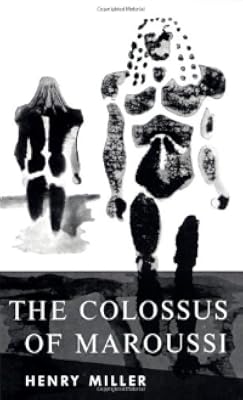
The Colossus of Maroussi
by Henry Miller
On This Page
Description
Like the ancient colossus that stood over the harbor of Rhodes, Henry Miller'sThe Colossus of Maroussi stands as a seminal classic in travel literature. It has preceded the footsteps of prominent travel writers such as Pico Iyer and Rolf Potts. The book Miller would later cite as his favorite began with a young woman's seductive description of Greece. Miller headed out with his friend Lawrence Durrell to explore the Grecian countryside: a flock of sheep nearly tramples the two as they lie show more naked on a beach; the Greek poet Katsmbalis, the "colossus" of Miller's book, stirs every rooster within earshot of the Acropolis with his own loud crowing; cold hard-boiled eggs are warmed in a village's single stove, and they stay in hotels that "have seen better days, but which have an aroma of the past." show lessTags
Recommendations


































Member Reviews
Miller was a writer that was very interesting to me as a young man. That make sense, because he’s one of those writers that is best encountered in late adolescence or early adulthood. He’s crass, immature, and sophomoric - yet strangely, his most famous books were all written when he was already well over 30 years old. This particular book finds him a little bit more down to earth than what I remember about his Paris books from the 20s, then again he was just about 50 years old when it was published.
I will say, Miller’s off the cuff, free-wheeling style was light years ahead of its time, so much so that you sometimes have to remind yourself that the events of this book took place at the outset of WWII and written by an author who show more was born in the 1800s. The character that Miller plays in his writing, the kind of acerbic, sneering self-styled “idiot” who clearly thinks he’s smarter than everyone around him, who boasts of his willful ignorance towards the canonical style/literature that your usual early 20th century writer would be immersed in, this type of guy seems like he is way more common in 2023 than it was back then. In that way, Miller frog hopped over even the Beats, who apparently loved him and were most 30 or 40 years his junior.
For better or worse, it’s always his “ecstatic” moments that stick out for me when I read Miller. He usually starts a scene in the most earthy of realms (he writes about shitting his pants in this book) and almost before you know it, he’s unaccountably rocketed off in the stratosphere, lost in the most abstract, incoherent ramblings about god knows what. It seems to me that his goal is to poke about until he finds someway to launch into this realm - but these parts of his books have always been the most awkward and forced in my opinion. He seems to have a brain jumbled with a hodgepodge of avant-garde critiques of modern man and the modern world that can hardly be said to coalesce, and they read like the confused ramblings of a schizo. One of the worst passages I’ve read in a book in a long time happens like this in Colossus of Marousi, when Miller, for some strange and inexplicable reason decides to launch off into a way too long paean to the popular jazz musicians of that time, written in a kind of literary black face. Definitely could have left that out.
Despite these memorable passages of “transcendance”, Miller is an extremely negative writer, quick to sharply criticize everyone and everything about him that rubs him the wrong way. Now it’s no rare thing that a famous writer is given to a bit of pessimism every now and then; in fact it’s more often the case than not. But something about the way Miller unleashes his disdain just feels catty and mean and worst of all, sort of inarticulate. I sense no real love for other people in him, which is no crime, but he seems to take a perverse pride in this enmity for his fellow man.
All that said, he’s a cool hang when he’s in a good and funny mood. The parts of this book that are pure travelogue are worth admission alone. Good travel writing recounts not only the physical peregrinations of the author but the mental as well. Miller is acutely aware of the fact that he is not only traversing the Greek landscape, he’s also wandering across the Greece he holds in his mind. show less
I will say, Miller’s off the cuff, free-wheeling style was light years ahead of its time, so much so that you sometimes have to remind yourself that the events of this book took place at the outset of WWII and written by an author who show more was born in the 1800s. The character that Miller plays in his writing, the kind of acerbic, sneering self-styled “idiot” who clearly thinks he’s smarter than everyone around him, who boasts of his willful ignorance towards the canonical style/literature that your usual early 20th century writer would be immersed in, this type of guy seems like he is way more common in 2023 than it was back then. In that way, Miller frog hopped over even the Beats, who apparently loved him and were most 30 or 40 years his junior.
For better or worse, it’s always his “ecstatic” moments that stick out for me when I read Miller. He usually starts a scene in the most earthy of realms (he writes about shitting his pants in this book) and almost before you know it, he’s unaccountably rocketed off in the stratosphere, lost in the most abstract, incoherent ramblings about god knows what. It seems to me that his goal is to poke about until he finds someway to launch into this realm - but these parts of his books have always been the most awkward and forced in my opinion. He seems to have a brain jumbled with a hodgepodge of avant-garde critiques of modern man and the modern world that can hardly be said to coalesce, and they read like the confused ramblings of a schizo. One of the worst passages I’ve read in a book in a long time happens like this in Colossus of Marousi, when Miller, for some strange and inexplicable reason decides to launch off into a way too long paean to the popular jazz musicians of that time, written in a kind of literary black face. Definitely could have left that out.
Despite these memorable passages of “transcendance”, Miller is an extremely negative writer, quick to sharply criticize everyone and everything about him that rubs him the wrong way. Now it’s no rare thing that a famous writer is given to a bit of pessimism every now and then; in fact it’s more often the case than not. But something about the way Miller unleashes his disdain just feels catty and mean and worst of all, sort of inarticulate. I sense no real love for other people in him, which is no crime, but he seems to take a perverse pride in this enmity for his fellow man.
All that said, he’s a cool hang when he’s in a good and funny mood. The parts of this book that are pure travelogue are worth admission alone. Good travel writing recounts not only the physical peregrinations of the author but the mental as well. Miller is acutely aware of the fact that he is not only traversing the Greek landscape, he’s also wandering across the Greece he holds in his mind. show less
Every time I pick up a Henry Miller book through-out my life it is like meeting up with an old buddy for a long stroll and a gabber. One of the few authors I know well enough to be able to have an internal dialogue with as I’m reading. Just like a conversation over time The Colossus of Maroussi is alive with contradictions and Miller’s flare for embellishing each moment, his literary company is indeed after a few minutes like being “embarked on an endless voyage comparable in feeling and trajectory only to the dream which the practiced dreamer slips into like a bone into its socket”. In this book we discover Miller escaping the impending second world war by taking a holiday in Greece. Miller writes that it is his first real show more vacation in twenty years and that on it he would not do a stroke of work, yet The Colossus of Maroussi was born from that workless period. Miller absorbs everything and so a workless time for him is purely intention and not action. The vacation also allowed Miller some time with his fellow writing pal Lawrence Durrell author of many books, “The Black Book” being the one of greatest interest to me.
So Miller explores Greece, the people and the ancient municipalities and landscape. He is thinking of the Greek people all the time, and of civilisation itself. This being the core of the work, but it is also a reflective piece on humankind and the nature of industrialisation and war. Some wonderful Miller observations like “We have but to melt, to dissolve, to swim in the solution. We are soluble fish and the world is an aquarium” and “It’s good to be just plain happy; it’s a little better to know that you’re happy; but to understand that you’re happy and to know why and how, in what way, because of concatenation of events or circumstances, and still be happy, be happy in the being and the knowing, well that is beyond happiness, that is bliss, and if you have any sense you ought to kill yourself on the spot and be done with it”.
One interesting moment was Miller’s visit to a soothsayer who told him that he wouldn’t die but vanish into the light. The forecast and Miller’s last hours are eerily copulative as Miller went back to Paris in the 1930s in his mind and perhaps really did just vanish into the light; his mind anyway.
Colossus of Maroussi is also a ramble on the many characters Henry encounters, and the legendary Greek places that bore the early triumphs of contemporary thoughts. There are a few classic Henry moments pertaining to his perverse wit but it is a book of potential fear, singular emotion and enormous transition from a writer's inner and outer world. show less
So Miller explores Greece, the people and the ancient municipalities and landscape. He is thinking of the Greek people all the time, and of civilisation itself. This being the core of the work, but it is also a reflective piece on humankind and the nature of industrialisation and war. Some wonderful Miller observations like “We have but to melt, to dissolve, to swim in the solution. We are soluble fish and the world is an aquarium” and “It’s good to be just plain happy; it’s a little better to know that you’re happy; but to understand that you’re happy and to know why and how, in what way, because of concatenation of events or circumstances, and still be happy, be happy in the being and the knowing, well that is beyond happiness, that is bliss, and if you have any sense you ought to kill yourself on the spot and be done with it”.
One interesting moment was Miller’s visit to a soothsayer who told him that he wouldn’t die but vanish into the light. The forecast and Miller’s last hours are eerily copulative as Miller went back to Paris in the 1930s in his mind and perhaps really did just vanish into the light; his mind anyway.
Colossus of Maroussi is also a ramble on the many characters Henry encounters, and the legendary Greek places that bore the early triumphs of contemporary thoughts. There are a few classic Henry moments pertaining to his perverse wit but it is a book of potential fear, singular emotion and enormous transition from a writer's inner and outer world. show less
It's the eve of World War II. Dark forces are gathering across Europe, about to tear the continent apart in an unprecedented act of barbarity. Henry Miller travels to Greece, ostensibly to visit a Greek writer but really to reacquaint himself with the humanistic spirit he sees flowing from there--a life-affirming spirit that's the opposite of the impending death everywhere else. Part travelogue, part diatribe, this is a book that's not going to be for everyone. I can certainly understand why some readers will have no patience for passages such as: "It is not enough to overthrow governments, masters, tyrants: one must overthrow his own preconceived ideas of right and wrong, good and bad, just and unjust. We must abandon the hard-fought show more trenches we have dug ourselves into and come out into the open, surrender our arms, our possessions, our rights as individuals, classes, nations, peoples." It's bombastic, to be sure, but it's also a reaction to events, a pained cry of: why can't we just act differently? It's an attempt to imagine a different, better world, and I was sympathetic to it, just as I was sympathetic to Miller's imagining of the Greek spirit he wanted to capture, a spirit that was as much a creature of his own mind as anything else. show less
A Millerian travel book, is of course, not really a travel book at all. Miller's memoir of his time spent in Greece as it waits on the brink of war forgoes the frothy mouthed bombast of the Tropic books, but retains its moods of exaltation, this time directed at the rich beauty of the ruins and the warmth and hospitality of the people whom Miller encounters. His encounters with Greeks who have lived in America, and who extol its virtues to him expecting enthusiastic agreement are, of course, disappointed when Miller airs his views.
Miller's characterizations of his enigmatic friend Katsimbalis are equally entertaining, and the appendix of Durrell's letter where he tells Miller of how Katsimbalis made the cocks crow throughout Athens is show more striking. Some of Miller's best writing is here. His free jazz prose poem retort against a Frenchwoman who expresses her distaste for Greece is pure surrealism when Agamemnon becomes the personification of Boogie Woogie and births Louis Armstrong. Equally great is Miller's recounting of his visit to the astronomical observatory, where he describes the sight of the stars as "an effulgent rose window shattered by a hand grenade."
And not a lick of sex in the whole book. Take that, Kate Millett. show less
Miller's characterizations of his enigmatic friend Katsimbalis are equally entertaining, and the appendix of Durrell's letter where he tells Miller of how Katsimbalis made the cocks crow throughout Athens is show more striking. Some of Miller's best writing is here. His free jazz prose poem retort against a Frenchwoman who expresses her distaste for Greece is pure surrealism when Agamemnon becomes the personification of Boogie Woogie and births Louis Armstrong. Equally great is Miller's recounting of his visit to the astronomical observatory, where he describes the sight of the stars as "an effulgent rose window shattered by a hand grenade."
And not a lick of sex in the whole book. Take that, Kate Millett. show less
OK, this is The Revelation of Henry Miller (in Greece), but don't judge and go along for the ride. You'll want to see that Aegean light and the bloody rocks for yourself.
This edition has a great intro by Will Self who describes Miller as "a compulsive expositor and deranged didact". Hard to argue with that when Miller expounds on Homer while admitting that he's never read a line of the Iliad. The weird part is that the exposition works.
But don't believe me, here is Miller from the last page of the book: "The Greek earth opens before me like the Book of Revelation. I never knew the earth contains so much; I had walked blindfolded, with faltering, hesitant steps; I was proud and arrogant, content to live the false, restricted life of the show more city man. The light of Greece opened my eyes, penetrated my pores, expanded my whole being." show less
This edition has a great intro by Will Self who describes Miller as "a compulsive expositor and deranged didact". Hard to argue with that when Miller expounds on Homer while admitting that he's never read a line of the Iliad. The weird part is that the exposition works.
But don't believe me, here is Miller from the last page of the book: "The Greek earth opens before me like the Book of Revelation. I never knew the earth contains so much; I had walked blindfolded, with faltering, hesitant steps; I was proud and arrogant, content to live the false, restricted life of the show more city man. The light of Greece opened my eyes, penetrated my pores, expanded my whole being." show less
On the recommendation of his friend and fellow author Lawrence Durrell, Henry Miller set out for Greece in 1939. After a decade of frenzied writing in which both “Tropic of Cancer “and “Tropic of Capricorn” were composed, Miller’s intention was really nothing more than to relax in preparation for a journey to Tibet in which he planned to, in a popular phrase Miller himself would have despised, “find himself.”
“Colossus of Maroussi” is pure prosopography, which isn’t of course to say that he does not give flashing insight into the individual lives of others. In fact, the colossus of the title – a Greek poet by the name of George Katsimbalis – has a personality which sometimes threatens to marginalize Miller’s. show more We also meet as a minor character the poet George Seferis long before he became the first Greek to win the Nobel Prize for Literature.
At one point, while Durrell and Miller are staring up into space, Durrell calls him a Rosicrucian. This is no lie. Not only does Miller have a preternatural affinity for the mystical and transcendent, but the various meditative bits of philosophy and courageously inventive speculative prose that dot the book are beautifully conceived, written in a kind of ecstatic encounter with the holy. Speaking of Rosicrucians…
“Saturn is the symbol of all omens and superstitions, the phony proof of divine entropy, phony because if it were true that the universe is running down Saturn would have melted away long ago. Saturn is as eternal as fear and irresolution, growing more milky, more cloudy, with each compromise, each capitulation. Timid souls cry for Saturn just as children are reputed to cry for Castoria. Saturn gives us only what we ask for, never an ounce extra. Saturn is the white hope of the white race which prattles endlessly about the wonders of nature and spends its time killing off the greatest wonder of all – MAN.”
To call this a travelogue is to tremendously devalue it. While its subject of the putative love of Greece and the Greek people, Miller’s approach is more reminiscent of Julian of Norwich’s “Revelations of Divine Love” or Thomas Merton’s “Seven Storey Mountain.” For him, Greece was a religious experience, and all the more precious because it was purely accidental. Miller was a mortal Antaeus whose powers seem like they would have been irrevocably sapped when he was finally compelled to bring himself back to the United States, something he only did because he saw the writing that Hitler was scrawling on the European political wall. show less
“Colossus of Maroussi” is pure prosopography, which isn’t of course to say that he does not give flashing insight into the individual lives of others. In fact, the colossus of the title – a Greek poet by the name of George Katsimbalis – has a personality which sometimes threatens to marginalize Miller’s. show more We also meet as a minor character the poet George Seferis long before he became the first Greek to win the Nobel Prize for Literature.
At one point, while Durrell and Miller are staring up into space, Durrell calls him a Rosicrucian. This is no lie. Not only does Miller have a preternatural affinity for the mystical and transcendent, but the various meditative bits of philosophy and courageously inventive speculative prose that dot the book are beautifully conceived, written in a kind of ecstatic encounter with the holy. Speaking of Rosicrucians…
“Saturn is the symbol of all omens and superstitions, the phony proof of divine entropy, phony because if it were true that the universe is running down Saturn would have melted away long ago. Saturn is as eternal as fear and irresolution, growing more milky, more cloudy, with each compromise, each capitulation. Timid souls cry for Saturn just as children are reputed to cry for Castoria. Saturn gives us only what we ask for, never an ounce extra. Saturn is the white hope of the white race which prattles endlessly about the wonders of nature and spends its time killing off the greatest wonder of all – MAN.”
To call this a travelogue is to tremendously devalue it. While its subject of the putative love of Greece and the Greek people, Miller’s approach is more reminiscent of Julian of Norwich’s “Revelations of Divine Love” or Thomas Merton’s “Seven Storey Mountain.” For him, Greece was a religious experience, and all the more precious because it was purely accidental. Miller was a mortal Antaeus whose powers seem like they would have been irrevocably sapped when he was finally compelled to bring himself back to the United States, something he only did because he saw the writing that Hitler was scrawling on the European political wall. show less
Covering Miller's travels in Greece (1939-1940) following his time in Paris writing the "Tropic" books, this book stands out as being a quite different beast. Totally lacking in explicit language or sexual conquests, "Maroussi" reflects more of a spiritual awakening in a non-secular, more humanistic sense, detailed in a series of epiphanies as Miller journeys from Athens to ancient spots such as Eleusis, Mycenae, and Knossos. Miller fully acknowledges his ignorance of the Greek language and the country's history, and the continual mixing of school-boy memories of Greek mythology with Miller's observations of contemporary Greece will certainly annoy those familiar with ancient Greece. However, the visceral flow of Miller’s language as show more he growingly comes to realize his path to happiness through transmission of the human spirit more than makes up for any inaccuracies. Highlights include fascinating portraits of the larger-than-life poets Katsimbalis (the colossus of the title) and Lawrence Durrell, a surrealistic bebop riff on French bourgeois living, an ominous portrait of a nation about to be swept up in WWII, and a stark, revelatory passage set literally atop Agamemnon's tomb (or it's supposed location). No red flags. show less
Members
- Recently Added By
Published Reviews
ThingScore 88
I read the book and immediately gave it away, not bearing for it to be unshared. I had entered a new realm. I had confirmed that my responsibilities were not just to myself, or to little England, but to the imagination and to something far greater than my present parlous condition. My immediate miserableness and loneliness were as nothing. And so what if I had nothing to show for life, no show more house or job, money or prospects? I too was a millionaire in spirit. I too had self-belief. show less
added by russianreader
added by booksaplenty1949
Lists

Best of Travel Narratives
142 works; 28 members

Best Biographies, Autobiographies and Memoirs
465 works; 160 members

Blue Pyramid 1,276 Best Books of All Time
1,248 works; 32 members

Greece - a reading list
83 works; 4 members
Author Information

Some Editions
Awards and Honors
Series
Belongs to Publisher Series
Work Relationships
Is contained in
Common Knowledge
- Canonical title*
- Le colosse de Maroussi
- Original title
- The Colossus of Maroussi
- Original publication date
- 1941
- People/Characters
- Henry Miller; George Katsimbalis; Lawrence Durrell; George Seferis
- Important places
- Athens, Greece; Crete, Greece; Greece
- First words
- Sans Betty Ryan - jeune femme qui habitait la même maison que moi, à Paris - jamais ne serais allés en Grèce.
I would never have gone to Greece had it not been for a girl named Betty Ryan who lived in the same house with me in Paris. - Quotations
- There is no salvation in becoming adapted to a world which is crazy.
To keep the mind empty is a feat, a very healthful feat too. To be silent the whole day long, see no newspaper, hear no radio, listen to no gossip, be thoroughly and completely lazy, thoroughly and completely indifferent to t... (show all)he fate of the world is the finest medicine a man can give himself.
It was one of those rare moments when I felt that, in a world which is almost entirely gagged, shackled and manacled, to be an American is almost a luxury. - Last words
- (Click to show. Warning: May contain spoilers.)Peace to all men, I say, and life more abundant!
- Blurbers
- Wilson, Edmund
*Some information comes from Common Knowledge in other languages. Click "Edit" for more information.
Classifications
Statistics
- Members
- 1,410
- Popularity
- 16,794
- Reviews
- 25
- Rating
- (3.72)
- Languages
- 17 — Catalan, Danish, Dutch, English, Finnish, French, German, Greek, Hungarian, Italian, Polish, Portuguese, Romanian, Russian, Serbian, Spanish, Swedish
- Media
- Paper, Ebook
- ISBNs
- 45
- ASINs
- 41