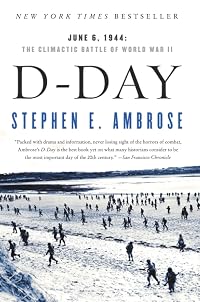
D Day: June 6, 1944: The Climactic Battle of World War II
by Stephen E. Ambrose
On This Page
Description
On the basis of 1,400 oral histories from the men who were there, Eisenhower biographer and World War II historian Stephen E. Ambrose reveals for the first time anywhere that the intricate plan for the invasion of France in June 1944, had to be abandoned before the first shot was fired. The true story of D-Day, as Ambrose relates it, is about the citizen soldiers - junior officers and enlisted men - taking the initiative to act on their own to break through Hitler's Atlantic Wall when they show more realized that nothing was as they had been told it would be. This is a brilliant telling of the battles of Omaha and Utah beaches, based on information only now available, from American, British, Canadian, French, and German veterans, from government and private archives, from never before utilized sources on the home front, gathered and analyzed by the author, who has made D-Day his life work. Ambrose's first interview was with General Eisenhower in 1964, his last with paratroopers from the 101st Airborne in 1993. Called the premier American narrative and military historian, Ambrose explains the most important day of the twentieth century. The action begins at midnight, June 5/6, when the first British and American airborne troops jumped into France to launch the invasion. It ends at midnight, June 6/7. Focusing on those pivotal twenty-four hours, this is the story of individuals rather than units. It moves from the level of Supreme Commander to that of a French child, from General Omar Bradley to an American paratrooper, from Field Marshal Montgomery to a British private, from Field Marshal Rommel to a German sergeant. Ambrose covers the politics of D-Day, from Churchill's resistance to the operation to Stalin's impatience and Roosevelt's concern. On the other side were Hitler's command structure, German policy, and the plot against the Fuhrer. This is the epic victory of democracy in winner-take-all combat. When Hitler declared war on the United States, he bet that the young men brought up in the Hitler Youth would outfight the Boy Scouts. Ambrose shows how wrong he was. show lessTags
Recommendations








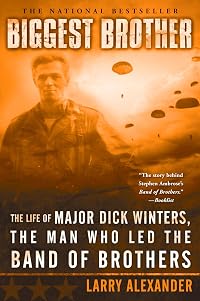
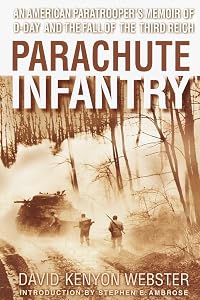
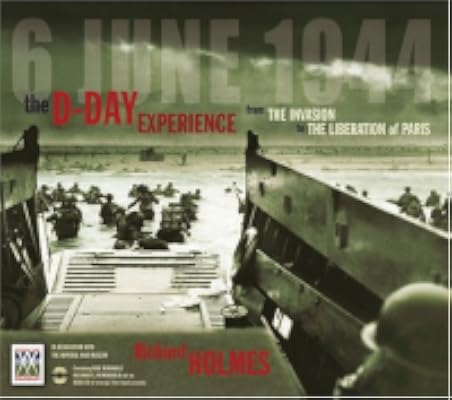
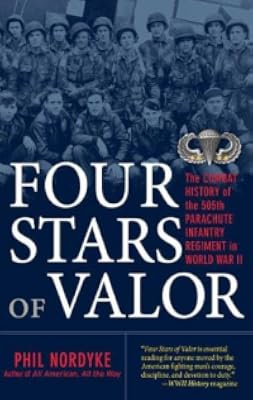



Member Recommendations


Member Reviews
The word for D-Day is "overwhelming." The amount of men and materiel moved on that day: overwhelming. The death, destruction and waste of the invasion (especially Omaha Beach): overwhelming. The heroism and courage of men of all different types, nationalities and personalities: overwhelming. Along with Cornelius Ryan's "The Longest Day," this narrative is well crafted. Most of the sources were oral histories from the actual participants. The many tales told give one a sense of what the soldiers experienced. These stories are interspersed with the main narrative which looks at the larger questions of strategy, tactics, wisdom and folly. The invasion was a complex plan (done without computers!) of mainly logistics. And that plan lasted show more until the invasion actually began. Some things went right, most went wrong. Much of the heroics was involved with the soldiers trying to accomplish their objectives anyway, and trying to bring order out of chaos. This book brings this fact home by dozens of stories told in a systematic way about what happened at the various beaches, and with the botching of the airborne paratroop landings. In these days of an all-volunteer army, it was wrenching to realize that most of these soldiers were conscripts and really didn't want to be there; but they did it because they believed Hitler needed to be stopped so badly it was worth their lives. Could we find a quarter of a million civilians with such courage today? Probably; but then, the US is a lot bigger now. Would I be willing to lay down my life for such a cause? A very disturbing question. show less
Where do I begin with a book like this? Imagine watching a scene from high above. Everything is muted and details are fuzzy. Now imagine swooping in to ground level and being able to engage all the senses. You hear, see, smell, taste and feel everything at close range. D-Day is such a book. You know all about June 6th, 1944 from your textbooks and your history classes. With D-Day, June 6th, 1944: the Climactic Battle of World War II Stephen Ambrose swoops in and takes you down the to fighting. Ground level. You get to hear first hand accounts from the American, British and Canadian men who survived Operation Overlord: the five separate attacks from sea and air. The opening chapter is a parachute drop into enemy territory. Soldiers who show more fought side by side with buddies who later wouldn't make it recall every emotion. What a strange circumstance, to be fighting for your life and watching men die around you and yet have no fear. They knew they could meet death at any minute but were so moved by commanding offices to keep surging forward. The battle at Omaha Beach illustrates this most poignantly.
Probably the most interesting section of the book was the comparisons between Commanders Eisenhower and Rommel. They had so many things in common they could have been friends had it not been for their opposing positions in the war. show less
Probably the most interesting section of the book was the comparisons between Commanders Eisenhower and Rommel. They had so many things in common they could have been friends had it not been for their opposing positions in the war. show less
This book is a gripping account of the men who were in the D-Day invasion. It is not a dry or difficult read, instead l found it to be a riveting book as easy to read as any of my favorite fictional books.
Ambrose is an excellent writer. Keeps you engaged with great details without getting bogged down.
This book should be titled "US Airborne and Omaha Beach on D-Day." After a start that discusses the great work of British paratroops Ambrose promises to give a complete look at the battle. But he only tells the US side of the story. It is frustrating how American writers can arrogantly say they are telling the complete story of a battle when dismissing all that is not about them. While admitting the landing at Juno beach was as difficult and bloody for the Canadians as the landing at Omaha was for the Americans (which he dissects in great detail and builds pedestals for all the brave GIs who dared set foot on the beach) he gives but a sentence to the Canadians. He fails to mention the Canadians did not drop their tanks at the bottom of show more the channel and executed that part of the landing exponentially better than the Yanks. He devotes chapters to the tiny successes of the screw-up American airborne troops that so poorly executed their plans that day. But he has just one obligatory mention of the Canadians and only one specific detail of the Brit paratroops.
We get it Steve, you love the old airborne guys. You love the guy that got hooked on the steeple and you don't care what the Brits and especially the Canadians did that day.
Fine.
Just don't claim to be writing about the entire battle. show less
We get it Steve, you love the old airborne guys. You love the guy that got hooked on the steeple and you don't care what the Brits and especially the Canadians did that day.
Fine.
Just don't claim to be writing about the entire battle. show less
Really comprehensive, gripping history of June 6, 1944 in Normandy. Ambrose is a great popular history writer, and in this book he really gives the reader a sense of the enormity of the endeavor on D-Day. The book focuses most of its time on Omaha Beach, which was the messiest of the invasion beaches due to the failure of the allies to properly bombard the emplacements first thing in the morning. But all the beaches get their due, and a sober assessment of the mistakes and brilliant decisions made by planners, generals, and lesser officers is offered.
The Greatest Generation indeed!
The difficult part of reading the book is that it would really be better as a documentary film, with diagrams and lots of maps. Not knowing the details of show more the geography of the French coast, I kept referring to maps from other places to get my bearings. There should have been more maps in the book. I would imagine, too, that a person with a military background would have an easier time than I did, as it's hard to picture this stuff if you haven't got a base of understanding. show less
The Greatest Generation indeed!
The difficult part of reading the book is that it would really be better as a documentary film, with diagrams and lots of maps. Not knowing the details of show more the geography of the French coast, I kept referring to maps from other places to get my bearings. There should have been more maps in the book. I would imagine, too, that a person with a military background would have an easier time than I did, as it's hard to picture this stuff if you haven't got a base of understanding. show less
An absolutely priceless piece of research regarding the climactic battle of WWII in June of 1944. Painstakingly researched and told in clear, straightforward prose, Ambrose places us on beaches and in the planning rooms as the battle teeters on the brink of failure. General Omar Bradley nearly calls the men off the beach. His communications are down and the beach is shrouded in smoke so he waits, unaware that most of his armor hasn’t made it to shore, that his officer corps has been decimated, and that it’s his non-coms who have carried the desperate battle to the enemy. A great read and a must for any student of World War II.
Members
- Recently Added By
Lists

Books bought at library sales
98 works; 4 members

THE WAR ROOM
813 works; 24 members
Author Information

72+ Works 43,889 Members
Historian Stephen E. Ambrose grew up in Wisconsin and attended the University of Wisconsin and the University of Louisiana. Ambrose is considered to be one of the foremost historical scholars of recent times and has been a professor for over three decades. He is also the founder and president of the National D-Day Museum in New Orleans. His works show more include D-Day: June 6, 1944: The Climactic Battle of World War II, Citizen Soldiers: The U. S. Army from Normandy Beaches to the Bulge to the Surrender of Germany, June 7, 1944-May 7, 1945, Band of Brothers: E Company, 506th Regiment, 101st Airborne from Normandy to Hitler's Eagle's Nest and Undaunted Courage: Meriwether Lewis, Thomas Jefferson and the Opening of the American West. Abrose served historical consultant on the motion picture Saving Private Ryan. (Bowker Author Biography) show less
Awards and Honors
Distinctions
Work Relationships
Is abridged in
Common Knowledge
- Canonical title*
- D-Day : Storia dello sbarco in Normandia
- Original title
- D-Day June 6, 1944: The Climatic Battle of World War II
- Original publication date
- 1994
- People/Characters
- Dwight D. Eisenhower; Winston Churchill (Churchill, Winston Leonard Spencer); Omar N. Bradley; Bernard Law Montgomery; Adolf Hitler; Erwin Rommel
- Important places
- Normandy, France; Juno Beach, Normandy, France; Utah Beach, Normandy, France; Omaha Beach, Normandy, France; Sword Beach, Normandy, France; Gold Beach, Normandy, France (show all 7); Sainte-Mère-Église, Normandy, France
- Important events
- World War II (1939 | 1945); Operation Overlord (1944-06-06 | 1944-08-30); D-Day (1944-06-06)
- Epigraph
- The most difficult and complicated operation ever to take place.
WINSTON CHURCHILL
The destruction of the enemy's landing is the sole decisive factor in the whole conduct of the war and hence in its final results.
ADOLF HITLER
The history of war does not know of an undertaking comparable to it for breadth of conception, grandeur of scale, and mastery of execution.
JOSEPH STALIN
Good Luck! And let us all beseech the blessing of Almighty God upon this great and noble undertaking.
DWIGHT D. EISENHOWER,
Order of the Day, June 4, 1944
In this column I want to tell you what the opening of the second front entailed, so that you can know and appreciate and forever be humbly grateful to those both dead and alive who did it for you.
ERNIE PYLE, June 12, 1944 - Dedication
- For
Forrest Pogue,
the first historian of D-Day - First words
- At 0016 hours, June 6, 1944, the Horsa glider crash landed alongside the Caen Canal, some fifty meters from the swing bridge crossing the canal.
- Quotations
- Summers then went to work, charging the first farmhouse, hoping his hodgepodge squad would follow. It did not, but he kicked in the door and sprayed the interior with his tommy gun. Four Germans fell dead, others ran out a ba... (show all)ck door to the next house. Summers, still alone, charged that house; again the Germans fled. His example inspired Pvt. William Burt to come out of the roadside ditch where the group was hiding, set up his light machine gun, and begin laying down a suppressing fire against the third barracks building. Once more Summers dashed forward. The Germans were ready this time; they shot at him from loopholes but, what with Burt's machine-gun fire and Summers's zigzag running, failed to hit him. Summers kicked in the door and sprayed the interior, killing six Germans and driving the remainder out of the building. Summers dropped to the ground, exhausted and in emotional shock. He rested for half an hour. His squad came up and replenished his ammunition supply. As he rose to go on, an unknown captain from the 101st, misdropped by miles, appeared at his side. "I'll go with you," said the captain. At that instant he was shot through the heart and Summers was again alone. He charged another building, killing six more Germans. The rest threw up their hands. Summers's squad was close behind; he tuned the prisoners over to his men. One of them, Pvt. John Camien from New York City, call out to Summers; "Why are you doing it?" "I can't tell you," Summers replied. "What about the others?" "They don't seem to want to fight," said Summers, "and I can't make them. So I've got to finish it." "OK," said Camien. "I'm with you." Together, Summers and Camien moved from building to building, taking turns charging and giving covering fire. Burt meanwhile moved up with his machine gun. Between the three of them, they killed more Germans. There were two building to go. Summers charged the first and kicked the door open, to see the most improbable sight. Fifteen German artillerymen were seated at mess tables eating breakfast. Summers never paused; he shot them down at the tables. The last building was the largest. Beside it was a shed and a haystack. Burt used tracer bullets to set them ablaze. The shed was used by the Germans for ammunition storage; it quickly exploded, driving thirty Germans out into the open, where Summers, Camien, and Burt shot some of them down as the others fled. Another member of Summers's makeshift squad came up. He had a bazooka, which he used to set the roof of the last building on fire. The Germans on the ground floor were firing a steady fusillade from loopholes in the walls, but as the flames began to build they dashed out. Many died in the open. Thirty-one others emerged with raised hands to offer their surrender. Summers collapsed, exhausted by his nearly five hours of combat. He lit a cigarette. One of the men asked him, "How do you feel?" "Not very good," Summers answered. "It was all kind of crazy. I'm sure I'll never do anything like that again." Summers got a battlefield commission and a Distinguished Service Cross. He was put in for the Medal of Honor, but the paperwork got lost. In the late 1980's, after Summers's death from cancer, Pvt. Baker and others made an effort to get the medal awarded posthumously, without success. Summers is a legend with American paratroopers nonetheless, the Sergeant York of World War II. His story has too much John Wayne/Hollywood in it to be believed, except that more than ten men saw and reported his exploits.
- Last words
- (Click to show. Warning: May contain spoilers.)" ... It just shows what free men will do rather than be slaves.". (General Eisenhower)
- Original language*
- Inglese
*Some information comes from Common Knowledge in other languages. Click "Edit" for more information.
Classifications
- Genres
- History, General Nonfiction, Nonfiction
- DDC/MDS
- 940.542142 — History & geography History of Europe History of Europe 1918- Military history of World War II Campaigns and battles by theatre European theatre France
- LCC
- D756.5 .N6 .A455 — History of Europe, Asia, Africa and Oceania History (General) World War II (1939-1945)
- BISAC
Statistics
- Members
- 4,055
- Popularity
- 3,839
- Reviews
- 44
- Rating
- (4.13)
- Languages
- 8 — Danish, Dutch, English, Hungarian, Italian, Polish, Portuguese, Spanish
- Media
- Paper, Audiobook, Ebook
- ISBNs
- 51
- UPCs
- 1
- ASINs
- 24