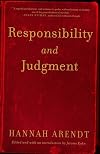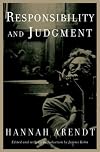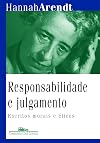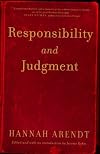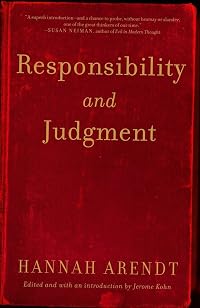
Responsibility and Judgment
by Hannah Arendt 
On This Page
Description
"At the heart of this book is a profound ethical investigation. "Some Questions of Moral Philosophy": in it Arendt confronts the inadequacy of traditional moral "truths" as standards to judge what we are capable of doing, and she examines anew our ability to distinguish good from evil and right from wrong. We see how Arendt comes to understand that alongside the radical evil she had addressed in earlier analyses of totalitarianism, there exists a more pernicious evil, independent of show more political ideology, whose execution is limitless when the perpetrator feels no remorse and can forget his acts as soon as they are committed." "Responsibility and Judgment is an essential work for understanding Arendt's conception of morality: it is also an indispensable investigation into some of the most troubling and important issues of our time."--Jacket. show lessTags
Recommendations






























Member Reviews
If you find yourself hankering to dive into Arendt but can't quite commit yourself to her major works like The Origins of Totalitarianism, The Human Condition, and The Life of the Mind, then this might be the book for you. This collection of essays touches on some of Arendt's major themes, such as the connection between thinking and morality, responsibility, guilt, freedom, human plurality, and human spontaneity.
While many of her works touch on these subjects to a greater or lesser degree, Responsibility and Judgment stands out as an extremely accessible and succinct read considering how mind-bogglingly large some of her ideas are.
While many of her works touch on these subjects to a greater or lesser degree, Responsibility and Judgment stands out as an extremely accessible and succinct read considering how mind-bogglingly large some of her ideas are.
Deze bundel bevat een achttal essays en toespraken van Arendt, vooral uit haar latere periode. De meeste ervan zijn erg toegankelijk, al staan er ook harde noten tussen. De thema's zijn hyper-relevant: ethiek, verantwoordelijkheid, oordelen. Arendt graaft onverbiddelijk diep, zeker als ze de holocaust aansnijdt en de notie van persoonlijke of collectieve verantwoordelijkheid. Met dat laatste concept heeft ze het erg moeilijk en dat frappeert wel. Een indrukwekkende persoonlijkheid.
1
Ratings
Members
- Recently Added By
Lists

In Our Time books
4,934 works; 2 members
Author Information

260+ Works 26,159 Members
Born in Hanover, Germany, Hannah Arendt received her doctorate from Heidelberg University in 1928. A victim of naziism, she fled Germany in 1933 for France, where she helped with the resettlement of Jewish children in Palestine. In 1941, she emigrated to the United States. Ten years later she became an American citizen. Arendt held numerous show more positions in her new country---research director of the Conference on Jewish Relations, chief editor of Schocken Books, and executive director of Jewish Cultural Reconstruction in New York City. A visiting professor at several universities, including the University of California, Columbia, and the University of Chicago, and university professor on the graduate faculty of the New School for Social Research, in 1959 she became the first woman appointed to a full professorship at Princeton. She also won a number of grants and fellowships. In 1967 she received the Sigmund Freud Prize of the German Akademie fur Sprache und Dichtung for her fine scholarly writing. Arendt was well equipped to write her superb The Origins of Totalitarianism (1951) which David Riesman called "an achievement in historiography." In his view, "such an experience in understanding our times as this book provides is itself a social force not to be underestimated." Arendt's study of Adolf Eichmann at his trial---Eichmann in Jerusalem (1963)---part of which appeared originally in The New Yorker, was a painfully searching investigation into what made the Nazi persecutor tick. In it, she states that the trial of this Nazi illustrates the "banality of evil." In 1968, she published Men in Dark Times, which includes essays on Hermann Broch, Walter Benjamin, and Bertolt Brecht (see Vol. 2), as well as an interesting characterization of Pope John XXIII. (Bowker Author Biography) show less
Hannah Arendt has a Legacy Library. Legacy libraries are the personal libraries of famous readers, entered by LibraryThing members from the Legacy Libraries group.
Some Editions
Awards and Honors
Notable Lists
Common Knowledge
- Original title
- Some Questions of Moral Philosophy
- Alternate titles*
- Basic Moral Propositions
- Original publication date
- 2003; 2006 [Italian translation]
- Publisher's editor*
- Random House / New York
- Original language
- English
*Some information comes from Common Knowledge in other languages. Click "Edit" for more information.
Classifications
Statistics
- Members
- 420
- Popularity
- 73,350
- Reviews
- 2
- Rating
- (4.10)
- Languages
- 9 — Chinese, Dutch, English, French, Italian, Polish, Portuguese, Russian, Spanish
- Media
- Paper, Ebook
- ISBNs
- 16
- ASINs
- 1