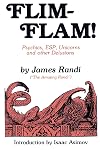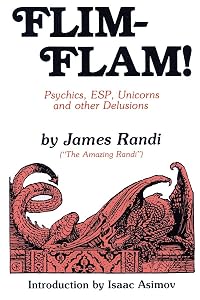
Flim-Flam! Psychics, ESP, Unicorns and other Delusions
by James Randi
On This Page
Description
A professional magician exposes mystics, mediums, psychic surgeons, and others who claim to possess supernatural or paranormal powers, demonstrating how their feats are little more than well-planned tricks that any competent magician can duplicate.Tags
Recommendations

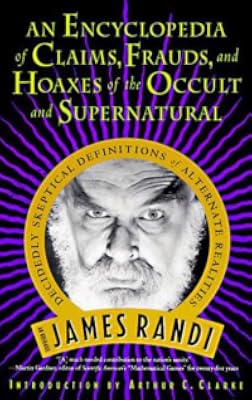
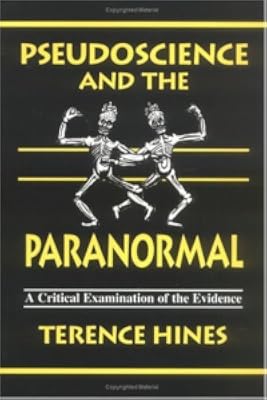
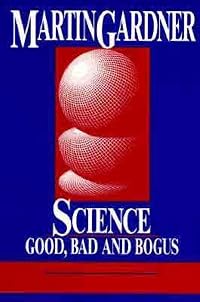
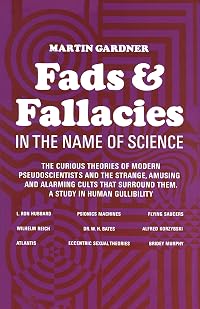

























Member Recommendations


Member Reviews
If Martin Gardner is the Godfather of skepticism, James Randi is the crude, but effective enforcer. He prefers to debunk by empirical means (as opposed to Gardner's thorough intellectual dismantling) and Randi hides no disdain, calling the "psychics" and other frauds charlatans and more while explaining how he handled the would be para-whatevers. And, he has yet to be proven wrong. Who best to out a trickster than a professional magician?
Magician and skeptic extraordinaire James "the Amazing" Randi examines and debunks all kinds of way-out-there stuff, from people who claim they can levitate by means of meditation, to "psychic surgery," to the Bermuda Triangle. He also details a number of experiments he conducted to test whether people with claimed paranormal powers could demonstrate them under controlled conditions. (Spoiler alert: They couldn't.)
Parts of this book, mostly chapters that focus closely on one particular topic, are in-depth, fascinating, and entertaining to read. (Although I suspect that whether one finds the tone of humor-laced curmudgeonliness Randi takes throughout charming or irritating is likely to depend upon one's predisposition.) Other parts are show more rather disjointed, choose odd details to focus on, and display, perhaps, more passion than polish in the writing. It's also kind of dated, as it was first published in the 80s and features a number of subjects that were big topics then, but have been replaced with new pseudoscientific fads since. (When was the last time you heard anybody talking about biorhythms?)
Still, uneven or not, I deeply appreciate the fact that this book, and other books like it, exist, and that Randi is and has been out there doing the things he does. His book about Uri Geller, in which he devastatingly exposed all the famous spoonbender's tricks, was a real eye-opener for me as a youngster. I started reading it as someone who'd always simply accepted psychic claims (as well as any number of other dubious phenomena) at face value, and finished it as a more mature and significantly less gullible thinker. I say we need more books that can do that sort of thing. Many, many more. show less
Parts of this book, mostly chapters that focus closely on one particular topic, are in-depth, fascinating, and entertaining to read. (Although I suspect that whether one finds the tone of humor-laced curmudgeonliness Randi takes throughout charming or irritating is likely to depend upon one's predisposition.) Other parts are show more rather disjointed, choose odd details to focus on, and display, perhaps, more passion than polish in the writing. It's also kind of dated, as it was first published in the 80s and features a number of subjects that were big topics then, but have been replaced with new pseudoscientific fads since. (When was the last time you heard anybody talking about biorhythms?)
Still, uneven or not, I deeply appreciate the fact that this book, and other books like it, exist, and that Randi is and has been out there doing the things he does. His book about Uri Geller, in which he devastatingly exposed all the famous spoonbender's tricks, was a real eye-opener for me as a youngster. I started reading it as someone who'd always simply accepted psychic claims (as well as any number of other dubious phenomena) at face value, and finished it as a more mature and significantly less gullible thinker. I say we need more books that can do that sort of thing. Many, many more. show less
This book systematically takes psuedoscience from the 60s and 70s and smashes it with the hammer of science. It can seem a little outdated, talking about pyramids, the Bermuda triangle, etc, until you start to see the patterns that are still around today. No one may be trying to pass off photoshopped pictures of fairies as real anymore, but there are plenty of people who believe in "power hologram" rubber bracelets, homeopathy, astrology, numerology, fung shui, tarot cards, palm reading, acupuncture, and any number of other hoaxes. This book teaches you to see these things like a magician sees them, to look for the trick, and to see them like a scientist sees them, as a phenomenon that, if genuine, is testable.
Well-paced, interesting topic, with an enjoyable bitchy tone, on occasions. Well-written and enjoyable.
I know Randi is more than a bit mean-spirited at times, but on the whole I appreciate this book: I'm quite sure there are real psychics out there somewhere...but so few that it's statistically unlikely anyone's ever going to claim Randi's prize.
Reviewed July 2002
Randi gives an interesting overview of cases he has been interested in. And these cases are very diverse indeed, air, water and Uri are just a few areas. The book is terrible dated (Randi's prize is only 10K) and many things like the Bermuda triangle are almost never mentioned these days. He does explain many different kinds of cases from people who shoot pictures of their hands and faces to people who tip tables. Card sharks dowsing, and on and on. This book must have been useful when it was current.
13-2002
Randi gives an interesting overview of cases he has been interested in. And these cases are very diverse indeed, air, water and Uri are just a few areas. The book is terrible dated (Randi's prize is only 10K) and many things like the Bermuda triangle are almost never mentioned these days. He does explain many different kinds of cases from people who shoot pictures of their hands and faces to people who tip tables. Card sharks dowsing, and on and on. This book must have been useful when it was current.
13-2002
Originally published in the early 80's the book covers things that are outside today's new age sphere. Spending time on ufology,the Bermuda triangle, and von daniken's aliens as gods theory.
It is also quite a dry read as Randi assembles facts and uses them to debunk or demolish various stories & psychics.
Chapter 13 in which he presents attempts on the (then) $10,000(*) Randi prize, is whilst enlightening quite depresssing. Self delusion, chicanery & charlatanism parade by. If you are a magician or want to be there are some nice things you can probably take away from it though.
(*) now $1,000,000 and still unclaimed.
It is also quite a dry read as Randi assembles facts and uses them to debunk or demolish various stories & psychics.
Chapter 13 in which he presents attempts on the (then) $10,000(*) Randi prize, is whilst enlightening quite depresssing. Self delusion, chicanery & charlatanism parade by. If you are a magician or want to be there are some nice things you can probably take away from it though.
(*) now $1,000,000 and still unclaimed.
Members
- Recently Added By
Lists

Atheism, humanism, freethought, &c. — Best nonfiction books in favour of
167 works; 14 members

The Great Courses: Your Deceptive Mind
60 works; 1 member

Books in the Bibliography of The Illusion of Conscious Will by Daniel Wegne
273 works; 1 member
Author Information

17+ Works 2,063 Members
Randall James Hamilton Zwinge was born on August 7, 1928 in Toronto, Ontario, Canada. He began his career in the late 40's as an illusionist and escape artist. He became known as the Amazing Randi and was an international success. In 1986, he received the McArthur "genius" grant. He retired from stage magic at the age of 60 and began a career of show more investigating claims of the paranormal. He devoted his life to debunking paranormal claims. Preferring to be called a skeptic or an investigator, he aimed to show that "something was not likely." He was considered a father of the modern skeptical movement. He wrote numerous books which included, Houdini, His Life and Art (1976) co-authored with Bert Randolp Sugar; Flim Flam! The Truth About Unicorns, Parapsychology, and Other Delusions (1980); The Faith Healers (1987); and An Encyclopedia of Claims, Frauds, and Hoaxes of the Occult and Supernatural (1995). In 1976, Mr. Randi, along with Carl Sagan, Isaac Asimov, and others, founded the Committee for Skeptical Inquiry. It published the magazine Skeptical Inquirer. James Randi, also known as the Amazing Randi, died at his home in Florida at the age of 92. (Bowker Author Biography) show less
Some Editions
Common Knowledge
- Canonical title
- Flim-Flam! Psychics, ESP, Unicorns and other Delusions
- Original publication date
- 1982
- People/Characters
- Arthur Conan Doyle; Uri Geller
- Epigraph
- And the crowd was stilled. One elderly man, wondering at the sudden silence, turned to the Child and asked him to repeat what he had said. Wide-eyed, the Child raised his voice and said once again, "Why, the Emperor has no cl... (show all)othes! He is naked!" - "The Emperor's New Clothes"
- First words
- The last ten years have seen a great resurgence of interest in the paranormal.
- Last words
- (Click to show. Warning: May contain spoilers.)The Emperor has no clothes!
Classifications
- Genres
- Nonfiction, General Nonfiction, Science & Nature, Religion & Spirituality
- DDC/MDS
- 133.8 — Philosophy & psychology Parapsychology & occultism Specific topics in parapsychology and occultism Psychic phenomena
- LCC
- BF1042 .R24 — Philosophy, Psychology and Religion Psychology Parapsychology Psychic research. Psychology of the conscious
- BISAC
Statistics
- Members
- 823
- Popularity
- 33,655
- Reviews
- 11
- Rating
- (4.01)
- Languages
- English, Italian, Norwegian (Bokmål), Spanish
- Media
- Paper, Audiobook, Ebook
- ISBNs
- 10
- ASINs
- 6