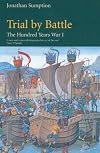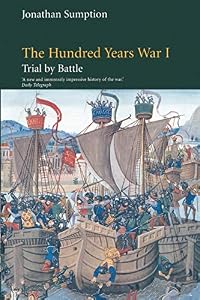
Trial by Battle
by Jonathan Sumption
The Hundred Years War (1), University of Pennsylvania Press Middle Ages Series
On This Page
Description
'Compulsively readable' (History), this is the first volume in a series that details the long and violent endeavour of the English to dismember Europe's strongest state, a succession of wars that is one of the seminal chapters in European history. Beginning with the funeral of Charles IV of France in 1328, it follows the Hundred Years War up to the surrender of Calais in 1347. It traces the early humiliations and triumphs of Edward III: the campaigns of Sluys, Crecy and Calais, which first show more made his name as a war leader and the reputation of his subjects as the most brutally effective warriors of their time. Trial by Battle is an account of the events of a pivotal period in both French and British history, from Wolfson History Prize-winning author and historian Jonathan Sumption. 'A new and immensely impressive history of the war.' Daily Telegraph show lessTags
Recommendations














Member Reviews
Though a long and at times wearying slog, this book is not an unpleasant one. Sumption's writing style is crisp and clear highly readable. The details it contains of the early years of the Hundred years War are, well, not. It's no fault of the author that the convolutions of the historical and economic and social conditions of the soon-to-be warring nations are so intricate and dull, but they are vital to understanding the reasons why the war goes the way it does, particularly the economic details, which mostly have to do with sheep.
My own understanding of the War was incredibly limited, saving a single Bernard Cornwall novel and Branagh's Henry V, to the extent that I'd mix it up with the Thirty Year's War. Whether it was a good idea show more to jump feet first into this vast, exhaustive, epic historical narrative without a better understanding of the broad sweep of events and more of the principal characters involved is a moot point at this stage, but it's a bit disheartening to actually feel yourself forgetting stuff almost as soon as you've read it. Anyway, let's see what I CAN remember.
There's a ton of dynastic kingly squabbling in the background here, slivers of France in the possession of the English king, but as a duchy, rendering him a vassal of the French king. The English king should pay homage to the French king, doesn't want to, avoids it like the plague, eventually sends his son, Edward III to do the homage. Edward II is deposed, Edward III ascends, gets to fighting with Scotland, who are allied to France, gets a taste for war, as do his nobles, and decides he wants to reclaim his birthright in France. There follow tortuous rounds of fundraising via taxes and loans and dodgy, not to mention stupid, wool-trading, all in the name of getting an army together to invade France. Dodgy fundraising becomes a repeated and familiar feature of both sides, often with a strategic bearing as on more than one occasion an army is left unopposed as the other side simply can't afford to pay its soldiers. Then again there's all sorts of military incompetence, mismanagement, timidity and downright idiocy which seem to prolong the conflict by failing to bring it to a definitive conclusion. Edward III comes across as a right sod, burning and pillaging all around, while poor old Philip VI is just hapless in the defence of his realm. and his son even worse. Will they ever learn to cope with the withering fire of the English archers?
In the midst of all the campaigning there's the odd startling turn, such as the daring actions of Edward III's French mother ('evil,' Sumption calls her, reserving such emotive adjectives only for her and one other woman in the book,) or the ten French men-at-arms who hold an army at bay at a ford or the six burghers of Calais who appear before Edward III with nooses around their necks. I could have done with more of this sort of thing, but Sumption seems keen to avoid the more sensationalistic stuff on the grounds that they're more exhaustively covered elsewhere, and the battles as recounted are plenty sensational enough.
Volume 1 leaves us at the fall of Calais the English ascendant and the French humiliated, a state of affairs not likely to change any time soon. I may leave the next two volumes for when I have a slightly better grasp of events and players. It's interesting to think that these events must have formed a sizable chunk of the history lessons of French and English schoolchildren, but only got a passing mention in Irish history books. Or maybe I wasn't paying attention. show less
My own understanding of the War was incredibly limited, saving a single Bernard Cornwall novel and Branagh's Henry V, to the extent that I'd mix it up with the Thirty Year's War. Whether it was a good idea show more to jump feet first into this vast, exhaustive, epic historical narrative without a better understanding of the broad sweep of events and more of the principal characters involved is a moot point at this stage, but it's a bit disheartening to actually feel yourself forgetting stuff almost as soon as you've read it. Anyway, let's see what I CAN remember.
There's a ton of dynastic kingly squabbling in the background here, slivers of France in the possession of the English king, but as a duchy, rendering him a vassal of the French king. The English king should pay homage to the French king, doesn't want to, avoids it like the plague, eventually sends his son, Edward III to do the homage. Edward II is deposed, Edward III ascends, gets to fighting with Scotland, who are allied to France, gets a taste for war, as do his nobles, and decides he wants to reclaim his birthright in France. There follow tortuous rounds of fundraising via taxes and loans and dodgy, not to mention stupid, wool-trading, all in the name of getting an army together to invade France. Dodgy fundraising becomes a repeated and familiar feature of both sides, often with a strategic bearing as on more than one occasion an army is left unopposed as the other side simply can't afford to pay its soldiers. Then again there's all sorts of military incompetence, mismanagement, timidity and downright idiocy which seem to prolong the conflict by failing to bring it to a definitive conclusion. Edward III comes across as a right sod, burning and pillaging all around, while poor old Philip VI is just hapless in the defence of his realm. and his son even worse. Will they ever learn to cope with the withering fire of the English archers?
In the midst of all the campaigning there's the odd startling turn, such as the daring actions of Edward III's French mother ('evil,' Sumption calls her, reserving such emotive adjectives only for her and one other woman in the book,) or the ten French men-at-arms who hold an army at bay at a ford or the six burghers of Calais who appear before Edward III with nooses around their necks. I could have done with more of this sort of thing, but Sumption seems keen to avoid the more sensationalistic stuff on the grounds that they're more exhaustively covered elsewhere, and the battles as recounted are plenty sensational enough.
Volume 1 leaves us at the fall of Calais the English ascendant and the French humiliated, a state of affairs not likely to change any time soon. I may leave the next two volumes for when I have a slightly better grasp of events and players. It's interesting to think that these events must have formed a sizable chunk of the history lessons of French and English schoolchildren, but only got a passing mention in Irish history books. Or maybe I wasn't paying attention. show less
The Hundred Years War is a conflict that stands out by virtue of its length -- and yet in one sense, it is about only one part of the longstanding struggle between England and France during the Middle Ages. From the moment William the Bastard of Normandy defeated Harold Godwinson at the Battle of Hastings and became William I of England, England and France were intertwined by the complex ties of feudalism, with the ruler of England also a vassal of the French monarch. As the power of the French crown grew, this complicated relationship led to increasing conflict, of which the Hundred Years War represented its culmination.
That Johnathan Sumption spends nearly a third of his book recounting the tangled events that led to the start of the show more conflict in 1337 is in part a reflection of this. It also embodies, though, the patient, detailed recounting of a conflict that was epic in both scope and length. In this, the first of his multi-volume history of the war, he details the development of the war from its origins in the inter-kingdom politics of 14th century England and France to the English victory at Crécy and its successful siege of Calais a decade later. This is less straightforward than it may appear on the surface, as more than England and France were involved in the conflict. In one sense, the war emerged out of England's ongoing conflict with it's Scottish neighbor to the north, which France sought to exploit in its ongoing pursuit of the English crown's holdings in Gascony. As war loomed England's king Edward III sought out allies from throughout northwestern Europe, whose support he gained primarily through generous subsidies, which were financed in large measure using extraordinary loans from Italian banking houses. As Sumption demonstrates, the financial aspects of the war were central to the conflict, often playing a more decisive role in developments than events on the battlefield.
One of the reasons for the centrality of finance was the scope of the conflict, which extended from Scotland to southwestern France and encompassed both land and naval conflict. Yet the governments of the era lacked the resources to fight wars on such a vast scale, which often led what a modern age would term outsourcing, with both sides relying upon third parties such as regional nobles to advance their interests, Usually these people were more interested in profit than in strategy and politics, yet even their mercenary goals could serve the interests of their employers by tying down enemy troops, even if it came at the cost of innumerable suffering for the inhabitants of the regions where the forces were engaged.
Much of Sumption's account is devoted to recounting these side struggles, which defined the experience of the war for most of its participants and victims. Yet for all of its complexity and detail (a level that might turn off some readers) Sumption's narrative never sags from it. This in itself makes Sumption's book a considerable achievement, one that once its subsequent volumes (of which there are two, with a third coming out this fall) are completed will likely stand as the definitive account of this epic struggle for decades to come. show less
That Johnathan Sumption spends nearly a third of his book recounting the tangled events that led to the start of the show more conflict in 1337 is in part a reflection of this. It also embodies, though, the patient, detailed recounting of a conflict that was epic in both scope and length. In this, the first of his multi-volume history of the war, he details the development of the war from its origins in the inter-kingdom politics of 14th century England and France to the English victory at Crécy and its successful siege of Calais a decade later. This is less straightforward than it may appear on the surface, as more than England and France were involved in the conflict. In one sense, the war emerged out of England's ongoing conflict with it's Scottish neighbor to the north, which France sought to exploit in its ongoing pursuit of the English crown's holdings in Gascony. As war loomed England's king Edward III sought out allies from throughout northwestern Europe, whose support he gained primarily through generous subsidies, which were financed in large measure using extraordinary loans from Italian banking houses. As Sumption demonstrates, the financial aspects of the war were central to the conflict, often playing a more decisive role in developments than events on the battlefield.
One of the reasons for the centrality of finance was the scope of the conflict, which extended from Scotland to southwestern France and encompassed both land and naval conflict. Yet the governments of the era lacked the resources to fight wars on such a vast scale, which often led what a modern age would term outsourcing, with both sides relying upon third parties such as regional nobles to advance their interests, Usually these people were more interested in profit than in strategy and politics, yet even their mercenary goals could serve the interests of their employers by tying down enemy troops, even if it came at the cost of innumerable suffering for the inhabitants of the regions where the forces were engaged.
Much of Sumption's account is devoted to recounting these side struggles, which defined the experience of the war for most of its participants and victims. Yet for all of its complexity and detail (a level that might turn off some readers) Sumption's narrative never sags from it. This in itself makes Sumption's book a considerable achievement, one that once its subsequent volumes (of which there are two, with a third coming out this fall) are completed will likely stand as the definitive account of this epic struggle for decades to come. show less
This is part 1 of a detailed history of the hundred years war. It is written with the general reader in mind, but is still packed with detail. The book starts with a powerhouse description of the funeral of Charles IV in Paris in February 1328 and hardly lets up until the seige of Calais in 1347. Descriptions of the battles and campaignes provide plenty of details and atmosphere and Sumption gives convincing analysis of their effects on the two Kingdoms. Sumption also provides fascinating details on raising armies, the financing of them and keeping them supplied. Much of which was of course essential to the relative success/failure of the campaigns. I would recommend this book to anyone interested in medieval history
Jonathan Sumpton gets me beyond the collection of War stories by Froissart, to the nuts and bolts of an analytical account. One of the best modern attempts to define a huge event, used by historians and politicians alike to prove various hobby horses. Well done, and quickly on to volume two!
Sumption is one of England's top 2 or 3 commercial lawyers. Goodness knows how he finds the time to research and write history books as well.
As Sumption points out, this is narrative history without much in the way of analysis. Although it is 600 pages and only covers teh first 10 years of the war, events move at a rapid pace and the number of personablities involved can make things a bit confusing.
There's a degree of unreality in that we don't ever get to understand the characters of the two main protaganists - Edward III and Philip VI - except through their actions. Sumption is right to point out that contempary chroniclers just didn't write about royalty in that way.
There's a solid section on the causes of the war - fundamentally show more the centiuries old problem of kings in England having to do homage for their possessions in France. Sumption is strong on the problems of paying for war and the devastation that maurading armies caused.
Good, solid history (and I'll certainly read volume 2 at some point) but Sumption the historian is not in the same rank as Sumption the lawyer. show less
As Sumption points out, this is narrative history without much in the way of analysis. Although it is 600 pages and only covers teh first 10 years of the war, events move at a rapid pace and the number of personablities involved can make things a bit confusing.
There's a degree of unreality in that we don't ever get to understand the characters of the two main protaganists - Edward III and Philip VI - except through their actions. Sumption is right to point out that contempary chroniclers just didn't write about royalty in that way.
There's a solid section on the causes of the war - fundamentally show more the centiuries old problem of kings in England having to do homage for their possessions in France. Sumption is strong on the problems of paying for war and the devastation that maurading armies caused.
Good, solid history (and I'll certainly read volume 2 at some point) but Sumption the historian is not in the same rank as Sumption the lawyer. show less
A narrative history of the early years of the Hundred Years War, up to the fall of Calais in 1347. I found it rather heavy going, but it was well worth preserving.
I'll probably pick up volume 2 at some point.
I'll probably pick up volume 2 at some point.
Members
- Recently Added By
Lists

In Our Time books
4,934 works; 2 members
Author Information

13+ Works 1,921 Members
Jonathan Sumption was a history fellow at Magdalen College, Oxford, until 1975.
Series


Common Knowledge
- Canonical title
- Trial by Battle
- Original publication date
- 1990
- People/Characters
- Edward III, King of England; John II, King of France; Edward, the Black Prince; Charles, Count of Alençon; John, Count of Armagnac; Jacob van Artevelde (show all 33); Robert of Artois; Edward Balliol; Benedict XII, Pope (Jacques Fournier, 1285-1342); John II, Duke of Brabant; Raoul I de Brienne, Count of Eu; Charles of Bloise, Duke of Brittany; Henry Burghersh, Bishop of London; Odo, Duke of Burgundy; Clement or Clemens VI, Pope (Pierre Roger, 1291-1352); David II, King of Scots; Louis of Nevers, Count of Flanders; John of Hainault, lord of Beaumont; William II, Count of Hainault; William Clinton, Earl of Huntingdon; Oliver Ingham; John of Valois, Duke of Normandy; William Juliers, Earl of Cambridge; Henry of Grosmont, duke of Lancaster; John, King of Bohemia; Walter Mauny; John de Montfort, Duke of Brittany; William de Bohun, Earl of Northampton; Philip IV, King of France; Philip VI, King of France; William Montagu, Earl of Salisbury; John Stratford, Bishop of Winchester; Egidio Boccanegra
- Important places
- London, England, UK; Paris, Île-de-France, France; Normandy, France; Calais, Pas-de-Calais, Hauts-de-France, France; Poitiers, Vienne, Nouvelle-Aquitaine, France; Crécy-en-Ponthieu, Hauts-de-France, France (show all 8); Brittany, France; County of Flanders
- Important events
- Hundred Years' War (1337 | 1453); Battle of Sluys (1340-06-24); Battle of Crécy (1346-08-26); Siege of Calais (1346 | 1347)
- First words
- Chapter I
France in 1328
Charles IV, the last Capetian King of France, died on 1 February 1328 at the royal manor of Vincennes, east of Paris.
Preface
This book is intended to be the first volume of a history of the Hundred Years War, from its outbreak in the 1330s until the final expulsion of the English from France in the middle of the fifteenth century. - Last words
- (Click to show. Warning: May contain spoilers.)Defeat and disappointment were still far away.
- Publisher's editor
- Ruth Mazo Karras
Classifications
- Genres
- History, Nonfiction, General Nonfiction
- DDC/MDS
- 944.025 — History & geography History of Europe France and Monaco France Capet and Valois 987-1589 Philip VI 1328-50; John II 1350-64; Charles V 1364-80 ; XIVth Century
- LCC
- DC96 .S86 — History of Europe, Asia, Africa and Oceania France – Andorra – Monaco History of France History By period Early and medieval to 1515 1328-1515 Hundred Years' War, 1339-1453
- BISAC
Statistics
- Members
- 450
- Popularity
- 67,692
- Reviews
- 7
- Rating
- (4.26)
- Languages
- English
- Media
- Paper, Ebook
- ISBNs
- 6
- ASINs
- 3