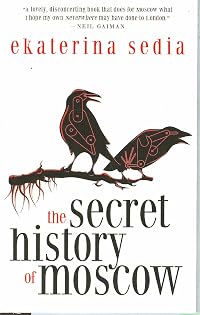
The Secret History of Moscow
by Ekaterina Sedia
On This Page
Description
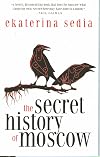
Every city contains secret places. Moscow in the tumultuous 1990s is nodifferent, its citizens seeking safety in a world below the streets -- adark, cavernous world of magic, weeping trees, and albino jackdaws, where exiledpagan deities and faery-tale creatures whisper strange tales to those who wouldlisten. Galina is a young woman caught, like her contemporaries, in the seeminglawlessness of the new Russia. In the midst of this chaos, her sister Mariaturns into a jackdaw and flies away -- show more prompting Galina to join Yakov, apoliceman investigating a rash of recent disappearances. Their search will takethem to the underground realm of hidden truths and archetypes, to findthemselves caught between reality and myth, past and present, honor and betrayal. . . the secret history of Moscow. show lessTags
Recommendations

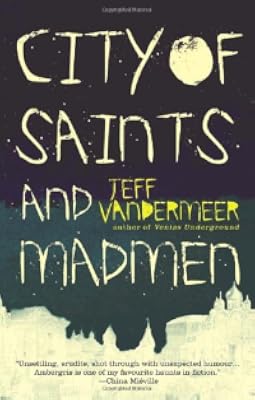
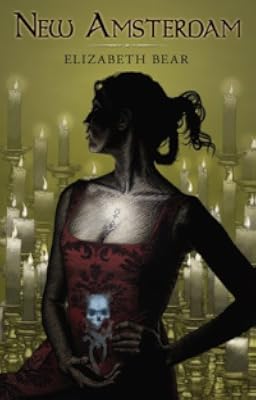
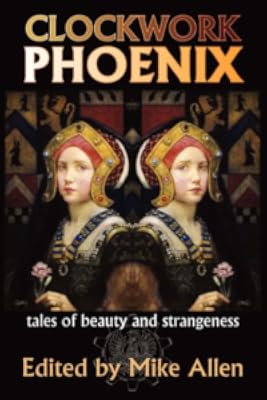
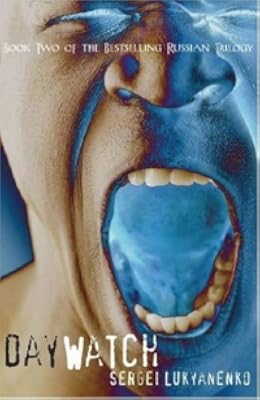







Member Recommendations


Member Reviews
The Secret History of Moscow is, judging by the wide range of reviews, the literary equivalent of an optical illusion:
You might read it and feel disconnected from the characters, as if you were living in a grey ice-slushy day with errands to run that mean wet boots and snow down your neck. Or you might read it and see the characters as part of a cultural mosaic, set against the background of gentle, fat flakes of snow falling out of a soft grey sky, the air crisp and fresh. The first time I read it, it was more of the first. The second, I was concentrating less on the primary characters and plot, and enjoying the tale-within-a-tale style, that gave tiny glimpses into Moscow and by extension, Russia.
"Yakov tried to keep the show more disappointment out of his voice. Nothing was ever easy, and he resented that his visit to a magical kingdom of fairytales was turning into a series of interviews. And corpse examinations."
It begins with Galina in the bathroom, struggling with her feelings. Her sister takes over and before one can turn around three times, has turned into a jackdaw and left her newborn baby behind. Finding her sister, Masha, becomes Galina's quest and raison d'être, bringing her first into contact with Fyodor, an alcoholic street artist, and then to Yakov, a divorced policeman settling uncomfortably into failure. When they witness a flock of crows disappear into a puddle, they know something mysterious is going on. Fyodor leads them to a subway station and they fall through an opening into the Underground.
"She always knew it would be a subway, and once again she lamented her lack of persistence. All this time she thought she was delusional, but in reality she wasn’t delusional enough to keep the hope alive."
Comparisons--not the least of which is Neil himself--abound to American Gods, but I'll be honest--this was far more palatable and charming. As we meet each entity in the narrative, we learn about a small piece of Russian history. Galina is a story of both mental illness and being a single female in modern Moscow. Fyodor indirectly illustrates the relationship between the Gypsies and townfolk. Yakov's grandfather gives insight into the days of control by the state and suspicion of outsiders. Countess Elena, wife of a member of the Decembrists' Revolt explains the no-win choices she faced. Sovin is a portrait of a plant scientist who fought in the wars and still ended up sent to a labor camp. Hershel was a Russian Jew in 1886 when persecution ramped up.
"Everyone liked to think that the worst was over, and that they were either important or inconspicuous enough to survive. Herschel smiled sadly at their self deception and felt embarrassed by his conceit—he was not so different from them after all."
Much of the history can be said to be grim, but that's what forgotten history means, isn't it? New York City's underground would no doubt have indentured servants, refugees starving in an overcrowded Irish tenement, women who were burned to death in factory fires with no exits. So perhaps these missing stories are indeed grim, and hard to connect to, but there's something to be said for just bearing witness to the descriptions, endeavoring to understand the cultural moment, that makes it worthwhile. That it is wrapped up in solid writing with interspersed forgotten fairy tale characters makes it more interesting.
"This place is for those of us who don’t mind being small, who can live without being noticed. Those who are not ashamed to hide. But even we fade away eventually— you can’t be small forever without disappearing."
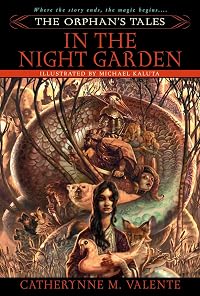
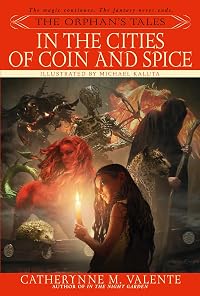
The plot becomes almost secondary; though Galina has a single-minded focus on her sister, nearly no one else does, including Sedia. The Underworld is concerned about the incursion of the top world into their own and wants some reconnaissance done. For the plot-driven reader, this may prove unsatisfying. The format is almost--but not quite--the tale-within-tale story of [b:In the Night Garden|202769|In the Night Garden (The Orphan's Tales, #1)|Catherynne M. Valente|https://images.gr-assets.com/books/1320548374s/202769.jpg|196179] or [b:Life and Death are Wearing Me Out|1320279|Life and Death are Wearing Me Out|Mo Yan|https://images.gr-assets.com/books/1348876602s/1320279.jpg|1309625]. I finished the book quickly, but something about it called for a re-read. I thought the second time even better, a very satisfying, cathartic experience. A truly modern fairy tale, it may be one I have to add to my own library.
“He was still wide awake when the morning came - the light changed imperceptibly underground, with the glowtrees flaring up brightly, and the shimmer of golden dust that remained suspended in the musty air, as if millions of butterflies had shed the scales of their wings in midair.”
four and a half nesting matryoshka dolls show less
You might read it and feel disconnected from the characters, as if you were living in a grey ice-slushy day with errands to run that mean wet boots and snow down your neck. Or you might read it and see the characters as part of a cultural mosaic, set against the background of gentle, fat flakes of snow falling out of a soft grey sky, the air crisp and fresh. The first time I read it, it was more of the first. The second, I was concentrating less on the primary characters and plot, and enjoying the tale-within-a-tale style, that gave tiny glimpses into Moscow and by extension, Russia.
"Yakov tried to keep the show more disappointment out of his voice. Nothing was ever easy, and he resented that his visit to a magical kingdom of fairytales was turning into a series of interviews. And corpse examinations."
It begins with Galina in the bathroom, struggling with her feelings. Her sister takes over and before one can turn around three times, has turned into a jackdaw and left her newborn baby behind. Finding her sister, Masha, becomes Galina's quest and raison d'être, bringing her first into contact with Fyodor, an alcoholic street artist, and then to Yakov, a divorced policeman settling uncomfortably into failure. When they witness a flock of crows disappear into a puddle, they know something mysterious is going on. Fyodor leads them to a subway station and they fall through an opening into the Underground.
"She always knew it would be a subway, and once again she lamented her lack of persistence. All this time she thought she was delusional, but in reality she wasn’t delusional enough to keep the hope alive."
Comparisons--not the least of which is Neil himself--abound to American Gods, but I'll be honest--this was far more palatable and charming. As we meet each entity in the narrative, we learn about a small piece of Russian history. Galina is a story of both mental illness and being a single female in modern Moscow. Fyodor indirectly illustrates the relationship between the Gypsies and townfolk. Yakov's grandfather gives insight into the days of control by the state and suspicion of outsiders. Countess Elena, wife of a member of the Decembrists' Revolt explains the no-win choices she faced. Sovin is a portrait of a plant scientist who fought in the wars and still ended up sent to a labor camp. Hershel was a Russian Jew in 1886 when persecution ramped up.
"Everyone liked to think that the worst was over, and that they were either important or inconspicuous enough to survive. Herschel smiled sadly at their self deception and felt embarrassed by his conceit—he was not so different from them after all."
Much of the history can be said to be grim, but that's what forgotten history means, isn't it? New York City's underground would no doubt have indentured servants, refugees starving in an overcrowded Irish tenement, women who were burned to death in factory fires with no exits. So perhaps these missing stories are indeed grim, and hard to connect to, but there's something to be said for just bearing witness to the descriptions, endeavoring to understand the cultural moment, that makes it worthwhile. That it is wrapped up in solid writing with interspersed forgotten fairy tale characters makes it more interesting.
"This place is for those of us who don’t mind being small, who can live without being noticed. Those who are not ashamed to hide. But even we fade away eventually— you can’t be small forever without disappearing."
The plot becomes almost secondary; though Galina has a single-minded focus on her sister, nearly no one else does, including Sedia. The Underworld is concerned about the incursion of the top world into their own and wants some reconnaissance done. For the plot-driven reader, this may prove unsatisfying. The format is almost--but not quite--the tale-within-tale story of [b:In the Night Garden|202769|In the Night Garden (The Orphan's Tales, #1)|Catherynne M. Valente|https://images.gr-assets.com/books/1320548374s/202769.jpg|196179] or [b:Life and Death are Wearing Me Out|1320279|Life and Death are Wearing Me Out|Mo Yan|https://images.gr-assets.com/books/1348876602s/1320279.jpg|1309625]. I finished the book quickly, but something about it called for a re-read. I thought the second time even better, a very satisfying, cathartic experience. A truly modern fairy tale, it may be one I have to add to my own library.
“He was still wide awake when the morning came - the light changed imperceptibly underground, with the glowtrees flaring up brightly, and the shimmer of golden dust that remained suspended in the musty air, as if millions of butterflies had shed the scales of their wings in midair.”
four and a half nesting matryoshka dolls show less
This book has been compared to American Gods meeting Neverwhere, blended with Russian culture. And while that's not incorrect, it's simplifying what a beautiful story this is, and how unlike any other book I've read.
This is a story about people living in a shifting culture, and how they cope with the world changing around them. This is a story about loss, and very much a story about familial love. It's worth going into it with an open mind and letting the story bring you along on its journey.
This is a story about people living in a shifting culture, and how they cope with the world changing around them. This is a story about loss, and very much a story about familial love. It's worth going into it with an open mind and letting the story bring you along on its journey.
The premise: Galina has always been the crazy one of the family; she's even been hospitalized for schizophrenia. So when she sees her sister Masha turn into a jackdaw and fly away, she doesn't tell anyone. That is until she meets a cop who's investigating a string of disappearances around Moscow and saw the very same thing himself. Together they seek out answers, and discover that there's more to the city of Russia than meets the eye. A secret city lies just beneath, a city of magic, exiled deities and fairytale creatures, where the missing become immortal. And unfortunately, the two different Moscows are starting to collide.
My Rating
Give It Away: it's a promising debut that promises to put Ekaterina Sedia in the same ranks as Charles show more de Lint, Neil Gaiman, and Catherynne Valente, if it hasn't put her there yet. It's not a book I'll keep and cherish forever, but I liked enough of what I read that I want to read more of Sedia's work. Sedia strikes me as the kind of writer who's going grow and improve with each story and book she writes, and I look forward to reading her other projects. The Secret History of Moscow is definitely DIFFERENT as far as urban fantasies go, and fans of de Lint and Gaiman should certainly check this out. Me, I'm just pleased Sedia's ignited my curiosity to learn more about Russia, Moscow, and its history and myth, and that's a powerful thing to pull off. A good read, though a bit slow, but with lots of promise, especially in the prose.
The full review, which does include spoilers, may be found in my LJ. As always, comments and discussion are most welcome.
REVIEW: Ekaterina Sedia's THE SECRET HISTORY OF MOSCOW
Happy Reading! :) show less
My Rating
Give It Away: it's a promising debut that promises to put Ekaterina Sedia in the same ranks as Charles show more de Lint, Neil Gaiman, and Catherynne Valente, if it hasn't put her there yet. It's not a book I'll keep and cherish forever, but I liked enough of what I read that I want to read more of Sedia's work. Sedia strikes me as the kind of writer who's going grow and improve with each story and book she writes, and I look forward to reading her other projects. The Secret History of Moscow is definitely DIFFERENT as far as urban fantasies go, and fans of de Lint and Gaiman should certainly check this out. Me, I'm just pleased Sedia's ignited my curiosity to learn more about Russia, Moscow, and its history and myth, and that's a powerful thing to pull off. A good read, though a bit slow, but with lots of promise, especially in the prose.
The full review, which does include spoilers, may be found in my LJ. As always, comments and discussion are most welcome.
REVIEW: Ekaterina Sedia's THE SECRET HISTORY OF MOSCOW
Happy Reading! :) show less
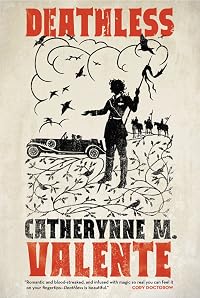
Moscow itself is the most intriguing character of this urban fantasy. It's an ancient place with an often brutal past, and the book's setting of the early 1990s isn't very kind, either. The premise here is intriguing, and really, the book acts as a gentle primer to the wonders of Russian mythology. I'm largely ignorant of Russian fables beyond Baba Yaga; I tried to read Cat Valente's book Deathless a while back and was overwhelmed by the other-worldlyness of it. Sedia applies a deft hand as she brings in Russian history and storied characters. The pace is perfect.
That said, I never fully connected with the main character from the present day, Galina. She's too singular in her goal--to save her sister--and as a reader, we never get to show more know her sister before she's lost. Galina never felt like a person beyond that, and that made the ending too predictable in that regard. show less
That said, I never fully connected with the main character from the present day, Galina. She's too singular in her goal--to save her sister--and as a reader, we never get to show more know her sister before she's lost. Galina never felt like a person beyond that, and that made the ending too predictable in that regard. show less
**Spoilerish
A beautiful book. Less - dreamy? lyrical? than many folklore / magic realist books of this kind are. Harsh edges, and the English tasted slightly foreign and translated, which added to the effect. As if the writer was translating her words from the Russian, translating her ideas, a culture, and there were jags where it didn't come through easily.
Other things I've read about modern Russia always seem to moralize slightly, even if perhaps they don't mean to - to have an agenda or a preconception, to know where they've gone wrong. Here I didn't get that feeling. Just that she was portraying people and a country without judging them, without trying to predict or prescribe.
The ending was almost perfect, I think, and yet I show more couldn't appreciate it. I'd grown invested in Galina, I had hopes for her. Identified with her, I guess. show less
A beautiful book. Less - dreamy? lyrical? than many folklore / magic realist books of this kind are. Harsh edges, and the English tasted slightly foreign and translated, which added to the effect. As if the writer was translating her words from the Russian, translating her ideas, a culture, and there were jags where it didn't come through easily.
Other things I've read about modern Russia always seem to moralize slightly, even if perhaps they don't mean to - to have an agenda or a preconception, to know where they've gone wrong. Here I didn't get that feeling. Just that she was portraying people and a country without judging them, without trying to predict or prescribe.
The ending was almost perfect, I think, and yet I show more couldn't appreciate it. I'd grown invested in Galina, I had hopes for her. Identified with her, I guess. show less
I'm a Russophile, and also a huge fan of Neil Gaiman. I agree that this is *reminiscent* of Gaiman's Neverwhere, but that is one of my all-time favorite books, and to actually *compare* the two is not useful. I thoroughly enjoyed The Secret History of Moscow, and would certainly recommend it -- but it would help if the reader were somewhat conversant with Russian culture and folklore, as that is part of the charm of this book. Expectations can really be a handicap. Go into this without expectations, and it is far more likely to enthrall.
Reviews at The Artemis Reader
Ekaterina Sedia is one of my new favorite authors. The Secret History of Moscow begins with the story of Galina who is looking for her missing sister after giving birth in the bathroom of their shared apartment. Galina spies a blackbird outside the window and is convinced her sister has been transformed. She is hesitant to say anything to her mother due to her history of schizophrenia. From there Galina encounters Fyodor, the artist, who has seen the strangeness invading Moscow, and Yakov, the cop, who has his own run in with the vanishing people and blackbirds. Together these characters venture into the underground world of Moscow to find out what is happening. The underground world Sedia creates is heavily show more influenced by Russian fairy tales, so having prior knowledge or access to a place to look them up is helpful while reading The Secret History of Moscow.
One thing I love about reading a Sedia novel is how easily I get sucked into the narrative. She weaves a colorful story with an ample amount of descriptions and character developments. The story started a little slow in the first 30 or 40 pages, the story moves quickly and before I knew it I had finished!
Sedia does an excellent job mixing fantasy, fairy tales and real people. I loved the mythological world underneath the streets of Moscow, it reminded me of Neil Gaiman’s Neverwhere. I think that is a large part in why I came to love The Secret History of Moscow. If you are a fan of Gaiman and the fantasy/mythological genres I definitely recommend looking into this book. show less
Ekaterina Sedia is one of my new favorite authors. The Secret History of Moscow begins with the story of Galina who is looking for her missing sister after giving birth in the bathroom of their shared apartment. Galina spies a blackbird outside the window and is convinced her sister has been transformed. She is hesitant to say anything to her mother due to her history of schizophrenia. From there Galina encounters Fyodor, the artist, who has seen the strangeness invading Moscow, and Yakov, the cop, who has his own run in with the vanishing people and blackbirds. Together these characters venture into the underground world of Moscow to find out what is happening. The underground world Sedia creates is heavily show more influenced by Russian fairy tales, so having prior knowledge or access to a place to look them up is helpful while reading The Secret History of Moscow.
One thing I love about reading a Sedia novel is how easily I get sucked into the narrative. She weaves a colorful story with an ample amount of descriptions and character developments. The story started a little slow in the first 30 or 40 pages, the story moves quickly and before I knew it I had finished!
Sedia does an excellent job mixing fantasy, fairy tales and real people. I loved the mythological world underneath the streets of Moscow, it reminded me of Neil Gaiman’s Neverwhere. I think that is a large part in why I came to love The Secret History of Moscow. If you are a fan of Gaiman and the fantasy/mythological genres I definitely recommend looking into this book. show less
Members
- Recently Added By
Lists

Books Read in 2014
2,344 works; 86 members

Novels Set Underground
28 works; 7 members
Talk Discussions
Past Discussions
The Secret History of Moscow in Fans of Russian authors (January 2016)
Author Information

Some Editions
Awards and Honors
Awards
Common Knowledge
- Original publication date
- 2007-11
- People/Characters
- Galina; Yakov; Fyodor; Sovin; Elena; Oksana
- Important places
- Moscow, Russia
- Dedication
- Моим родителям, Нине и Алексею, зта книга посвящается
- First words
- She had long pale fingers, tapered like candles at the church.
- Last words
- (Click to show. Warning: May contain spoilers.)And that was all that mattered.
- Blurbers
- Frost, Gregory; Gaiman, Neil; Kushner, Ellen; Lake, Jay; Shepard, Lucius
Classifications
Statistics
- Members
- 637
- Popularity
- 45,868
- Reviews
- 33
- Rating
- (3.44)
- Languages
- Czech, English, German, Polish
- Media
- Paper, Audiobook, Ebook
- ISBNs
- 6
- ASINs
- 4