On This Page
Description
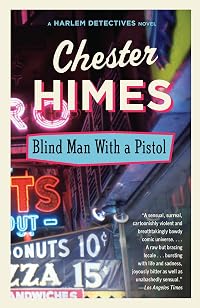
At once grotesquely comic and unflinchingly violent,nbsp;Blind Mannbsp;With a Pistolnbsp;is the final entry in Chester Himes's trailblazing Harlem Detectives series. nbsp; New York is sweltering in the summer heat, and Harlem is close to the boiling point. To Coffin Ed Johnson and Grave Digger Jones, at times it seems as if the whole world has gone mad. Trying, as always, to keep some kind of peace--their legendary nickel-plated Colts very much in evidence--Coffin Ed and Grave Digger find show more themselves pursuing two completely different cases through a maze of knifings, beatings, and riots that threaten to tear Harlem apart. show lessTags
Recommendations









Member Reviews
I shd really create a bkshelf called "crime fiction" & get rid of "mysteries" since most of what I call "mysteries" here are more appropriately called the former. That's the case here. Himes is yet-another author I've known about for a long time w/o ever having gotten around to reading until now. This bk is copyrighted 1969 & reading it falls conveniently on the heels of my listening to a record of an Eldridge Cleaver speech at Syracuse Univ in 1968. Why convenient? B/c Cleaver was a black radical in his prime in 1968 & Himes' bk has as its main background black social unrest & rioting around the same time.
The foreword:
""Motherfucking right, it's confusing; it's a gas, baby, you dig."
A Harlem intellectual"
Cleaver's record is called show more "Dig" & in his speech he explains the use of "motherfucker". &, yes, I'd call Cleaver an intellectual too.
ANYWAY, I'd almost rank Himes w/ Hammett & Chandler as a crime fiction writer but I want to read more by him before I go that far. This was a good start for me. Himes' preface explains the title of the bk:
"A friend of mine, Phil Lomax, told me this story about a blind man with a pistol shooting at a man who slapped him on a subway train and killing an innocent bystander [..:] and thought further that all unorganized violence is like a blind man with a pistol."
Himes' bk is a collection of portraits in Harlem, NYC. It's tied together by the 2 main characters, 2 black police detectives, trying to solve crimes that the reader is privy to the solution of but that the detectives are prevented from learning much about. & Himes uses this context as a way of introducing social commentary - esp from the detectives mouths when they talk w/ their lieutenant:
""All right, all right! I take it you know who started the riot."
"Some folks call him by one name, some another," Coffin Ed said.
"Some call him lack of respect for law and order, some lack of opportunity, some the teachings of the Bible, some the sins of their fathers," Grave Digger expounded. "Some call him ignorance, some poverty, some rebellion. Me and Ed look at him with compassion. We're victims."
"Victims of what?" Anderson asked foolishly.
"Victims of your skin," Coffin Ed shouted brutally"
At any rate, Himes is hardly an oversimplifier - he casts a cynical eye on almost all he sees - but I'd have to say it's mostly a fair one. show less
The foreword:
""Motherfucking right, it's confusing; it's a gas, baby, you dig."
A Harlem intellectual"
Cleaver's record is called show more "Dig" & in his speech he explains the use of "motherfucker". &, yes, I'd call Cleaver an intellectual too.
ANYWAY, I'd almost rank Himes w/ Hammett & Chandler as a crime fiction writer but I want to read more by him before I go that far. This was a good start for me. Himes' preface explains the title of the bk:
"A friend of mine, Phil Lomax, told me this story about a blind man with a pistol shooting at a man who slapped him on a subway train and killing an innocent bystander [..:] and thought further that all unorganized violence is like a blind man with a pistol."
Himes' bk is a collection of portraits in Harlem, NYC. It's tied together by the 2 main characters, 2 black police detectives, trying to solve crimes that the reader is privy to the solution of but that the detectives are prevented from learning much about. & Himes uses this context as a way of introducing social commentary - esp from the detectives mouths when they talk w/ their lieutenant:
""All right, all right! I take it you know who started the riot."
"Some folks call him by one name, some another," Coffin Ed said.
"Some call him lack of respect for law and order, some lack of opportunity, some the teachings of the Bible, some the sins of their fathers," Grave Digger expounded. "Some call him ignorance, some poverty, some rebellion. Me and Ed look at him with compassion. We're victims."
"Victims of what?" Anderson asked foolishly.
"Victims of your skin," Coffin Ed shouted brutally"
At any rate, Himes is hardly an oversimplifier - he casts a cynical eye on almost all he sees - but I'd have to say it's mostly a fair one. show less
“… that all unorganized violence is like a blind man with a pistol.”
With their usual tardiness, Grave Digger Jones and Coffin Ed Johnson don’t show up in this book until chapter four! And of course they are carrying their thirty-eight-caliber nickel-plated revolvers, on .44-caliber frames.
The blind man doesn’t show up until chapter 21! But it’s one heck of a chapter! Funny, and racially charged. The last few sentences of the chapter are perfect!
The rest of the book is good, but it does end with many loose ends. In fact, maybe all of the plotlines outside of the blind man's are not wrapped up. But I really enjoy reading these books for the characters, the language, and the glimpse into the world that makes of their Harlem. So show more for those things alone, it was a good read.
“This mother-raping white man gets himself killed on our beat chasing black sissies and you want us to whitewash the investigation.” - that’s the main plot of this book. And Black Power rallies by various groups.
“They welcomed the Black Jesus to their neighborhood. The white Jesus hadn’t done anything for them.”
“Lincoln,” Grave Digger said. “He hadn’t ought to have freed us if he didn’t want to make provisions to feed us,”…
“It was Harlem, where anything might happen.” show less
With their usual tardiness, Grave Digger Jones and Coffin Ed Johnson don’t show up in this book until chapter four! And of course they are carrying their thirty-eight-caliber nickel-plated revolvers, on .44-caliber frames.
The blind man doesn’t show up until chapter 21! But it’s one heck of a chapter! Funny, and racially charged. The last few sentences of the chapter are perfect!
The rest of the book is good, but it does end with many loose ends. In fact, maybe all of the plotlines outside of the blind man's are not wrapped up. But I really enjoy reading these books for the characters, the language, and the glimpse into the world that makes of their Harlem. So show more for those things alone, it was a good read.
“This mother-raping white man gets himself killed on our beat chasing black sissies and you want us to whitewash the investigation.” - that’s the main plot of this book. And Black Power rallies by various groups.
“They welcomed the Black Jesus to their neighborhood. The white Jesus hadn’t done anything for them.”
“Lincoln,” Grave Digger said. “He hadn’t ought to have freed us if he didn’t want to make provisions to feed us,”…
“It was Harlem, where anything might happen.” show less
Harlem, a summer in the late 1960s: temperatures are sweltering, and its residents are becoming more agitated and tense, fueled by a series of protests and violent murders that threaten to tear the neighborhood's fragile structure apart. Coffin Ed Johnson and Grave Digger Jones, two of NYC's finest detectives, are called upon to solve these crimes and help restore order. The two encounter a variety of odd and unsavory characters, including a preacher who claims to be 100 years old and the father of innumerable children by the "nuns" who share a squalid flat with him, and an inscrutable gay counterman at a restaurant on 125th Street who knows far more than he will admit to. Despite their efforts, the tension and violence progressively show more escalate, as former allies become hated enemies.
The title of this book refers to Himes' comment about unorganized violence in the black community, fueled by community leaders that urged black men to act, often recklessly. I found this novel to be disjointed and difficult to follow, which made for an unpleasant read. I understand that his earlier novels are better than this one, particularly If He Hollers Let Him Go, so I'll try Himes again in the near future. show less
The title of this book refers to Himes' comment about unorganized violence in the black community, fueled by community leaders that urged black men to act, often recklessly. I found this novel to be disjointed and difficult to follow, which made for an unpleasant read. I understand that his earlier novels are better than this one, particularly If He Hollers Let Him Go, so I'll try Himes again in the near future. show less
Reason Read: Sept 2024 TBR takedown. Reading 1001. This book is a crime novel and it the 8th book of the Harlem Cycle. It is set in the 1950s and early 1960s and featuring two black policemen called Grave Digger Jones and Coffin Ed Johnson. In 1958, Himes won France's Grand Prix de Littérature Policière. Chester's brother Joseph was refused treatment at a hospital under Jim Crow Laws after an explosion of gunpowder left him blind. Chester spent time in prison for an armed robbery where he began to write short stories and was published. Himes eventually traveled to France and met other writers there such as James Baldwin. He divorced, eventually remarried in a mixed race relationship. They moved to Spain where he died.
This book is a show more crime novel. A white man is found dead and semi naked in a red light district. A black suspect was seen running away with the dead man’s trousers. Somewhere else, a card appears in an urban convent window requesting “fertile womens, lovin God, inquire within”. Meanwhile, a vexed blind man sits on the subway with his pistol ready. Yes, it’s just another day in Chester Himes’ Harlem. The time period includes the Vietnam War, Black Power, Moslem blacks. The time span is about one day and it is all pretty chaotic. It is bawdy and there is a lot of sexual content with "sissies". All in all there is action but it is all confusing and it is hard to know what if anything is resolved. Low on plot development. show less
This book is a show more crime novel. A white man is found dead and semi naked in a red light district. A black suspect was seen running away with the dead man’s trousers. Somewhere else, a card appears in an urban convent window requesting “fertile womens, lovin God, inquire within”. Meanwhile, a vexed blind man sits on the subway with his pistol ready. Yes, it’s just another day in Chester Himes’ Harlem. The time period includes the Vietnam War, Black Power, Moslem blacks. The time span is about one day and it is all pretty chaotic. It is bawdy and there is a lot of sexual content with "sissies". All in all there is action but it is all confusing and it is hard to know what if anything is resolved. Low on plot development. show less
3.5 stars
Two Harlem cops are following two cases in Harlem at a time of racial tension and outbreak of riots and demonstration. The characters are odd and mostly corrupt or powerless police (with the exception of the two protagonists, two African American detectives whose beat is Harlem), prostitutes, criminals, some strange cultist types, etc. Characters are not really well developed and this is more driven by the cases and the stories about the riots.
Amazon described this as grotesquely comic and unflinchingly violent so I was pretty sure I was going to hate it. I did not hate it, there were parts that were entertaining and within the story there was some interesting commentary about race relationships in the North East. I liked the show more two detectives Coffin Ed and Grave Digger. There were definitely several very graphic descriptions of the violence and some very vivid imagery that I could have done without. There was something oddly engaging about the book but I can’t quite describe what I liked – this is normally not the type of book I would enjoy. The main problem for me was that I was so confused half the time that I didn’t know what was going on. Lots of characters, many fairly similar and thus I had a hard time following who did what and how everything was connected. I am not sure if this was me (reading too many books right now) or the book. show less
Two Harlem cops are following two cases in Harlem at a time of racial tension and outbreak of riots and demonstration. The characters are odd and mostly corrupt or powerless police (with the exception of the two protagonists, two African American detectives whose beat is Harlem), prostitutes, criminals, some strange cultist types, etc. Characters are not really well developed and this is more driven by the cases and the stories about the riots.
Amazon described this as grotesquely comic and unflinchingly violent so I was pretty sure I was going to hate it. I did not hate it, there were parts that were entertaining and within the story there was some interesting commentary about race relationships in the North East. I liked the show more two detectives Coffin Ed and Grave Digger. There were definitely several very graphic descriptions of the violence and some very vivid imagery that I could have done without. There was something oddly engaging about the book but I can’t quite describe what I liked – this is normally not the type of book I would enjoy. The main problem for me was that I was so confused half the time that I didn’t know what was going on. Lots of characters, many fairly similar and thus I had a hard time following who did what and how everything was connected. I am not sure if this was me (reading too many books right now) or the book. show less
Couldn't get into it, just depressing how little progress seems to have been made.
Good, but this one felt a bit more disjointed.
Members
- Recently Added By
Lists

1001 Books You Must Read Before You Die
1,448 works; 1,137 members

1,001 BYMRBYD Concensus
723 works; 27 members

Donald E. Westlake's Top Ten Mystery Books
20 works; 3 members

H.R.F. Keating's 100 Best Crime & Mystery Books
100 works; 8 members
Author Information

59+ Works 6,154 Members
Chester B. Himes was born in Jefferson City, Missouri on July 29, 1909. He attended Ohio State University in Columbus, but was expelled his freshman year for a prank. He began writing short stories and having them published in national magazines such as Abbott's Monthly Magazine and Esquire while in prison for armed robbery. He was paroled after 8 show more years and eventually joined the Works Progress Administration, where he served as a writer with the Ohio Writers' Project. His first novel, If He Hollers Let Him Go, is about the fear, anger, and humiliation of a black employee at a racist defense plant during World War II and was published in 1945. He moved to Paris, France in the 1950s and then to Moraira, Spain in 1969. He was more popular in Europe than in the United States and primarily wrote about black protagonists plagued by white racism and self-hate. His other works include Lonely Crusade, Pinktoes, Black on Black, The Quality of Hurt, and My Life As Absurdity. He also wrote detective novels set in Harlem, New York City including Run Man, Run, The Real Cool Killers, and Blind Man with a Pistol. He won the 1958 Grand Prix de Littérature Policière and the 1982 Columbus Foundation award. He died on November 12, 1984 from Parkinson's Disease. (Bowker Author Biography) show less
Awards and Honors
Series

Belongs to Publisher Series
Work Relationships
Common Knowledge
- Canonical title
- Blind Man with a Pistol
- Original title
- Blind Man with a Pistol
- Alternate titles
- Hot Day, Hot Night
- Original publication date
- 1969
- People/Characters
- Coffin Ed Johnson; Grave Digger Jones
- Important places
- New York, New York, USA; Harlem, New York, New York, USA
- Original language
- English
Classifications
Statistics
- Members
- 494
- Popularity
- 61,414
- Reviews
- 11
- Rating
- (3.48)
- Languages
- 8 — Catalan, English, French, German, Italian, Norwegian, Portuguese, Spanish
- Media
- Paper, Audiobook, Ebook
- ISBNs
- 27
- ASINs
- 11