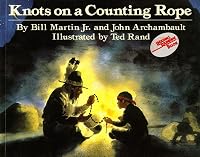
Knots on a Counting Rope
by Bill Martin, Jr., John Archambault
On This Page
Description
A grandfather and his blind grandson, Boy-Strength-of-Blue-Horses, reminisce about the young boy's birth, his first horse, and an exciting horse race.Tags
Recommendations



Member Reviews
This is a sweet story of the close relationship between an old grandfather and his young handicapped grandson. “Strength-of-Blue-Horses” is left blind after a difficult birth, but two blue horses give him the strength and will to survive. The boy and his horse learn how to run the trail and enter a race. They do not win, but his grandfather tells him he has “raced darkness and won.” The boy loves for his grandfather to tell the story of his birth, the blue horses, and the race. Each time he tells it, he ties a knot in the counting rope, which also signifies that he is growing older.
This book is valuable because it shows the close relationship between the grandfather and the boy. It is also a story of inclusion because the boy is show more never left out by the other boys, and of overcoming a handicap. show less
This book is valuable because it shows the close relationship between the grandfather and the boy. It is also a story of inclusion because the boy is show more never left out by the other boys, and of overcoming a handicap. show less
I had mixed feelings about the book after reading it. The story is about a grandfather telling his grandson of the night he was born and how he got his name. When the boy was born, he was ill, and his parents weren't sure if he was going to make it. The grandfather brought him outside where two blue horse stopped. The little boy stuck out his hand towards the horses, and the horses gave him the courage to see in the dark. Throughout the story, it is revealed that the little boy was born blind. The knots on the counting rope symbolize the boy's courage for overcoming his disability. I enjoyed this book because I like how the wisdom and courage where being passed down from one generation to the next throughout the book. Every page you show more could tell how much the little boy loved and looked up to his grandfather. Secondly, I enjoyed this book because organizing of the plot and how the story unfolds. As the story begins readers are unaware of the little boy's disability but, through reading the book it is revealed. One reason I did not enjoy this book was that I believe it did not represent native American people correctly. Overall, this book promotes self-confidence and to believe in yourself. show less
I liked the storytelling within the book. I liked how the book talks about passing stories through traditions and down from generation to generation. The grandson wants his grandfather to share the story of when he was born and other moments in the Boy's life. The knots represent these moments and how the boy will eventually be able to tell the story on his own. The rope with knots also represents time passing and the grandfather no longer being around to help the by tell his story. I also thought it was good that the boy overcame an obstacle and was able to accomplish the tasks.
I enjoyed this story for the fact that it is unlike one I’ve ever read before. The main character is a boy, my estimate about seven years old, who is visually impaired. The unique thing about this is that the reader does not know about his disability until the middle of the story. I appreciated that the author didn’t use the term blind. Martin simply dropped hints, for instance, saying that all the child could see was darkness. The illustration of the boy having black circles as eyes, with no pupils, could also infer his lack of sight. For this reason, readers can learn that visually impaired children can live the same lives as others. For example, the boy describes the sounds he hears and his internal reactions that in the end show more leave him with happiness. The author gives off a positive message at this point because a new life was born, a fawn, that the boy named and nurtured all himself. His grandfather supported him and encouraged him that he could train a horse, learn the trails, and ride in a race. All in which the boy did, with the support and love from his grandfather. The boy was recognized for riding the horse with ease and his named prevailed as Boy-Strength-Of-Blue-Horses. Even though he didn’t win the race, he was overwhelmed with joy and satisfaction.
I liked that the setting of the book took place “in the wild”. It gave insight to the Native American culture through the illustrations and activities that the characters did together, for example, riding on trails with wild horses. I like that it was relatable to students in the sense that the grandfather and child were sharing an old story and bonding. The reader could feel how eager the boy was to hear the story from his grandfather.
From the previous details, I think the overall big idea of the book is how significant and influential elders are in children’s lives. Another theme, in relation to the young boy, is that with courage, determination, and passion, an individual can have success.
The ending was particularly interesting. The author expressed that the grandfather knew he wasn’t going to be able to share the story with his grandson forever and will eventually pass on. This is unavoidable in life, and it is expressed in a positive way from the grandfathers’ last words in this story that even if he won’t be there physically, he will always be with his grandson. This can comfort readers and give them a positive outlook on the circumstance of losing their grandparents. show less
I liked that the setting of the book took place “in the wild”. It gave insight to the Native American culture through the illustrations and activities that the characters did together, for example, riding on trails with wild horses. I like that it was relatable to students in the sense that the grandfather and child were sharing an old story and bonding. The reader could feel how eager the boy was to hear the story from his grandfather.
From the previous details, I think the overall big idea of the book is how significant and influential elders are in children’s lives. Another theme, in relation to the young boy, is that with courage, determination, and passion, an individual can have success.
The ending was particularly interesting. The author expressed that the grandfather knew he wasn’t going to be able to share the story with his grandson forever and will eventually pass on. This is unavoidable in life, and it is expressed in a positive way from the grandfathers’ last words in this story that even if he won’t be there physically, he will always be with his grandson. This can comfort readers and give them a positive outlook on the circumstance of losing their grandparents. show less
This book is age-appropriate for primary students and classrooms.
A grandfather tells his grandson the story of how he was born, a story that he has heard many times before. He then goes onto tell many more stories, about his name, his horse, and the race. The grandfather ties another knot on the counting rope, and when the rope is full, the boy will know the story by heart and won't need it to be told anymore.
I would not recommend this books for use in the classroom, because it does not give an accurate depiction of Native Americans. It contains bits and pieces of different tribal traditions and experiences, and mixes them together into one story. This is not accurate or beneficial. It doesn't specify a tribe, which is generalizing a show more population group that has a lot of diversity and variation within it. show less
A grandfather tells his grandson the story of how he was born, a story that he has heard many times before. He then goes onto tell many more stories, about his name, his horse, and the race. The grandfather ties another knot on the counting rope, and when the rope is full, the boy will know the story by heart and won't need it to be told anymore.
I would not recommend this books for use in the classroom, because it does not give an accurate depiction of Native Americans. It contains bits and pieces of different tribal traditions and experiences, and mixes them together into one story. This is not accurate or beneficial. It doesn't specify a tribe, which is generalizing a show more population group that has a lot of diversity and variation within it. show less
Intermediate,
A boy and grandfather sit and recount boy's birth, and life story. The boy asks questions and the grandpa clarifies. The Grandfather directs the boy to understand what blue is, and what it means. The grandfather tells the boy hard truths but uplifts him enough to bare it.
I really liked this book and it's depiction of culture and family. I would use this book to talk about metaphors and symbolism. As well as life experience, and culture. I would also use this to discuss the importance of conversation.
A boy and grandfather sit and recount boy's birth, and life story. The boy asks questions and the grandpa clarifies. The Grandfather directs the boy to understand what blue is, and what it means. The grandfather tells the boy hard truths but uplifts him enough to bare it.
I really liked this book and it's depiction of culture and family. I would use this book to talk about metaphors and symbolism. As well as life experience, and culture. I would also use this to discuss the importance of conversation.
“Knots on a Counting Rope” written by Bill Martin Jr. and John Archambault is a great children’s story. This story is a Native American tale, which is much different from most children’s books. In this story, a young boy asks his grandfather to tell him a story he has heard many, many times. It is the story of the young boy’s life. The boy was born very weak and they thought they were going to lose him; one day the boy received strength from a great blue horse and he was named Boy Strength of Blue Horses. The horse and the boy were very strong together and rode together like the wind. Each time the story was told to the boy, his grandfather would tie another knot in the boys rope; one day, they rope would be filled and when show more that happened the boy would have enough courage to live on his own. This story is appropriate for older elementary students. show less
Members
- Recently Added By
Published Reviews
ThingScore 25
Written as a dialogue between a grandfather and his blind grandson, this romanticized tale recounts the boy's birth and childhood. No specific tribe is indicated, though the illustrations place the story in a Southwest setting. This is an unlikely American Indian story---for instance, the boy's name, Boy-Strength-of-Blue-Horses, and his constant interruptions of an elder.
added by CourtyardSchool
Lists

Under The Chinaberry Tree
194 works; 1 member

Reading Rainbow
193 works; 10 members

Youth: DEI
296 works; 2 members
Author Information

204+ Works 73,091 Members
Children's writer Bill Martin, Jr. was born and raised in Hiawatha, Kansas. Ironically, the future early childhood educator had difficulty reading until he taught himself, before graduating with a teaching certificate from Emporia State University. After graduation, he taught high school drama and journalism in Kansas. He served in the Army Air show more Force as a newspaper editor during World War II. He wrote his first book, The Little Squeegy Bug, for his brother, Bernard, an artist, to illustrate while recuperating from war wounds. It was published in 1945 and the brothers would go on to collaborate on 10 more books by 1955. He earned a master's degree and doctorate in early childhood education from Northwestern University and became principal of an elementary school in Evanston, Ill., where he developed innovative reading programs. In 1962 Martin moved to New York City to become editor of the school division of Holt, Rhinehart and Winston where he developed the literature-based reading programs Sounds of Language and The Instant Readers. Martin returned to full-time writing in 1972 and ended up writing over three hundred children's books during his career. His titles include; Brown Bear, Brown Bear, What do You See?, Polar Bear, Polar Bear, What do you Hear?, The Ghost-Eye Tree, Barn Dance, and Chicka, Chicka, Boom, Boom. He died on August 11, 2004 at the age of 88. (Bowker Author Biography) show less

66+ Works 30,200 Members
Some Editions
Awards and Honors
Awards
Distinctions
Series
Belongs to Publisher Series
Common Knowledge
- Canonical title
- Knots on a Counting Rope
- Original publication date
- 1987
- People/Characters
- Boy-Strength-of-Blue-Horses; Grandfather [in Knots]
- First words
- Tell me the story again, Grandfather.
- Last words
- (Click to show. Warning: May contain spoilers.)My love, like the strength of blue horses, will always surround you.
- Original language
- English
Classifications
- Genre
- Children's Books
- DDC/MDS
- 305.89 — Society, government, & culture Social sciences, sociology & anthropology Social group - Age, Gender, Ethnicity Ethnic and national groups Other ethnic and national groups
- LCC
- PZ7 .M3643 .K — Language and Literature Fiction and juvenile belles lettres Fiction and juvenile belles lettres Juvenile belles lettres
- BISAC
Statistics
- Members
- 2,366
- Popularity
- 8,344
- Reviews
- 67
- Rating
- (3.89)
- Languages
- English
- Media
- Paper, Audiobook
- ISBNs
- 21
- UPCs
- 1
- ASINs
- 12