On Art and Life
by John Ruskin
On This Page
Description
Throughout history, some books have changed the world. They have transformed the way we see ourselves - and each other. They have inspired debate, dissent, war and revolution. They have enlightened, outraged, provoked and comforted. They have enriched lives - and destroyed them. Now Penguin brings you the works of the great thinkers, pioneers, radicals and visionaries whose ideas shook civilization, and helped make us who we are.Tags
Recommendations

Member Reviews
This book consists of two sections, "The Nature of Gothic" from Vol. 2 of The Stones of Venice(1853), and "The Work of Iron", originally given as a lecture at Tunbridge Wells, and later published in The Two Paths(1859). I learnt of the importance of Ruskin's influence only recently when watching the movie Mr Turner(2014), starring one of my favourite actors, Timothy Spall, in the lead role. Ruskin was a supporter of the work of J.M.W. Turner and apparently played a role in elevating landscape painting as a major genre. I enjoy Turner's work immensely, and Ruskin's influence encouraged me to read some of his work. I have not been disappointed and I have discovered other works that I intend to read, which coincide with a particular show more publisher's series. I find the Dover Thrift Editions of great works easy to read in terms of size of print and page, and Dover also has a series on architecture (I have read the work of Le Corbusier from this series). Ruskin's The Seven Lamps of Architecture is presented in the Dover series, so this will be a welcome addition to my library. I find architecture fascinating, and while I recently designed and built my own chook pen, I stand in awe of the great architectural and engineering miracles we use every day, often without giving a thought for the magnificence of the outcome of thought and practice. There is something about architecture that stirs the soul. I am reminded of Lord Kenneth Clark's 1960s book and BBC TV series, Civilisation, where Clark tells the audience that his personal view of the history of civilisation focuses on art and architecture, and he does not care whether others should think him a fuddy-duddy or not. I went off in search of the precise words, and was struck that Clark's first words are Ruskin's! "Ruskin said":
Great nations write their autobiographies in three manuscripts—the book of their deeds, the book of their words, and the book of their art. Not one of these books can be understood unless we read the two others; but of the three, the only quite trustworthy one is the last.However, in this book, Ruskin first focuses on the nature of Gothic architecture, and presents an interesting view of workmanship and the worker: if one wants a consistent product, much like a machine would produce, then the man becomes a tool - if one wants a creative man, then the outcome will be inconsistent, but of a finer nature. As the subtitle reads:
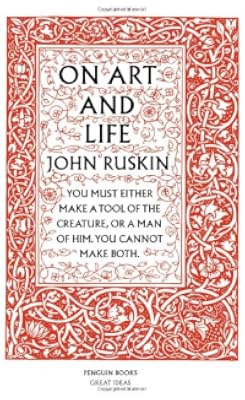
You must either make a tool of the creature, or a man of him. You cannot make both.Ruskin uses the example of Venetian glass and its artisanal qualities compared with the precisely uniform production glass of his time. I am pleased to learn that my own thoughts on the standardisation of education echo Ruskin's. Ruskin's idea of truth is:
...that great art, whether expressing itself in words, colours, or stones, does not say the same thing over and over again... Yet...I have the same argument against marking rubrics for essays - if it were possible to produce a perfect marking rubric, there would be no need to teach essay writing; yet marking rubrics are somehow seen as "fairer"! More likely, as Lord Kenneth Clark said, the ancient civilisations ended because they were "exhausted". Moreover, the next time I hear someone mention coining a phrase like "change fatigue", my scepticism will know no bounds! Ruskin (p. 36) basically outlines all we need to know about change, and more eloquently than any recent airport-read management guru book. The trouble with reading classic texts is one realises how much written today is a rip-off of the past, but presents itself as something new, without a hint of an acknowledgement. And this is not because it is plagiarised, but that the contemporary author has simply not done her or his homework, and has independently thought up something that had already been thought before. Imagine how much further we might advance if we did not have to reinvent the wheel every time we began to apply our thought-forces to a problem? Hence the literature review. But what if one could be original. Being original is more difficult than one might think. In the second section of the book, Ruskin discusses the importance of iron in its many forms. Here I learn more about geography, and the chalybeate spring (a natural mineral spring containing iron salts) at Tunbridge Well, and the importance of this site to so many great artists. Ruskin was addressing a general audience and arriving at turning "swords into ploughshares" (Isaiah 2:4) from a mineral spring is a fascinating journey that is captivating, if a little bewildering, as if caught up in some 1960s psychological experiment. There are several messages in this book, but most prominent is the belief that forcing labourers to work as machines in order to reduce the price of goods was STEALING (capitalised in the original) from the workers. (Ruskin believed that "the architect [should] work in the mason's yard with his men", p. 25) Moreover, love of order (or the standardisation aesthetic, as I would call it) is useful in "practical matters":
this is... only hidden from us... by false teaching. Nothing is a great work of art,
for the production of which rules or models can be given.
...but love of order has no more to do with our right enjoyment of architecture or painting, than love of punctuality with the appreciation of an opera.I daresay that Ruskin, if he were writing today, would be regarded as "discursive". But I like his style. There is so much that underpins his work, a depth of reading that is obvious, yet creates the scaffolding for his originality; political, yet not radical; radical, yet not revolutionary; revolutionary, yet not wanting to overthrow the status quo; accepting of change, or more importantly for my own thinking, of the punctuated equilibrium of living and civilisation, but all moving toward an end where men (sic) no longer wage war, having learnt to live peacefully (much like the literal truth-speaking "long-livers" in George Bernard Shaw's Back to Methuselah). I must admit that the portrayal of John Ruskin in Mr Turner influenced my reading mind, and I pictured a lisping flatterer who was socially-tolerated. But now having read Ruskin "in the flesh", I am inspired, and I just may have found the source of so many other things I enjoy (landscape painting, Clark's Civilisation, Turner's art, etc), and a new appreciation for the role of the critic. show less
John Ruskin (1819-1900), gave us impassioned critique of a society obsessed with getting and spending that struck a chord that has continued to reverberate with thoughtful individuals across the political spectrum. Ruskin was a seer in both senses of the word: an acutely perceptive observer of art, architecture, literature, and Nature, and an uncannily prescient Cassandra who warned of developing threats - moral, social, economic, cultural, and environmental - to human life and happiness.
Ruskin's politics were something of a paradox. A forceful critic of greed, the profit motive, the degradation of labor, and economic injustice, he was also a staunch believer in hierarchy and authority.
"John Ruskin, the nineteenth-century British show more writer with the most wide-ranging influence on contemporary thought, has gone unread for a long time. His ideas have lived through the words of other writers while his own works are ignored. Their style suited an age that found the fortymile-per-hour speed of the railway frightening, that never dreamed of multi-tasking, channel surfing, and sound bites. Reading was then a majestic activity in pace and status, total attention demanded by it and total attention given it. We have lost that patience and those skills, so Ruskin's prose seems difficult, and we avoid it. That is our loss". Phyllis Rose.
Some quotes from Ruskin:
"Of all inorganic substances, acting in their own proper nature, without assistance or combination, water is the most wonderful. If we think of it as the source of all the changefulness and beauty which we have seen in clouds; then as the instrument by which the earth we have contemplated was modelled into symmetry, and its crags chiselled into grace; then as, in the form of snow, it robes the mountains it has made with that transcendent light which we could not have conceived if we had not seen; then as it exists in the foam of the torrent, in the iris which spans it, in the morning mist which rises from it, in the deep crystalline pools which its hanging shore, in the broad lake and glancing river; finally, in that which is to all human minds the best emblem of unwearied unconquerable power, the wild, various, fantastic, tameless unity of the sea; what shall we compare to this mighty, this universal element, for glory and for beauty? or how shall we follow its eternal changefulness of feeling? It is like trying to paint a soul. show less
Ruskin's politics were something of a paradox. A forceful critic of greed, the profit motive, the degradation of labor, and economic injustice, he was also a staunch believer in hierarchy and authority.
"John Ruskin, the nineteenth-century British show more writer with the most wide-ranging influence on contemporary thought, has gone unread for a long time. His ideas have lived through the words of other writers while his own works are ignored. Their style suited an age that found the fortymile-per-hour speed of the railway frightening, that never dreamed of multi-tasking, channel surfing, and sound bites. Reading was then a majestic activity in pace and status, total attention demanded by it and total attention given it. We have lost that patience and those skills, so Ruskin's prose seems difficult, and we avoid it. That is our loss". Phyllis Rose.
Some quotes from Ruskin:
"Of all inorganic substances, acting in their own proper nature, without assistance or combination, water is the most wonderful. If we think of it as the source of all the changefulness and beauty which we have seen in clouds; then as the instrument by which the earth we have contemplated was modelled into symmetry, and its crags chiselled into grace; then as, in the form of snow, it robes the mountains it has made with that transcendent light which we could not have conceived if we had not seen; then as it exists in the foam of the torrent, in the iris which spans it, in the morning mist which rises from it, in the deep crystalline pools which its hanging shore, in the broad lake and glancing river; finally, in that which is to all human minds the best emblem of unwearied unconquerable power, the wild, various, fantastic, tameless unity of the sea; what shall we compare to this mighty, this universal element, for glory and for beauty? or how shall we follow its eternal changefulness of feeling? It is like trying to paint a soul. show less
Not quite what I was expecting, but interesting none the less. Who knew a discussion about Gothic architecture could be so rich with so many ideas tied up in it?
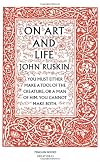
I’m a big believer in reading primary texts. I get a little sick at the idea of studying a philosopher without reading the works of that philosopher, but I’m realistic enough to know that for the general reader, primary texts aren’t always a good option. They’re often too long or too involved for someone just looking for a passing familiarity, and so we end up relying on secondary sources. If this little book from the Penguin Great Ideas series is typical, this series is a great way of filling the need for primary texts for the general reader. Plus, with its lovely embossed cover, this book is a thing of beauty.
The 98-page book contains just two essays by Ruskin: “The Nature of Gothic” from The Stone of Venice and “The show more Work of Iron in Nature, Art, and Policy,” a lecture Ruskin delivered in 1858. My only complaint is that there’s no actual context or introduction provided. Just a few pages of basic biographical and historical information would have made this a perfect little introduction to Ruskin.
See my complete review at Shelf Love. show less
The 98-page book contains just two essays by Ruskin: “The Nature of Gothic” from The Stone of Venice and “The show more Work of Iron in Nature, Art, and Policy,” a lecture Ruskin delivered in 1858. My only complaint is that there’s no actual context or introduction provided. Just a few pages of basic biographical and historical information would have made this a perfect little introduction to Ruskin.
See my complete review at Shelf Love. show less
Indeholder "The Nature of Gothic", "The Work of Iron".
"The Nature of Gothic" handler om ???
"The Work of Iron" handler om ???
???
Teksten "The Nature of Gothic" er taget fra "The Stone of Venice" og "The Work of Iron in Nature, Art, and Policy" er teksten til en forelæsning som Ruskin holdt i 1858. Han er ikke meget for massereproduceret kunst.
"The Nature of Gothic" handler om ???
"The Work of Iron" handler om ???
???
Teksten "The Nature of Gothic" er taget fra "The Stone of Venice" og "The Work of Iron in Nature, Art, and Policy" er teksten til en forelæsning som Ruskin holdt i 1858. Han er ikke meget for massereproduceret kunst.
Nov 7, 2016Danish
Ratings
Members
- Recently Added By
Author Information

498+ Works 9,075 Members
Ruskin was one of the most influential man of letters of the nineteenth century. An only child, Ruskin was born in Surrey. He attended Christ Church, Oxford, from 1839 to 1842. His ties to his parents, especially his mother, were very strong, and she stayed with him at Oxford until 1840, when, showing ominous signs of consumption, he left for a show more long tour of Switzerland and the Rhineland with both parents. His journeys to France, Germany, and, especially, Italy formed a great portion of his education. Not only did these trips give him firsthand exposure to the art and architecture that would be the focus of much of his long career; they also helped shape what he felt was his main interest, the study of nature. Around this time Ruskin met the landscape artist J. M. W. Turner, for whose work he had developed a deep admiration and whom he lauded in his Modern Painters (1843). In 1848 Ruskin married Euphemia (Effie) Gray, a distant cousin 10 years his junior. This relationship has been the focus of much scholarship, for six years later the marriage was annulled on the grounds of nonconsummation, and in 1855 Effie married John Everett Millais, the Pre-Raphaelite painter and an acquaintance of Ruskin. During the years 1849--52, Ruskin lived in Venice, where he pursued a course of architectural studies, publishing The Seven Lamps of Architecture (1849) and where he began The Stones of Venice (1851--53). It was also during this period that Ruskin's evangelicalism weakened, leading finally to his "unconversion" at Turin in 1858. His subsequent interest in political economy was clearly stated when, echoing his "hero," Carlyle, Ruskin remarked in the last volume of Modern Painters that greed is the deadly principle that guides English life. In a series of essays in Cornhill Magazine attacking the "pseudo-science" of political economists like J. S. Mill, David Ricardo, and Thomas Malthus, Ruskin argues that England should base its "political economy" on a paternalistic, Christian-based doctrine instead of on competition. The essays were not well received, and the series was canceled short of completion, but Ruskin published the collected essays in 1862 as Unto This Last. At the same time, he renewed his attacks on the political economists in Fraser's Magazine, later publishing these essays as Munera Pulveris (1872). From about 1862 until his death, Ruskin unsuccessfully fought depression. He was in love with Rose La Touche, whom he met when she was 11 and he 41. When she turned 18, Ruskin proposed, but the her parents opposed the marriage, and religious differences (she was devout; Ruskin was at this time a freethinker) kept them from ever marrying. La Touche died in 1875, insane, and three years later Ruskin experienced the first of seven attacks of madness that would plague him over the next 10 years. By 1869 Ruskin had accepted the first Slade Professorship of Fine Art at Oxford, begun his serial Fors Clavigera, been sued and found guilty of libel for his attack on Whistler in Fors Clavigera (he was fined a farthing), and resigned his professorship. Ruskin's work was instrumental in the formation of art history as a modern discipline. A capable artist, he complemented his technical understanding of art with insightful analysis and passionately held social ideals. His social writings are of interest today primarily as artifacts of the age, but his art criticism still holds an important place, especially in his appreciation of Turner. There is a vast number of works on Ruskin. From a literary standpoint, John Rosenberg's study, although dated because of many of its assumptions, is still an outstanding book. Jay Fellows's work is interesting and has caused much controversy among Ruskin scholars. (Bowker Author Biography) show less
Some Editions
Series
Belongs to Publisher Series
Penguin Great Ideas (15)
Common Knowledge
- Canonical title
- On Art and Life
- Original publication date
- 2004
- First words
- If the reader will look back to the division of our subject which was made in the first chapter of the first volume, he will find that we are now about to enter upon the examination of that school of Venetian architecture whi... (show all)ch forms an intermediate step between the Byzantine and Gothic forms; but which I find may be conveniently considered in its connexion with the latter style.
- Quotations
- You must either make a tool of the creature, or a man of him. You cannot make him both.
- Last words
- (Click to show. Warning: May contain spoilers.)For many a year to come, the sword of every righteous nation must be whetted to save or to subdue; nor will it be by patience of others' suffering, but by the offering of your own, that you will ever draw nearer to the time when the great change shall pass upon the iron of the earth; -- when men shall beat their swords into ploughshares, and their spears into pruning-hooks; neither shall they learn war any more.
Classifications
Statistics
- Members
- 709
- Popularity
- 40,251
- Reviews
- 5
- Rating
- (3.69)
- Languages
- English, French
- Media
- Paper, Ebook
- ISBNs
- 5
- ASINs
- 8