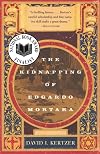
The Kidnapping of Edgardo Mortara
by David I. Kertzer
On This Page
Description
Soon to be a major motion picture from Steven Spielberg. A National Book Award Finalist The extraordinary story of how the vatican's imprisonment of a six-year-old Jewish boy in 1858 helped to bring about the collapse of the popes' worldly power in Italy. Bologna: nightfall, June 1858. A knock sounds at the door of the Jewish merchant Momolo Mortara. Two officers of the Inquisition bust inside and seize Mortara's six-year-old son, Edgardo. As the boy is wrenched from his father's arms, his show more mother collapses. The reason for his abduction: the boy had been secretly "baptized" by a family servant. According to papal law, the child is therefore a Catholic who can be taken from his family and delivered to a special monastery where his conversion will be completed. With this terrifying scene, prize-winning historian David I. Kertzer begins the true story of how one boy's kidnapping became a pivotal event in the collapse of the Vatican as a secular power. The book evokes the anguish of a modest merchant's family, the rhythms of daily life in a Jewish ghetto, and also explores, through the revolutionary campaigns of Mazzini and Garibaldi and such personages as Napoleon III, the emergence of Italy as a modern national state. Moving and informative, the Kidnapping of Edgardo Mortara reads as both a historical thriller and an authoritative analysis of how a single human tragedy changed the course of history. show lessTags
Recommendations































Member Reviews
I'm sure I must have heard about this practice of abducting Jewish children from their parents when they were baptized by someone completely unrelated to them, but I completely forgot.
It is mind boggling that in the 1858 the Jews in the Papal States are still considered devoid of basic human rights and any human dignity. The story of a child taken by force from his family and not returned regardless all the international intervention in the matter is so frightening on one hand, but so very enlightening on the other. The treatment of Jews is so abominably different even in the days when some human rights become achievable for practically everyone else provides a very logical reasoning for the events of the Holocaust, that will come in show more less than a century. show less
It is mind boggling that in the 1858 the Jews in the Papal States are still considered devoid of basic human rights and any human dignity. The story of a child taken by force from his family and not returned regardless all the international intervention in the matter is so frightening on one hand, but so very enlightening on the other. The treatment of Jews is so abominably different even in the days when some human rights become achievable for practically everyone else provides a very logical reasoning for the events of the Holocaust, that will come in show more less than a century. show less
A Jewish family's illiterate Catholic housekeeper sprinkles well-water over an infant child and furtively mumbles the baptismal sacrament. When the Inquisitor learns of the deed, he orders the kidnapping of the then six-year-old Jewish boy. This foul deed is almost certainly sanctioned by the highest levels of the Catholic hierarchy. The police forcibly remove the child from his family's Bologna home and swiftly transport him to the Church's House of Catechumens in Rome for reeducation. Despite all protests from the boy's family and the Jewish community and in the face of a destabilizing international uproar, the Holy Father refuses to yield. By holy grace, the boy has been miraculously saved and the Church keeps him, inculcates him in show more the Catholic Christian religion, and assiduously converts the boy.
The boy kidnapped in the name of religion? Edgardo Mortara. The Holy Father in question? Pope Pius IX. The year? 1858. That's right 1858, not 1458, not 1658, but smack dab in the middle of 19th century Europe.
Historian David Kertzer tells the complete tale in his excellent work, `The Kidnapping of Edgardo Mortara.' As Kertzer relates in the epilogue he learned to his surprise that there was no reliable work on this topic. Kertzer sets out to remedy this gap and succeeds by examining the episode in fine detail. Using detailed court and police investigation records, Kertzer explores numerous evidentiary questions such as whether the baptism took place at all, whether the proper conditions for a valid lay baptism existed, who put the girl up to it, and how did the Inquisition find out about it?
The story is told against the background of the movement to unify Italy under secular rule. And here is yet another surprise for the uninitiated reader, including this one: until 1861 the Pope was still the temporal ruler of a wide swath of the Italian peninsula (this rule continued on a lesser scale to 1870). The treatment of young Edgardo was one of the factors that helped build support across Italy and internationally for the Risorgimento or Italian reunification.
The episode also hastened Pius IX's evolution, shall we say, to reactionary beliefs. Pius IX not only made papal infallibility part of Church dogma, but he also issued his infamous Syllabus of Errors in 1864, a broad attack on rationalism, science, and religious freedom - really a frontal assault on the Enlightenment and most other signs of progress in the previous three centuries. If Kertzer's book does nothing more than direct his reader's attention to this astonishing document, he has succeeded in the historian's task.
Kertzer examines the trial of the Inquisitor in detail and the formidable difficulties facing the prosecution. For example, what crime did the Inquisitor commit when his acts were legal at the time he committed them? Would the new government prove willing to violate the fundamental principle that the accused must have had notice of the illegality of his acts?
As for Edgardo, he remained with the Church fathers until he reached his majority and by then his conversion had firmly taken hold. He went on to become a famed proselytizer for Catholicism especially among the Jewish peoples. This role may help explain why this story has remained untold: it embarrassed Jews and Catholics alike.
Some readers may find the detail devoted to the investigations and trials to be excessive, but bear in mind that Kertzer is writing the seminal history of Edgardo's kidnapping. A fascinating tale full of surprises, very highly recommended. show less
The boy kidnapped in the name of religion? Edgardo Mortara. The Holy Father in question? Pope Pius IX. The year? 1858. That's right 1858, not 1458, not 1658, but smack dab in the middle of 19th century Europe.
Historian David Kertzer tells the complete tale in his excellent work, `The Kidnapping of Edgardo Mortara.' As Kertzer relates in the epilogue he learned to his surprise that there was no reliable work on this topic. Kertzer sets out to remedy this gap and succeeds by examining the episode in fine detail. Using detailed court and police investigation records, Kertzer explores numerous evidentiary questions such as whether the baptism took place at all, whether the proper conditions for a valid lay baptism existed, who put the girl up to it, and how did the Inquisition find out about it?
The story is told against the background of the movement to unify Italy under secular rule. And here is yet another surprise for the uninitiated reader, including this one: until 1861 the Pope was still the temporal ruler of a wide swath of the Italian peninsula (this rule continued on a lesser scale to 1870). The treatment of young Edgardo was one of the factors that helped build support across Italy and internationally for the Risorgimento or Italian reunification.
The episode also hastened Pius IX's evolution, shall we say, to reactionary beliefs. Pius IX not only made papal infallibility part of Church dogma, but he also issued his infamous Syllabus of Errors in 1864, a broad attack on rationalism, science, and religious freedom - really a frontal assault on the Enlightenment and most other signs of progress in the previous three centuries. If Kertzer's book does nothing more than direct his reader's attention to this astonishing document, he has succeeded in the historian's task.
Kertzer examines the trial of the Inquisitor in detail and the formidable difficulties facing the prosecution. For example, what crime did the Inquisitor commit when his acts were legal at the time he committed them? Would the new government prove willing to violate the fundamental principle that the accused must have had notice of the illegality of his acts?
As for Edgardo, he remained with the Church fathers until he reached his majority and by then his conversion had firmly taken hold. He went on to become a famed proselytizer for Catholicism especially among the Jewish peoples. This role may help explain why this story has remained untold: it embarrassed Jews and Catholics alike.
Some readers may find the detail devoted to the investigations and trials to be excessive, but bear in mind that Kertzer is writing the seminal history of Edgardo's kidnapping. A fascinating tale full of surprises, very highly recommended. show less
The Kidnapping of Edgardo Mortara describes a period during the mid 1800s when Italy was becoming a unified, secular country, modeled after France, Great Britain and other European countries. Prior to this time, it was a conglomerate of separate states with large areas ruled by the Catholic Church. Edgardo, a young Jewish boy, was taken from his home because he was reportedly baptized by a young illiterate servant working in the Mortara home. What made this so incredible was that, although baptism was not permitted without parental consent, once it was done, the Church felt it had no choice but to remove the child from his home so that he could be brought up as a proper Catholic. At the same time, there was a movement in Italy to unite show more under a secular ruler. The author contends that the Mortara case, although not unusual, was so widely publicized across the western world that it tipped the balance in favor of anti-papist sentiment and precipitated the annexation (under force) of the papal lands to Sardinia and the other parts of Italy. I don't know if I entirely buy this premise, but it certainly suggested to the rest of Europe an archaic way of thinking that they no longer wished to support.
My expectations for this book were slightly different. I think there was more of an emphasis on history than I expected, although the personal plight of the Mortara family was addressed within the context of the struggle between secular and religious forces in Italy. I was fascinated to learn that there was still an Inquisition in Italy at this time and that regions outside the papal rule did not require Jews to live in ghettos. The book clearly serves as a warning that theocracies are dangerous as governing bodies and likely to treat those of other religions as second class citizens. For the most part, the book was well written, although there were times when it seemed disorganized and repetitive, because it would go back a few centuries, then come back the the 1800s. I was also unfamiliar with the Catholic hierarchy, so it took me a while to realize that Cardinals could be archbishops etc. Nevertheless, I enjoyed the book and found that it significantly broadened my understanding of European history.
For those of you with the kindle edition: there are numerous typos, which did not really affect my enjoyment of the book, but just so you know... show less
My expectations for this book were slightly different. I think there was more of an emphasis on history than I expected, although the personal plight of the Mortara family was addressed within the context of the struggle between secular and religious forces in Italy. I was fascinated to learn that there was still an Inquisition in Italy at this time and that regions outside the papal rule did not require Jews to live in ghettos. The book clearly serves as a warning that theocracies are dangerous as governing bodies and likely to treat those of other religions as second class citizens. For the most part, the book was well written, although there were times when it seemed disorganized and repetitive, because it would go back a few centuries, then come back the the 1800s. I was also unfamiliar with the Catholic hierarchy, so it took me a while to realize that Cardinals could be archbishops etc. Nevertheless, I enjoyed the book and found that it significantly broadened my understanding of European history.
For those of you with the kindle edition: there are numerous typos, which did not really affect my enjoyment of the book, but just so you know... show less
Sadly, my background in European history is quite deficient, so much of what was in this book I had to reread a couple of times. Even still, this is a really engrossing book; extremely well written, deftly organized, and very readable even to folks like me who have little grounding in European history (especially Italian history).
It's a sad story of a little Jewish boy (Edgardo Mortara) taken from his parents by the Catholic church because the child had supposedly been baptized by the family's Catholic servant, and their efforts to get him back. It is told against the backdrop of the turmoil surrounding the unification of Italy and backlash against Papal temporal rule in the middle part of the nineteenth century.
It highlights very well show more the discrimination practiced against Jews - particularly by the Catholic church - presaging what would happen to them in the 1940s.
Highly recommended! show less
It's a sad story of a little Jewish boy (Edgardo Mortara) taken from his parents by the Catholic church because the child had supposedly been baptized by the family's Catholic servant, and their efforts to get him back. It is told against the backdrop of the turmoil surrounding the unification of Italy and backlash against Papal temporal rule in the middle part of the nineteenth century.
It highlights very well show more the discrimination practiced against Jews - particularly by the Catholic church - presaging what would happen to them in the 1940s.
Highly recommended! show less
This book was a finalist for the National Book Award, and deservedly so. But the catch is, you probably really have to like a good history; the story is not told in straightforward, narrative style, and it isn't a novel. Parts of it read like one, but it probably isn't a book that you'll want to check out if you're looking for a "folksy" history for the lay person. This book has a great deal to do with the risorgimento, the unification of Italy, and it does give a lot of well-researched historical treatment to Edgar Mortara's story and that of his parents, the Jewish community at the time, and the outrage that was the last straw in the eyes and minds of many calling for the removal of the Pope from temporal power & the elimination of show more his territory, the Papal States. If you're interested in that topic, Kertzer has a marvelous book called Prisoner of the Vatican, which I can very highly recommend; again, another history.
But let me try to synopsize here. In 1858, the family of Momolo Mortara, living in Bologna, answer the door to find two Inquisition officers at their door, saying that they were there to take away their boy Edgardo, who was just 6. It turns out that when Edgardo was younger, a Catholic servant girl working in the Mortara home thought Edgardo was going to die during an illness, and "baptized" him. The law was that having been baptized (and how a mere girl could do this and have it stick is fascinating reading with long history), Edgardo was no longer a Jew and had to be put under the protection of the Catholic Church. Well, naturally, this didn't sit well with Edgardo's family; the story tells all about their efforts for years trying to reclaim their son. At first, the office of the Inquisition would not even tell them where he was being taken; Edgardo's father, Momolo, was simply told that the boy was going to "someone who is a good family man." (33) Before you think that this was an isolated case, the author notes that "the taking of Jewish children was a common occurrence in nineteenth-century Italy." (34) These types of "clandestine" baptisms occurred often. But they were also punishable by corporal punishment (44), but the cases where this law was actually applied were pretty rare.
One of the most interesting parts of this book was the "clash of two realities," or the Jewish take on the situation v. the Catholic take. The accounts in the newspapers & in reported testimony are absolutely fascinating to read... you can't tell who's telling the truth, although it's easy to see that both sides are embellishing for their own purposes. But even more fascinating is the fact that the news of this kidnapping leaked out of the Bologna borders into Europe & even into America -- there the same polemic started all over again, based on one's side in the religious debate. The case spawned several plays -- for example, the author notes "La Famiglia Ebrea" (The Jewish Family) in 1861 -- in which a Jewish boy was baptized in secret by the family servant & raised by Jesuits. However, in this version, the boy "nourished a smoldering hatred for those who had deprived him of his parents," and eventually came to lead the fight for Italy's unification! (252-253)
Absolutely fascinating; I also found a reference to the testimony of Edgardo Mortara himself, a deposition taken at a time when Pius IX (the pope at the time) was being considered for sainthood: here -- again, you have to kind of take it for what it's worth.
I didn't decide to read this as a part of any anti-Catholic campaign; the premise looked interesting and the subject matter looked intriguing. It is a very well-researched book, and it's obvious the author has a passion for his subject. The link between the kidnapping of Edgardo Mortara and the chain of events leading to unification of Italy is well established in his research.
Very well done, and if you are at all into history, you may really enjoy this. I had also read that at some point there was going to be a film made about this (with Anthony Hopkins as Pius IX), but funding fell through or some such thing.
I'm happy to have had the opportunity to read this one! show less
But let me try to synopsize here. In 1858, the family of Momolo Mortara, living in Bologna, answer the door to find two Inquisition officers at their door, saying that they were there to take away their boy Edgardo, who was just 6. It turns out that when Edgardo was younger, a Catholic servant girl working in the Mortara home thought Edgardo was going to die during an illness, and "baptized" him. The law was that having been baptized (and how a mere girl could do this and have it stick is fascinating reading with long history), Edgardo was no longer a Jew and had to be put under the protection of the Catholic Church. Well, naturally, this didn't sit well with Edgardo's family; the story tells all about their efforts for years trying to reclaim their son. At first, the office of the Inquisition would not even tell them where he was being taken; Edgardo's father, Momolo, was simply told that the boy was going to "someone who is a good family man." (33) Before you think that this was an isolated case, the author notes that "the taking of Jewish children was a common occurrence in nineteenth-century Italy." (34) These types of "clandestine" baptisms occurred often. But they were also punishable by corporal punishment (44), but the cases where this law was actually applied were pretty rare.
One of the most interesting parts of this book was the "clash of two realities," or the Jewish take on the situation v. the Catholic take. The accounts in the newspapers & in reported testimony are absolutely fascinating to read... you can't tell who's telling the truth, although it's easy to see that both sides are embellishing for their own purposes. But even more fascinating is the fact that the news of this kidnapping leaked out of the Bologna borders into Europe & even into America -- there the same polemic started all over again, based on one's side in the religious debate. The case spawned several plays -- for example, the author notes "La Famiglia Ebrea" (The Jewish Family) in 1861 -- in which a Jewish boy was baptized in secret by the family servant & raised by Jesuits. However, in this version, the boy "nourished a smoldering hatred for those who had deprived him of his parents," and eventually came to lead the fight for Italy's unification! (252-253)
Absolutely fascinating; I also found a reference to the testimony of Edgardo Mortara himself, a deposition taken at a time when Pius IX (the pope at the time) was being considered for sainthood: here -- again, you have to kind of take it for what it's worth.
I didn't decide to read this as a part of any anti-Catholic campaign; the premise looked interesting and the subject matter looked intriguing. It is a very well-researched book, and it's obvious the author has a passion for his subject. The link between the kidnapping of Edgardo Mortara and the chain of events leading to unification of Italy is well established in his research.
Very well done, and if you are at all into history, you may really enjoy this. I had also read that at some point there was going to be a film made about this (with Anthony Hopkins as Pius IX), but funding fell through or some such thing.
I'm happy to have had the opportunity to read this one! show less
True story of the Catholic Inquisition in Italy in 1858 taking a 6 yr old boy from his Jewish family because the illiterate maid had secretly baptised him when he was sick! Stunning story told in great detail.
Read Feb 2007
Read Feb 2007
Heartbreaking story of Edguardo Mortara's kidnapping at age 6, and how it affected his family, the Church, European history, the Jewish community and the press.
Members
- Recently Added By
Lists

MBL's Top 5 of 2014
5 works; 1 member
Author Information

28+ Works 2,096 Members
He is a professor anthropology & history at Brown University. He lives in Providence, Rhode Island. (Publisher Provided)
Awards and Honors
Common Knowledge
- Canonical title*
- Pie IX et l'enfant juif. L'enlèvement d'Edgardo Mortara
- Original title
- The kidnapping of Edgardo Mortara
- Original publication date
- 1997
- People/Characters
- Pius IX, Pope (Beatified, Giovanni Maria Mastai Ferretti, 1792–1878); Victor Emmanuel II of Italy; Napoleon III; Edgardo Mortara; Giuseppe Garibaldi; Giuseppe Agostini (show all 26); Giacomo Cardinal Antonelli; Flaminio Bolaffi; Enrico Bottrigari; Regina Bussolari; Francesco Carboni; Camillo di Cavour (Count); Luigi Carlo Farini; Pier Gaetano Feletti (Inquisitor); Cesare Lepori; Pietro Lucidi; Sir Moses Montefiore; Anna Morisi, "Nina"; Marianna Mortara (nee Padovani); Momolo Mortara (given name Salomone); Napoleon III; Angelo Padovani; Pasquale Saragoni; Sabatino Scazzocchio; Rosa Tagnazzi; Michele Cardinal Viale-Prela
- Important places
- Rome, Italy; Vatican City; Bologna, Emilia Romagna, Italia
- Important events
- Mortara Case
- Original language*
- Anglais (Etats-Unis) (Etats-Unis)
*Some information comes from Common Knowledge in other languages. Click "Edit" for more information.
Classifications
- Genres
- History, Nonfiction, Religion & Spirituality, General Nonfiction, Biography & Memoir
- DDC/MDS
- 945.004924 — History & geography History of Europe Italy Italy
- LCC
- DS135 .I9 .M595 — History of Europe, Asia, Africa and Oceania Asia History of Asia Israel (Palestine). The Jews Jews outside of Palestine
- BISAC
Statistics
- Members
- 396
- Popularity
- 78,658
- Reviews
- 12
- Rating
- (3.82)
- Languages
- 6 — English, French, German, Polish, Russian, Spanish
- Media
- Paper, Audiobook, Ebook
- ISBNs
- 14
- ASINs
- 3