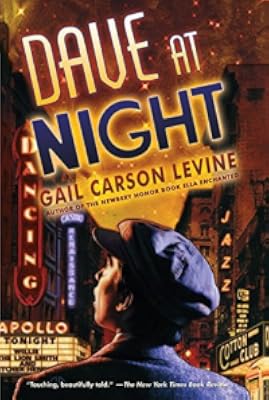
Dave at Night
by Gail Carson Levine
On This Page
Description
When orphaned Dave is sent to the Hebrew Home for Boys where he is treated cruelly, he sneaks out at night and is welcomed into the music- and culture-filled world of the Harlem Renaissance.Tags
Recommendations
















Member Recommendations
Member Reviews
When Dave's father dies, his stepmother Ida ties to give Dave and his brother, Gideon, to relatives at the funeral. Gideon goes to Chicago with an uncle, but since no one is willing to take Dave, Ida brings him to the Hebrew Home for Boys. Dave's adventures at the HHB (and other creative, not-so-flattering terms that HHB would also stand for) include making friends with the other elevens, dealing with bullies, and night-time escapades to salon parties during the Harlem Renaissance.
This rich historical fiction was an absolute joy to listen to. Jason Harris brings a variety of characters to life, including our narrator, Dave, a young black girl, and an older man whose speech is peppered with Yiddish phrases. The historical aspect is show more detailed without feeling forced, and includes descriptions of music and art of the time period. I appreciated the afterword in which Gail Carson Levine explains what was true, based on the truth, or made up. Equally recommended to children and adults, and believe me, I will be! show less
This rich historical fiction was an absolute joy to listen to. Jason Harris brings a variety of characters to life, including our narrator, Dave, a young black girl, and an older man whose speech is peppered with Yiddish phrases. The historical aspect is show more detailed without feeling forced, and includes descriptions of music and art of the time period. I appreciated the afterword in which Gail Carson Levine explains what was true, based on the truth, or made up. Equally recommended to children and adults, and believe me, I will be! show less
Dave Karos’ life is turned upside down in one fell swoop; his father died in a carpentry accident, and at the funeral, his stepmother announces she can’t afford to keep Dave and his brother, Gideon, and asks who will take them. Dave’s uncle Jack agrees to take Gideon, but nobody wants Dave, so he is sent to live at the Hebrew Home for Boys, an all-boy orphan asylum. Dave wastes no time in sneaking out. He makes some good and trustworthy friends while visiting salon parties and listening to Jazz music. The orphan director is cruel and abusive (as Dave quickly finds out after he is caught for sneaking out) and to make matters worse, he has stolen Dave’s prized possession, a carving of Noah’s Ark that his father made. Dave show more decides that he will do whatever it takes to get his carving back, and then he will run away. Over time, however, despite some bad things about the orphanage (like bullies eating their food and it’s always freezing cold), Dave also realizes there are good things, like all of his new “buddies” – the other 11 year olds – who will look out for him through thick and thin, and the art lessons he enjoys so much.
Based on Gail Carson Levine’s own father’s experience in a similar orphanage.
*Listened to audiobook - good! show less
Based on Gail Carson Levine’s own father’s experience in a similar orphanage.
*Listened to audiobook - good! show less
Jews do not come out looking well in this book. The hero, Dave, is abandoned by his family and placed in the Hebrew Home for Boys, run by a sadistic man who steals children's valuable keepsakes. Dave manages to escape at night and stumbles upon the Harlem Renaissance; he becomes friends with a wealthy Black girl and an older Jewish man, a self-described gonif who tells phony fortunes.
Eventually Dave realizes that his family did the best they could for him. His brother, taken in by an uncle, is not tough enough to cope with the HHB; his aunts, who are boarders in a family's small apartment, really have no room for him, but do visit him; his step-mother truly cannot afford to keep him. Dave realizes that the other elevenses at the Home show more are wonderful friends. The art teacher goes out of his way to encourage Dave's talent.
The happy resolution requires a deus ex machina. This is always a bad sign, usually meaning that in reality there is no good resolution.
Life in the orphanage is based on the experiences of the author's father, who lived in the Hebrew Orphan Asylum; Art Buchwald also lived there. As the author says in an Afterword, the conditions at the Asylum were not as bad as those she makes up. 2003 nominee for Nutmeg Children's Book Award. show less
Eventually Dave realizes that his family did the best they could for him. His brother, taken in by an uncle, is not tough enough to cope with the HHB; his aunts, who are boarders in a family's small apartment, really have no room for him, but do visit him; his step-mother truly cannot afford to keep him. Dave realizes that the other elevenses at the Home show more are wonderful friends. The art teacher goes out of his way to encourage Dave's talent.
The happy resolution requires a deus ex machina. This is always a bad sign, usually meaning that in reality there is no good resolution.
Life in the orphanage is based on the experiences of the author's father, who lived in the Hebrew Orphan Asylum; Art Buchwald also lived there. As the author says in an Afterword, the conditions at the Asylum were not as bad as those she makes up. 2003 nominee for Nutmeg Children's Book Award. show less
When orphaned Dave is sent to New York's Hebrew Home for Boys in 1926 where he is treated cruelly, he sneaks out at night and is welcomed into the music and culture-filled world of the Harlem Renaissance.
When Dave Caros’ father dies, his stepmother ships Dave off to the Hebrew Home for Boys. Mr. Doom is the abusive headmaster, Moe steals food off Dave’s plate, the Home is always cold, and most disheartening, Mr. Doom has taken away Dave’s treasured possession, a wood carving of the Noah’s Ark that his father made. As Dave plots to take back his carving and escape, he meets the other age eleven boys in the home and gets to know them as buddies. Mr. Hillinger the art teacher recognizes Dave’s art talents. And then Dave sneaks out one night he meets Solly, a Jewish man who tells fortunes at rent parties in Harlem. Through Solly, Dave meets Irma Lee and they become friends. Through all these people, he discovers true friendship show more and loyalty. show less
When orphaned Dave is sent to the Hebrew Home for Boys and treated cruelly, he sneaks out at night and welcomed into the music- and culture-filled world of the Harlem Renaissance, where he discovers the power of friendship.
I read this book several times when I was a kid and am happy to report that it still stands up reading it as an adult. Great historical fiction with a diverse cast of characters and good handling of difficult topics.
Members
- Recently Added By
Lists

Honey For a Child's Heart
1,152 works; 25 members

Sonlight Books
1,487 works; 25 members
1001 Children's Books You Must Read Before You Grow Up
774 works; 101 members

GCS 6th grade summer reading list
171 works; 4 members

Newbery Adjacent
747 works; 3 members
Author Information

Some Editions
Awards and Honors
Awards
Common Knowledge
- Canonical title
- Dave at Night
- Original publication date
- 1999
- People/Characters
- Dave Caros; Gideon Caros; Papa; Ida (Dave's step-mother); Mr. Hillinger (the art teacher); Mr. Meltzer (prefect for the elevens) (show all 12); Mr. Bloom aka Mr. Doom; Solly Gruber; Irma Lee Packer; Odelia Packer; Aunt Lily; Aunt Sarah
- Important places
- New York, New York, USA (Lower East Side, Harlem, Manhattan); Harlem, New York, New York, USA
- Dedication
- To my father, the real Dave,
and to my mother,
You speak through me always. - First words
- From the start, I've always made trouble.
- Last words
- (Click to show. Warning: May contain spoilers.)Tell for you your fortune?
Classifications
- Genres
- Kids, Fiction and Literature, Children's Books
- DDC/MDS
- 813.54 — Literature & rhetoric American literature in English American fiction in English 1900-1999 1945-1999
- LCC
- PZ7 .L578345 .D — Language and Literature Fiction and juvenile belles lettres Fiction and juvenile belles lettres Juvenile belles lettres
- BISAC
Statistics
- Members
- 1,003
- Popularity
- 26,097
- Reviews
- 14
- Rating
- (3.62)
- Languages
- English, Italian
- Media
- Paper, Audiobook, Ebook
- ISBNs
- 30
- ASINs
- 9