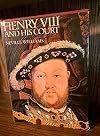
Henry VIII and His Court
by Neville Williams
On This Page
Tags
Recommendations




















Member Reviews
In the last sentence of this book, Neville Williams reveals his basic thesis: Henry VIII was a transformational king. Well, not in so many words. Instead, he writes that Henry was “the miracle-maker who turned the water of medieval kingship into the heady wine of a personal, national monarchy, with the court as its chosen vessel.”
This is neither a full biography of Henry nor is it a full history of his reign, although the book contains elements of both. It is above all a narrative of court life, far-ranging in the topics it covers, including architecture, the decorative arts, music, and diplomacy. It recounts the improbable rise from working-class origins of his two most able ministers, Wolsey and Cromwell (and their fall), as well show more as the king’s relations with his six wives. The oft-told tale of Henry’s estrangement from his first wife, Catherine of Aragon, and his infatuation with Anne Boleyn takes into account the complex motivations and fears involved. Eternal damnation? Dying without leaving a male heir for the throne? Which would you choose?
It was an age when Henry, as well as most of his subjects, took religion very seriously. At the same time, economic pressures and an inchoate nationalism made the pope unpopular. In Williams’ telling, Henry’s faith was most consistently a popeless catholicism, rather than protestant.
The book is generously illustrated, including several full-color, full-page reproductions. These were particularly helpful to imagine the seven castles in and around London to which the court moved (including cartloads of furniture).
For those who can’t read enough about the Tudor era—so like and unlike our own—there is a helpful annotated bibliography (up to 1970, when this book was first published).
I turned to this book to get up to speed on the back story of the people and places while reading the final volume of Hilary Mantel’s Wolf Hall trilogy. It provided what I hoped for. show less
This is neither a full biography of Henry nor is it a full history of his reign, although the book contains elements of both. It is above all a narrative of court life, far-ranging in the topics it covers, including architecture, the decorative arts, music, and diplomacy. It recounts the improbable rise from working-class origins of his two most able ministers, Wolsey and Cromwell (and their fall), as well show more as the king’s relations with his six wives. The oft-told tale of Henry’s estrangement from his first wife, Catherine of Aragon, and his infatuation with Anne Boleyn takes into account the complex motivations and fears involved. Eternal damnation? Dying without leaving a male heir for the throne? Which would you choose?
It was an age when Henry, as well as most of his subjects, took religion very seriously. At the same time, economic pressures and an inchoate nationalism made the pope unpopular. In Williams’ telling, Henry’s faith was most consistently a popeless catholicism, rather than protestant.
The book is generously illustrated, including several full-color, full-page reproductions. These were particularly helpful to imagine the seven castles in and around London to which the court moved (including cartloads of furniture).
For those who can’t read enough about the Tudor era—so like and unlike our own—there is a helpful annotated bibliography (up to 1970, when this book was first published).
I turned to this book to get up to speed on the back story of the people and places while reading the final volume of Hilary Mantel’s Wolf Hall trilogy. It provided what I hoped for. show less
My favorite book about my favorite king of England.
Ratings
Members
- Recently Added By
Lists

al.vick-parents books
301 works; 1 member
Common Knowledge
- People/Characters
- Henry VIII, King of England; Catherine of Aragon; Anne Boleyn; Thomas Wolsey; Jane Seymour, Queen Consort of Henry VIII of England; Anne of Cleves (show all 80); Katherine Howard; Katherine Parr; Thomas Cromwell, 1st Earl of Essex; Thomas More (Sir, Saint, 1478-1535); Stephen Gardiner, Bishop of Winchester; Thomas Howard, 3rd Duke of Norfolk; Robert Barnes (Martyr, ca. 1495-1540); Elizabeth Blount; George Boleyn (2nd Viscount Rochford); Mary Boleyn; Thomas Boleyn, 1st Earl of Wiltshire and 1st Earl of Ormond, 1st Viscount Rochford; Eustace Chapuys; Charles Brandon, 1st Duke of Suffolk; Sir Anthony Browne; Sir Francis Bryan; Charles V, Holy Roman Emperor; Christina of Denmark, Duchess of Milan and Lorraine; Clement VII, Pope (Giulio de' Medici, 1478-1534); William V, Duke of Jülich-Cleves-Berg; Henry Courtenay, 1st Marquess of Exeter; Thomas Cranmer, Archbishop of Canterbury; John Fisher, Bishop of Rochester; Charles de Marillac; Edward VI, King of England; Elizabeth I, Queen of England; Mary I, Queen of England (1516&ndash | 1558); François I, King of France; Hugh Latimer; James V, King of Scots; Arthur Plantagenet, 1st Viscount Lisle; John London (priest); Sir Edward Neville; William Parr, 1st Marquess of Northampton; John Dudley, 1st Duke of Northumberland; Sir Edward Neville; Henry Pole, 1st Baron Montagu; Edward Seymour, 1st Duke of Somerset; William Paulet, 1st Marquess of Winchester; Henry Percy, 6th Earl of Northumberland; Reginald Pole, Archbishop of Canterbury; Richard Rich, 1st Baron Rich; John Russell, 1st Earl of Bedford; Margaret Pole, Countess of Salisbury; Sir Ralph Sadler; Richard Sampson, Bishop of Chichester; Mark Smeaton; Sir Richard Southwell; Cuthbert Tunstall, Bishop of Durham; Thomas Wriothesley, 1st Earl of Southampton; William Warham, Archbishop of Canterbury; Thomas Wyatt (Sir, Poet, 1503-1542); Henry Howard, 3rd Earl of Surrey; Robert Radcliffe, 10th Baron Fitzwalter, 1st Earl of Sussex; Anne Askew; Robert Aske; William Paget, 1st Baron Paget; Sir Geoffrey Pole; Thomas Howard, 1st Viscount Howard of Bindon; Edward Stafford, 3rd Duke of Buckingham; Thomas Grey, 2nd Marquis of Dorset; Richard de la Pole; Sir Gawen Carew; Henry FitzRoy, 1st Duke of Richmond and Somerset; Mary Howard FitzRoy, Duchess of Richmond and Somerset; Louis XII, King of France; Julius II, Pope (Giuliano della Rovere, 1443-1513); James IV, King of Scots; Mary Tudor, Queen of France; Leo X, Pope (Giovanni di Lorenzo de' Medici, 1475-1521); Thomas Audley, 1st Baron Audley of Walden; Nicholas Carew (courtier); Hans Holbein the Younger; Thomas Culpeper (courtier); Francis Dereham (courtier)
- Important places
- England, UK (as England)
- Important events
- Reign of Henry VIII (1509-04-21 | 1547-01-28)
- Dedication
- To J. H. K.
- First words
- Winter was over.
- Last words
- (Click to show. Warning: May contain spoilers.)His qualities and achievements can be traced in various ways, but in this book he has been portrayed for the first time as the miracle-maker who turned the water of medieval kingship into the heady wine of a personal, national monarchy, with the court as its chosen vessel.
Classifications
- Genres
- History, Nonfiction, General Nonfiction, Biography & Memoir
- DDC/MDS
- 942.052 — History & geography History of Europe England and Wales England 1485-1603, Tudors Henry VIII 1509-47
- LCC
- DA332 .W53 — History of Europe, Asia, Africa and Oceania Great Britain History of Great Britain England History By period Modern, 1485- Tudors, 1485-1603
Statistics
- Members
- 321
- Popularity
- 99,664
- Reviews
- 2
- Rating
- (3.71)
- Languages
- English
- Media
- Paper
- ISBNs
- 5
- ASINs
- 13