On This Page
Description
Jacy, the high school beauty, returns to Thalia from a career as a Hollywood star and changes the lives of her fellow townspeople.Tags
Recommendations
















Member Reviews
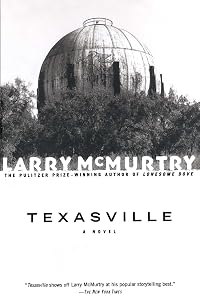
It is the 1980s, and the small Texas oil town, Thalia, which we first visited in Larry McMurtry's [The Last Picture Show], is reeling from the OPEC-driven crash in oil prices. We see the town through the eyes of Duane Moore, also the protagonist of Picture Show. Moore owns the small, local oil company that until recently has employed a good many of the town's citizens and kept the Thalia economy humming. Now, as oil prices keep falling and the bottom falls out of the recent boom, he faces bankruptcy and the town faces economic disaster. Sounds pretty grim, but this book is in fact a dark comedy, as the town, unhinged by these developments, becomes whackier and whackier. Duane's family is nuts, his friends are going nuts, and the show more preparations for the town's Centennial Celebration, of which Duane is chairman, grow more contentious and ever more absurd.
McMurtry puts it this way:
"{Duane} had never supposed that people really lived as they ought to live, but he had gone through much of his life at least believing there was a way they ought to live. And Thalia of all places--a modest small town--ought to be a place where people lived as they ought to live, allowing for a normal margin of human error. Surely, in Thalia, far removed from big-city temptations, people ought to be living on the old model--putting their families and neighbors first, leading more or less orderly, more or less responsible lives.
But he knew almost everyone in Thalia--indeed, knew more than he wanted to know about most of them--and it was clear from what he knew that the old model had been shattered. The arrival of money cracked the model; it's departure shattered it. Irrationality now bloomed as prolifically as broom weeds in a wet year."
Duane's confusion and despondency grow, as his wife seems disappointed in every word out of his mouth and his marriage seems to be slipping away.
I found the first half of this book to be excellent indeed, with many spot-on, wry observations about small town life and human nature within that growing irrationality of the town's denizens. I frequently laughed out loud while recognizing quite clearly the solid humanity of the characters. The second half, I think, loses steam, but not nearly to the extent that it robs the book of its enjoyability or value. And, happily, the last 40 pages or so are excellent. I do recommend this book. show less
McMurtry puts it this way:
"{Duane} had never supposed that people really lived as they ought to live, but he had gone through much of his life at least believing there was a way they ought to live. And Thalia of all places--a modest small town--ought to be a place where people lived as they ought to live, allowing for a normal margin of human error. Surely, in Thalia, far removed from big-city temptations, people ought to be living on the old model--putting their families and neighbors first, leading more or less orderly, more or less responsible lives.
But he knew almost everyone in Thalia--indeed, knew more than he wanted to know about most of them--and it was clear from what he knew that the old model had been shattered. The arrival of money cracked the model; it's departure shattered it. Irrationality now bloomed as prolifically as broom weeds in a wet year."
Duane's confusion and despondency grow, as his wife seems disappointed in every word out of his mouth and his marriage seems to be slipping away.
I found the first half of this book to be excellent indeed, with many spot-on, wry observations about small town life and human nature within that growing irrationality of the town's denizens. I frequently laughed out loud while recognizing quite clearly the solid humanity of the characters. The second half, I think, loses steam, but not nearly to the extent that it robs the book of its enjoyability or value. And, happily, the last 40 pages or so are excellent. I do recommend this book. show less
There are no adults in this story, at all. The dialogue is fun at first, but the novelty wears off over 500 pages and nearly 100 weirdly short chapters of cynicism. Wildly unlikeable characters do nothing but fling wisecracks, drive a few blocks to have joyless sex with inappropriate partners, spend money they don't have on useless junk, and neglect their out of control children. There is no resolution, no satisfaction, no decisions made, no responsibility taken, and very little plot. (I mean Larry - couldn't you at least have let us in on what Ruth was doing with the mail, after teasing it half a dozen times?!) Only because I love McMurtry did I push through to the end, but it was not an enjoyable read.
Larry McMurtry is a fantastic author. His Lonesome Dove series of novels, are among the best I have ever read, of any genre. His more contemporary work, while not the equal of Lonesome Dove, are nevertheless excellent models of character development and engaging dialogue.
Texasville is a sequel to the author’s The Last Picture Show, set roughly 25 years later. Duane Moore is an oil and gas operator that lives in the small town of Thalia, Texas. The price of oil has crashed and he is technically insolvent, teetering on bankruptcy. His wife, Karla, is the quintessential big-haired, loud, brash, profane wife you would expect of a Texas wildcatter. His oldest son is a drug dealer, his daughter marries everyone she sees and his youngest show more twins are delinquents. Duane’s old flame, Jacy (think Cybil Shepard) has returned to Thalia after a successful European movie career.
Thalia is populated by exactly the type of people you would expect of a small, Texas oil town. Everyone has either slept with everyone else, or is making plans to. The town is on the verge of celebrating its centennial.
The first 300 pages of this novel are excellent. The characters are well developed and interesting. However, the story simply gets old. By the time it concludes (with a whimper), you are pretty much tired of listening to the same, tired dialogue, which at first was fresh, but ultimately becomes irritating.
A shorter, tighter book could have been 9/10. As it is, it devolves into 7/10. show less
Texasville is a sequel to the author’s The Last Picture Show, set roughly 25 years later. Duane Moore is an oil and gas operator that lives in the small town of Thalia, Texas. The price of oil has crashed and he is technically insolvent, teetering on bankruptcy. His wife, Karla, is the quintessential big-haired, loud, brash, profane wife you would expect of a Texas wildcatter. His oldest son is a drug dealer, his daughter marries everyone she sees and his youngest show more twins are delinquents. Duane’s old flame, Jacy (think Cybil Shepard) has returned to Thalia after a successful European movie career.
Thalia is populated by exactly the type of people you would expect of a small, Texas oil town. Everyone has either slept with everyone else, or is making plans to. The town is on the verge of celebrating its centennial.
The first 300 pages of this novel are excellent. The characters are well developed and interesting. However, the story simply gets old. By the time it concludes (with a whimper), you are pretty much tired of listening to the same, tired dialogue, which at first was fresh, but ultimately becomes irritating.
A shorter, tighter book could have been 9/10. As it is, it devolves into 7/10. show less
As I slowly read more of Larry McMurtry’s books, I become even fonder of his style, both in fiction and nonfiction. His prose flows easily and evenly, never wandering off-course. In fiction, his dialogue is strong and real, sparkling with pithy responses and smart banter. This book follows Duane Moore, some 30 years after the point where The Last Picture Show left off, as he stares down bankruptcy in the wake of the oil bust. Duane lives in a ridiculously large house with his beautiful, restless wife Karla, and at varying times, most of his endearingly flawed children. The book offers a true insider’s view of life in small-town Texas, illustrated primarily through the continuously shifting relationships of the town’s inhabitants. show more At the center is Duane, who spends much of his time either worrying about going broke or assessing his standing with the various women in his life. It’s easy to root for Duane and the rest of Thalia’s citizens, as they each confront their own private (and, whether they like it or not, often public) crises. After all, they’re only trying to get by and make sense of it all, maybe hoping to have a little fun along the way, just like the rest of us. And who can fault them for that? show less
Larry Mcmurtry has a special ability to write books about irritating, unlikable, and sometimes even loathsome characters that I nevertheless tend to enjoy for at least half the book. He did it with Moving On, too, which I actually reread once.
Duane is an almost total non-entity. His only personality trait is his inexplicable love for his psychotic wife. I keep waiting for him to do the obvious thing, and climb in his truck, and drive away from the whole rotten, chaotic mess of Karla, Jaycee, his family, and the lunatic town, but he never does. It's bewildering.
Despite all this, I still enjoy Mcmurtry's writing. I just wish he'd written this one with an actual plot. Even Moving On had a plot, and an arc of growth for the main character, show more as sprawling as the book was. Texasville doesn't have that. Duane doesn't seem to grow or change at all. Which is disappointing. show less
Duane is an almost total non-entity. His only personality trait is his inexplicable love for his psychotic wife. I keep waiting for him to do the obvious thing, and climb in his truck, and drive away from the whole rotten, chaotic mess of Karla, Jaycee, his family, and the lunatic town, but he never does. It's bewildering.
Despite all this, I still enjoy Mcmurtry's writing. I just wish he'd written this one with an actual plot. Even Moving On had a plot, and an arc of growth for the main character, show more as sprawling as the book was. Texasville doesn't have that. Duane doesn't seem to grow or change at all. Which is disappointing. show less
(09 April 2000, America)
A re-read of this second book in the Last Picture Show series, as I build up to reading the newly acquired fourth and fifth volumes. It’s thirty years since the events of “The Last Picture Show”. Duane and Sonny are still in Thalia; Duane’s married to the terrifying but wonderful Karla, and Jacy’s rumoured to be back in town. Depression and boredom are rife as the oil recession hits,and everyone in town seems to be sleeping with the wrong person. It’s a depressing but moving slice of small town life, pinned loosely around preparations for the town’s centennial celebrations, even though the original county town, the Texasville of the title, has disappeared into the dust. The book has an open, fluid show more structure that mirrors that of many of the marriages portrayed, and there are some great wild kids and set pieces – who could forget the tumbleweed stampede? (well, I had, in the 12 years since I last read this). The side characters such as the magnificent Ruth Popper, with her marathon running, make this a full and rich read. Amusingly, Danny Deck has a cameo, or his house did. Danny is the hero of “All My Friends are Going to be Strangers” and later on, “Some Can Whistle” – McMurtry pops characters from one book into another a lot; Cadillac Jack has his own book and appears in another one.
My review from April 2000:
Another of his wonderful books – this one comes between “The Last Picture Show” and “Duane’s Depressed” and we see the tragi-comic life of Thalia (the tumbleweed stampede being a comedy high point). Characters are so, so believable, as are the sprawling events. show less
A re-read of this second book in the Last Picture Show series, as I build up to reading the newly acquired fourth and fifth volumes. It’s thirty years since the events of “The Last Picture Show”. Duane and Sonny are still in Thalia; Duane’s married to the terrifying but wonderful Karla, and Jacy’s rumoured to be back in town. Depression and boredom are rife as the oil recession hits,and everyone in town seems to be sleeping with the wrong person. It’s a depressing but moving slice of small town life, pinned loosely around preparations for the town’s centennial celebrations, even though the original county town, the Texasville of the title, has disappeared into the dust. The book has an open, fluid show more structure that mirrors that of many of the marriages portrayed, and there are some great wild kids and set pieces – who could forget the tumbleweed stampede? (well, I had, in the 12 years since I last read this). The side characters such as the magnificent Ruth Popper, with her marathon running, make this a full and rich read. Amusingly, Danny Deck has a cameo, or his house did. Danny is the hero of “All My Friends are Going to be Strangers” and later on, “Some Can Whistle” – McMurtry pops characters from one book into another a lot; Cadillac Jack has his own book and appears in another one.
My review from April 2000:
Another of his wonderful books – this one comes between “The Last Picture Show” and “Duane’s Depressed” and we see the tragi-comic life of Thalia (the tumbleweed stampede being a comedy high point). Characters are so, so believable, as are the sprawling events. show less
I'm not sure what I was thinking when I picked up this mass market paperback. Probably was homesick - I think I got this book sometime in the 20-year period I lived in Washington state. Finally got around to reading it after being back in Texas nearly 16 years. You can tell it was not a high priority - the only book left on my TBR shelf (after reading them, I donate the books) is the 1036-page Hawaii by James Michener.
Texasville, the sequel to Larry McMurtry's The Last Picture Show (which I never read nor saw at the movies), was an okay read for the end-of-year holiday period, when one tends to be distracted by so many other things. The 98 short chapters made it easy to pick up and put down.
The book is basically a bunch of show more navel-gazing by Duane Moore, 30 years after the events in the first book. It's the 1980s, and the big drop in oil prices has put 48-year-old Duane about $12 million in debt. Meanwhile his wife Karla continues to spend money like crazy, and his four children, in their teens through early 20s, are out of control. Everybody in town (including Duane) seems to be having at least one affair. No wonder Duane's Depressed (oh wait - that's the next book in the series).
At 561 pages, this book is way too long. It rambles and is only loosely tied together by the Hardtop County centennial celebration in the town of Thalia, where Duane, his family, and all the rest of the eccentric characters live (in or near). The Texasville of the title is the original settlement in the county, and no longer exists. Thalia is based on McMurtry's real hometown of Archer City, Texas, and I have to wonder just how much of Duane is McMurtry.
I do think this is a book where it would have been better to have read The Last Picture Show first (or at least seen the movie). The characters were not well developed in Texasville, and I might have understood some of them better if I'd read the first book in the series first. As it is, I'm not interested in reading anything else in the series now. show less
Texasville, the sequel to Larry McMurtry's The Last Picture Show (which I never read nor saw at the movies), was an okay read for the end-of-year holiday period, when one tends to be distracted by so many other things. The 98 short chapters made it easy to pick up and put down.
The book is basically a bunch of show more navel-gazing by Duane Moore, 30 years after the events in the first book. It's the 1980s, and the big drop in oil prices has put 48-year-old Duane about $12 million in debt. Meanwhile his wife Karla continues to spend money like crazy, and his four children, in their teens through early 20s, are out of control. Everybody in town (including Duane) seems to be having at least one affair. No wonder Duane's Depressed (oh wait - that's the next book in the series).
At 561 pages, this book is way too long. It rambles and is only loosely tied together by the Hardtop County centennial celebration in the town of Thalia, where Duane, his family, and all the rest of the eccentric characters live (in or near). The Texasville of the title is the original settlement in the county, and no longer exists. Thalia is based on McMurtry's real hometown of Archer City, Texas, and I have to wonder just how much of Duane is McMurtry.
I do think this is a book where it would have been better to have read The Last Picture Show first (or at least seen the movie). The characters were not well developed in Texasville, and I might have understood some of them better if I'd read the first book in the series first. As it is, I'm not interested in reading anything else in the series now. show less
Members
- Recently Added By
Lists

Read the book and saw the movie
1,170 works; 195 members

Novels Published in 1987
81 works; 19 members
Author Information

97+ Works 43,639 Members
Larry McMurtry, winner of the Pulitzer Prize for Fiction, among other awards, is the author of twenty-four novels, two collections of essays, two memoirs, more than thirty screenplays, & an anthology of modern Western fiction. He lives in Archer City, Texas. (Publisher Provided) Novelist Larry McMurtry was born June 3, 1936 in Wichita Falls, show more Texas. He received a B.A. from North Texas State University in 1958, an M.A. from Rice University in 1960, and attended Stanford University. He married Josephine Ballard in 1959, divorced in 1966, and had one son, folksinger James McMurtry. Until the age of 22, McMurtry worked on his father's cattle ranch. When he was 25, he published his first novel, "Horseman, Pass By" (1961), which was turned into the Academy Award-winning movie Hud in 1962. "The Last Picture Show" (1966) was made into a screenplay with Peter Bogdanovich, and the 1971 movie was nominated for eight Oscars, including one for best screenplay adaptation. "Terms of Endearment" (1975) received little attention until the movie version won five Oscars, including Best Picture, in 1983. McMurtry's novel "Lonesome Dove" (1985) won the Pulitzer Prize in 1986 and the Spur Award and was followed by two popular TV miniseries. The other titles in the Lonesome Dove Series are "Streets of Laredo" (1993), "Dead Man's Walk" (1995), and "Comanche Moon" (1997). The other books in his Last Picture Show Trilogy are "Texasville" (1987) and "Duane's Depressed" (1999). McMurtry suffered a heart attack in 1991 and had quadruple-bypass surgery. Following that, he suffered from severe depression and it was during this time he wrote "Streets of Laredo," a dark sequel to "Lonesome Dove." His companion Diana Ossana, helping to pull him out of his depression, collaborated with him on "Pretty Boy Floyd" (1994) and "Zeke and Ned" (1997). He co-won the Best Screenplay Golden Globe and the Academy Award for Best Adapted Screenplay for Brokeback Mountain in 2006. He made The New York Times Best Seller List with his title's Custer and The Last Kind Words Saloon. McMurtry is considered one of the country's leading antiquarian book dealers. (Bowker Author Biography) show less
Awards and Honors
Distinctions
Series

Work Relationships
Has the adaptation
Common Knowledge
- Canonical title
- Texasville
- Original publication date
- 1988-05-15
- People/Characters
- Duane Moore; Karla Moore; Jacy; Doctor Deckert; Janine Wells; Bobby Lee (show all 11); Sonny Crawford; Joe Coombs; Lester Marlow; Eddie Bolt; Luther Sawyer
- Important places
- Thalia, Texas, USA; Wichita Falls, Texas, USA
- Important events
- Centennial celebration for Thalia, Texas (fictional town). (fictional town)
- Related movies
- Texasville (1990 | IMDb)
- Dedication
- For Cybill Shepherd
- First words
- Duane was in the hot tub, shooting at his new dog-house with a .44 Magnum.
- Last words
- (Click to show. Warning: May contain spoilers.)"These centennials are awesome," Jack said. "I think we should have one every year."
Classifications
Statistics
- Members
- 990
- Popularity
- 26,623
- Reviews
- 18
- Rating
- (3.52)
- Languages
- 5 — English, French, German, Portuguese, Swedish
- Media
- Paper, Ebook
- ISBNs
- 21
- ASINs
- 11