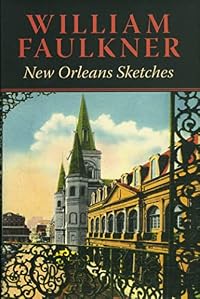
New Orleans Sketches
by William Faulkner
On This Page
Description
In 1925 William Faulkner began his professional writing career in earnest while living in the French Quarter of New Orleans. He had published a volume of poetry ( The Marble Faun ), had written a few book reviews, and had contributed sketches to the University of Mississippi student newspaper. He had served a stint in the Royal Canadian Air Corps and while working in a New Haven bookstore had become acquainted with the wife of the writer Sherwood Anderson. In his first six months in New show more Orleans, where the Andersons were living, Faulkner made his initial foray into serious fiction writing. Here show lessTags
Recommendations
































Member Reviews
The short and very short stories in this collection are Faulkner's first published works of prose, from 1925, and they are quite uneven. "Out of Nazareth" is an homage to "David," a 17-year-old hobo ("I have no destination. Why should I hurry?") who gives the narrator a sample of his writing, quoted in its entirety. Can this be said to foreshadow Faulkner's encouragement to young writers in his Nobel Prize acceptance speech of 1950? "The Liar" demonstrates Faulkner's extraordinary ear for the dialects of rural Southern whites, with a surprise twist on the power of lying. Other stories like "Jealousy" are powerfully written, but "Country Mice" is a strange tale about bootleggers and a biplane, and "Yo Ho and Two Bottles of Rum" is show more racist: superficially anti-Chinese, but deeply anti-British-lower-class. Despite the title, there is very little in *New Orleans Sketches* about New Orleans culture and traditions. The racetrack touts, petty criminals and tough cops could have inhabited any city of the 1920's. The stories were first published in the New Orleans *Times-Picayune*. The even shorter "sketches" are from the New Orleans literary magazine *The Double Dealer*. Editor Carvel Collins, a professor at Notre Dame, re-collected them and amplified on them with a preface. He added a short essay by Faulkner on the works of Sherwood Anderson, originally published in 1925 in the Dallas *Morning News*. The essay contains surprisingly blunt criticism, given Anderson was an important mentor and friend of Faulkner. show less
Ratings
Members
- Recently Added By
Author Information

461+ Works 98,934 Members
Born in an old Mississippi family, William Faulkner made his home in Oxford, seat of the University of Mississippi. After the fifth grade he went to school only off and on-lived, read, and wrote much as he pleased. In 1918, refusing to enlist with the "Yankees," he joined the Canadian Air Force, and was transferred to the British Royal Air Force. show more After the war he studied a little at the University, did house painting, worked as a night superintendent at a power plant, went to New Orleans and became a friend of Sherwood Anderson, then to Europe and back home to Oxford. By this time he had written two novels. The Sound and the Fury followed in 1929. Financial success came with Sanctuary in 1931, which he assisted in filming. Faulkner 's novels are intense in their character portrayals of disintegrating Southern aristocrats, poor whites, and African Americans. A complex stream-of-consciousness rhetoric often involves Faulkner in lengthy sentences of anguished power. Most of his tales are set in the mythical Yoknapatawpha County, Mississippi, and are characterized by the use of many recurring characters from families of different social levels spanning more than a century. His best subjects are the old, dying South and the newer materialistic South. As I Lay Dying (1930), is a grotesquely tragicomic story about a family of poor southern whites. With Absalom, Absalom! (1936); the difficult parts of his famous short novel "The Bear" (published in Go Down, Moses, 1942); and the allegorical A Fable (1954), a non-Yoknapatawpha novel set in France during World War I; Faulkner returned to an innovative and difficult style that most readers have trouble with. Yet, interspersed among such works are collections of easily read stories originally published in popular magazines. There seems to be a growing sentiment among critics that the Snopes trilogy-The Hamlet (1940), The Town (1957), and The Mansion (1959)-for the most part an example of Faulkner's "moderate" style, could well be among his most important works. Faulkner was awarded the 1949 Nobel Prize for literature "for his powerful and artistically independent contribution to the new American novel," but it would appear now that he also deserved to win that honor for his contribution to world literature. When reporting his death, the Boston Globe quoted Faulkner's having once told an interviewer: "Since man is mortal, the only immortality for him is to leave something behind him that is immortal since it will always move. That is the artist's way of scribbling "Kilroy was here" on the wall of the final and irrevocable oblivion through which he must some day pass." In addition to the Nobel Prize, Faulkner received the Howells Medal of the American Academy of Arts and Letters in 1950, and in 1951 he was given the National Book Award for his Collected Stories Collected Stories. For his novel A Fable he received the National Book Award for the second time, as well as the Pulitzer Prize in 1955. The Reivers (1962) was awarded the Pulitzer Prize in 1963. In 1957 and 1958, he was the University of Virginia's first writer-in-residence, and in January 1959 he accepted an appointment as consultant on contemporary literature to the Alderman Library of that university. Although Faulkner was not without honors in his lifetime and has received world recognition since then, it is surprising to learn that, when Malcolm Cowley edited The Portable Faulkner in 1946, he found that almost all of Faulkner's books were out of print. By arranging selections from the works to form a continuous chronicle, Cowley deserves much of the credit for making readers aware of the way in which Faulkner was creating a fictive world on a scale grander than that of any novelist since Balzac. William Faulkner died in Oxford, Mississippi, in 1962. (Bowker Author Biography) show less
Some Editions
Common Knowledge
- Canonical title
- New Orleans Sketches
- Original title
- New Orleans Sketches
- Alternate titles*
- Stories of New Orleans
- Original language
- English
*Some information comes from Common Knowledge in other languages. Click "Edit" for more information.
Classifications
Statistics
- Members
- 257
- Popularity
- 125,647
- Reviews
- 1
- Rating
- (3.13)
- Languages
- 7 — English, Finnish, French, German, Italian, Portuguese, Spanish
- Media
- Paper, Ebook
- ISBNs
- 18
- ASINs
- 11