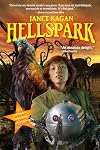
Hellspark
by Janet Kagan
On This Page
Description
Murder, Mystery, and Interstellar Intrigue Hugo Award winner Janet Kagan's Hellspark is now back in print Lassti, a newly discovered planet, is the center of political intrigue. Recently, Oloitokitok, the planet survey team's physicist was found dead. Was he killed? If so, by who? One of his fellow surveyors? Or by one of the Sprookjes, the birdlike natives of Lassti? Are the Sprookjes intelligent? If so, then parties that want the planet for development will lose it. Why is the survey team show more having so much trouble finding out? Into this situation arrives Tocohl, a Hellspark trader who just wanted to have a vacation on Sheveschke at the St. Veschke festival. After being attacked, rescuing a young woman, and going before a judge, Tocohl has learned all she ever wanted to know about being in the wrong place at the wrong time. Now, she is on her way to find Lasti to find answers to the mysteries there. show lessTags
Recommendations















Member Recommendations
pnppl Another nice, upbeat scifi novel about culture clash
Member Reviews
Wonderful as usual. I've read and reread this, in both editions (the original, and this one where Kagan was allowed to correct some things she noticed after the original was printed). Small things - the casual use of spectacles and 2nd skin, which are VR and wearables in their finished form. Bigger things - Maggy's existence and development. And the real story of the book - not the focus, exactly, but why the main story can happen - the interaction of the multiple human cultures, and how they mix and clash. I love that each of the cultures is "based" on a simple, English, phrase or thought or (American, mostly) habit - the term "my foot" for disbelief flowers here into a culture where feet are taboo areas, and one character swears by show more saying "Foot. Heel! Toe! Toenails, with green toenail polish!" The characters are very real - (as they keep saying) their cultures inform them, but do not define them. The main character, Tocohl Susumo, is a translator/polyglot, from a culture focused on that - on speaking the language, including the body language, of every human culture. She comes to an expedition exploring a new planet, that have found a non-human race which may or may not be sentient. The puzzle of the new race gets tangled with the clashes between the cultures of the various humans on the expedition, and Tocohl's presence both helps and exacerbates this. It's an utterly fantastic universe, and I really wish she'd been able to write (and publish) more here - I want to know more about Hellsparks! But rereading this book remains rewarding - every time I read it, I find something else I've missed, or something I forgot about that I noticed in an earlier reading. Wonderful book, and I will doubtless reread it many more times. I own three (four) copies - two of the original, one of the edited version (this one), and an ebook that most closely matches the edited (Meisha Merlin) version. The spare original is for lending out! show less
mild spoilers for some aspects of the world building EDIT: This book is a 3.5 to me
Since I was a kid I always adored Sci-Fi but often times felt like there was something missing. Authors creating a fascinating premise, a thought experiment and an excited "what if!". But more often than not, these thought experiments are fun but very shallow. They take place in the future but still feel stuck in the time they were written in. They have some surface level "what-ifs" the author deemed interesting but everything else stays static and familiar. Like a cardboard background with a sci-fi aesthetic. I am in awe at how much Janet Kagan didn't get stuck in the familiar and static. To be more precise: I always longed for a story that made language show more and culture not an overly simplified cardboard background but the actual main focus of science fiction. I mean, this is the fascinating stuff! I never understood why sci-fi was so obsessed with universal translators and simple intergalactic cultures that were no different than our current human cultures. Sure, it makes things easier but why do you want to make things easier if you could invent the most creative and fascinating stories instead ? Janet Kagan wrote a story I always wanted to read, showed me things I always wanted to see. I found so much child-like joy and wonder in her ideas. There is a heavy (and I mean HEAVY) focus on vastly different forms of communications, cultures and how they connect, interesect or interact. The author elaborates a lot on these things and explains everything in detail. It can feel a bit tedious and very slow if you aren't very much into this kind of thing but I am very much into this kind of thing so it felt like an exciting field trip: complex and a bit difficult at times, lots to learn and lots to remember but ultimately so much fun.
And oh is there a lot of fun, or better joy in this book. There is so much wonder and joy not only in what the author describes but also in how the characters themselves perceive everything. I am so used to the grim-dark or pessimist-realist perspective of modern media that so much awe and wonder just blew me away. It doesn't feel artificial, it doesn't feel displaced. Dark themes still have a place, they just do not take over. It makes you remember that a realistic, nuanced and complex portrayal of human beings doesn't necessarily have to be completely dark and brutal (and I'm saying this as someone who likes dark and brutal). That a complete world will always have room for wonder and joy. This felt so fresh and new even though it's from 1988. Made me think about how bleak and same-y a lot of current media is.
My first language isn't english but I rarely have any issues reading literature in english. This one proved to be a bit of a challenge, even though I'm not sure if it is because it's written in a particularly difficult manner or just in a very different manner. There are many new terms, names and overall words that I needed to push through the first pages to get into the books rythm. Most of the time when I don't know certain english words, I look them up and from then on recognize them if they appear again. This technique makes reading an english book with more complex terminology not only possible but also enjoyable to me. But here I sometimes didn't know if a word was originally english or an invention by the author, which made everything a bit more complex, in the beginning at least.
Interestingly, this somehow enhanced my reading experience. I felt a bit like an explorer fighting my way through a dense forest but with enough wonderful things to see on the way to make the hardships absolutely worthwhile. The reader is bombarded with new names, concepts and terms every few sentences and usually i hate something like this. But here it somehow works? Things weirdly stuck with me more often than not because they just made sense. The book is also kinda forgiving if you don't get or remember something. Sometimes I was a bit overwhelmed with all the different names and terms but in the end it always made sense and I didn't feel completely stupid. However, I understand why some people do not finish this book and can't find much to enjoy in the endless stream of weird words and concepts. I am usually not a big fan of immense and complicated world building that always stands in front of the story progression but here it worked for me.
There are lots of fascinating characters and a good portion of them are women, which I very much enjoyed. I especially liked Tocohl (the main character) and her relationship with her ships computer, Maggy. Maggy herself adds some humor to the book, something I also often times do not enjoy in books. But her humor actively adds to the topics of language and culture. And gives a voice to the slightly-confused reader in some situations. To me she didn't feel cheesy or cringy, I actually even laughed out loud a few times.
Edge-of-Dark and Buntecs (two of the many researchers and secondary characters) interactions were so much fun (and a bit cute) to read about too. In a better world there would have been a little bit of homosexual activity here and I was tempted but I refuse to write fanfiction at the ripe old age of 30, especially for something so niche as this story.
A character I am a bit conflicted on is Layli-layli calulan, a shaman from a matriarchal society. I absolutely loved her and she is definitely the character I would like to meet the most. I will elaborate further on why some things about her make me feel conflicted.
Because despite my praise there are a few things I personally and mostly very subjectively didn't like. For its time and for the genre this is a great and progressive book, with a competent, smart, cool and not sexualized female main character and several other interesting women. But I don't like the tired trope of "powerful/scary woman from a matriarchal society has a deep bond with a special guy against her cultural upbringing and is heavily defined by that bond in the story" pushed onto one of the female secondary and already mentioned characters, Layli-layli (even though the special guy is dead, which enhances the usage of the trope slightly).
There were also some other things I rolled my eyes at regarding this character. Such as her accepting a man temporarily as a woman after a false two-second mock-ritual quickly invented by an AI so he could talk to her because of an emergency despite her being in deep mourning (only women are allowed to enter her home during that time). As if a matriarchal and quote "gyno-centric" society would be able to tolerate something like this at all, much less in a situation so obviously made up. I can however see how layli-layli would accept it regardless because she is smart, matter-of-fact, has some kind of appreciation for well thought out lies and would probably let it slide so she could help in that emergency without breaking her cultural rites.
But still, it's one of those rare cultural thought experiments in the book that felt half baked and not convincing. The book often times makes a point that characters will apply their cultural norms more lightly if there is a misunderstanding or cultural divide (such as not holding someone accountable by their own cultural measures if the other person didn't know any better). Generally people are more often than not trying to find ways to get along and support each other despite some wildly different cultures, languages and moral compasses. This applies here too but again, not as convincing as in other instances. In part because I found it funny and unbelievable that after word about it got around, male traders wanted to use the mock ritual to be able to trade with the women of that matriarchal society (something they couldn't do before) and that this society would just... accept it. You are telling me no man ever had a similar idea to this? Not one from all of these different cultures and planets? Possibly hundreds or thousands of years of not being able to trade with a vital part of a very advanced culture and all this time a "I am saying a magic word so I am a woman for a minute" would have surpassed intricate ancient rites and rules? And more importantly: a social hierarchy grown over many generations? There are so many well written instances in the book where people are able to outwit cultural norms this way, so why was this given so little thought? And how did this matriarchal society survive as a matriarchal and (again quote) "gyno centric" society over generations if any man could just for a few minutes be a woman sometimes? It basically makes everything we learn about that society quite meaningless. If it had just been the initial scene of the breaking of mourning it would have worked much better. But drawing it out revealed way too many flaws. I somehow get why it was done because the author tried to tie it to several other plot points but it's just not well done.
Layli-layli in general sometimes felt like a little spin on 80s feminism, observing it and gently pulling its teeth. Something I notice sometimes with books written by female authors of that time: Bold, progressive and quite feminist portrayal of women but at the last minute a sudden fear of coming off as mean and man hating. And a half baked attempt of deflecting that with some not thought out story elements. I don't think this was done consciously but it gave me this all too familiar feeling of it. This definitely is a book with feminist intent, fantastic female characters and layli-layli seems to be more of an appreciation of that instead of a mockery but some parts just didn't work for me. Even though I feel a bit conflicted because otherwise she is a character I adore! Probably and surprisingly even my favourite character all things considered. Maybe that's exactly why those details annoy me. At first she and her culture seem so intelligent and mysterious and interesting. But after the entire ritual thing both feel very hollow and not thought out.
Additionally if you'd look at the plot without any of the heavy cultural sci-fi elements it wouldn't be something to write home about . It's solid but not groundbreaking but that didn't really matter to me. This book is less about a story and more about discovery.
This sounded like I had a lot to complain but these are details, happening only in a few sentences.
All in all, this is such a wonderful and fascinating book. It was also an extremely slow read for me. Strangely not a boring or dragging one for a vast majority of the time. Contemplative but fun is the more fitting description. The confusion took over sometimes in the beginning but it never made me stop reading. Despite some (subjective and objective) flaws this book might have, it gives me a warm and comfortable feeling. It made me happy in a way not many books manage to make me happy. I felt challenged but also at home. The book describes itself quite well for me in the main characters observation of the planet the story takes place on:
"Yet, as she sat in the misty sunlight and gazed into the flashwood, she felt the world had more than sufficient beauty to compensate for the trouble it caused" show less
Since I was a kid I always adored Sci-Fi but often times felt like there was something missing. Authors creating a fascinating premise, a thought experiment and an excited "what if!". But more often than not, these thought experiments are fun but very shallow. They take place in the future but still feel stuck in the time they were written in. They have some surface level "what-ifs" the author deemed interesting but everything else stays static and familiar. Like a cardboard background with a sci-fi aesthetic. I am in awe at how much Janet Kagan didn't get stuck in the familiar and static. To be more precise: I always longed for a story that made language show more and culture not an overly simplified cardboard background but the actual main focus of science fiction. I mean, this is the fascinating stuff! I never understood why sci-fi was so obsessed with universal translators and simple intergalactic cultures that were no different than our current human cultures. Sure, it makes things easier but why do you want to make things easier if you could invent the most creative and fascinating stories instead ? Janet Kagan wrote a story I always wanted to read, showed me things I always wanted to see. I found so much child-like joy and wonder in her ideas. There is a heavy (and I mean HEAVY) focus on vastly different forms of communications, cultures and how they connect, interesect or interact. The author elaborates a lot on these things and explains everything in detail. It can feel a bit tedious and very slow if you aren't very much into this kind of thing but I am very much into this kind of thing so it felt like an exciting field trip: complex and a bit difficult at times, lots to learn and lots to remember but ultimately so much fun.
And oh is there a lot of fun, or better joy in this book. There is so much wonder and joy not only in what the author describes but also in how the characters themselves perceive everything. I am so used to the grim-dark or pessimist-realist perspective of modern media that so much awe and wonder just blew me away. It doesn't feel artificial, it doesn't feel displaced. Dark themes still have a place, they just do not take over. It makes you remember that a realistic, nuanced and complex portrayal of human beings doesn't necessarily have to be completely dark and brutal (and I'm saying this as someone who likes dark and brutal). That a complete world will always have room for wonder and joy. This felt so fresh and new even though it's from 1988. Made me think about how bleak and same-y a lot of current media is.
My first language isn't english but I rarely have any issues reading literature in english. This one proved to be a bit of a challenge, even though I'm not sure if it is because it's written in a particularly difficult manner or just in a very different manner. There are many new terms, names and overall words that I needed to push through the first pages to get into the books rythm. Most of the time when I don't know certain english words, I look them up and from then on recognize them if they appear again. This technique makes reading an english book with more complex terminology not only possible but also enjoyable to me. But here I sometimes didn't know if a word was originally english or an invention by the author, which made everything a bit more complex, in the beginning at least.
Interestingly, this somehow enhanced my reading experience. I felt a bit like an explorer fighting my way through a dense forest but with enough wonderful things to see on the way to make the hardships absolutely worthwhile. The reader is bombarded with new names, concepts and terms every few sentences and usually i hate something like this. But here it somehow works? Things weirdly stuck with me more often than not because they just made sense. The book is also kinda forgiving if you don't get or remember something. Sometimes I was a bit overwhelmed with all the different names and terms but in the end it always made sense and I didn't feel completely stupid. However, I understand why some people do not finish this book and can't find much to enjoy in the endless stream of weird words and concepts. I am usually not a big fan of immense and complicated world building that always stands in front of the story progression but here it worked for me.
There are lots of fascinating characters and a good portion of them are women, which I very much enjoyed. I especially liked Tocohl (the main character) and her relationship with her ships computer, Maggy. Maggy herself adds some humor to the book, something I also often times do not enjoy in books. But her humor actively adds to the topics of language and culture. And gives a voice to the slightly-confused reader in some situations. To me she didn't feel cheesy or cringy, I actually even laughed out loud a few times.
Edge-of-Dark and Buntecs (two of the many researchers and secondary characters) interactions were so much fun (and a bit cute) to read about too. In a better world there would have been a little bit of homosexual activity here and I was tempted but I refuse to write fanfiction at the ripe old age of 30, especially for something so niche as this story.
A character I am a bit conflicted on is Layli-layli calulan, a shaman from a matriarchal society. I absolutely loved her and she is definitely the character I would like to meet the most. I will elaborate further on why some things about her make me feel conflicted.
Because despite my praise there are a few things I personally and mostly very subjectively didn't like. For its time and for the genre this is a great and progressive book, with a competent, smart, cool and not sexualized female main character and several other interesting women. But I don't like the tired trope of "powerful/scary woman from a matriarchal society has a deep bond with a special guy against her cultural upbringing and is heavily defined by that bond in the story" pushed onto one of the female secondary and already mentioned characters, Layli-layli (even though the special guy is dead, which enhances the usage of the trope slightly).
There were also some other things I rolled my eyes at regarding this character. Such as her accepting a man temporarily as a woman after a false two-second mock-ritual quickly invented by an AI so he could talk to her because of an emergency despite her being in deep mourning (only women are allowed to enter her home during that time). As if a matriarchal and quote "gyno-centric" society would be able to tolerate something like this at all, much less in a situation so obviously made up. I can however see how layli-layli would accept it regardless because she is smart, matter-of-fact, has some kind of appreciation for well thought out lies and would probably let it slide so she could help in that emergency without breaking her cultural rites.
But still, it's one of those rare cultural thought experiments in the book that felt half baked and not convincing. The book often times makes a point that characters will apply their cultural norms more lightly if there is a misunderstanding or cultural divide (such as not holding someone accountable by their own cultural measures if the other person didn't know any better). Generally people are more often than not trying to find ways to get along and support each other despite some wildly different cultures, languages and moral compasses. This applies here too but again, not as convincing as in other instances. In part because I found it funny and unbelievable that after word about it got around, male traders wanted to use the mock ritual to be able to trade with the women of that matriarchal society (something they couldn't do before) and that this society would just... accept it. You are telling me no man ever had a similar idea to this? Not one from all of these different cultures and planets? Possibly hundreds or thousands of years of not being able to trade with a vital part of a very advanced culture and all this time a "I am saying a magic word so I am a woman for a minute" would have surpassed intricate ancient rites and rules? And more importantly: a social hierarchy grown over many generations? There are so many well written instances in the book where people are able to outwit cultural norms this way, so why was this given so little thought? And how did this matriarchal society survive as a matriarchal and (again quote) "gyno centric" society over generations if any man could just for a few minutes be a woman sometimes? It basically makes everything we learn about that society quite meaningless. If it had just been the initial scene of the breaking of mourning it would have worked much better. But drawing it out revealed way too many flaws. I somehow get why it was done because the author tried to tie it to several other plot points but it's just not well done.
Layli-layli in general sometimes felt like a little spin on 80s feminism, observing it and gently pulling its teeth. Something I notice sometimes with books written by female authors of that time: Bold, progressive and quite feminist portrayal of women but at the last minute a sudden fear of coming off as mean and man hating. And a half baked attempt of deflecting that with some not thought out story elements. I don't think this was done consciously but it gave me this all too familiar feeling of it. This definitely is a book with feminist intent, fantastic female characters and layli-layli seems to be more of an appreciation of that instead of a mockery but some parts just didn't work for me. Even though I feel a bit conflicted because otherwise she is a character I adore! Probably and surprisingly even my favourite character all things considered. Maybe that's exactly why those details annoy me. At first she and her culture seem so intelligent and mysterious and interesting. But after the entire ritual thing both feel very hollow and not thought out.
Additionally if you'd look at the plot without any of the heavy cultural sci-fi elements it wouldn't be something to write home about . It's solid but not groundbreaking but that didn't really matter to me. This book is less about a story and more about discovery.
This sounded like I had a lot to complain but these are details, happening only in a few sentences.
All in all, this is such a wonderful and fascinating book. It was also an extremely slow read for me. Strangely not a boring or dragging one for a vast majority of the time. Contemplative but fun is the more fitting description. The confusion took over sometimes in the beginning but it never made me stop reading. Despite some (subjective and objective) flaws this book might have, it gives me a warm and comfortable feeling. It made me happy in a way not many books manage to make me happy. I felt challenged but also at home. The book describes itself quite well for me in the main characters observation of the planet the story takes place on:
"Yet, as she sat in the misty sunlight and gazed into the flashwood, she felt the world had more than sufficient beauty to compensate for the trouble it caused" show less
I enjoyed this incredible ride of a story. Set in a future world and space, with most of the time spent on an alien planet with different biology and social animals, the story was about how we communicate.
The strongest theme and and storyline is about how language divides us and bridges gaps between us. This aspect of the book is fascinating to me.
This has one of the most impressive heroines in fiction. Her preferred approach to hostility is to prevent a fight with words and cultural knowledge. That is what I'm talking about. I believe the most powerful weapon humans have is language, this author wrote about that idea.
We live the story with the characters. There is a naive narrator, who contributes to us learning through her show more questions.
One of my favorite reads of all time. If you like hard science fiction and like to think during your reads, this is a book for you. show less
The strongest theme and and storyline is about how language divides us and bridges gaps between us. This aspect of the book is fascinating to me.
This has one of the most impressive heroines in fiction. Her preferred approach to hostility is to prevent a fight with words and cultural knowledge. That is what I'm talking about. I believe the most powerful weapon humans have is language, this author wrote about that idea.
We live the story with the characters. There is a naive narrator, who contributes to us learning through her show more questions.
One of my favorite reads of all time. If you like hard science fiction and like to think during your reads, this is a book for you. show less
When learning other languages, do they teach you what kind of personal space native speakers are comfortable with? For example, Asians don't like to have a conversation with others with the Same proximity that westerners are accustomed to. What about mannerisms and facial expressions? These are known as proximics and kinesics, and they include how a speaker shows impatience, thoughtfulness, agreement, disagreement, etc, without speech. I know when I learned Spanish, I was not taught kinesics to go along with the learning. Now take Humans on the autism spectrum--they struggle to read facial expressions and body language that accompanies spoken language. Do those not on the spectrum give them the same courtesy and learn to"read" them? show more Sadly, very few. All animals, in fact, have actions and vocalizations that communicate, if we would only take the time to learn it from them.
Kagan's book uses these ideas and takes them to another level: the way multiple universal races of humans and a native of a planet being surveyed, try successfully or not, to communicate. More than that: this author takes a computer and puts it through the same paces as the natives are, to prove sapience, and save them and their planet from being exploited.
A wonderful book that is not only delightfully inventive and entertaining, but extremely educational and thought-provoking. This artist's marvelous talent may be gone from the world, but it's owner has generously left her gifts behind. show less
Kagan's book uses these ideas and takes them to another level: the way multiple universal races of humans and a native of a planet being surveyed, try successfully or not, to communicate. More than that: this author takes a computer and puts it through the same paces as the natives are, to prove sapience, and save them and their planet from being exploited.
A wonderful book that is not only delightfully inventive and entertaining, but extremely educational and thought-provoking. This artist's marvelous talent may be gone from the world, but it's owner has generously left her gifts behind. show less
Janet Kagan's death in 2008 ended a brilliant but tragically short career. She wrote only three novels, Uhura's Song, Mirabile, and Hellspark. Although published almost a decade and a half ago, Hellspark remains as rich in fresh ideas and wonderful characters as when the ink was still wet on the pages. The story begins as a murder mystery, a pilot versed in languages enlisted to help solve the death of a member of a multi-cultural survey mission. As an outsider, Tocohl Susumo brings a new perspective to the community and the planet it is investigating, a wonderfully inventive world in which plants use lightning-generated electricity for energy. She also understands that language is more than words, it's culture, gestures, and proxemics show more as well. The pivotal question faced by the expedition is whether the native species, bird-like bipeds who echo human speech with uncanny accuracy, are sentient. Kagan's depiction of how different cultures view the same behavior through the filtering lenses of their own biases is fresh, startling, and ultimately satisfying. Highly recommended. show less
A group of explorers are surveying a distant planet, and one of them dies under somewhat mysterious circumstances. Another explorer calls for help in assessing whether or not an alien species on the planet is sentient. A Hellspark is brought in to study the alien. Hellsparks specialize in understanding and translating not only verbal language, but also body language and cultural norms.
There is some interesting stuff going on here, but ultimately I found this to be a very frustrating book. Kagan is exploring the idea that language isn't just verbal: that different cultures have different norms around body language, how close people stand to each other, what tone of voice they use, how high they like their ceilings, etc. That's certainly show more an interesting thing to explore, but Kagan repeatedly beats the reader over the head with it. The first third of the book could be about 15 pages long if it didn't spend so long explaining in minute detail every bit of body language and cultural baggage in every little interaction between characters. The Hellspark is an expert in these sorts of cultural differences, but it's a bit insulting to the other characters than none of them are aware of it. It's hard to believe that a group of scientists could spend months working closely together on an alien planet without ever once realizing that some cultures stand closer to others when they talk. There are points in the story when characters almost come to blows over a small matter of etiquette, and if the Hellspark weren't there to mediate, they would have killed each other. That seems like a very extreme reaction.
The Hellspark character is annoying because she's flawless. She's pretty and she has a neat cloak and she's smarter than everyone else and she never makes a mistake and everyone respects and admires her. Given when this was written, this was probably a pretty revolutionary character, but the trope has not aged well.
The Hellspark's spaceship has an AI that is very intelligent and is learning about humans and human interaction (while also being capable of plotting interstellar travel routes), and for several chapters the book is really about the AI basically developing the social skills of a human toddler. It's like Data from Star Trek, but far more annoying.
All in all, I found this to be a difficult read. There were moments I enjoyed: for a while, it's a murder mystery, and that part was engaging. But it gets really bogged down because Kagan spends so much time explaining the intricacies of different culture's communication. show less
There is some interesting stuff going on here, but ultimately I found this to be a very frustrating book. Kagan is exploring the idea that language isn't just verbal: that different cultures have different norms around body language, how close people stand to each other, what tone of voice they use, how high they like their ceilings, etc. That's certainly show more an interesting thing to explore, but Kagan repeatedly beats the reader over the head with it. The first third of the book could be about 15 pages long if it didn't spend so long explaining in minute detail every bit of body language and cultural baggage in every little interaction between characters. The Hellspark is an expert in these sorts of cultural differences, but it's a bit insulting to the other characters than none of them are aware of it. It's hard to believe that a group of scientists could spend months working closely together on an alien planet without ever once realizing that some cultures stand closer to others when they talk. There are points in the story when characters almost come to blows over a small matter of etiquette, and if the Hellspark weren't there to mediate, they would have killed each other. That seems like a very extreme reaction.
The Hellspark character is annoying because she's flawless. She's pretty and she has a neat cloak and she's smarter than everyone else and she never makes a mistake and everyone respects and admires her. Given when this was written, this was probably a pretty revolutionary character, but the trope has not aged well.
The Hellspark's spaceship has an AI that is very intelligent and is learning about humans and human interaction (while also being capable of plotting interstellar travel routes), and for several chapters the book is really about the AI basically developing the social skills of a human toddler. It's like Data from Star Trek, but far more annoying.
All in all, I found this to be a difficult read. There were moments I enjoyed: for a while, it's a murder mystery, and that part was engaging. But it gets really bogged down because Kagan spends so much time explaining the intricacies of different culture's communication. show less
Finally, an author who pays proper attention to communication! Unlike Star Trek or any of the other sf that uses a "universal translator," Hellspark makes great use of the importance of body language, personal space, and other unmentionable things that no one ever thinks about when conversing with aliens. A great deal of this novel is taken up with emphasizing the differences between various cultures, while at the same time asking, "so with all these differences...what exactly defines us as sentient?" Very good, although again, I felt it fell apart a little by the end and moreover, didn't identify with the characters that much.
Members
- Recently Added By
Lists

Favorite Science Fiction by Women Authors
737 works; 202 members

Science fiction novels with a female protagonist
105 works; 30 members

hypatian_kat to-read
429 works; 3 members

Books That Changed Our Perspective
423 works; 168 members

Favorite Science Fiction
457 works; 220 members
Author Information

19+ Works 1,841 Members
Some Editions
Work Relationships
Was inspired by
Common Knowledge
- Original publication date
- 1988
- People/Characters
- Tocohl Susumo; Lord Lynn Margaret (Maggy); Layli-layli calulan; swift-Kalat twis Jalakat; Tinling Alfvaen; Om im Chadeayne (show all 25); Buntecreih; Geremy Kantyka; Nevelen Darragh; Captain Rev Kejesli; Ruurd van Zoveel; John the Smith; Timosie Megeve; Dyxte ti-Amax; Vielvoye ha-Somol; Hitoshi Dan; Edge-of-Dark; Oloitokitok; Bayd Shandon; Yannick Windhoek; Harle Jad-Ing; Mirrrit; LightningStruck (Sunchild); FineGarden; Vikry
- Important places
- Flashfever (Lassti); Sheveschke
- First words
- South of base camp, a daisy-clipper skimmed through the flashwood, buffeting the undergrowth into a brilliant display of light.
- Last words
- (Click to show. Warning: May contain spoilers.)"Yes," Tocohl said. "That's very much all right."
Classifications
Statistics
- Members
- 486
- Popularity
- 62,602
- Reviews
- 11
- Rating
- (4.39)
- Languages
- English
- Media
- Paper, Ebook
- ISBNs
- 3
- ASINs
- 6