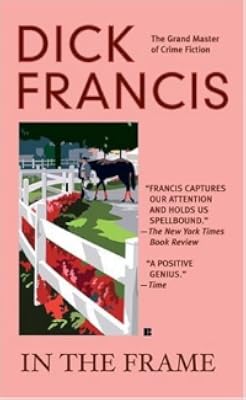
In the Frame
by Dick Francis
On This Page
Description
Dick Francis, the bestselling master of mystery and suspense, takes you into the thrilling world of horse racing.Charles Todd, a renowned painter of horses, is shocked when he turns up at his cousin Donald's house for a weekend visit to find his cousin's young wife dead on the floor and Donald the police's prime suspect. Determined to prove Donald's innocence, Todd trails a series of clues from England to Australia to New Zealand, only to realise someone is trailing him. Someone with every show more intention of taking him out of the picture for. show lessTags
Recommendations













Member Reviews
Artist Charles Todd arrives at his cousin’s house to find that the house has just been burgled and his cousin’s wife was killed in the process. When Charles realizes that his cousin Donald is the chief suspect in his wife’s murder and that Donald is in no shape to defend himself, he takes matters into his own hands. His unofficial investigation takes him to Australia, where Donald and his wife had recently traveled on business. With the help of his old friend, Jik, and Jik’s new wife, Sarah, Todd uncovers a criminal conspiracy, but the discovery just may cost him his life.
While the characters have an interest in horses and racing, horse racing is not at the forefront of this Francis novel. It’s more thriller, with Todd show more alternately pursuing and being pursued by the criminals. I loved the Australian setting and the art theme, but I was annoyed by first-person narrator Todd’s habit of withholding some of his discoveries and suspicions from the reader to reveal later in the story. show less
While the characters have an interest in horses and racing, horse racing is not at the forefront of this Francis novel. It’s more thriller, with Todd show more alternately pursuing and being pursued by the criminals. I loved the Australian setting and the art theme, but I was annoyed by first-person narrator Todd’s habit of withholding some of his discoveries and suspicions from the reader to reveal later in the story. show less
3.5***
From the book jacket: Charles Todd—a renowned painter of horses—is shocked when he turns up at his cousin Donald’s house for a weekend visit to find his cousin’s young wife dead on the floor—and Donald the police’s prime suspect. Determined to prove Donald’s innocence, Todd trails a set of clues from England to Australia to New Zealand, only to realize that someone is trailing him. Someone with every intention of taking him out of the picture for good…
My reactions
The focus of this mystery is art forgery and theft, but there’s a significant amount of horseracing involved (it IS by Dick Francis, after all).
I came late to the Dick Francis fan club, but I’m glad I’m finally here. His mysteries are tightly show more plotted, with quick action and enough twists and turns to keep things interesting. His lead characters almost always find themselves in very dicey situations, and serious injuries are common, but they persevere in the pursuit of justice.
This stand alone novel was no exception. Charles is a marvelous lead – intelligent, tenacious, physically strong, and able to outwit the bad guys. He’s helped by his old friend, Jik, and Jik’s new bride, Sarah. They make a great team. One thing I really like about Charles is that he expresses fear when one should be afraid. Too many fictional heroes seem never to fear anything.
I was happy to learn a bit about a couple of famous painters of horses – Alfred Munnings and Raoul Millais. It piqued my interest enough to send me down a google rabbit hole looking up images of their work. show less
From the book jacket: Charles Todd—a renowned painter of horses—is shocked when he turns up at his cousin Donald’s house for a weekend visit to find his cousin’s young wife dead on the floor—and Donald the police’s prime suspect. Determined to prove Donald’s innocence, Todd trails a set of clues from England to Australia to New Zealand, only to realize that someone is trailing him. Someone with every intention of taking him out of the picture for good…
My reactions
The focus of this mystery is art forgery and theft, but there’s a significant amount of horseracing involved (it IS by Dick Francis, after all).
I came late to the Dick Francis fan club, but I’m glad I’m finally here. His mysteries are tightly show more plotted, with quick action and enough twists and turns to keep things interesting. His lead characters almost always find themselves in very dicey situations, and serious injuries are common, but they persevere in the pursuit of justice.
This stand alone novel was no exception. Charles is a marvelous lead – intelligent, tenacious, physically strong, and able to outwit the bad guys. He’s helped by his old friend, Jik, and Jik’s new bride, Sarah. They make a great team. One thing I really like about Charles is that he expresses fear when one should be afraid. Too many fictional heroes seem never to fear anything.
I was happy to learn a bit about a couple of famous painters of horses – Alfred Munnings and Raoul Millais. It piqued my interest enough to send me down a google rabbit hole looking up images of their work. show less
Good solid Dick Francis. The technical aspects were well done, the character parts less so. The British view of Australia was interesting. The criminal activity was fairly well thought out, but some of the actions of the protagonist were non-sensical. In Dick Francis novel's the protagonist must be, at some point, actually captured by the bad guys.
Usual good Francis. This is the other painter one - not the Scot hiding things, but the largely itinerant painter of horses. In this case his involvement is entirely second-hand - he's not a direct target at all, until he involves himself. His cousin is very hard hit, and that's his major motivation, but it's the second victim of the theft ring that he runs into that triggers real action. And of course he suffers considerable injury in the course of his intervention, and keeps going to solve the problem - it is a Francis, after all. I like him, and his painter friend, and the friend's wife - all very well drawn. The real villain - this time I did remember him when we first meet him, but the first time he was a total surprise. The three show more questions really doesn't foreshadow much, since we don't hear the actual questions. Good story. show less
In the Frame is one of many, many novels by the British author Dick Francis. His novels are a lot of fun, just as much brainless fluff as romances, but instead represent the action genre and generally shelved in mysteries. And just like the romance genre, these action stories rely on formulaic plot and entertaining dialogue rather than character development. However, they do have charm and share insights on the human condition.
The first novel I encountered was Flying Finish. It was a bit slow to begin because I found the hero rather unsympathetic, but by the end I was hooked. Then I tried The Edge, which was a treat, right from the start. I proceeded to blaze through all of the Francis novels published at that time (1990s). I haven't show more kept up with the more recent works. I would consider these a comfort read, in terms of being something pleasant and enjoyable. But I don't own any.
I was sorry to learn while getting background for these reviews that Dick Francis died just over a year ago. He used to be a professional jockey and retired young enough to develop a long second career. From sports writer he went into fiction. At first, his protagonists and stories were entirely set in the racing world: jockeys, horse owners, trainers, race tracks, the Jockey Club, and so on. These stories are an intimate portrayal of the racing life from the inside, much as Nevada Barr has done for the relatively small, closed world of career national park staff. Over time, he started exploring other professions as well: banker, pilot, architect, diplomat, wine taster/merchant, actor, glassblower, meteorologist, inventor/entrepreneur, ransom consultant, and so on. In each case, he has clearly done his research and gives excellent descriptions of each of these professions as an avocation--the passion that drives people into such fields; the activities, skills, and concerns involved; a look at a day in the life--once again, something of an intimate, inside look, but derived from interviews and research and experimentation rather than deep-seated personal experience. But even in these cases, there's some link to the racing world. The banker makes a business loan for a stud stallion; the artist paints horses or is related to a horse owner; the wine merchant is at a ritzy party (horse owner) when tragedy strikes; the kidnap victim is a female jockey.
So what is the formula? The Dick Francis hero is always a smart, capable, quiet, white, straight, cis man going about his business. Then something shady happens, and our hero is forced to get involved, either because he's the target and really has no choice, or because his personal principles do not allow him to remain a bystander/leave it for law enforcement/pretend it isn't important. Sometimes this happens only after coincidences allow him to make unexpected connections.
Such is the case for In the Frame. Charles Todd, a painter of horses, visits his cousin for the weekend and walks into a murder scene, with the bereaved widower cousin as the chief suspect in the police inspector's insurance-fraud-gone-horribly-awry scenario. Soon afterward, he's hired by someone just met at a racetrack bar to paint the burned-out shell of a house--arson is confirmed, and once again insurance fraud suspected. What do these completely unrelated incidents have in common? A recent trip to Australia and purchase of an amazingly affordable painting by a reknowned artist. And so the action unfolds.
While the heroes are always of a type, I appreciate that Dick Francis always mixes up the personal details. Their backgrounds and current entanglements run the gamut. Hardscrabble childhood, life of wealth and privilege, broken homes, foster system, dysfunctional family, stable happily married parents, alcoholism. depression, no mental health issues, chronic health problems, debilitating injury, only child, many siblings, un/happily married, un/happily single, un/happily divorced, un/happily widowered, looking to get laid/settle down/find freedom/not really looking, wife meets social ideals/physically handicapped/estranged/loving/tolerant/bitter/forgiving, no kids/lots of kids/small child, family/in-laws loved/despised/distant/underfoot/nonexistent, whatever. He really does seem to try out just about every combo involving a straight white cis guy.
This is not to say he is homophobic or racist or otherwise bigoted as such, though people of color and strong women are rare (beyond the largely asexual forceful horsewoman of whatever stripe). In his many books, I recall all of two mentions of gay characters, both positive yet very minor. One is in The Edge: the actor who teaches our hero about makeup and disguises; the other is the gay couple who teach the hero of Reflex photography in his youth.
There's always a love interest. Sometimes it's wifey back home. Sometimes it's a new love met in the course of the adventure. Or maybe it's explored but not yet fulfilled: Rat Race, where they meet, they date, they each know it's "the one" (we won't go into how trite and problematic this trope can be) but leaping to conclusions and bad-guy intervention leads to angst before reconciliation, so no consummation within the plotline. Other times it's mentally acknowledged and recognized as out of bounds, for example, In the Frame, usually because she already belongs to somebody (yay, property! yes, yes, it's not meant this way, male honor and all that). Other times they meet, they have sex, and it looks it'll be an enduring relationship. Sometimes the hero even has sex but not with his real love interest! While these female characters often have some personality, they have a very limited role and only as adjuncts to the men.
These formulaic action novels fulfill sexist stereotypes of the genre to varying degrees, and looked at more carefully, one could argue that the sexism might go a little beyond that. In the Frame contains all of three female characters: Regina, the murdered wife in the opening scene, a classic women-in-refrigerators motif; Sarah the newlywed of our hero's oldest friend, whose last name we never learn, presumably changed to her husband's; and one of the bad guys who is never named, in fact the ONLY one who is never named, even though she plays more of a role than some of the other villains. That last fact is what makes me consider implicit sexism in the writing. And yet. Our hero is shocked and appalled at the explicit sexism in Australian racing, in terms of gender-segregated seating, where the women definitely have inferior accommodations. He makes a point of sitting there when meeting a male character, after sitting in that section by necessity in mixed company (and unwilling to separate). That's a pretty feminist act, and essentially irrelevant in terms of the story, but perhaps a necessary detail for defining the protagonist's character (read: moral fiber).
This is intended to stand in contrast to the villains. They are always working some fiddle that entails getting rich by ripping off one or many people, depending on the scheme. Or they simply want power in the racing world and will stop at nothing to achieve their goal. Inevitably, they rely on violence to achieve their ends, or simply act out their frustration at being foiled (Curses! If it hadn't been for you snoopy kids!). So our villains are immoral, sometimes sleazy, sometimes powerful, determined, dangerous. Their character is revealed as less than shiny by the usual methods: mean to animals and children, into kinky sex, bullying, arrogance, and so on. Good guys are good, and bad guys are bad. But at least Dick Francis recognizes that moral quality is not proportional to physical attractiveness.
Our hero stands in contrast: he outsmarts the bad guys, relying on strategy and allies to gather the evidence, box the villains into a corner, extract justice, or otherwise respond to the threat. Often he takes quite a beating along the way. Such is the case with In the Frame, where they try to kill him twice. Twice! But even with broken bones, our hero is able to outmaneuver them.
After my recent trip to Australia, I especially enjoyed rereading In the Frame, which goes from England to Australia. Admittedly, the only scenes in the book that I have some personal experience with are some parts of Sydney, but still the thrill of recognition and delight! Who knew that I would have a greater appreciation for pop fiction revisits as a result of the plot twists in my own life?
In sum, I still enjoy these fast-paced action adventures. I find them educational and rewarding in terms of painting portraits of different livelihoods and always the view of British sporting life. The characters remain individuals within a limited formula. I can live with the endemic faults far better than those in much of the historical fiction I've tried, because Dick Francis immerses us in these worlds quite successfully, and I'm more able to suspend my disbelief for just a little while, even as I admit to some of the ridiculous coincidences and awful stereotypes. Dick Francis novels will always be a go-to read when I need to kill a few hours with a book that is sure to entertain. show less
The first novel I encountered was Flying Finish. It was a bit slow to begin because I found the hero rather unsympathetic, but by the end I was hooked. Then I tried The Edge, which was a treat, right from the start. I proceeded to blaze through all of the Francis novels published at that time (1990s). I haven't show more kept up with the more recent works. I would consider these a comfort read, in terms of being something pleasant and enjoyable. But I don't own any.
I was sorry to learn while getting background for these reviews that Dick Francis died just over a year ago. He used to be a professional jockey and retired young enough to develop a long second career. From sports writer he went into fiction. At first, his protagonists and stories were entirely set in the racing world: jockeys, horse owners, trainers, race tracks, the Jockey Club, and so on. These stories are an intimate portrayal of the racing life from the inside, much as Nevada Barr has done for the relatively small, closed world of career national park staff. Over time, he started exploring other professions as well: banker, pilot, architect, diplomat, wine taster/merchant, actor, glassblower, meteorologist, inventor/entrepreneur, ransom consultant, and so on. In each case, he has clearly done his research and gives excellent descriptions of each of these professions as an avocation--the passion that drives people into such fields; the activities, skills, and concerns involved; a look at a day in the life--once again, something of an intimate, inside look, but derived from interviews and research and experimentation rather than deep-seated personal experience. But even in these cases, there's some link to the racing world. The banker makes a business loan for a stud stallion; the artist paints horses or is related to a horse owner; the wine merchant is at a ritzy party (horse owner) when tragedy strikes; the kidnap victim is a female jockey.
So what is the formula? The Dick Francis hero is always a smart, capable, quiet, white, straight, cis man going about his business. Then something shady happens, and our hero is forced to get involved, either because he's the target and really has no choice, or because his personal principles do not allow him to remain a bystander/leave it for law enforcement/pretend it isn't important. Sometimes this happens only after coincidences allow him to make unexpected connections.
Such is the case for In the Frame. Charles Todd, a painter of horses, visits his cousin for the weekend and walks into a murder scene, with the bereaved widower cousin as the chief suspect in the police inspector's insurance-fraud-gone-horribly-awry scenario. Soon afterward, he's hired by someone just met at a racetrack bar to paint the burned-out shell of a house--arson is confirmed, and once again insurance fraud suspected. What do these completely unrelated incidents have in common? A recent trip to Australia and purchase of an amazingly affordable painting by a reknowned artist. And so the action unfolds.
While the heroes are always of a type, I appreciate that Dick Francis always mixes up the personal details. Their backgrounds and current entanglements run the gamut. Hardscrabble childhood, life of wealth and privilege, broken homes, foster system, dysfunctional family, stable happily married parents, alcoholism. depression, no mental health issues, chronic health problems, debilitating injury, only child, many siblings, un/happily married, un/happily single, un/happily divorced, un/happily widowered, looking to get laid/settle down/find freedom/not really looking, wife meets social ideals/physically handicapped/estranged/loving/tolerant/bitter/forgiving, no kids/lots of kids/small child, family/in-laws loved/despised/distant/underfoot/nonexistent, whatever. He really does seem to try out just about every combo involving a straight white cis guy.
This is not to say he is homophobic or racist or otherwise bigoted as such, though people of color and strong women are rare (beyond the largely asexual forceful horsewoman of whatever stripe). In his many books, I recall all of two mentions of gay characters, both positive yet very minor. One is in The Edge: the actor who teaches our hero about makeup and disguises; the other is the gay couple who teach the hero of Reflex photography in his youth.
There's always a love interest. Sometimes it's wifey back home. Sometimes it's a new love met in the course of the adventure. Or maybe it's explored but not yet fulfilled: Rat Race, where they meet, they date, they each know it's "the one" (we won't go into how trite and problematic this trope can be) but leaping to conclusions and bad-guy intervention leads to angst before reconciliation, so no consummation within the plotline. Other times it's mentally acknowledged and recognized as out of bounds, for example, In the Frame, usually because she already belongs to somebody (yay, property! yes, yes, it's not meant this way, male honor and all that). Other times they meet, they have sex, and it looks it'll be an enduring relationship. Sometimes the hero even has sex but not with his real love interest! While these female characters often have some personality, they have a very limited role and only as adjuncts to the men.
These formulaic action novels fulfill sexist stereotypes of the genre to varying degrees, and looked at more carefully, one could argue that the sexism might go a little beyond that. In the Frame contains all of three female characters: Regina, the murdered wife in the opening scene, a classic women-in-refrigerators motif; Sarah the newlywed of our hero's oldest friend, whose last name we never learn, presumably changed to her husband's; and one of the bad guys who is never named, in fact the ONLY one who is never named, even though she plays more of a role than some of the other villains. That last fact is what makes me consider implicit sexism in the writing. And yet. Our hero is shocked and appalled at the explicit sexism in Australian racing, in terms of gender-segregated seating, where the women definitely have inferior accommodations. He makes a point of sitting there when meeting a male character, after sitting in that section by necessity in mixed company (and unwilling to separate). That's a pretty feminist act, and essentially irrelevant in terms of the story, but perhaps a necessary detail for defining the protagonist's character (read: moral fiber).
This is intended to stand in contrast to the villains. They are always working some fiddle that entails getting rich by ripping off one or many people, depending on the scheme. Or they simply want power in the racing world and will stop at nothing to achieve their goal. Inevitably, they rely on violence to achieve their ends, or simply act out their frustration at being foiled (Curses! If it hadn't been for you snoopy kids!). So our villains are immoral, sometimes sleazy, sometimes powerful, determined, dangerous. Their character is revealed as less than shiny by the usual methods: mean to animals and children, into kinky sex, bullying, arrogance, and so on. Good guys are good, and bad guys are bad. But at least Dick Francis recognizes that moral quality is not proportional to physical attractiveness.
Our hero stands in contrast: he outsmarts the bad guys, relying on strategy and allies to gather the evidence, box the villains into a corner, extract justice, or otherwise respond to the threat. Often he takes quite a beating along the way. Such is the case with In the Frame, where they try to kill him twice. Twice! But even with broken bones, our hero is able to outmaneuver them.
After my recent trip to Australia, I especially enjoyed rereading In the Frame, which goes from England to Australia. Admittedly, the only scenes in the book that I have some personal experience with are some parts of Sydney, but still the thrill of recognition and delight! Who knew that I would have a greater appreciation for pop fiction revisits as a result of the plot twists in my own life?
In sum, I still enjoy these fast-paced action adventures. I find them educational and rewarding in terms of painting portraits of different livelihoods and always the view of British sporting life. The characters remain individuals within a limited formula. I can live with the endemic faults far better than those in much of the historical fiction I've tried, because Dick Francis immerses us in these worlds quite successfully, and I'm more able to suspend my disbelief for just a little while, even as I admit to some of the ridiculous coincidences and awful stereotypes. Dick Francis novels will always be a go-to read when I need to kill a few hours with a book that is sure to entertain. show less
Artist Charles Todd paints mostly horses. But he arrives for a weekend away at his cousin Donald's to find the house burgled and Donald's wife murdered. A suspiciously similar story at the races leads him to Australia on the trail of the murderous burglars.
This was a fast read. Lots of travel and changes of scenery. I didn't get as much a sense of the main character as in others. Still, a pleasure.
This was a fast read. Lots of travel and changes of scenery. I didn't get as much a sense of the main character as in others. Still, a pleasure.
I always turn to a Dick Francis novel, when I need a break from the latest writing styles of today. Francis always turns out to be a refreshingly sweet breeze from the past, full of old-fashioned manners, lifestyles, and attitudes, and isn't it nice to go there once in a while, for a short stay? Even if it's in a short novel such as this.
In the Frame is a novel about a painter, instead of the usual jockey, which was a nice change of pace. Francis makes sure to write, in the beginning of the book, about how he spent time with two different real artists, just to be able to tell us how things work. How the artist paints, how he cleans his brushes, and how he feels about other artists. And I think Francis does an amazing job, once again.
In show more the Frame deals not only with artists, painting, and (of course) horse racing, but also forgery, on a large, overseas scale. Once again, I was fascinated, and wanted to spend more time with the main character, even though the main reason for the mystery was a death. What a lovely time I had, living in this novel. I hope you will have one as well. show less
In the Frame is a novel about a painter, instead of the usual jockey, which was a nice change of pace. Francis makes sure to write, in the beginning of the book, about how he spent time with two different real artists, just to be able to tell us how things work. How the artist paints, how he cleans his brushes, and how he feels about other artists. And I think Francis does an amazing job, once again.
In show more the Frame deals not only with artists, painting, and (of course) horse racing, but also forgery, on a large, overseas scale. Once again, I was fascinated, and wanted to spend more time with the main character, even though the main reason for the mystery was a death. What a lovely time I had, living in this novel. I hope you will have one as well. show less
Members
- Recently Added By
Published Reviews
This is an interesting book. The protagonist of this book is Charles. He is a painter, and he visits his cousins's house. He decides to help his cousins when he knew his cousins's house was stole and his wife was killed. The beginning of the story is very attracting. In my opinion, the author is good at writing. The writer has very great logical ideas about this story.
added by Hengyi
Lists

Crime and Mysteries to Read
746 works; 31 members

Stories set on Australian Continent
67 works; 5 members

Australia, New Zealand and Oceania
88 works; 20 members

Alphabetical Books
211 works; 3 members

Books Read in 2020
4,379 works; 124 members
Author Information

244+ Works 64,094 Members
Dick Francis was born in Wales on October 31, 1920. Because his father was a professional steeplechase jockey and a stable manager, Francis grew up around horses, and after a stint as a pilot in the Royal Air Force during World War II, he became a steeplechase jockey himself, turning professional in 1948. He was named champion jockey of the show more 1953-54 racing season by the British National Hunt after winning more than 350 races and was retained as jockey to the queen mother for four seasons. When he retired from racing in 1957 at the age of 36, Francis went to work as a racing correspondent for the Sunday Express, a London paper, where he worked for 16 years. In the early sixties, he decided to combine his love of mysteries with his knowledge of the racing world, and published Dead Cert in 1962. Set mostly in the racing world, he has written more than 40 novels including Forfeit, Blood Sport, Slay-Ride, Odds Against, Flying Finish, Smoke Screen, High Stakes, and Long Shot. He wrote his last four books Dead Heat, Silks, Even Money, and Crossfire with his son Felix Francis. He has received numerous awards including the Silver Dagger award from Britain's Crime Writers Association for For Kicks, the Gold Dagger award for Whip Hand, the Diamond Dagger award in 1990, and three Edgar awards. He died on February 14, 2010 at the age of 89. (Bowker Author Biography) show less
Some Editions
Series
Belongs to Publisher Series
Work Relationships
Is contained in
Common Knowledge
- Canonical title
- In the Frame
- Original title
- In the Frame
- Original publication date
- 1976
- People/Characters
- Charles Neil Todd; Donald Stuart; Inspector Frost [In The Frame]; Billy Pyle; Auntie Sal; Maisie Matthews (show all 22); Mr. Greene [In The Frame]; D. J. Lagland; Gary Robinson; Jik Cassavetes; Sarah Cassavetes; Howard K. Petrovitch; Mrs. Wyatt L. Minchless; Hudson Taylor; Ivor Wexford; Norman Updike; Inspector Porter; Superintendent Wall; Harley Renbo; Mr. Snell; Mrs. Howard K. Petrovitch; Wyatt L. Minchless
- Important places
- England, UK; Australia; Shropshire, England, UK; Worthing, West Sussex, England, UK; Sydney, New South Wales, Australia; Melbourne, Victoria, Australia (show all 7); Alice Springs, Northern Territory, Australia
- Important events
- Melbourne Cup
- Related movies
- Dick Francis: In the Frame (1989 | IMDb)
- Dedication
- For Caroline sound asleep
- First words
- I stood on the outside of disaster, looking in.
- Last words
- (Click to show. Warning: May contain spoilers.)"We can get some more," he said, sniffling, "...on the motorway."
Classifications
Statistics
- Members
- 1,255
- Popularity
- 19,571
- Reviews
- 30
- Rating
- (3.70)
- Languages
- 9 — Czech, Danish, Dutch, English, Estonian, German, Norwegian (Bokmål), Norwegian, Swedish
- Media
- Paper, Audiobook, Ebook
- ISBNs
- 60
- UPCs
- 1
- ASINs
- 22