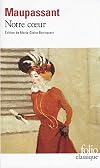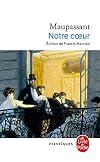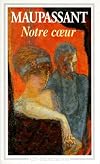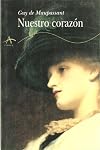
Alien Hearts
by Guy de Maupassant
On This Page
Description
Alien Hearts "was the last novel that Guy de Maupassant completed before succumbing to the effects of tertiary syphilis of which he was to die at forty-three. It is the most original and surprising of his novels and the one in which he attains a truly tragic perception of the wounded human heart. "Alien Hearts "is the story of lovers bound by bitterness as much as by passion. Maupassant's hero falls for a woman of the world, a glacially dazzling beauty whose past with an abusive husband show more leads her to hold him-and everyone-at arm's length. He seeks solace with a servant girl, but remains racked by pointless infatuation. show lessTags
Recommendations






























Member Reviews
The premise of this short novel is pretty simple. It's high-society Paris at the end of the 19th century. André Mariolle is a rich, handsome young man that isn't really doing much aside from enjoying his place in society. He's convinced by a friend to attend an exclusive salon of artist- and intellectual-types, hosted by the magnificent Madame de Burne. She's the type of woman that every man falls in love with, but after an unhappy, abusive first marriage, she refuses to involve herself in any kind of romantic relationship. Mariolle is determined to resist Madame's spell (a characteristic that initially intrigues her) but with nothing else to do, he quickly succumbs and devotes himself to loving her. Their subsequent affair starts off show more with a bang but quickly dwindles, leaving each to contemplate their own views on love and relationships.
Lots of people in the book group found this book boring and the characters unlikeable. I didn't really have an opinion when I immediately read it—it wasn't bad but it wasn't great, either. Once we discussed it, though, I liked it a lot more because I got more out of it. Maupassant didn't write this book for great in-depth character development; it's a book of ideas.
First of all, examine this setting: it's a society that's divided by class. Men hold the power, and women have very little of it. Artists and intellectuals have no real place—they're "bourgeois" but at least a little interesting. Associating with them when you're clearly in a much higher class is almost trendy.
Then look at Madame de Burne: a miserable first marriage has left her jaded. Sure, she may get off on having all these men fawning over her, but she's honest from the beginning—no relationships, no love. If they keep at it, it's not her fault; she told them she wasn't going to fall in love. She's clearly wealthy and has almost a full-time job in entertaining and maintaining such an image and high-status. She flirted with a relationship with Mariolle, which seemed more of a personal experiment than anything—testing the waters to see if she could do the relationship thing. But in a time when women need to marry for status, she already has it and without a husband. So what would she gain from a marriage she's not really into? Nothing. She's in a good place, personally, so why rock that boat?
Finally, Mariolle: love to him is just something to do. Maybe his heart is genuinely in it, but there's a point where it just gets pathetic and you can't feel much sympathy. Certainly a rejection will sting, but can it really be heart-breaking when your feelings were never reciprocated? He does, however, represent that feeling of hope when you're trying to get a relationship to go the way you want it. You justify actions and words, choosing to believe what you want to believe, with the hope that the person is going to suddenly change and love you right back.
It may not have been the most compelling story to read, but it had a lot there. It's a story that would translate well to any medium set in any time, because the emotions are universal and very relatable. Have you seen (500) Days of Summer? Because that is a case in point. show less
Lots of people in the book group found this book boring and the characters unlikeable. I didn't really have an opinion when I immediately read it—it wasn't bad but it wasn't great, either. Once we discussed it, though, I liked it a lot more because I got more out of it. Maupassant didn't write this book for great in-depth character development; it's a book of ideas.
First of all, examine this setting: it's a society that's divided by class. Men hold the power, and women have very little of it. Artists and intellectuals have no real place—they're "bourgeois" but at least a little interesting. Associating with them when you're clearly in a much higher class is almost trendy.
Then look at Madame de Burne: a miserable first marriage has left her jaded. Sure, she may get off on having all these men fawning over her, but she's honest from the beginning—no relationships, no love. If they keep at it, it's not her fault; she told them she wasn't going to fall in love. She's clearly wealthy and has almost a full-time job in entertaining and maintaining such an image and high-status. She flirted with a relationship with Mariolle, which seemed more of a personal experiment than anything—testing the waters to see if she could do the relationship thing. But in a time when women need to marry for status, she already has it and without a husband. So what would she gain from a marriage she's not really into? Nothing. She's in a good place, personally, so why rock that boat?
Finally, Mariolle: love to him is just something to do. Maybe his heart is genuinely in it, but there's a point where it just gets pathetic and you can't feel much sympathy. Certainly a rejection will sting, but can it really be heart-breaking when your feelings were never reciprocated? He does, however, represent that feeling of hope when you're trying to get a relationship to go the way you want it. You justify actions and words, choosing to believe what you want to believe, with the hope that the person is going to suddenly change and love you right back.
It may not have been the most compelling story to read, but it had a lot there. It's a story that would translate well to any medium set in any time, because the emotions are universal and very relatable. Have you seen (500) Days of Summer? Because that is a case in point. show less
Never has such a short novel seemed so long, unless I've blocked others out of my memory. I've spent days trying to figure out what to say about it, because de Maupassant is an excellent writer, but I just could not bring myself to care about the romantic torments of his protagonist, a rich young man with time on his hands named Mariolle, or the woman he becomes obsessed with, Madame de Burne, who seems to play with the emotions of men for fun. Furthermore, many of the characters in the novel say insulting and degrading things about women, although I suppose this only reflects the time and the place. This was a bleak novel in which the members of the upper classes, even when artists of various kinds, seem removed from the reality of show more life and spend their time playing at parties and affairs and gossip; the only people who seem to have a grasp on something substantive are a sculptor who enters the story only briefly and a young girl Mariolle meets when he flees to the country to try to forget Madame de Burne. I felt that I was experiencing some of the torment Mariolle felt by reading endlessly about his thoughts and feelings; all I can say is that Proust did this a lot better even though he did it at much greater length. I wanted to like this book a lot more than I did. show less
The back cover description threw me off for I expected a story about the games and deception we practice when we're in love but in fact the story was more of a foray into what it means to love and how love has many faces. I absolutely adored this book, the vivid descriptions of salons frequented by glittering artistes, the manner in which love manifests and most of all, the power of a woman to capture and retain a man's love. A beautiful story.
Maupassant's final novel is another gem. Perhaps readers will not find the central characters likeable but, as the introduction mentions, perhaps the book is more about who is to be pitied. Personally, I found it possible to empathize with the leads to certain degrees (as I imagine anyone who has endured a number of relationships would) and that rendered them quite believable. As always with his novels I am astonished with Maupassant's perceptive grasp of the psychology of men and women and the characters he creates from this.
If I have one problem with the novella it's with Madame de Burne. Although I find her a very interesting character the hole she has within herself also creates a hole within the story. We see and feel so much from show more Mariolle but so little from de Burne. It leaves the book feeling slightly imbalanced and as if there's just a little something lacking.
Otherwise it's a fine novella that packs a lot into its small size, even if it's not quite as engaging as Maupassant's best work. show less
If I have one problem with the novella it's with Madame de Burne. Although I find her a very interesting character the hole she has within herself also creates a hole within the story. We see and feel so much from show more Mariolle but so little from de Burne. It leaves the book feeling slightly imbalanced and as if there's just a little something lacking.
Otherwise it's a fine novella that packs a lot into its small size, even if it's not quite as engaging as Maupassant's best work. show less
I am not a literary critic, an academic, or an intellectual. My reviews are simply my personal reaction to the writing, the story, or the topic, and how much those engaged me. I really didn't like this book. I only finished it because it was by de Maupassant and I thought I should. I haven't read anything by him in many years, but I still vaguely remember the story about the girl who cut off and sold her hair for her lover who.... He's a master storyteller and, because he's French, knows all about love.
This was about love -- two kinds of love and how a clever (but pathetic) young man finally figures out how to bring the two together to work for him. But it wasn't so much a story as an exposition of some theory of love, and this didn't show more interest me. Madame de Burne was a bitch and Andre Mariolle was insufferable. And I was bored. show less
This was about love -- two kinds of love and how a clever (but pathetic) young man finally figures out how to bring the two together to work for him. But it wasn't so much a story as an exposition of some theory of love, and this didn't show more interest me. Madame de Burne was a bitch and Andre Mariolle was insufferable. And I was bored. show less
MAUPASSANT ne déroge pas ici à son style, si caractéristique : il décrit sans indulgence des personnages très divers et très représentatifs de son époque. Son héroïne s'inscrit dans son temps et s'en éloigne à la fois par la modernité dont elle fait preuve : libre et maîtresse de sa vie, elle est l'objet du désir et des souffrances des hommes qui l'entourent. Abordant le thème de l'amour malheureux, MAUPASSANT est sans complaisance avec ses personnages ce qui laisse à penser qu'il livre beaucoup de lui même dans son écriture.
Aug 28, 2014French
Guy de Maupassantin myöhäisin romaani pursuilee korkealentoista kirjallista kielellä koreilua ja vanhanaikaisia eufemismeja. Romaani on - yksinkertaistettuna - kertomus rakkaussuhteesta viulunsoittaja Mariollen ja vaarallisen, itserakkaan, aikansa femme fatalen, rouva de Burnen välillä. Koko romaani koostuu oikeastaan näiden kahden henkilön välisten tunteiden kuvauksesta.
Maupassantin romaanien juonen tai aiheen kuvaus saa ne aina kuulostamaan tylsemmiltä ja pinnallisemmilta kuin ne ovat. Tätäkään romaania en olisi varmasti lukenut esimerkiksi pelkästään takakannen kuvauksen perusteella (joka sisältää mm. seuraavan oudon väitteen: Mestari tarkastelee [romaanissaan] niitä kiihottavia ja ongelmallisia mielentiloja, show more joihin rakkaus saattaa viedä tyypillisesti ranskalaisen mentaliteetin.). Romaani kuulostaakin takakannen perusteella lähinnä halvalta kioskikirjallisuudelta tai yliromanttiselta 1800-luvun harlekiinilta, mutta lukiessa jotenkin tottuu lauseisiin, jotka alkavat "Ah!", "Voi!" tai "Kernaasti!" Lopputuloksena on totaalisen koukuttava, päivässä tai parissa ahmittava romaani.
Alkuperäinen arvostelu show less
Maupassantin romaanien juonen tai aiheen kuvaus saa ne aina kuulostamaan tylsemmiltä ja pinnallisemmilta kuin ne ovat. Tätäkään romaania en olisi varmasti lukenut esimerkiksi pelkästään takakannen kuvauksen perusteella (joka sisältää mm. seuraavan oudon väitteen: Mestari tarkastelee [romaanissaan] niitä kiihottavia ja ongelmallisia mielentiloja, show more joihin rakkaus saattaa viedä tyypillisesti ranskalaisen mentaliteetin.). Romaani kuulostaakin takakannen perusteella lähinnä halvalta kioskikirjallisuudelta tai yliromanttiselta 1800-luvun harlekiinilta, mutta lukiessa jotenkin tottuu lauseisiin, jotka alkavat "Ah!", "Voi!" tai "Kernaasti!" Lopputuloksena on totaalisen koukuttava, päivässä tai parissa ahmittava romaani.
Alkuperäinen arvostelu show less
Jul 19, 2012Finnish
Members
- Recently Added By
Talk Discussions
Past Discussions
Maupassant: Alien Hearts in Author Theme Reads (May 2013)
Author Information

2,543+ Works 26,592 Members
Henry-René-Albert-Guy de Maupassant was born on August 5, 1850 in France. He was schooled at a seminary in Yvetot and Le Harve. He fought in the Franco-German War, then held civil service posts with the Ministry of the Navy and the Ministry of Public Instruction. He also worked with Gustave Flaubert, who helped him develop his writing talent and show more introduced him to many literary greats. During his lifetime, he wrote six novels, three travel books, one book of verse, and over 300 short stories. He is considered one of the fathers of the modern short story. His works include The Necklace, A Piece of String, Mademoiselle Fifi, Miss Harriet, My Uncle Jules, Found on a Drowned Man, and The Wreck. He suffered from mental illness in his later years and attempted suicide on January 2, 1892. He was committed to a private asylum in Paris, where he died on July 6, 1893. (Bowker Author Biography) show less
Some Editions
Awards and Honors
Series
Belongs to Publisher Series
Work Relationships
Is contained in
Common Knowledge
- Canonical title
- Alien Hearts
- Original title
- Notre cœur
- Original publication date
- 1890
Classifications
Statistics
- Members
- 283
- Popularity
- 113,470
- Reviews
- 7
- Rating
- (3.55)
- Languages
- 9 — Dutch, English, Finnish, French, German, Italian, Russian, Slovak, Spanish
- Media
- Paper, Ebook
- ISBNs
- 25
- ASINs
- 10