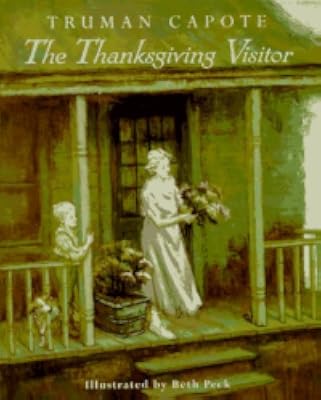
The Thanksgiving Visitor
by Truman Capote
On This Page
Description
A boy recalls his life with an elderly relative in rural Alabama in the 1930s and the lesson she taught him one Thanksgiving Day about dealing with a bully from school.Tags
Recommendations


















Member Reviews
You know, I quite like it. The story itself could easily become a saccharine morality tale of told by anyone else, but it’s so earnest and vividly remembered you can’t help but warm to it.
Despite a very sad childhood, Truman had one shining star. His elderly cousin Sooke navigated him through a tough patch, teaching him right from wrong, and good from evil.
When he was dumped in rural Alabama by parents who did not want to be responsible in raising him, this bright, sensitive, lonely boy temporarily found an anchor in Sooke.
Bullied abusively by many, but in particular by a near do well named Odd, he dreaded going to school. Told by Odd that he was beating him to "toughen him up", Truman truly never did toughen up. Both as a child and an adult, Truman was an incredibly insecure person.
In this story, when he confesses to Sooke that he fears Odd, she explains that Odd and his family are poorer than most, that his father is show more not exactly a great man, and that his mother does the best she can.
Sooke tells Truman he must invite Odd to the family Thanksgiving dinner. Sooke paves the way and Thanksgiving day finds Odd in Truman's company. Jealous beyond comprehension, Truman seethes when Odd is given attention by family members.
The opportunity for revenge strikes when Truman observes Odd stealing Sookes one and only valuable item -- an old cameo.
Deliberately embarrassing Odd, Truman waits for the opportunity to announce to those at the table that Odd is a thief.
Sooke becomes incredibly angry at Truman, berating him and noting that it is never right to deliberately exhibit cruelty.
Sadly, in the pages of the book Truman seems to understand this lesson. If real life, this adage is not carried through.
Five stars for this well-written, poignant tale. show less
When he was dumped in rural Alabama by parents who did not want to be responsible in raising him, this bright, sensitive, lonely boy temporarily found an anchor in Sooke.
Bullied abusively by many, but in particular by a near do well named Odd, he dreaded going to school. Told by Odd that he was beating him to "toughen him up", Truman truly never did toughen up. Both as a child and an adult, Truman was an incredibly insecure person.
In this story, when he confesses to Sooke that he fears Odd, she explains that Odd and his family are poorer than most, that his father is show more not exactly a great man, and that his mother does the best she can.
Sooke tells Truman he must invite Odd to the family Thanksgiving dinner. Sooke paves the way and Thanksgiving day finds Odd in Truman's company. Jealous beyond comprehension, Truman seethes when Odd is given attention by family members.
The opportunity for revenge strikes when Truman observes Odd stealing Sookes one and only valuable item -- an old cameo.
Deliberately embarrassing Odd, Truman waits for the opportunity to announce to those at the table that Odd is a thief.
Sooke becomes incredibly angry at Truman, berating him and noting that it is never right to deliberately exhibit cruelty.
Sadly, in the pages of the book Truman seems to understand this lesson. If real life, this adage is not carried through.
Five stars for this well-written, poignant tale. show less
a quick, easy read. well written, good message.
"'There's just this I want to say, Buddy. Two wrongs never made a right. It was wrong of him to take the cameo. But we don't know why he took it. Maybe he never meant to keep it. Whatever his reason, it can't have been calculated. Which is why what you did was much worse: you planned to humiliate him. It was deliberate. Now listen to me, Buddy: there is only one unpardonable sin - deliberate cruelty. All else can be forgiven. That, never. Do you understand me, Buddy?'
I did, dimly, and time has taught me that she was right. But at that moment I mainly comprehended that because my revenge had failed, my method must have been wrong."
"'There's just this I want to say, Buddy. Two wrongs never made a right. It was wrong of him to take the cameo. But we don't know why he took it. Maybe he never meant to keep it. Whatever his reason, it can't have been calculated. Which is why what you did was much worse: you planned to humiliate him. It was deliberate. Now listen to me, Buddy: there is only one unpardonable sin - deliberate cruelty. All else can be forgiven. That, never. Do you understand me, Buddy?'
I did, dimly, and time has taught me that she was right. But at that moment I mainly comprehended that because my revenge had failed, my method must have been wrong."
Very good short story.
based on Capotes own life a wonderful read.
Ratings
Members
- Recently Added By
Lists

Recommend the 20 best books you've read in the last five years
2,168 works; 606 members
Author Information

175+ Works 57,046 Members
Truman Capote, 1924 - 1984 Novelist and playwright Truman Streckfus Person was born in 1924 in New Orleans to a salesman and a 16-year-old beauty queen. His parents divorced when he was four years old and was then raised by relatives for a few years in Monroeville. His mother was remarried to a successful businessman, moved to New York, and Truman show more adopted his stepfather's surname. He attended Greenwich High School and never went to college. When he was 17, Capote's formal education ended when he was employed at The New Yorker magazine. He belived he did not need to go to college to be a writer, since he was writing seriously since age 11. Capote's first novel was "Other Voices, Other Rooms" (1948), which told the story of a boy growing up in the Deep South. "The Grass Harp" (1951) is about a young boy and his elderly cousin discovering that some compromise is necessary for people to live together in a community and was adapted to screen in 1996. The play "The House of Flowers" (1954) is a musical set in a West Indies bordello. Capote then wrote, "Breakfast at Tiffanys" (1958), which tells the story of how Holly Golightly goes to New York seeking happiness. Capote became preoccupied with journalism and, sparked by the murder of a wealthy family in Holcomb, Kansas, began interviewing the locals to recreate the lives of the murderers and their victims. The research and writing for this novel, "In Cold Blood" (1966), took six years for him to complete. Other works of Capote's include the classic "A Christmas Memory" (1966), which is an autobiographical account of a seven-year-old boy, his cousin, and an eccentric old lady, "Music for Chameleons" (1981), which is a collection of short pieces, interviews, stories and conversations that were published in several magazines, and "One Christmas" (1982). On August 26, 1984 in Los Angeles, Truman Capote died of liver disease complicated by phlebitis and multiple drug intoxication. Published after his death were "Conversations With Capote" (1985) and "Answered Prayers: The Untitled Novel" (1986). (Bowker Author Biography) show less
Series
Belongs to Publisher Series
Work Relationships
Common Knowledge
- Original title
- Thanksgiving Day
- Original publication date
- 1967
- People/Characters
- Buddy; Odd Henderson; Miss Sook
- Important places
- Alabama, USA
- Important events
- Thanksgiving
- Dedication
- for Lee
- First words
- Talk about mean!
- Last words
- (Click to show. Warning: May contain spoilers.)We watched until he turned a bend at the corner, innocent of the menace he carried, the chrysanthemums that burned, that groweled and roared against a greenly lowering dusk.
Classifications
Statistics
- Members
- 344
- Popularity
- 91,664
- Reviews
- 6
- Rating
- (4.04)
- Languages
- English, French, Italian
- Media
- Paper
- ISBNs
- 10
- ASINs
- 5