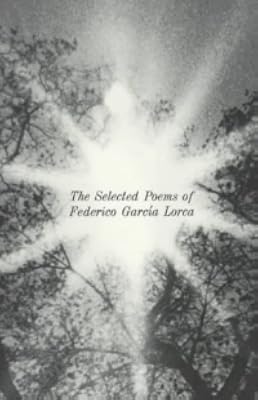
The Selected Poems of Federico Garcia Lorca
by Federico García Lorca
On This Page
Description
Presents the Spanish text and English translation of Llanto por Ignacio Sanchez Mejias as well as poems selected from works including Romancero Gitano, Canciones, and Poeta en Nueva York.Tags
Recommendations




Member Recommendations
Member Reviews
I have lost myself in the sea many tunes
with my ear full of freshly cut flowers,
with my tongue full of love awl agony.
I have lost myself in the sea many times
as I lose myself in the heart of certain children.
It has been a meandering weekend, laden with thoughts on consciousness and narrative, These thoughts led to a certain brooding. Most of the selected work here appeared lighter, odes to tranquility and affection. My soul wasn't overly callous for such but neither did it bloom.
These clipped lines embrace Spain's Moorish past. Not the Caliphate but traditions of poetry which rolled across deserts and seas. There were troubadours of the moment who found hope in the scent of flowers. Unfortunately the same tide of history which show more propels those sentiments brought something ugly his way. show less
Throughout this selection from Lorca's body of work, his poems ring out with a melancholy, dreamlike, and sometimes morbid lyricism. His development is clearly noticeable here. Some of the earliest work is rather juvenile, but the majority of the last third of this volume, especially the Gacela and Casida included from Divan del Tamarit, employ the aforementioned elements to such effect and with such an amount of skill that I do not hesitate to count them among some of the best poetry I have read.
The book notes explain that Federico Garcia Lorca greatly contributed to saving traditional Spanish poetic forms and songs, particularly the Saeta, and there were some poems that were quite striking and worthwhile in this book. I enjoyed the opportunity to experience this book in both Spanish and English, as I am not entirely fluent in Spanish.
Unfortunately, what I will remember most from this book is the Ode to Walt Whitman. There is an attempt to put this poem in context- it was written during the Great Depression in New York, by a man who was missing country life and was homesick. The point of the poem was to tie male homosexuality to the decay of the city. Garcia Lorca takes pains to say that he is not criticizing closeted gay men show more and boys, but only those blatantly gay. I tried to find a different interpretation of this poem, and failed. What is for me unfortunate is that there are also worthwhile poems in this book, but they are overshadowed by the memory of this one. show less
Unfortunately, what I will remember most from this book is the Ode to Walt Whitman. There is an attempt to put this poem in context- it was written during the Great Depression in New York, by a man who was missing country life and was homesick. The point of the poem was to tie male homosexuality to the decay of the city. Garcia Lorca takes pains to say that he is not criticizing closeted gay men show more and boys, but only those blatantly gay. I tried to find a different interpretation of this poem, and failed. What is for me unfortunate is that there are also worthwhile poems in this book, but they are overshadowed by the memory of this one. show less
This selection of Lorca's poetry does a good job illustrating his career from beginning to end and his growth as a poet. The poems are arranged chronologically. His immaturity as a poet are evident in the early works. He hones his skills and develops his own style noticeably with the selections from his third book of poems. From then on, the poems sing with a folk lyricism and surrealism. This collection contains translations by many notable writers, including Langston Hughes and W.S. Merwin.
From the early poems through to the last the beauty of language and nature creates an iridescent glow. The poetry of Lorca has a simplicity that belies the depth of its meaning.
Garcia Lorcan (1898-1936) kootuissa runoissa tulee esille hänen kykynsä tuoda esille psykologisia sävyjä ja erilaisia vertauskuvia. Lorcan runomitta on kaunis ja soljuva. Lorcan tuotannossa kuuluu espanjalainen kansanperimä.
Poems about self, being other, society, repression. Lorca is a favorite poet.
Members
- Recently Added By
Lists

Philip Ward's Lifetime Reading Plan
592 works; 22 members

Harold Bloom - The Western Canon: D. The Chaotic Age
833 works; 24 members
Author Information

943+ Works 15,465 Members
Federico del Sagrado Corazón de Jesús García Lorca was born in a small town west of Granada, Spain, on June 5, 1898. He was a poet and playwright. His collections of poetry included Gypsy Ballads and Poet in New York. His plays included The Butterfly's Evil Spell, The Shoemaker's Prodigious Wife, Don Perlimplin, Blood Wedding, Yerma, and The show more House of Bernarda Alba. In 1936, he was assassinated by an anti-communist death squad during the beginning of the Spanish Civil War. Franco's regime placed a ban on Lorca's work and this was not lifted until 1953. It was not until Franco died that Lorca's work could be openly discussed in Spain. (Bowker Author Biography) Federico Garcia Lorca, born in Granada in 1898, was murdered by Franco's soldiers in 1936. (Publisher Provided) show less
All Editions
Awards and Honors
Notable Lists
Common Knowledge
- Canonical title
- The Selected Poems of Federico Garcia Lorca
- Original publication date
- 1955 (English collection) (English collection)
- First words
- In the half-century since Lorca's murder his plays have been performed throughout Europe with great success. - Introduction
These poems, written in the 1920s, are selected from a very large body of early work. - Last words
- (Click to show. Warning: May contain spoilers.)A wind with a smell of children's spittle, crushed grass and a jellyfish veil which announces the constant baptism of newly created things.
Classifications
Statistics
- Members
- 760
- Popularity
- 37,026
- Reviews
- 8
- Rating
- (4.30)
- Languages
- English, Multiple languages, Spanish
- Media
- Paper, Ebook
- ISBNs
- 5
- ASINs
- 6