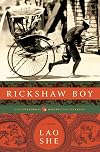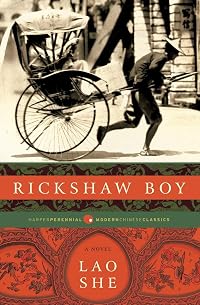
Rickshaw Boy
by She Lao
On This Page
Description
"Lao She's great novel." -The New York Times A beautiful new translation of the classic Chinese novel from Lao She, one of the most acclaimed and popular Chinese writers of the twentieth century, Rickshaw Boy chronicles the trials and misadventures of a poor Beijing rickshaw driver. Originally published in 1937, Rickshaw Boy-and the power and artistry of Lao She-can now be appreciated by a contemporary American audience.Tags
Recommendations



















Member Reviews
Rickshaw Boy appears to be widely considered to be a classic of modern Chinese literature. (I note that a list of the “’100 greatest Chinese novels of the 20th century’ selected by 14 Chinese critics from different Chinese speaking regions” listed Rickshaw Boy third and Lao She is fourth among “60 Greatest Chinese Writers of the Century.”) This novel, first published in 1937, follows the arrival in the capital of Xiangzi, a poor peasant from the countryside. Xiangzi is illiterate and hard-working, blessed with youth, strength, determination, and integrity. He becomes the perfect protagonist for the author’s purpose, to illustrate the power and brutality of the environment and the inevitable futility of the individual’s show more struggle to escape the unending cycle of poverty, hunger, and violence. For a Western reader, Lao She also sheds a fascinating light on Chinese philosophy and religious beliefs. The social fabric is woven in such a way that without great luck—which is constantly just beyond his grasp—Xiangzi’s life is guaranteed to amount to nothing. As we follow his fortunes—up, down, then up again and finally down again—he seeks nothing more than to own his own rickshaw and be content. (For reasons explained in detail in the introduction, this translation, by Howard Goldblatt, is clearly the one to get.) My greatest disappointment? That the author’s other works are so hard to find in English. show less
This deceptively simple book Rickshaw Boy by Lao She (1899-1966) is a classic of Chinese literature. According to the helpful introduction by translator Howard Goldblatt, Lao She was a prolific writers of plays, short stories and novels, and his status as one of the most widely read and best beloved Chinese authors is all the more remarkable given his humble beginnings. His father was a lowly palace guard for the emperor when he was killed during the Boxer rebellion in 1900, plunging the family into dire poverty, which influenced Lao She for the rest of his life.
Despite disruption to his education due to financial difficulties, he was able to graduate from Beijing Normal University and, became a teacher, eventually making his way to the show more University of London where he taught Chinese from 1924-1929. He read voraciously and became a great admirer of Dickens, whose devotion to the urban downtrodden and use of ironic humour Lao She found particularly affecting; they would inform much of his own work, particularly the early novels and stories. He wrote his first three novels in London, and continued writing when he returned to China, mostly writing stories which critiqued the malaise which inhibited development in China and made it vulnerable to foreign incursions. During what became a turbulent period in Chinese history, his belief in the Confucian ideal of individual moral integrity, shifted as he began to doubt that individual heroism could be of any use in a generally corrupt society. Yes, hard on the heels of Barnard Eldershaw's Tomorrow and Tomorrow and Tomorrow which posited the hopelessness of individual effort to achieve social mobility or even to keep one's head above water, I read Rickshaw Boy which has the same political and moral message: that individualism is bankrupt in the face of a corrupting and dehumanising social system.
But where the Barnard Eldershaw novel expounded the message in 400+ pages of sledgehammer polemics, the simplicity and elegance of Rickshaw Boy is a different reading experience altogether. Its central character is an orphaned rural labourer who comes to Beijing (called Beiping in the novel) determined to better himself. Despite his poverty Xiangzi is the embodiment of the Confucian man of virtue: he beggars himself to dress neatly and to rent the smartest of rickshaws; he offers superior service; he is as classy as a rickshaw boy can be to get the work he wants so that he can buy his own rickshaw and be financially independent. Never at any time are the disasters which befall him his fault.
If you aren't already feeling uneasy about the cover image on this book, the descriptions of Xiangzi pulling his rickshaw through all kinds of terrible weather and at the mercy of his customers, will make you realise how degrading this form of human exploitation is. In the beginning Xiangzi pities the older men, never imagining that he will be old before his time too:
Summer is equally perilous, on days when the torrid heat means no one should be doing hard physical labour of this kind.
To read the rest of my review please visit https://anzlitlovers.com/2019/11/23/rickshaw-boy-by-lao-she-translated-by-howard... show less
Despite disruption to his education due to financial difficulties, he was able to graduate from Beijing Normal University and, became a teacher, eventually making his way to the show more University of London where he taught Chinese from 1924-1929. He read voraciously and became a great admirer of Dickens, whose devotion to the urban downtrodden and use of ironic humour Lao She found particularly affecting; they would inform much of his own work, particularly the early novels and stories. He wrote his first three novels in London, and continued writing when he returned to China, mostly writing stories which critiqued the malaise which inhibited development in China and made it vulnerable to foreign incursions. During what became a turbulent period in Chinese history, his belief in the Confucian ideal of individual moral integrity, shifted as he began to doubt that individual heroism could be of any use in a generally corrupt society. Yes, hard on the heels of Barnard Eldershaw's Tomorrow and Tomorrow and Tomorrow which posited the hopelessness of individual effort to achieve social mobility or even to keep one's head above water, I read Rickshaw Boy which has the same political and moral message: that individualism is bankrupt in the face of a corrupting and dehumanising social system.
But where the Barnard Eldershaw novel expounded the message in 400+ pages of sledgehammer polemics, the simplicity and elegance of Rickshaw Boy is a different reading experience altogether. Its central character is an orphaned rural labourer who comes to Beijing (called Beiping in the novel) determined to better himself. Despite his poverty Xiangzi is the embodiment of the Confucian man of virtue: he beggars himself to dress neatly and to rent the smartest of rickshaws; he offers superior service; he is as classy as a rickshaw boy can be to get the work he wants so that he can buy his own rickshaw and be financially independent. Never at any time are the disasters which befall him his fault.
If you aren't already feeling uneasy about the cover image on this book, the descriptions of Xiangzi pulling his rickshaw through all kinds of terrible weather and at the mercy of his customers, will make you realise how degrading this form of human exploitation is. In the beginning Xiangzi pities the older men, never imagining that he will be old before his time too:
Xiangzi was not heedless of the wretched condition of the old, frail rickshaw men whose clothes were so tattered, a light wind blew through them and a strong one tore them to shreds. Their feet were wrapped in rags. They waited, shivering in the cold, at rickshaw stands, wanting to be first to shout "Rickshaw!" when a prospective fare approached. Running warmed them up and soaked their tattered clothes in sweat, which froze as soon as they stopped. Strong winds nearly stopped them in their tracks. When the wind came from above, they ducked their heads down into their chests; wind gusting up from below nearly knocked them off their feet. They dared not raise their heads in a headwind, to keep from turning into kites, and when the wind was at their backs, they lost control of both their rickshaws and themselves. They tried every trick they knew, used every ounce of energy they possessed, to pull their rickshaws to their destination, nearly killing themselves for a few coins. After each trip, their faces were coated with dust mixed with sweat, through which poked three frozen red circles—two eyes and mouth. Few people were out on the streets during the short, cold days of winter, and a day of running might not bring in enough for one good meal. And yet the older men had wives and children at home, while the younger ones had parents and siblings. For these men, winters were sheer torture... (p.95)
Summer is equally perilous, on days when the torrid heat means no one should be doing hard physical labour of this kind.
To read the rest of my review please visit https://anzlitlovers.com/2019/11/23/rickshaw-boy-by-lao-she-translated-by-howard... show less
A remarkable must-read book set in pre-Communist China. It’s about the rise and fall of an inherently good country boy who comes to the city to try to achieve a modest life. He is reduced to poverty after an initial success at being a rickshaw-driver. His decline is due to the sick society he lives in. With its emphasis on individualism and capitalism, the rickshaw driver gives up his inner sense of morality, and becomes a pauper and a thief. I would like to write more about this book which really moved me both in its thoughts and in the writing. Thank you to @Gypsy_Boy for putting me onto this book.
This is really one of the saddest books I have read in a long time. A life of poverty and one strong young man trying his hardest to have a better life in 1930s China. Well, not a chance.
My copy of the book was published in the People's Republic of China in 1981, Foreign Language Press, Beijing. It is a lovely book complete with a ribbon bookmark and several woodblock style colored illustrations scattered through the novel. The novel was first published in (I think) 1935 but was subsequently revised a number of times, before and after the revolution. What I found especially informative was the 1979 preface by the author's widow and the afterwords by the author from Sept 1954 and 1945.
My copy of the book was published in the People's Republic of China in 1981, Foreign Language Press, Beijing. It is a lovely book complete with a ribbon bookmark and several woodblock style colored illustrations scattered through the novel. The novel was first published in (I think) 1935 but was subsequently revised a number of times, before and after the revolution. What I found especially informative was the 1979 preface by the author's widow and the afterwords by the author from Sept 1954 and 1945.
This classic of modern Chinese literature is the story of the life of Xiangzi, who comes to Beijing as a youth, hoping to make his fortune as a rickshaw boy. More universally, it is the story of a life of poverty and the difficulties of overcoming the hardships and inequities that afflict the poor in most societies.
Xiangzi works hard and scrimps so that he can ultimately purchase his own rickshaw, rather than renting it. He is initially successful, but through a series of events loses that rickshaw. Over and over again, as Xiangzi appears about to better his life, circumstances intervene which push him to the bottom again. For the most part, he seems to accept these setbacks as his due, and he recognizes the futility of fighting back show more against the corruption of his society.
This was a touching book, as well as being informative and historically important. Although it involves a segment of the undersociety in 1930's China, it could just as well have been written by Zola or Dickens.
While Lao She was never a rickshaw puller, his parents were illiterate and worked menial jobs. He was well acquainted with poverty, and many of the characters and events in the book are based on people he knew in childhood. The book is written in simple prose, and ends thusly:
"Watching a skinny stray dog waiting by the sweet-potato vendor's carrying pole for some peel and rootlets, he knew that he was just like this dog, struggling for some scraps to eat. As long as he managed to keep alive, why think of anything else?"
Highly recommended. show less
Xiangzi works hard and scrimps so that he can ultimately purchase his own rickshaw, rather than renting it. He is initially successful, but through a series of events loses that rickshaw. Over and over again, as Xiangzi appears about to better his life, circumstances intervene which push him to the bottom again. For the most part, he seems to accept these setbacks as his due, and he recognizes the futility of fighting back show more against the corruption of his society.
This was a touching book, as well as being informative and historically important. Although it involves a segment of the undersociety in 1930's China, it could just as well have been written by Zola or Dickens.
While Lao She was never a rickshaw puller, his parents were illiterate and worked menial jobs. He was well acquainted with poverty, and many of the characters and events in the book are based on people he knew in childhood. The book is written in simple prose, and ends thusly:
"Watching a skinny stray dog waiting by the sweet-potato vendor's carrying pole for some peel and rootlets, he knew that he was just like this dog, struggling for some scraps to eat. As long as he managed to keep alive, why think of anything else?"
Highly recommended. show less
Xiangzi is a country boy who moves to Beiping (Beijing). He works as a rickshaw puller, and through hard work, saving, clean living, and honesty, he plans to save until he can buy his own rickshaw and eventually own a rickshaw stand. Despite his best efforts, he is thwarted every time he starts to get ahead, through no fault of his own, and eventually gives up his grand dreams, and then his basic dreams as well.
An easy read, but fairly repetitive and obvious once you catch on to the pattern. Also sad and predictable.
——————
This novel has been very popular in China, and is an indictment of the philosophy of individualism (per the back cover)--one man, working hard alone, is unlikely or unable to move ahead given a lack of show more safety net or family/friend network. show less
An easy read, but fairly repetitive and obvious once you catch on to the pattern. Also sad and predictable.
——————
This novel has been very popular in China, and is an indictment of the philosophy of individualism (per the back cover)--one man, working hard alone, is unlikely or unable to move ahead given a lack of show more safety net or family/friend network. show less
Ever wonder what it's like to be a human pack animal? I think it's better for the humans than for animal slaves. Still, it's a hard life. A sad book but an uplifting ending.
Members
- Recently Added By
Lists

The Guardian's 1000 Novels Everyone Must Read
1,005 works; 548 members

CHINESE FICTION (in translation)
33 works; 1 member

The China Project Book List
100 works; 2 members
Author Information

111+ Works 1,363 Members
Lao She (1899-1966) is a master novelist and playwright famous for his revisioning of China
Some Editions
Awards and Honors
Distinctions
Notable Lists
Series
Belongs to Publisher Series
Common Knowledge
- Canonical title
- Rickshaw Boy
- Original title
- 骆驼祥子 [Luo Tuo Xiang Zi]
- Alternate titles
- Rickshaw Boy; Camel Xiangzi; Rickshaw
- Original publication date
- 1937 (Chinese original) (Chinese original)
- Original language
- Chinese
Classifications
- Genres
- General Fiction, Fiction and Literature
- DDC/MDS
- 895.1 — Literature & rhetoric Literatures of other languages Literatures of East and Southeast Asia Chinese
- LCC
- PL2804 .C5 .L613 — Language and Literature Languages and literatures of Eastern Asia, Africa, Oceania Languages of Eastern Asia, Africa, Oceania Chinese language and literature Chinese literature Individual authors and works
- BISAC
Statistics
- Members
- 557
- Popularity
- 53,209
- Reviews
- 10
- Rating
- (3.76)
- Languages
- 7 — Chinese, Dutch, English, Esperanto, Finnish, French, German
- Media
- Paper, Audiobook, Ebook
- ISBNs
- 51
- ASINs
- 23