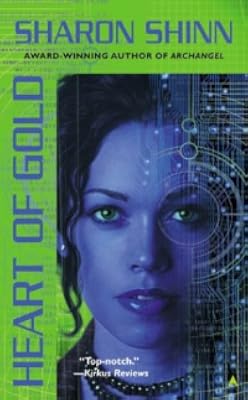
Heart of Gold
by Sharon Shinn
On This Page
Description
On a planet torn apart by class and economic divisions and feuding factions, a scientist and a rebel are drawn together in a forbidden love that could change their world forever.... Nolan uses his rational powers of observation to examine more closely the privileges he was born to enjoy--and the people he was raised to despise. Katrini follows her fiercest passions in the struggle to overthrow a legacy of hate--one that has poisoned her family for generations. Between rich and poor, strong show more and weak, intellect and feeling, only one thing could bring these two opposites together: a passion that is strictly forbidden. show lessTags
Recommendations

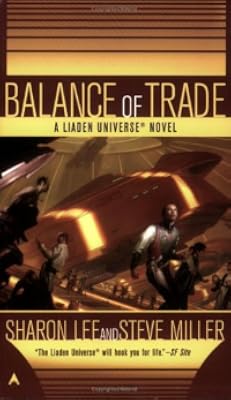
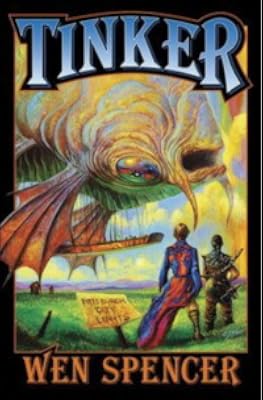
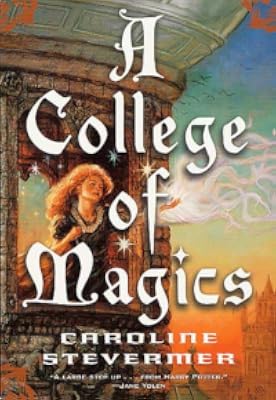
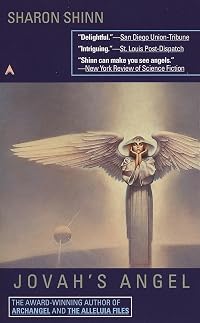


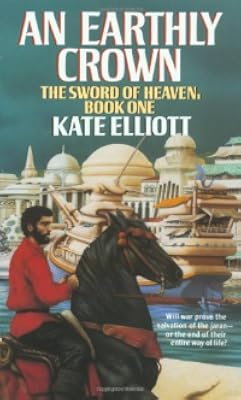
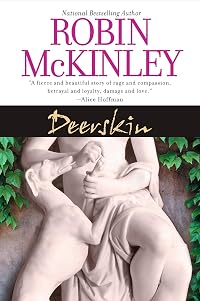
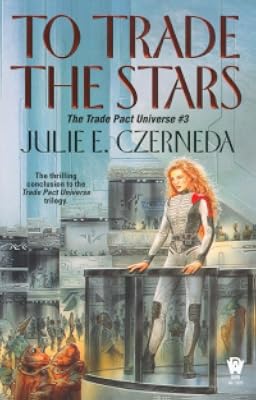
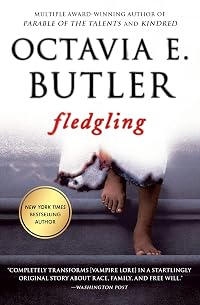





Member Recommendations

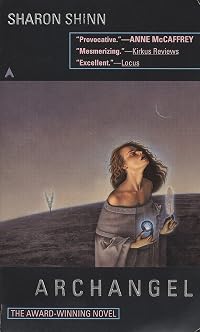
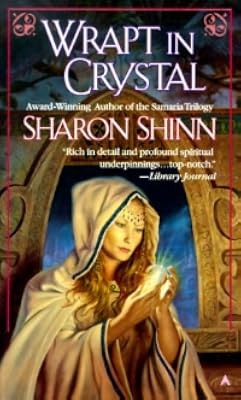
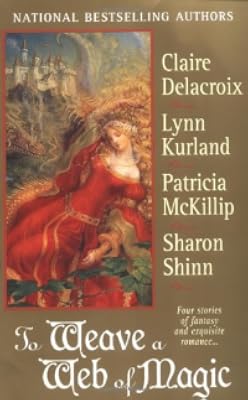
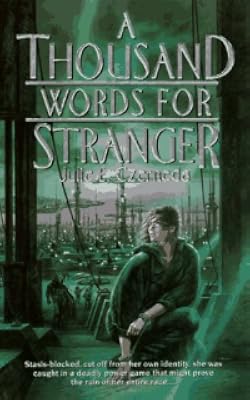
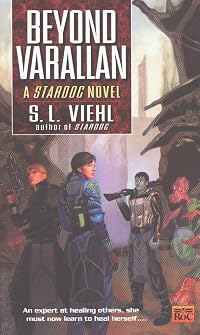
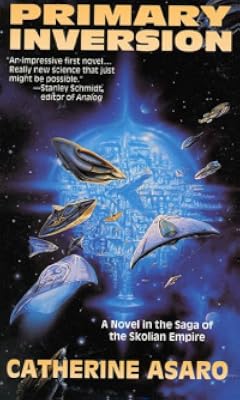
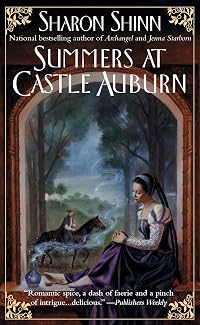
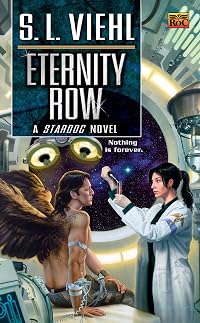
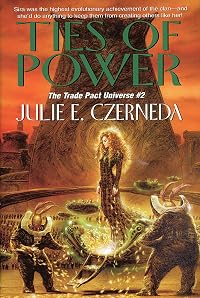
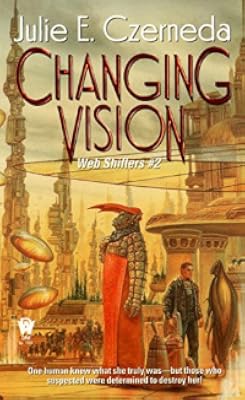
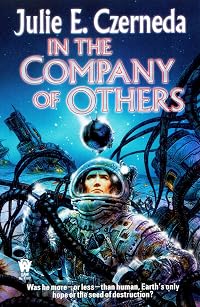
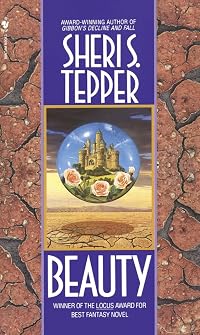
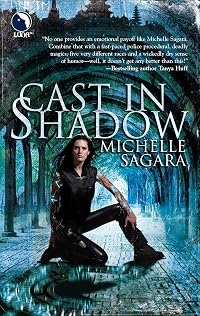
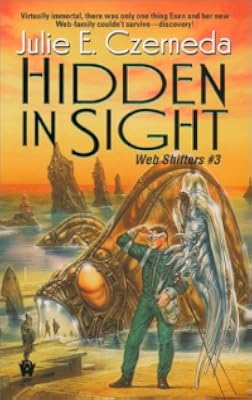
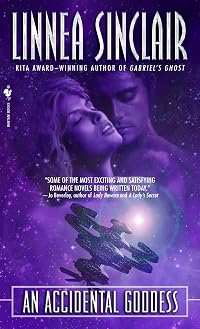
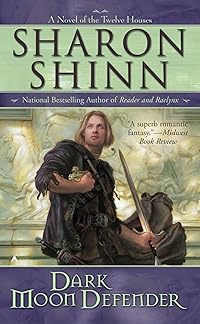
espertus Both books deftly depict struggles between tribal and familial loyalty and broader humanitarianism among human races different from our own.
Member Reviews
As I now expect from Shinn's novels, this was brilliant. The world is just what I expect from a good science fiction novel: strange enough to make it feel completely alien, yet familiar enough for me to relate to the problems its society faces. The summary only gives the romantic aspects of the book, I think. While romance plays a big role, this is also a book about impending war between the indigo and gulden. Through this, Shinn is able to explore major issues about discrimination, politics, racism, and biological warfare all the while entertaining us as readers. I like the idea of two races not getting along not just because of their skin color and bad history, but because of fundamental differences about how they believe life should show more be lived. I really think this would be a good novel to study and analyze because it's able to fit so much in its three hundred fifty pages. As always with Shinn, the characters were interesting and complex; even the minor characters were able to hold my attention.
The one major pitfall of Heart of Gold is the ending. What I particularly loved while reading it was that there were huge internal conflicts and external conflicts that were intricately linked to each other. While the characters' internal conflicts are nicely wrapped up, I felt like the external conflict had just begun to reach its peak at the ending of the novel. In the last few dozen pages, it was building up to be something quite dramatic, but the novel ends before the action can be carried out. That greatly disappointed me, and I know it will frustrate many other readers. show less
The one major pitfall of Heart of Gold is the ending. What I particularly loved while reading it was that there were huge internal conflicts and external conflicts that were intricately linked to each other. While the characters' internal conflicts are nicely wrapped up, I felt like the external conflict had just begun to reach its peak at the ending of the novel. In the last few dozen pages, it was building up to be something quite dramatic, but the novel ends before the action can be carried out. That greatly disappointed me, and I know it will frustrate many other readers. show less
I couldn't help thinking throughout about the Irish word for a black person, daoine gorm or blue people, because to call someone black was to associate them with the devil, or so I was told. This features a world with three main races, blue, gold and white, where white is in the minority and the blue and gold are two very different worlds, blue are a matriarcy and hold men as inferior, and the gold are patriarchal and very much so.
When a male scientist finds a secret that will change his world and change his future he has to get the help of a female blue who understands.
I guessed a few of the twists, and the sexism and racism analogues were a bit overt but overall it's very interesting.
When a male scientist finds a secret that will change his world and change his future he has to get the help of a female blue who understands.
I guessed a few of the twists, and the sexism and racism analogues were a bit overt but overall it's very interesting.
Shinn has created a sf world where three races coexist, each almost biologically identical save for the color of their skin. Through a plot about terrorism and falling in love, Shinn examines the tense relationship between the brutal, colorful and patriarchal Gilder and the repressed, agrarian and martiarchal Indigo. There are a few great moments: when an Indigo character realizes that although she was raised by the Gulden, she still has all the privileges of an Indigo; the long and uncomfortable bus ride two Indigo take to visit a golden friend; the Gulden newspapers printed with two languages, side by side...But the moments that feel like true statements about race, gender, and sexuality are too rare to make up for a hackneyed plot show more and stale characters. I was also really annoyed that Shinn was so lazy in creating the two clashing cultures—each is clearly an Earth culture, with sf colored skin. The Gulden are stereotypically Middle Eastern, complete with honor killings, while the Indigo are oh-so-Western European, complete with fancy balls. Why not create two NEW cultures, or at the very least not map them so closely onto clichés? Still and all, worth a read. show less
First of all, the writing was all right. It started off a little shaky but improved a lot over the book and I got into it enough that I wanted to continue reading.
This book is really something and in a bad way. Shinn tries to do a whole lot and it ends up being WAY too much. I had very high hopes for this book. The racial and sexual politics intrigued me at first. The set up of EXTREMELY flawed characters was nice in the beginning. There was room for a lot of growth. However, that growth never really happens as much as it should. I mean, we have a bit of it. But the "change" wasn't actually that far from the original points of views of the characters anyway.
Shinn really should have also stuck to just race. She brought in homosexuality show more (and made a really mind-boggling distinction between female and male homosexuality that was unbelievable in such a society) and abortion, but she never dealt with them. I mean, we have two conversations where it's like, "yeah. We believe this and you believe that and we both make no sense," in terms of homosexuality, but it's never resolved. On one hand, we're cool with female homosexuality, but even though Nolan spends quite a bit of time talking about his feelings about male homosexuality, it's never resolved. I mean, why put it in, if you're not going to actually tackle it? It makes it seem as if you're supporting that kind of idea. And then abortion is brought up for literally no reason. I got the idea that Shinn is anti-abortion because that side kinda wins the argument (even after comparing abortion to murdering children um . . . ).
Race is dealt with acceptably for the most part, though I must point out that we never actually meet a "good" guldman even though we have several "good" blueman characters. It could have been done a whole lot more effectively but it wasn't atrocious. And sex is done about the same.
I think Shinn tried too hard to reverse all the conventions of our world and ended up messing up big time.
The romance is kind of weird but turns out relatively cute, which was nice. show less
This book is really something and in a bad way. Shinn tries to do a whole lot and it ends up being WAY too much. I had very high hopes for this book. The racial and sexual politics intrigued me at first. The set up of EXTREMELY flawed characters was nice in the beginning. There was room for a lot of growth. However, that growth never really happens as much as it should. I mean, we have a bit of it. But the "change" wasn't actually that far from the original points of views of the characters anyway.
Shinn really should have also stuck to just race. She brought in homosexuality show more (and made a really mind-boggling distinction between female and male homosexuality that was unbelievable in such a society) and abortion, but she never dealt with them. I mean, we have two conversations where it's like, "yeah. We believe this and you believe that and we both make no sense," in terms of homosexuality, but it's never resolved. On one hand, we're cool with female homosexuality, but even though Nolan spends quite a bit of time talking about his feelings about male homosexuality, it's never resolved. I mean, why put it in, if you're not going to actually tackle it? It makes it seem as if you're supporting that kind of idea. And then abortion is brought up for literally no reason. I got the idea that Shinn is anti-abortion because that side kinda wins the argument (even after comparing abortion to murdering children um . . . ).
Race is dealt with acceptably for the most part, though I must point out that we never actually meet a "good" guldman even though we have several "good" blueman characters. It could have been done a whole lot more effectively but it wasn't atrocious. And sex is done about the same.
I think Shinn tried too hard to reverse all the conventions of our world and ended up messing up big time.
The romance is kind of weird but turns out relatively cute, which was nice. show less
I wanted to like it. I loved Shinn's YA fantasies. I am a feminist, and am interested in topics of race, privilege, and gender. But this is just so clunky, so graceless. I felt like, by p. 24, I got the point of the story, and didn't need to struggle with these unlikable characters any longer. Sorry. Thanks to all who wrote reviews, who convinced me I didn't have to read further before making my decision!
Initially, indigo male Nolan Adelpho's only break from tradition is to work in the city before his arranged marriage, after which he will devote himself to hearth and home back in indigo lands, in which the other races rarely mix and never as equals. In the lab, however, he works as equals with alibinos and guldens, whose male chauvinism he finds shocking compared to the female chauvinism under which he was raised.
His unconventional opposite, Kitrini Cadachi, is a rare indigo raised among the gulden and in love with an imprisoned gulden terrorist, Jex, the son of the gulden leader.
As the novel unfolds and unrest between the indigo and gulden races grows, Nolan's and Kitrini's loyalties and values are increasingly challenged in a manner show more I found both realistic and engaging. show less
His unconventional opposite, Kitrini Cadachi, is a rare indigo raised among the gulden and in love with an imprisoned gulden terrorist, Jex, the son of the gulden leader.
As the novel unfolds and unrest between the indigo and gulden races grows, Nolan's and Kitrini's loyalties and values are increasingly challenged in a manner show more I found both realistic and engaging. show less
I read Sharon Shinn's Samaria series many years ago (when it was still a trilogy), and thought it simply wonderful. Heart of Gold, while good, doesn't measure up. And that's disappointing, because there's a lot of potential in its premise.
On an unnamed continent of an unnamed planet, three diverse races live in a state of unarmed truce. The Indigos, a blue-skinned matriarchal society, are the de facto rulers of the continent by virtue of their numbers and control of arable land. The Guldens, a gold-skinned patriarchal society, are more technologically innovative, but stifled by restricted access to land, wealth, and power. The third race, the Albinos, exist in meek servitude, primarily to the Indigos.
Nolan Adelpho, the scion of one of show more the High Hundred families, the Indigo elite, is a scientist in Biolab in the Central City. His family is waiting for him to get this notion of working for a living out of system and marry according to family arrangement. He is quietly rebelling: although he loves Leesa, his fiancee, he is resisting the pressure being put on him to come home, where all he will then be required to do is raise the children and take care of the house. He enjoys his work and has made several satisfactory discoveries in his field: antivirals and antibiotics.
Kitrini Candachi is the somewhat disreputable member of another High Hundred family: disreputable by virtue of her father's youthful rebellion in leaving home and raising her among the Guldens. Much to her indomitable grandmother's dismay, she does her reputation no good by being the mistress of Jex Zanlan, the son of the Gulden chief Chay Zanlan.
The Indigo and the Gulden have viewed each other with suspicion for generations. Long ago, the Indigo bullied the Gulden out of their native lands and pushed them toward the rocky coast. Non-aggression treaties were eventually signed, but lately the Indigo have been pushing into Gulden territory again. Terrorist attacks have taken place in retaliation, attacks laid at the feet of Jex Zanlan, now under arrest and awaiting trial in the Central City.
Shinn spends nearly half of the book introducing us to the various aspects and conflicts of Indigo and Gulden society, and then plunges us into the midst of a terrorist attack, a frantic escape from Central City, and a clandestine journey to Gulden territory in an effort to thwart a malicious plot. The slow build-up is necessary, especially due to the severe role reversal of Indigo society, where women have all the power, land, money, and prestige, and men are the virginal chattel bargained away in marriage. Even the action-packed second half progresses at a leisurely pace. For all its leisure, though, this is a fast read, easily consumed in a day or two.
All that being said, this book's premise is one that could have easily been expanded to twice its length. Too much was left unexplored. What was the origin of the different skin tones? Did the Indigo come from some other planet or some other continent and take over the Gulden lands? If not, how did two such radically different societal structures evolve on the same continent? Was there some geologic feature which separated them that the Indigo eventually surmounted? Why did Shinn even include the Albino race since they played virtually no part in the story? What about the Guldens' trading partners on other continents, mentioned only in passing? Were they Gulden as well? Albino? Or something else? So many questions, so little information. I guess that's what comes from having a mind attuned to anthropology....
So. Bottom line. Enjoyable light SF/fantasy with a romantic bent, not too taxing on the brain. Could have been better, but not too shabby a way to spend a Sunday afternoon. show less
On an unnamed continent of an unnamed planet, three diverse races live in a state of unarmed truce. The Indigos, a blue-skinned matriarchal society, are the de facto rulers of the continent by virtue of their numbers and control of arable land. The Guldens, a gold-skinned patriarchal society, are more technologically innovative, but stifled by restricted access to land, wealth, and power. The third race, the Albinos, exist in meek servitude, primarily to the Indigos.
Nolan Adelpho, the scion of one of show more the High Hundred families, the Indigo elite, is a scientist in Biolab in the Central City. His family is waiting for him to get this notion of working for a living out of system and marry according to family arrangement. He is quietly rebelling: although he loves Leesa, his fiancee, he is resisting the pressure being put on him to come home, where all he will then be required to do is raise the children and take care of the house. He enjoys his work and has made several satisfactory discoveries in his field: antivirals and antibiotics.
Kitrini Candachi is the somewhat disreputable member of another High Hundred family: disreputable by virtue of her father's youthful rebellion in leaving home and raising her among the Guldens. Much to her indomitable grandmother's dismay, she does her reputation no good by being the mistress of Jex Zanlan, the son of the Gulden chief Chay Zanlan.
The Indigo and the Gulden have viewed each other with suspicion for generations. Long ago, the Indigo bullied the Gulden out of their native lands and pushed them toward the rocky coast. Non-aggression treaties were eventually signed, but lately the Indigo have been pushing into Gulden territory again. Terrorist attacks have taken place in retaliation, attacks laid at the feet of Jex Zanlan, now under arrest and awaiting trial in the Central City.
Shinn spends nearly half of the book introducing us to the various aspects and conflicts of Indigo and Gulden society, and then plunges us into the midst of a terrorist attack, a frantic escape from Central City, and a clandestine journey to Gulden territory in an effort to thwart a malicious plot. The slow build-up is necessary, especially due to the severe role reversal of Indigo society, where women have all the power, land, money, and prestige, and men are the virginal chattel bargained away in marriage. Even the action-packed second half progresses at a leisurely pace. For all its leisure, though, this is a fast read, easily consumed in a day or two.
All that being said, this book's premise is one that could have easily been expanded to twice its length. Too much was left unexplored. What was the origin of the different skin tones? Did the Indigo come from some other planet or some other continent and take over the Gulden lands? If not, how did two such radically different societal structures evolve on the same continent? Was there some geologic feature which separated them that the Indigo eventually surmounted? Why did Shinn even include the Albino race since they played virtually no part in the story? What about the Guldens' trading partners on other continents, mentioned only in passing? Were they Gulden as well? Albino? Or something else? So many questions, so little information. I guess that's what comes from having a mind attuned to anthropology....
So. Bottom line. Enjoyable light SF/fantasy with a romantic bent, not too taxing on the brain. Could have been better, but not too shabby a way to spend a Sunday afternoon. show less
Members
- Recently Added By
Published Reviews
Blobs of fuzzy sociopolitical preaching clot what little narrative nudges Shinn's two story lines along, while her characters, indigo and gulden alike, seem equally cardboardy--and downright colorless despite their hues.
added by cattriona
Lists

Science fiction novels with a female protagonist
105 works; 30 members
Author Information

49+ Works 18,358 Members
Sharon Shinn was born in 1957. She is a novelist who writes combining fantasy, science fiction and romance. She attended and graduated from Northwestern University. She has published more than a dozen novels for adult and young adult readers. She works as a journalist in St. Louis Missouri. She is a frequent attender of science-fiction/ fantasy show more conventions such as ArmadilloCon26 and Capricorn 29 in 2009. Sharon Shinn donated her archive to the department of Rare Books and Special Collections at Northern Illinois University. Sharon Shinn won the William Crawford Award for Achievement in Fantasy and was nominated for the John W. Campbell Award for Best New Writer. A journalist who lives in St. Louis, Shinn is also the author of Archangel, Jovah's Angel, The Alleluia Files, Wrapt in Crystal, and The Shape-Changer's Wife. (Bowker Author Biography) show less
Some Editions
Awards and Honors
Awards
Common Knowledge
- Original publication date
- 2000
Classifications
Statistics
- Members
- 597
- Popularity
- 49,350
- Reviews
- 14
- Rating
- (3.66)
- Languages
- English
- Media
- Paper, Ebook
- ISBNs
- 4
- ASINs
- 4