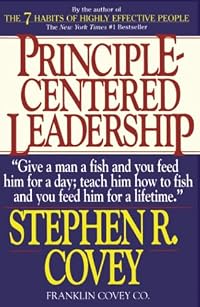
Principle-Centered Leadership
by Stephen R. Covey
On This Page
Description
How do we as individuals and organizations survive and thrive amid tremendous change? Why are efforts to improve falling so short in real results despite the millions of dollars in time, capital, and human effort being spent on them? How do we unleash the creativity, talent, and energy within ourselves and others in the midst of pressure? Is it realistic to believe that balance among personal, family, and professional life is possible? The answer to these and other dilemmas is show more Principle-Centered Leadership, a long-term, inside-out approach to developing people and organizations. The key to dealing with the challenges that face us today is the recognition of a principle-centered core within both ourselves and our organizations. Dr. Covey offers insights and guidelines that can help you apply these principles both at work and at home -- leading not just to a new understanding of how to increase quality and productivity, but also to a new appreciation of the importance of building personal and professional relationships in order to enjoy a more balanced, more rewarding, more effective life. show lessTags
Recommendations




Member Reviews
The theme of Principle-Centred Leadership is to become a leader by centering oneself on principles, values, and natural laws rather than on external centers such as family, money, possessions, enemies, work, etc. On this basis, Covey emphasizes that a man’s security comes from inside principles rather than from outside factors.
Covey dives into the nature of human beings and capitalizes on its capabilities to transform the team and the organization. He stresses the necessity of achieving the Private Victory on the individual level to achieve the Public Victory, which is the concept around which his 7 Habits of Highly Effective People are built around.
Stephen Covey considers mission statement the essential recipe for success in any show more leadership endeavor. He urges individuals and organizations to develop mission statements that will guide people and align systems and procedures to achieve its goals.
PCL (Principle-Centred Leadership) requires hard work and diligent efforts to give its fruits. Covey stresses the need to ‘obey’ and respect natural laws in order to succeed. He adopts the Law of the Farm as a metaphor to successful leadership; you can’t reap the crop before you seed, water, cultivate…
PCL enforces tapping people’s potentials and creativity rather than using them only as resources and assets. Involving people in creating a mission statement is necessary to get buy-in, else, you’re running the risk of losing talented people to somewhere else.
Although ideas and concepts of the book could’ve been organized more properly, it taps on invaluable concept that must be applied in all arenas. I recommend the book to starters and to versed leaders. I also recommend reading Covey’s “7 Habits of Highly Effective People” before reading this book as it draws its concepts from those Habits. show less
Covey dives into the nature of human beings and capitalizes on its capabilities to transform the team and the organization. He stresses the necessity of achieving the Private Victory on the individual level to achieve the Public Victory, which is the concept around which his 7 Habits of Highly Effective People are built around.
Stephen Covey considers mission statement the essential recipe for success in any show more leadership endeavor. He urges individuals and organizations to develop mission statements that will guide people and align systems and procedures to achieve its goals.
PCL (Principle-Centred Leadership) requires hard work and diligent efforts to give its fruits. Covey stresses the need to ‘obey’ and respect natural laws in order to succeed. He adopts the Law of the Farm as a metaphor to successful leadership; you can’t reap the crop before you seed, water, cultivate…
PCL enforces tapping people’s potentials and creativity rather than using them only as resources and assets. Involving people in creating a mission statement is necessary to get buy-in, else, you’re running the risk of losing talented people to somewhere else.
Although ideas and concepts of the book could’ve been organized more properly, it taps on invaluable concept that must be applied in all arenas. I recommend the book to starters and to versed leaders. I also recommend reading Covey’s “7 Habits of Highly Effective People” before reading this book as it draws its concepts from those Habits. show less
Very good to have in tandem with "The 7 habits of highly effective people."Provides tremendous insight on human nature. Provides a great foundation for Management and how to utilize your people effectively. I highly recommend Stephen Covey's books.
Audio book (only) available through Christchurch City Libraries
https://goo.gl/jz7goX
If you don't have membership of Christchurch City Libraries use the CORE Library card H228848301 PIN 1234
Learn the powerful principles Dr. Stephen R. Covey has taught to many of the world's top executives and most influential leaders. Align your organization's resources and structures to increase long-term performance and create a high-trust culture, the ultimate competitive advantage.
https://goo.gl/jz7goX
If you don't have membership of Christchurch City Libraries use the CORE Library card H228848301 PIN 1234
Learn the powerful principles Dr. Stephen R. Covey has taught to many of the world's top executives and most influential leaders. Align your organization's resources and structures to increase long-term performance and create a high-trust culture, the ultimate competitive advantage.
Ratings
Members
- Recently Added By
Author Information

313+ Works 36,647 Members
Stephen R. Covey was born on October 24, 1932, in Salt Lake City, Utah. He received a degree in business administration from the University of Utah, an M.B.A. from Harvard Business School, and a D.R.E. from Brigham Young University. He was a teacher and administrator at Brigham Young University. In 1983, he founded the Covey Leadership Center, a show more training and consulting concern. He wrote numerous books on leadership, personal and organizational effectiveness, and family and interpersonal relationships. His best known book, The Seven Habits of Highly Effective People: Restoring the Character Ethic, first published in 1989. His other books include Principle Centered Leadership; First Things First: To Live, to Love, to Learn, and to Leave a Legacy; Daily Reflections for Highly Effective People; Seven Habits of Highly Effective Families; The 8th Habit: From Effectiveness to Greatness; and The 3rd Alternative. He received the Thomas More College Medallion and the Utah Symphony Fiftieth Anniversary Award in 1990, and the McFeely Award of the International Management Council for contributions and service in 1991. He died from injuries sustained in a bicycle accident on July 16, 2012 at the age of 79. (Bowker Author Biography) show less
Work Relationships
Common Knowledge
- Canonical title
- Principle-Centered Leadership
- Original publication date
- 1990
- Dedication
- To inspired principle-centered leaders and thinkers of the past and present for their timeless wisdom, and to our clients and their organizations for the challenge to bridge the gap between the theoretical and the practical.
- First words
- Preface:
In my seminars I often invite people to share their toughest problems or ask their hardest questions. Inevitably these deal with conflicts or dilemmas that can't be resolved using conventional approaches.
Introduction:
I have long advocated a natural, gradual, day-by-day, step-by-step, sequential approach to personal development.
Chapter 1:
From study and observation and from my own strivings, I have isolated eight discernible characteristics of people who are principle-centered leaders. - Last words
- (Click to show. Warning: May contain spoilers.)"...Life is no brief candle to me; it is a sort of splendid torch which I've got a hold of for the moment and I want to make it burn as brightly as possible before handing it on to future generations."
- Blurbers
- Walton, Sam; Crier, Catherine; Dudenhoffer, Phyllis J.; Horton, Thomas R.; Hammond, Joshua; Jule, Willard
Classifications
Statistics
- Members
- 2,280
- Popularity
- 8,692
- Reviews
- 3
- Rating
- (3.82)
- Languages
- 6 — Chinese, English, French, Portuguese, Serbian, Spanish
- Media
- Paper, Audiobook, Ebook
- ISBNs
- 34
- ASINs
- 17