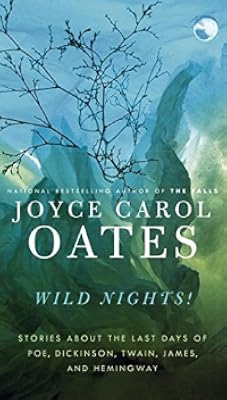
Wild Nights!: Stories About the Last Days of Poe, Dickinson, Twain, James, and Hemingway
by Joyce Carol Oates
On This Page
Description
Reimagines the final days of five major American writers, in a collection of short works written in the subtly nuanced language style of each.Tags
Recommendations






Member Reviews
Great writers do not necessarily lead great lives, and the end of their lives can be as miserable as anybody's. "Wild Nights!," the 2008 book of short stories by Joyce Carol Oates, examines the last days of five of the greatest American writers. Although she writes fiction, Oates did her homework and bases her tales on biographical information about the writers.
The one possible exception may be "EDickinsonRepliLuxe," a wonderful bit of science fiction in which Oates imagines a future time when anyone with enough money can purchase small robots with the appearance and personalities of famous people from the past. Mr. and Mrs. Krim choose to have a little Emily Dickinson in their home. Is there any other writer whose personality would be show more less suited to being, in effect, someone's household pet than the reclusive poet? Little Emily, her pockets stuffed with little pieces of paper covered with lines of poetry, tries to keep to herself until Mr. Krim, his wife away, decides to finally get his money's worth. The title of this collection, by the way, comes from a Dickinson poem.
The least successful story, "Poe Posthumous; or, The Light-House," takes the form of journal entries written by Poe while living in a lighthouse near the end of his brief life. Oates captures the increasing madness and declining health of the writer, but I didn't find the story very interesting. The three others prove to be gems, however.
"Grandpa Clemens & Angelfish, 1906" focuses on Mark Twain's late-in-life fascination with pretty girls between the ages of 10 and 16. He called them his Angelfish. In the story, Maddie is the favorite of his Angelfish, with whom he maintains a secret correspondence and conspires to meet in their secret place until he discovers, to his horror, that she has passed her 16th birthday. Then he shuts her off completely, even after the girl's mother, discovering his letters, begs him to write again because Maddie, in her despair, refuses to eat.
"Papa at Ketchum, 1961" takes us inside Ernest Hemingway's mind as he contemplates suicide. Always vain and selfish, he worries that even with a shotgun he will not do as good a job at it as his father managed with a handgun.
The writer who looks the best at the end of his life, at least in these stories, is Henry James in "The Master at St. Bartholomew's." The pompous and privileged writer, who loves being called the Master, chooses to become a servant to English boys wounded in the trenches during the Great War. He volunteers to help at a hospital in London where many of these soldiers are brought. At first he only talks with them or reads to them, but as the burden of so many wounded becomes too much for the strained hospital staff, he takes on less agreeable tasks, including emptying bedpans. Never in his life has he performed such labor. Now he does so willingly and with pride, wishing there was more he could do for these boys.
Oates has given us some fine stories about some fine writers. They may be fiction, but you will feel like you know the writers better after reading them. show less
The one possible exception may be "EDickinsonRepliLuxe," a wonderful bit of science fiction in which Oates imagines a future time when anyone with enough money can purchase small robots with the appearance and personalities of famous people from the past. Mr. and Mrs. Krim choose to have a little Emily Dickinson in their home. Is there any other writer whose personality would be show more less suited to being, in effect, someone's household pet than the reclusive poet? Little Emily, her pockets stuffed with little pieces of paper covered with lines of poetry, tries to keep to herself until Mr. Krim, his wife away, decides to finally get his money's worth. The title of this collection, by the way, comes from a Dickinson poem.
The least successful story, "Poe Posthumous; or, The Light-House," takes the form of journal entries written by Poe while living in a lighthouse near the end of his brief life. Oates captures the increasing madness and declining health of the writer, but I didn't find the story very interesting. The three others prove to be gems, however.
"Grandpa Clemens & Angelfish, 1906" focuses on Mark Twain's late-in-life fascination with pretty girls between the ages of 10 and 16. He called them his Angelfish. In the story, Maddie is the favorite of his Angelfish, with whom he maintains a secret correspondence and conspires to meet in their secret place until he discovers, to his horror, that she has passed her 16th birthday. Then he shuts her off completely, even after the girl's mother, discovering his letters, begs him to write again because Maddie, in her despair, refuses to eat.
"Papa at Ketchum, 1961" takes us inside Ernest Hemingway's mind as he contemplates suicide. Always vain and selfish, he worries that even with a shotgun he will not do as good a job at it as his father managed with a handgun.
The writer who looks the best at the end of his life, at least in these stories, is Henry James in "The Master at St. Bartholomew's." The pompous and privileged writer, who loves being called the Master, chooses to become a servant to English boys wounded in the trenches during the Great War. He volunteers to help at a hospital in London where many of these soldiers are brought. At first he only talks with them or reads to them, but as the burden of so many wounded becomes too much for the strained hospital staff, he takes on less agreeable tasks, including emptying bedpans. Never in his life has he performed such labor. Now he does so willingly and with pride, wishing there was more he could do for these boys.
Oates has given us some fine stories about some fine writers. They may be fiction, but you will feel like you know the writers better after reading them. show less
This short story collection examines the last days and nights of five prolific American writers, from Poe to Hemingway. Together these five tales describe five eminient writers on the brink of despair and madness that culminates in their deaths. The stories vary in the extent to which they depart from realistic portraits of these authors' deaths. While Oates's treatment of Hemingway's death could conceivably be a factual rendering, those of Poe and Dickinson are far more fanicful, and depart from the historical record. Together, these stories create a riveting and unusual collection. Because the reader knows from the outset that each of these tales ends in death, the narratives flow with significant dramatic tension. From the beginning show more of each story the reader gets a sense of how each author will meet his or her end. As they move toward this preordained conclusion tension builds for the reader, as he or she discovers just how his or her assumptions will play out. Oates does an excellent job of adopting the voice and persona of each of the writers in question. Each story has its own flavor and style. Hemingway's story reads with the stark prose one might expect from the man, and Poe's narrative reads like a nineteenth-century gothic tale. Overall, this was a very enjoyable read, one that showcases Oates's remarkable versatility, and reaffirms her place as a master of psychological suspense. show less
Oates is tweaking some of our most revered iconic American authors in these fabricated tales of their last days. Poe is tending a lighthouse in the Pacific, Dickinson returns to life in the 21st century as a human-looking robot, Mark Twain finds another young woman for his Angelfish collection, James finds passion amidst the horror of a wartime hospital ward, and Hemingway can't get out of his own head, it seems. Oates takes something from the authors' own writing styles and makes it her own here. She also mixes some elements of horror, SF & fantasy in some of the stories. I'm not sure she succeeds entirely in what she is doing, but it was a fun read (and I had some good laughs either over some particular scene, the entire premise of show more the story, or in her use of the authors' writing styles). show less
Joyce Carol Oates has reimagined the final days of five important American authors: Poe, Dickinson, Twain, Henry James and Hemingway. The stories of Twain, James and Hemingway are the ones that stick closer to the historical record, while those of Poe and Dickinson take flight into the fantastic.
"Poe, Posthomous" imagines that Poe spent his final days not in Baltimore but in an isolated lighthouse off the coast of Chile, hoping that the solitude would allow him to produce an important philosophical treatise. As with most of the stories, Oates mimics the writing style of the author in question, and the story is very reminiscent of those Poe tales where the protagonist succumbs to madness, yet there are several elements, including the show more setting and the final development, that suggest Oates is channeling not Poe but Lovecraft. "EDickinsonRepiluxe" tells not so much about Emily Dickinson's last days, as of her 21st century resurrection as a sort of robotic family member/pet, purchased by a childless middle-aged couple to fill a void in their lives. Intriguing, but aside from its Twilight Zone-like premise, it felt like a familiar story of middle-age disappointment and estrangement.
The Twain, James and Hemingway are closer to what you'd expect given these authors final days. Twain is a broken man after the death of his wife and beloved daughter, resentful of the public persona he has to play. He seeks solace in the company of girls, younger than 16, mostly innocent but with somewhat creepy undertones. James volunteers in a veteran's hospital during WWI, where the suffering of young men affects him deeply. Hemingway struggles with his poor mental and physical health as he obsesses over bringing his life to an end. There's an interesting dichotomy between the first two stories, with their fantastic concepts, and the final three, which feel so much more grounded that it's hard to know when the truth ends and Oates' extrapolations begin. show less
"Poe, Posthomous" imagines that Poe spent his final days not in Baltimore but in an isolated lighthouse off the coast of Chile, hoping that the solitude would allow him to produce an important philosophical treatise. As with most of the stories, Oates mimics the writing style of the author in question, and the story is very reminiscent of those Poe tales where the protagonist succumbs to madness, yet there are several elements, including the show more setting and the final development, that suggest Oates is channeling not Poe but Lovecraft. "EDickinsonRepiluxe" tells not so much about Emily Dickinson's last days, as of her 21st century resurrection as a sort of robotic family member/pet, purchased by a childless middle-aged couple to fill a void in their lives. Intriguing, but aside from its Twilight Zone-like premise, it felt like a familiar story of middle-age disappointment and estrangement.
The Twain, James and Hemingway are closer to what you'd expect given these authors final days. Twain is a broken man after the death of his wife and beloved daughter, resentful of the public persona he has to play. He seeks solace in the company of girls, younger than 16, mostly innocent but with somewhat creepy undertones. James volunteers in a veteran's hospital during WWI, where the suffering of young men affects him deeply. Hemingway struggles with his poor mental and physical health as he obsesses over bringing his life to an end. There's an interesting dichotomy between the first two stories, with their fantastic concepts, and the final three, which feel so much more grounded that it's hard to know when the truth ends and Oates' extrapolations begin. show less
Wild Nights, the latest from Joyce Carol Oates, is a collection of five longish short-stories, each of which fantasizes about the end days of one of America’s best known and most respected writers. As indicated by the book’s complete title, there are stories about Poe, Dickinson, Twain, James, and Hemmingway, in that order. And strangely enough, at least to me, the stories seem to have been ordered in such a way that each tops the previous one in degree of sadness the reader will feel on behalf of the author being featured.
Edgar Allan Poe, grateful for having been given the job of lighthouse keeper on Vina de Mar and looking forward to the complete isolation promised by his employer, comes to find that sanity is not an easy thing to show more hold onto when one’s only companion is an independent little dog. Emily Dickinson’s end days, as envisioned by author Oates, come in the twenty-first century, not in the nineteenth, and are bought and paid for by a couple who decide to make their home more intellectually interesting by purchasing a robotic replicate of Dickinson’s talents, emotions, and memories. The very fact that “Dickinson” would face similar end days numerous times in different homes marks the story as an even greater tragedy than the one faced by Poe.
Next comes the story of Sam Clemens, forced to “perform” as the character Mark Twain in order to make a living because his royalties will not sustain his lifestyle any longer, and desperately unhappy since the deaths of his favorite daughter and his wife. His only comfort is the friendships he so desperately seeks with little girls between the ages of ten and fifteen, something that drives his daughter Clara crazy and that, even in early twentieth century America, had to be a little suspect. This story is more realistic than the first two and it more directly reflects the actual lifestyle of its subject, rating it an even higher notch on the “sadness meter,” as a result.
But things get worse because of the way that Henry James, up next, has his days as a London hospital volunteer during World War I so bleakly imagined by Oates. Himself desperately suffering from a heart condition that made physical work dangerous, James, when not debasing himself allows another to do it for him in a most shocking way, a scene that will stick in my mind longer than I really want it to (and, no, it is not the one between James and his favorite male patient).
Ernest Hemingway is saved for last and, although his final days are more familiar to most readers than those of the other four authors, his story seems saddest of all. Oates manages to place the reader into Hemingway’s mind in such a way that his ultimate suicide seems almost justifiable due to the man’s inability to face the loss of both his physical and his mental powers. It is heartbreaking to see this lion of a man go down with only the slightest of whimpers.
Wild Nights is one of those rare collections of which I will easily remember each of its stories for a long time to come. Joyce Carol Oates has, in a sense, “humanized” each of her subjects by emphasizing their weaknesses, the same weaknesses that, in combination with their particular strengths, made these writers the geniuses they were. Each of her stories mimics the writing style of the author being featured, part of the fun, and yet, part of the sadness that blankets the entire book. I’m not sure what motivated this particular book, nor what Ms. Oates hoped to accomplish by writing it, and I hesitate to recommend it to others because I don’t know how other readers will react to the extreme “realism” at its heart. Those afraid to have the images they carry of these authors in their heads changed might best avoid the book because change they certainly will. But those willing to take a chance on it will likely find it to be a book they will always remember in great detail.
This one won’t cheer you up, but I guarantee you that this time next year you won’t have a hard time remembering what it was about.
Rated at: 5.0 show less
Edgar Allan Poe, grateful for having been given the job of lighthouse keeper on Vina de Mar and looking forward to the complete isolation promised by his employer, comes to find that sanity is not an easy thing to show more hold onto when one’s only companion is an independent little dog. Emily Dickinson’s end days, as envisioned by author Oates, come in the twenty-first century, not in the nineteenth, and are bought and paid for by a couple who decide to make their home more intellectually interesting by purchasing a robotic replicate of Dickinson’s talents, emotions, and memories. The very fact that “Dickinson” would face similar end days numerous times in different homes marks the story as an even greater tragedy than the one faced by Poe.
Next comes the story of Sam Clemens, forced to “perform” as the character Mark Twain in order to make a living because his royalties will not sustain his lifestyle any longer, and desperately unhappy since the deaths of his favorite daughter and his wife. His only comfort is the friendships he so desperately seeks with little girls between the ages of ten and fifteen, something that drives his daughter Clara crazy and that, even in early twentieth century America, had to be a little suspect. This story is more realistic than the first two and it more directly reflects the actual lifestyle of its subject, rating it an even higher notch on the “sadness meter,” as a result.
But things get worse because of the way that Henry James, up next, has his days as a London hospital volunteer during World War I so bleakly imagined by Oates. Himself desperately suffering from a heart condition that made physical work dangerous, James, when not debasing himself allows another to do it for him in a most shocking way, a scene that will stick in my mind longer than I really want it to (and, no, it is not the one between James and his favorite male patient).
Ernest Hemingway is saved for last and, although his final days are more familiar to most readers than those of the other four authors, his story seems saddest of all. Oates manages to place the reader into Hemingway’s mind in such a way that his ultimate suicide seems almost justifiable due to the man’s inability to face the loss of both his physical and his mental powers. It is heartbreaking to see this lion of a man go down with only the slightest of whimpers.
Wild Nights is one of those rare collections of which I will easily remember each of its stories for a long time to come. Joyce Carol Oates has, in a sense, “humanized” each of her subjects by emphasizing their weaknesses, the same weaknesses that, in combination with their particular strengths, made these writers the geniuses they were. Each of her stories mimics the writing style of the author being featured, part of the fun, and yet, part of the sadness that blankets the entire book. I’m not sure what motivated this particular book, nor what Ms. Oates hoped to accomplish by writing it, and I hesitate to recommend it to others because I don’t know how other readers will react to the extreme “realism” at its heart. Those afraid to have the images they carry of these authors in their heads changed might best avoid the book because change they certainly will. But those willing to take a chance on it will likely find it to be a book they will always remember in great detail.
This one won’t cheer you up, but I guarantee you that this time next year you won’t have a hard time remembering what it was about.
Rated at: 5.0 show less
Oates reimagines the last days of Poe, Dickinson, Twain, James, and Hemingway in this series of novellas. In each, the sexuality of is examined in the context of his or her dying days. In each, their death is brought about as a result of their own sexual proclivities. Each is depressed and suicidal as their writing skills leave them and it becomes apparent that death is at hand.
Each story is disturbing in itself, but representative of the individual author Oates is examining. Poe, left alone with his own imagination to man a lighthouse in the South Seas, goes insane. Dickinson is a manufactuered person, purchased by a rich couple for their own amusements, who, as a result of her poetry, is expected to be sexual, but, being manufactured, show more is not. Twain dies among the little girls he surrounded himself with in his old age. James cannot help but moon over the WWII soldiers he has volunteered to care for in a British hospital. And Hemingway loses his manhood along with his writing skills and his mind as he tries to figure a way to take his own life.
A great book for fans of classic literature and the lives of those who wrote them. For the Oates fan, another example of her diversity and depth as a writer. show less
Each story is disturbing in itself, but representative of the individual author Oates is examining. Poe, left alone with his own imagination to man a lighthouse in the South Seas, goes insane. Dickinson is a manufactuered person, purchased by a rich couple for their own amusements, who, as a result of her poetry, is expected to be sexual, but, being manufactured, show more is not. Twain dies among the little girls he surrounded himself with in his old age. James cannot help but moon over the WWII soldiers he has volunteered to care for in a British hospital. And Hemingway loses his manhood along with his writing skills and his mind as he tries to figure a way to take his own life.
A great book for fans of classic literature and the lives of those who wrote them. For the Oates fan, another example of her diversity and depth as a writer. show less
"Like fucking, like writing, the secret is technique. Amateurs are eager and careless, professionals take care."
How ironic.
How ironic.
Members
- Recently Added By
Lists

Let's Tell a Story Using a Sequence of Titles
17 works; 15 members

At the Library
217 works; 1 member
Author Information

473+ Works 63,228 Members
Joyce Carol Oates was born on June 16, 1938 in Lockport, New York. She received a bachelor's degree in English from Syracuse University and a master's degree in English from the University of Wisconsin. She is the author of numerous novels and collections of short stories. Her works include We Were the Mulvaneys, Blonde, Bellefleur, You Must show more Remember This, Because It Is Bitter, Because It Is My Heart, Solstice, Marya : A Life, and Give Me Your Heart. She has received numerous awards including the National Book Award for Them, the PEN/Malamud Award for Excellence in Short Fiction, and the F. Scott Fitzgerald Award for Lifetime Achievement in American Literature. She was a finalist for the 2015 Pulitzer Prize for Fiction with her title Lovely, Dark, Deep. She also wrote a series of suspense novels under the pseudonym Rosamond Smith. In 2015, her novel The Accursed became listed as a bestseller on the iBooks chart. She worked as a professor of English at the University of Windsor, before becoming the Roger S. Berlind Distinguished Professor of Humanities at Princeton University. She and her late husband Raymond J. Smith operated a small press and published a literary magazine, The Ontario Review. (Bowker Author Biography) Joyce Carol Oates is one of the most eminent and prolific literary figures and social critics of our times. She has won the National Book Award and several O. Henry and Pushcart prizes. Among her other awards are an NEA grant, a Guggenheim fellowship, the PEN/Malamud Lifetime Achievement Award, and the F. Scott Fitzgerald Award for Lifetime Achievement in American Literature. (Publisher Provided) show less
Some Editions
Awards and Honors
Awards
Common Knowledge
- Original publication date
- 1985
- People/Characters
- Edgar Allan Poe; Emily Dickinson; Henry James; Samuel Langhorne Clemens (Mark Twain); Ernest Hemingway
- Epigraph
- Wild Nights--Wild Nights!
Were I with thee
Wild Nights should be
Our luxury!
Futile--the Winds--
To a Heart in port--
Done with the Compass--
Done with the Chart!
Rowing... (show all) in Eden--
Ah, the Sea!
Might I but moor--Tonight--
In Thee!
Emily Dickinson (1861) - Dedication
- For Joyce and Seward Johnson
Classifications
Statistics
- Members
- 469
- Popularity
- 65,089
- Reviews
- 21
- Rating
- (3.72)
- Languages
- English, French, Portuguese
- Media
- Paper, Audiobook, Ebook
- ISBNs
- 15
- ASINs
- 6