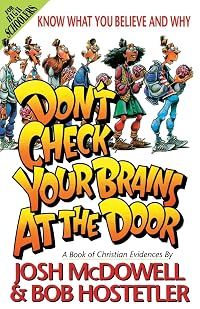
Don't Check Your Brains at the Door: A Book of Christian Evidences (Know What You Believe and Why)
by Josh McDowell, Bob Hostetler
On This Page
Description
Examines common myths about God, religion, and life that contradict God's Word.Tags
Recommendations

















Member Reviews
** I received this book free from Thomas Nelson's Booksneeze program in exchange for an honest review.**
I requested this book, nervous it would be too "traditional" for me, but strongly hoping it would be along my line of belief. I am one who strongly believes that to be Christian doesn't mean we must surrender our intellectualism, or as the author puts it "check our brains at the door"...
Sadly my hopes were squashed when, as I was reading, I had to accept that the more "traditional" line of thought is given in this book.
The author/s and I disagree greatly on issues like Universalism (I am a Christian Universalist), the Bible being "copied with precision" (as he claims on page 49 - I tend to agree more with Bart D. Ehrman on this show more subject), the nature/divinity of Jesus (I'm a Unitarian who rejects the divinity of Christ), the nature of the Bible (I don't see it as "the" Word of God complete, or as historical fact, and I don't believe that it was meant to be written as a history textbook - that doesn't mean I believe it is fiction, though), and the Resurrection (which I reject, while still believing Christianity can be meaningful without it), humanism (do the authors not realize there are Christian Humanists? I know I tend to be humanistic in my beliefs, and many other Christians do, too...) just to name a few.
Not only do I disagree with the author on these issues, but I felt that this book was too short and not comprehensive enough to really mean much. It was written for teenagers, I understand, but I felt it could have been a little more comprehensive, instead of just presenting the "myths" and disagreeing and then offering questions/Bible verses at the end of each, quite short, chapter... There wasn't any real evidence, other than using those Bible verses - and considering the difference in the way we understand the Bible, you can understand my not thinking that such "evidence" is enough to really make their point.
This was typical of the evangelical style, though, and was a lot less intellectual than I had hoped for. Apologetics, it seems, is often more concerned about making persuading arguments, in terms of at least seeming convincing, without really getting into the details or evidence, which is disappointing. I'd love a book from a traditional standpoint discussing Biblical Criticism (or any other issue), for example, even if I don't agree with typical traditional stances, if I were to find one that actually goes into the various examples and evidences, etc. I just don't feel that this style - or this book in particular - does that. They make their argument, support it with the Bible (and their interpretation/understanding of it), and move on...
So I'm kind of glad I'm finished with it, so I, too, can move on... ;)
(No offense intended, just not a book for me.) show less
I requested this book, nervous it would be too "traditional" for me, but strongly hoping it would be along my line of belief. I am one who strongly believes that to be Christian doesn't mean we must surrender our intellectualism, or as the author puts it "check our brains at the door"...
Sadly my hopes were squashed when, as I was reading, I had to accept that the more "traditional" line of thought is given in this book.
The author/s and I disagree greatly on issues like Universalism (I am a Christian Universalist), the Bible being "copied with precision" (as he claims on page 49 - I tend to agree more with Bart D. Ehrman on this show more subject), the nature/divinity of Jesus (I'm a Unitarian who rejects the divinity of Christ), the nature of the Bible (I don't see it as "the" Word of God complete, or as historical fact, and I don't believe that it was meant to be written as a history textbook - that doesn't mean I believe it is fiction, though), and the Resurrection (which I reject, while still believing Christianity can be meaningful without it), humanism (do the authors not realize there are Christian Humanists? I know I tend to be humanistic in my beliefs, and many other Christians do, too...) just to name a few.
Not only do I disagree with the author on these issues, but I felt that this book was too short and not comprehensive enough to really mean much. It was written for teenagers, I understand, but I felt it could have been a little more comprehensive, instead of just presenting the "myths" and disagreeing and then offering questions/Bible verses at the end of each, quite short, chapter... There wasn't any real evidence, other than using those Bible verses - and considering the difference in the way we understand the Bible, you can understand my not thinking that such "evidence" is enough to really make their point.
This was typical of the evangelical style, though, and was a lot less intellectual than I had hoped for. Apologetics, it seems, is often more concerned about making persuading arguments, in terms of at least seeming convincing, without really getting into the details or evidence, which is disappointing. I'd love a book from a traditional standpoint discussing Biblical Criticism (or any other issue), for example, even if I don't agree with typical traditional stances, if I were to find one that actually goes into the various examples and evidences, etc. I just don't feel that this style - or this book in particular - does that. They make their argument, support it with the Bible (and their interpretation/understanding of it), and move on...
So I'm kind of glad I'm finished with it, so I, too, can move on... ;)
(No offense intended, just not a book for me.) show less
Josh McDowell and Bob Hostetler have done a good job of taking the belief pulse of today’s teens. Don’t Check Your Brains at the Door is their book for this age group. It identifies and refutes 42 commonly held beliefs about Christianity in an attempt to “…discuss common myths, many of which people accept without thinking, and evaluate them in the light of the Bible.” (Introduction, Kindle Location 184.)
The book is broadly divided into six subject sections: Myths about God, Jesus, the Bible, the Resurrection, Religion and Christianity, and Life and Happiness. Each chapter within those sections deals with one myth.
The short chapters have colorful titles with descriptive subtitles, making it easy to locate chapters by subject show more (e.g. “The Luke Skywalker God — the Impersonal Force Myth"; "Lily-White Jesus–The Racist Myth” etc.). Each begins with a captivating anecdote or example. The writing style is snappy and the authors come to their signature conclusion, “But that’s a myth” efficiently and without beating around the bush. Each chapter ends with a “Brain Food” section—a deeper look at what the Bible says about the chapter’s subject.
Don't Check Your Brains has a lot going for it. It does a good job of tapping into common perceptions and beliefs about Christianity. The anecdotes and examples that begin each chapter are interesting and pull the reader in. The authors cite a variety of supporting sources and illustrations, from the quotes of famous theologians to illustrations from sports and entertainment. The “Brain Food” section makes excellent use of the Bible, employing a variety of assignment types (reading, fill in the blanks, checking the right response, character analysis, story analysis etc.).
However, there were a few things I didn’t get. For example, I wondered why the authors chose the order they did for handling these myths. They began with myths about God and Jesus, which they debunked using, among other things, lots of passages from the Bible — and this before they established the credibility and reliability of the Bible, which wasn’t addressed till Chapter 9. It seemed that a more logical order would have been to deal first with the Relativity Myth (Chapter 18) to establish the possibility of the existence of objective truth, then the myths about the Bible to lay the foundation of the Bible as a possible purveyor of that truth, and then the other subjects.
I also wondered why McDowell and Hostetler used so many dated illustrations and examples. They cited lyrics of a song from “Jesus Christ Superstar,” a popular musical from 1971, took life lessons from Elmer Gantry, a character in a book written in 1927, and sports heroes from the ‘50s to ‘70s, and more. Though the illustrations were well explained, I wondered how modern kids would relate. Those old-fashioned illustrations, along with the often dogmatic tone, made the book seem a little like the attempt of a couple of boomers to set a new generation straight.
Finally, I was disappointed with the superficial way in which some of these myths were supposedly debunked. The relativity myth was one. In our time of prevailing postmodernism — a philosophy foundationed on the absence of objective truth — the quoted witty words of C. S. Lewis were what the authors used to make their case:
"Whenever you find a man who says he does not believe in a real Right and Wrong, you will find the same man going back on this a moment later. He may break his promise to you, but if you try breaking one to him he will be complaining ‘It’s not fair’ before you can say Jack Robinson.
"It seems, then, we are forced to believe in a real Right and Wrong. People may be sometimes mistaken about them, just as people sometimes get their sums wrong; but they are not a matter of mere taste and opinion any more than the multiplication table” – C. S. Lewis, Kindle Location 1174.
Of course they went on to buttress their conclusion with quotes from the Bible, which is all well and good if the reader accepts the Bible as truth; not so compelling if he or she doesn’t.
Those things aside, I can see Don't Check Your Brains being a helpful personal read for teens seeking to make their Christian faith their own, as well as a discussion instigator for parents and church youth leaders.
(I received this book from Thomas Nelson Publishing as a free gift for the purpose of writing a review.)
Published originally on Blogcritics: show less
The book is broadly divided into six subject sections: Myths about God, Jesus, the Bible, the Resurrection, Religion and Christianity, and Life and Happiness. Each chapter within those sections deals with one myth.
The short chapters have colorful titles with descriptive subtitles, making it easy to locate chapters by subject show more (e.g. “The Luke Skywalker God — the Impersonal Force Myth"; "Lily-White Jesus–The Racist Myth” etc.). Each begins with a captivating anecdote or example. The writing style is snappy and the authors come to their signature conclusion, “But that’s a myth” efficiently and without beating around the bush. Each chapter ends with a “Brain Food” section—a deeper look at what the Bible says about the chapter’s subject.
Don't Check Your Brains has a lot going for it. It does a good job of tapping into common perceptions and beliefs about Christianity. The anecdotes and examples that begin each chapter are interesting and pull the reader in. The authors cite a variety of supporting sources and illustrations, from the quotes of famous theologians to illustrations from sports and entertainment. The “Brain Food” section makes excellent use of the Bible, employing a variety of assignment types (reading, fill in the blanks, checking the right response, character analysis, story analysis etc.).
However, there were a few things I didn’t get. For example, I wondered why the authors chose the order they did for handling these myths. They began with myths about God and Jesus, which they debunked using, among other things, lots of passages from the Bible — and this before they established the credibility and reliability of the Bible, which wasn’t addressed till Chapter 9. It seemed that a more logical order would have been to deal first with the Relativity Myth (Chapter 18) to establish the possibility of the existence of objective truth, then the myths about the Bible to lay the foundation of the Bible as a possible purveyor of that truth, and then the other subjects.
I also wondered why McDowell and Hostetler used so many dated illustrations and examples. They cited lyrics of a song from “Jesus Christ Superstar,” a popular musical from 1971, took life lessons from Elmer Gantry, a character in a book written in 1927, and sports heroes from the ‘50s to ‘70s, and more. Though the illustrations were well explained, I wondered how modern kids would relate. Those old-fashioned illustrations, along with the often dogmatic tone, made the book seem a little like the attempt of a couple of boomers to set a new generation straight.
Finally, I was disappointed with the superficial way in which some of these myths were supposedly debunked. The relativity myth was one. In our time of prevailing postmodernism — a philosophy foundationed on the absence of objective truth — the quoted witty words of C. S. Lewis were what the authors used to make their case:
"Whenever you find a man who says he does not believe in a real Right and Wrong, you will find the same man going back on this a moment later. He may break his promise to you, but if you try breaking one to him he will be complaining ‘It’s not fair’ before you can say Jack Robinson.
"It seems, then, we are forced to believe in a real Right and Wrong. People may be sometimes mistaken about them, just as people sometimes get their sums wrong; but they are not a matter of mere taste and opinion any more than the multiplication table” – C. S. Lewis, Kindle Location 1174.
Of course they went on to buttress their conclusion with quotes from the Bible, which is all well and good if the reader accepts the Bible as truth; not so compelling if he or she doesn’t.
Those things aside, I can see Don't Check Your Brains being a helpful personal read for teens seeking to make their Christian faith their own, as well as a discussion instigator for parents and church youth leaders.
(I received this book from Thomas Nelson Publishing as a free gift for the purpose of writing a review.)
Published originally on Blogcritics: show less
This book is designed for teens and young adults; (I'm much older than that). I did like that each section was short and to the point and that it had scripture references to do your own research into the topic of that chapter. I found it Biblically sound and would recommend it to the age group that it is written for.
Don't Check Your Brains at the Door gives teens answers that make sense, even for the toughest of questions. Internationally known defender of the faith Josh McDowell and co-author Bob Hostetler offer clarity laced with humor to expose common myths about God, the Bible, religion, and life to show how Christianity stands up to the test of fact and reason. Teens will be better equipped to stick with their faith as they begin to understand why they believe and why it's important to make a lifetime commitment to Christ and the church.
This book gives great insight on what a Christian, particularly a teenager, should believe and how Christianity is not for the brain-dead.
This is a nice devotional for youths. I think it is good for late middle/early high school. Just a simple was of dealing with the pressures facing the youth today.
Very informative book. Good for youth.
Members
- Recently Added By
Lists

Christianity Books You've Read
179 works; 19 members

Sonlight Books
1,487 works; 25 members

Books Read in 2006
421 works; 8 members
Author Information

404+ Works 33,149 Members
Josh McDowell has been at the forefront of culture trends and ground-breaking ministry for over five decades. He and his wife have been married for 43 years and have four wonderful children and ten beloved grandchildren. For more information, please visit www.josh.org

35 Works 2,735 Members
Bob Hostetler was a teenager working at Camp Swoneky in Ohio when he fully surrendered his life to Jesus-and they've been best friends ever since. Today Bob is an award-winning and best-selling author with more than 4 million copies of his books in print. Some of his favorites include Don't Check Your Brains at the Door (with Josh McDowell), Life show more Stinks and Then You Die, and Take Time to Be Holy. Find mote about this happy camper at BobHostetler.com. show less
Common Knowledge
- Alternate titles
- Do not check your brains at the door; Don't Check Your Brains at the Door: A Book of Christian Evidences (For High Schoolers: Know What You Believe and Why) (For High Schoolers: Know What You Believe and Why)
- Original publication date
- 1992
- First words
- Many people imagine God as a cosmic cop standing in the center of the galaxies like a policeman directing traffic.
- Last words
- (Click to show. Warning: May contain spoilers.)Read the following portions of Scripture and, in the spaces provided, jot the names of these four people (the speaker or writer in each passage) who revealed their belief in heaven:
Classifications
Statistics
- Members
- 850
- Popularity
- 32,213
- Reviews
- 7
- Rating
- (3.59)
- Languages
- English, German, Russian
- Media
- Paper, Ebook
- ISBNs
- 9
- UPCs
- 1
- ASINs
- 8