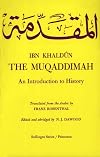
The Muqaddimah
by Ibn Khaldūn, Ibn Khaldun
On This Page
Description
The Muqaddimah, often translated as "Introduction" or "Prolegomenon," is the most important Islamic history of the premodern world. Written by the great fourteenth-century Arab scholar Ibn Khaldûn (d. 1406), this monumental work established the foundations of several fields of knowledge, including the philosophy of history, sociology, ethnography, and economics. The first complete English translation, by the eminent Islamicist and interpreter of Arabic literature Franz Rosenthal, was show more published in three volumes in 1958 as part of the Bollingen Series and received immediate acclaim in the United States and abroad. A one-volume abridged version of Rosenthal's masterful translation first appeared in 1969. This Princeton Classics edition of the abridged version includes Rosenthal's original introduction as well as a contemporary introduction by Bruce B. Lawrence. This volume makes available a seminal work of Islam and medieval and ancient history to twenty-first century audiences. "Ibn Khaldûn, the great 14th-century Arab scholar, is the most authoritative and most beguiling of Arabic polymaths…. His learning and ideas have an astonishingly modern relevance. His encyclopaedic work is a wonderfully readable mixture of history, sociology, ethnography, economics, science, art, literature, cookery, and medicine."---Iain Finlayson, Times "{The} most remarkable book written during the entire Middle Ages, one of the great intellectual achievements of all time." "From review of Princeton's original edition: "{N. J. Dawood} has, by skillful abridgement and deft but unobtrusive editing, produced an attractive and manageable volume, which should make the essential ideas of Ibn Khaldûn accessible to a wide circle of readers."" "From review of Princeton's original edition: "Undoubtedly the greatest work of its kind that has ever been created by any mind in any time or place . . . the most comprehensive and illuminating analysis of how human affairs work that has been made anywhere.""---Arnold J. Toynbee, Observer. show lessTags
Recommendations

































Member Reviews
Provides an insight into the views of a Berber-Arab Muslim of his period on the superiority of Islam and the workings of historical forces as understood in the period.
A philosophical text on the uses and meaning of the study of history, written in 1377. It includes historical descriptions as well. Ibn Khaldun was an Andalusian who moved to the Maghrib after the fall of Seville to the Spanish. He spent the last 20 years of his life in Egypt.
This edition is an abridgement of the three-volume set translated from Arabic by Franz Rosenthal.
This edition is an abridgement of the three-volume set translated from Arabic by Franz Rosenthal.
Ratings
Members
- Recently Added By
Lists

100 Books to Read in a Lifetime (That Are Older Than 200 Years)
415 works; 175 members

Política - Clásicos
164 works; 2 members

Books I Wrote Essays on
34 works; 1 member

Shaykh Hamza's Book Recommendations
439 works; 3 members

Books Read in College
80 works; 5 members

Books recommended in the history category on FiveBooks.com
329 works; 4 members

Books cited in Progress by Samuel McDonald
160 works; 1 member
Author Information

67 Works 1,241 Members
Called the Father of the Philosophy of History and the Father of Sociology, Ibn Khaldun is considered the first and one of the greatest philosophers of history. Born in Muslim Spain and educated in Tunis, he served as a judge and a secretary in the service of rulers in both Spain and North Africa. In 1382 he moved to Egypt, where he became chief show more judge of Cairo and a lecturer at the Azhar Mosque University. In 1400 he accompanied the Egyptians on their campaign against the Mongol warrior Tamerlane and played a role in the arrangements for the surrender of Damascus. Ibn Khaldun gained much recognition for his seven-volume work on universal history, Kitab al-Ibar (Book of Lessons). In the work, focused mostly on the Muslim world, Ibn Khaldun attempts to treat history as a science. He made his most important contribution in the first part of the work, Muqaddimah (The Introduction), in which he outlines his philosophy of history, analyzing causes of events and setting social, geographic, and economic contexts for historical changes. (Bowker Author Biography) show less
6 Works 223 Members
Some Editions
Awards and Honors
Notable Lists
Common Knowledge
- Canonical title
- The Muqaddimah
- Original title
- مقدّمة ابن خلدون
- Original publication date
- 1377; 1958
- Important places
- Al-Andalus; Maghreb
- First words
- History is a discipline widely cultivated among nations and races.
- Last words
- (Click to show. Warning: May contain spoilers.)His successors, then, may gradually add more problems, until the discipline is completely (presented).
- Disambiguation notice
- Originally (1958) published as a three volume set. Abridged edition published 1967
Classifications
Statistics
- Members
- 220
- Popularity
- 148,656
- Reviews
- 2
- Rating
- (4.08)
- Languages
- 9 — Arabic, Dutch, English, French, German, Hungarian, Indonesian, Swedish, Turkish
- Media
- Paper, Ebook
- ISBNs
- 24
- ASINs
- 5