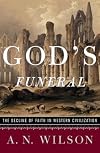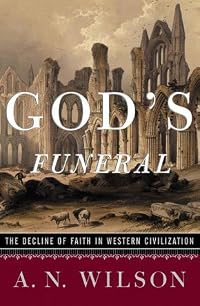
God's Funeral: The Decline of Faith in Western Civilization
by A. N. Wilson
On This Page
Description
By the end of the nineteenth century, almost all the great writers, artists, and intellectuals had abandoned Christianity; many had abandoned belief in God altogether. This was in part the result of scientific discovery, particularly the work of Charles Darwin in The Origin of Species and the controversy that followed. But the doubt about religion had many sources. A.N. Wilson demonstrates in this synthesis of biography and intellectual history that the real destruction of religions belief show more had been achieved well before Darwin's momentous publication. Yet despite the fact that the church had essentially become an edifice empty of faith, it survived into our century because so few of the fascinating, tortured people Wilson portrays could face the brutal consequences of their own logic. Whether or not God was dead, they still needed to believe, hence the great spiritual angst of their culture which is now echoed in ours.--Publisher description. show lessTags
Recommendations






Member Reviews
In this elegantly written book, prolific biographer A. N. Wilson (Tolstoy, Milton, Paul, Jesus) presents a group portrait of the leading British intellectuals of the century between Napoleon and World War I. It is a time when inquiring minds found it ever harder to accept the existence of God. Wilson is at pains to refute the common notion that this was due to Darwin’s theory of evolution. Instead, the roots of British agnosticism and atheism lay in Hume’s trenchant criticisms of the Deism fashionable in the previous century, Gibbon’s witty depiction of the less-than-Christian behavior of the church hierarchy from the last days of the Roman Empire onward, Lyell’s demonstration that the geology of the earth required a much longer show more span of time than the six to ten thousand assumed by many Bible-readers, and the effect of German higher criticism on literal readings of the Bible.
All of this was before Darwin, Marx, or Freud published.
For every Swinburne or Gosse eager to be done with God as part of a break with a tyrannical father, there were others who mourned the loss of the comfort faith afforded. Others, meanwhile, clung ever more tightly to a rigid belief system that shielded them.
Wilson name-checks many intellectuals; most of them I’d heard of, but others were new to me. I never knew, for instance, that John Henry Newman had a brother, Francis. They started out together as evangelical Anglicans. While one converted to Roman Catholicism, the other resigned his Oxford fellowship because he could not subscribe to the Thirty-Nine Articles that summarize the Anglican faith, after which John Henry refused to speak to Francis again.
Such stubborn fundamentalism wasn’t limited to believers, Wilson observes. Science became the new fundamentalism for many.
I felt that Wilson had read the works of all the writers he touches on, including the “windbag” (Wilson’s term) Carlyle or the once popular and now nearly-forgotten Herbert Spencer. He deflates the reputations of some (Shaw, for instance) while pointing out other books unjustly neglected, such as Ruskin’s Praeterita or the novels of Ivy Compton-Burnett. In addition, Wilson is sure-footed and informed about the leading philosophical schools of the time. I was disappointed that, for all his evident erudition, he never gives any indication that he is aware of the misunderstanding of natural selection that led to Social Darwinism, with its dolorous belief that aggression and rapacity ensure the survival of the human species.
After seeming to have officiated at the funeral of God that Hardy, in the poem from which the book takes its title, imagined viewing, Wilson takes the book in another direction. The penultimate chapter is devoted to William James. Not a believer, James nonetheless took religious experience seriously, terming it “mankind’s most important function.” In his concluding chapter, Wilson turns to the Modernists, Catholics such as Tyrrell and Loisy, who sought to “maintain religion without sacrificing intellectual integrity.” Theirs is a sad tale—forbidden to say mass or hear confession, even denied burial on consecrated ground—yet the reader senses Wilson’s sympathy. For him, they testify to a living faith that is not fundamentalist. The chapter fittingly has, as one of two epigraphs, words of Christ quoted in the Book of Revelation: “I am the first, and the last; I live, and I was dead.” show less
All of this was before Darwin, Marx, or Freud published.
For every Swinburne or Gosse eager to be done with God as part of a break with a tyrannical father, there were others who mourned the loss of the comfort faith afforded. Others, meanwhile, clung ever more tightly to a rigid belief system that shielded them.
Wilson name-checks many intellectuals; most of them I’d heard of, but others were new to me. I never knew, for instance, that John Henry Newman had a brother, Francis. They started out together as evangelical Anglicans. While one converted to Roman Catholicism, the other resigned his Oxford fellowship because he could not subscribe to the Thirty-Nine Articles that summarize the Anglican faith, after which John Henry refused to speak to Francis again.
Such stubborn fundamentalism wasn’t limited to believers, Wilson observes. Science became the new fundamentalism for many.
I felt that Wilson had read the works of all the writers he touches on, including the “windbag” (Wilson’s term) Carlyle or the once popular and now nearly-forgotten Herbert Spencer. He deflates the reputations of some (Shaw, for instance) while pointing out other books unjustly neglected, such as Ruskin’s Praeterita or the novels of Ivy Compton-Burnett. In addition, Wilson is sure-footed and informed about the leading philosophical schools of the time. I was disappointed that, for all his evident erudition, he never gives any indication that he is aware of the misunderstanding of natural selection that led to Social Darwinism, with its dolorous belief that aggression and rapacity ensure the survival of the human species.
After seeming to have officiated at the funeral of God that Hardy, in the poem from which the book takes its title, imagined viewing, Wilson takes the book in another direction. The penultimate chapter is devoted to William James. Not a believer, James nonetheless took religious experience seriously, terming it “mankind’s most important function.” In his concluding chapter, Wilson turns to the Modernists, Catholics such as Tyrrell and Loisy, who sought to “maintain religion without sacrificing intellectual integrity.” Theirs is a sad tale—forbidden to say mass or hear confession, even denied burial on consecrated ground—yet the reader senses Wilson’s sympathy. For him, they testify to a living faith that is not fundamentalist. The chapter fittingly has, as one of two epigraphs, words of Christ quoted in the Book of Revelation: “I am the first, and the last; I live, and I was dead.” show less
Wilson's book is a tour de force of the unraveling of bourgeois Christianity in the English speaking world during the Victorian Era. He guides us through the minds of the great believers-at-all-costs and unbelievers, including both the at-all-costs and the because-I-must types, with skill, wit, and precision. In his own sympathy for the various figures of this period, he leads us to sympathize with the plight of those who wouldn't and those who couldn't believe. This sympathy, in turn, leads us to a great understanding of our own modern situation as we fall in at the tail end of the dismantling of bourgeois Christianity.
In spite of the excellence of this book, however, I have two complaints to lodge against it and its author. The first: show more as I mentioned twice in the preceding paragraph, this is a book about bourgeois Christianity and about those members of the bourgeoisie (and, yes, that includes Karl Marx) who came to disbelieve in it, and came to disbelieve in it largely because both it and they were (and are) bourgeois. What might have been a great credit to this book, or perhaps to another study as it might not have fit in this book, is the effect that, for example, Darwin's and Lyell's theories or perhaps the biblical criticism a la the Tubingen School had upon believers of other classes in society and castes of mind.
The other complaint is that A.N. Wilson seems himself to advocate a form of Christianity that is no-Christianity at all; while complaining – rightly – about the watered-down pseudo-religiosity of the Deists, Wilson seems very close to their ideas, especially in the conclusion of his book. Whether that is the effect he intended, I do not know, but it is the impression I received. A Christianity without the Resurrection, with a God who intervenes directly and is/can be experienced by mystics and saints, etc. – that is, a Christianity without passion, asceticism, mysticism, and zeal -- is not Christianity at all. show less
In spite of the excellence of this book, however, I have two complaints to lodge against it and its author. The first: show more as I mentioned twice in the preceding paragraph, this is a book about bourgeois Christianity and about those members of the bourgeoisie (and, yes, that includes Karl Marx) who came to disbelieve in it, and came to disbelieve in it largely because both it and they were (and are) bourgeois. What might have been a great credit to this book, or perhaps to another study as it might not have fit in this book, is the effect that, for example, Darwin's and Lyell's theories or perhaps the biblical criticism a la the Tubingen School had upon believers of other classes in society and castes of mind.
The other complaint is that A.N. Wilson seems himself to advocate a form of Christianity that is no-Christianity at all; while complaining – rightly – about the watered-down pseudo-religiosity of the Deists, Wilson seems very close to their ideas, especially in the conclusion of his book. Whether that is the effect he intended, I do not know, but it is the impression I received. A Christianity without the Resurrection, with a God who intervenes directly and is/can be experienced by mystics and saints, etc. – that is, a Christianity without passion, asceticism, mysticism, and zeal -- is not Christianity at all. show less
God still has " value" e.g., when a politician or other prominent individual gets himself into trouble (usually through a failing of his zipper or wallet), and he (rarely she) seeks redemption in the eyes of the public by public confession of his sins and expression of the need for divine forgiveness and grace. Witness Charles Colson, Eldridge Cleaver, and Bill Clinton (the bizarre prayer breakfast).
" Value" may have a rather foreign meaning in this context, but the philosopher who coined the phrase meant that whether God exists or not may be irrelevant; those in disgrace can always fall back on Divine Mercy to seek redemption. It's effective. This despite centuries of scientific destruction of religious dogma. It was no wonder the show more Renaissance popes reacted so fiercely to Galilean ideas. The anthropomorphic view of the universe, and " made in God's image" was being effectively destroyed.
The discovery by geologists of the long evolution of the earth and the creation and extinction of numerous forms of life on the planet made belief in a loving, benevolent, and omnipotent creator seem fatuous. The scientific research of the nineteenth century revealed a Nature with no discernible purpose, "not a loving purpose, or an anthropocentric purpose. In other words, if you pressed the argument from Design too far you might infer a God who was curious about a multiplicity of life-forms, entirely unconcerned about the bloodiness and painfulness with which many of these forms sustained life while on this planet, a God who was no more demonstrably interested in the human race than He was in, say, beetles, of which He created an inordinately large variety."
What Wilson has done is to examine the origins of the twentieth-century conflict that has evolved between scientific fact and religious belief (fantasy) through brief sketches of a variety of nineteenth-century philosophers, writers, and naturalists who participated in this great debate. He examines the Victorian experience of the conflict between doubt and faith and its effect on the twentieth century. The nineteenth century provided the context for the debate and polemics for the discussion of God's demise.
It was a time for celebration of political thinkers, scientists and artists to proclaim the end of religion, yet Wilson notes that church attendance remained constant. Even the debate between Thomas Huxley and Bishop Wilberforce helped create an atmosphere of optimism about the perfectibility of humankind. Thinking ranged from the stubborn unbelief of people like Marx and Swinbourne to Freud, who thought religion would just wither away, to William James, who argued it provided a useful psychological crutch.
Thinkers of the nineteenth century had to "choose between giving up intellectual honesty or abandoning that spiritual and religious dimension to life which, as far as we can discover from the historians and anthropologists, is so fundamental a part of all previous human existence."
The title of the book is from a poem by Thomas Hardy, subject of the first chapter. In this poem, Hardy imagines himself at God's funeral. He speaks of the death of the myth of God that we have created, but simultaneously he regrets the loss of faith and notes sympathetically those who continue to believe despite evidence that the God we have created no longer exists. Hardy, himself atheist, remained very fond of religious trappings, the music and liturgical ceremony. When he was invested in Magdalene College, the dons were very worried he might eschew the formal religious ceremony, but he surprised them by accepting it completely. His remark, " course, it' all just sentiment to me now" did spoil the effect, however. show less
" Value" may have a rather foreign meaning in this context, but the philosopher who coined the phrase meant that whether God exists or not may be irrelevant; those in disgrace can always fall back on Divine Mercy to seek redemption. It's effective. This despite centuries of scientific destruction of religious dogma. It was no wonder the show more Renaissance popes reacted so fiercely to Galilean ideas. The anthropomorphic view of the universe, and " made in God's image" was being effectively destroyed.
The discovery by geologists of the long evolution of the earth and the creation and extinction of numerous forms of life on the planet made belief in a loving, benevolent, and omnipotent creator seem fatuous. The scientific research of the nineteenth century revealed a Nature with no discernible purpose, "not a loving purpose, or an anthropocentric purpose. In other words, if you pressed the argument from Design too far you might infer a God who was curious about a multiplicity of life-forms, entirely unconcerned about the bloodiness and painfulness with which many of these forms sustained life while on this planet, a God who was no more demonstrably interested in the human race than He was in, say, beetles, of which He created an inordinately large variety."
What Wilson has done is to examine the origins of the twentieth-century conflict that has evolved between scientific fact and religious belief (fantasy) through brief sketches of a variety of nineteenth-century philosophers, writers, and naturalists who participated in this great debate. He examines the Victorian experience of the conflict between doubt and faith and its effect on the twentieth century. The nineteenth century provided the context for the debate and polemics for the discussion of God's demise.
It was a time for celebration of political thinkers, scientists and artists to proclaim the end of religion, yet Wilson notes that church attendance remained constant. Even the debate between Thomas Huxley and Bishop Wilberforce helped create an atmosphere of optimism about the perfectibility of humankind. Thinking ranged from the stubborn unbelief of people like Marx and Swinbourne to Freud, who thought religion would just wither away, to William James, who argued it provided a useful psychological crutch.
Thinkers of the nineteenth century had to "choose between giving up intellectual honesty or abandoning that spiritual and religious dimension to life which, as far as we can discover from the historians and anthropologists, is so fundamental a part of all previous human existence."
The title of the book is from a poem by Thomas Hardy, subject of the first chapter. In this poem, Hardy imagines himself at God's funeral. He speaks of the death of the myth of God that we have created, but simultaneously he regrets the loss of faith and notes sympathetically those who continue to believe despite evidence that the God we have created no longer exists. Hardy, himself atheist, remained very fond of religious trappings, the music and liturgical ceremony. When he was invested in Magdalene College, the dons were very worried he might eschew the formal religious ceremony, but he surprised them by accepting it completely. His remark, " course, it' all just sentiment to me now" did spoil the effect, however. show less
After a slow and shaky start, my philosophy-challenged brain cells adapted to the intellectual tone of this meticulously researched and documented book about the decline of religious faith in the 19th century. The author discusses the various scientific discoveries and philosophical arguments that led to many prominent individuals to abandon Christianity, and even God, altogether; and the effects this abandonment of belief had on these individuals and on society itself.
The thing I found most notable is how much this 19th-century struggle between intellectualism and faith is still going on for many people today. It certainly was mirrored in my own life. After about age 17 or 18, I could no longer accept the dogmatic, literalist show more fundamentalism with which I had been raised, but I couldn't reject the concept of God out of hand. After several years of searching, I returned to Christianity, but a different faith tradition: one which allows and encourages me to think, to question, to come to my own understanding of God and a faith that works for me.
I found it interesting, and encouraging, that the book itself ends on a similar note. show less
The thing I found most notable is how much this 19th-century struggle between intellectualism and faith is still going on for many people today. It certainly was mirrored in my own life. After about age 17 or 18, I could no longer accept the dogmatic, literalist show more fundamentalism with which I had been raised, but I couldn't reject the concept of God out of hand. After several years of searching, I returned to Christianity, but a different faith tradition: one which allows and encourages me to think, to question, to come to my own understanding of God and a faith that works for me.
I found it interesting, and encouraging, that the book itself ends on a similar note. show less
Ratings
Members
- Recently Added By
Lists

One Book, Many Authors
441 works; 39 members

Pleasant Surprises: Books That Exceeded Our Expectations
418 works; 143 members

In Our Time books
4,934 works; 2 members
Author Information

80+ Works 10,130 Members
A. N. Wilson grew up in Staffordshire, England, and was educated at the Rugby School and New College, Oxford. A fellow of the Royal Society of Literature, he holds a prominent position in the world of literature and journalism. He is a prolific and award-winning biographer and celebrated novelist. He lives in North London.
Common Knowledge
- Original publication date
- 1999
- People/Characters
- Matthew Arnold; Samuel Butler II; Thomas Carlyle; Samuel Taylor Coleridge; Charles Darwin [Charles Robert: 1809-1882]; Charles Dickens (show all 39); Fyodor Dostoevsky; George Eliot; Friedrich Engels; Robert Evans; Sigmund Freud; James Anthony Froude; Edward Gibbons; William Ewart Gladstone; Edmund Gosse; Thomas Hardy; Georg Wilhelm Friedrich Hegel (1770-1831); David Hume (1711-1776); Thomas Henry Huxley; Henry James; William James; Benjamin Jowett; Immanuel Kant (1724-1804); Vladimir Lenin; Charles Lyell; Karl Marx; Frederick Denison Maurice; John Stuart Mill; John Morley, 1st Viscount Morley; John Henry Newman; Friedrich Nietzsche; Charles Sanders Peirce; Edward Bouverie Pusey; John Ruskin; Herbert Spencer; Algernon Charles Swinburne; Alfred Lord Tennyson; Voltaire "François-Marie Arouet", 1694-1778; William Wordsworth
- Epigraph
- GOD'S FUNERAL
Thomas Hardy
I
I saw a slowly-stepping train --
Lined on the brows, scoop-eyed and bent and hoar --
Following in files across a twilit plain
A strange and mystic form the foremost ... (show all)bore
II
And by contagious throbs of thought
Or latent knowledge that within me lay
And had already stirred me, I was wrought
To consciousness of sorrow even as they.
III
The fore-borne shape, to my blurred eyes,
At first seemed man-like, and anon to change
To an amorphous cloud of marvellous size,
At times endowed with wings of glorious range.
IV
And this phantasmal variousness
Ever possessed it as they drew along:
Yet throughout all it symboled none the less
Potency vast and loving-kindness strong.
V
Almost before I knew I bent
Towards the moving columns without a word;
They, growing in bulk and numbers as they went,
Struck out sick thought that could be overheard:-
VI
'O man-projected Figure, of late
Imaged as we, thy knell who shall survive?
Whence came it we were tempted to create
One whom we can no longer keep alive?
VII
'Framing him jealous, fierce, at first,
We gave him justice as the ages rolled,
Will to bless those by circumstance accurst,
And long suffering, and mercies manifold.
VIII
'And tricked by our own early dream
And need of solace, we grew self-deceived,
Our making soon our maker did we deem,
And what we had imagined we believed.
IX
'Till, in Time's stayless stealthy swing,
Uncompromising rude reality
Mangled the Monarch of our fashioning,
Who quavered, sank; and now has ceased to be.
X
'So, toward our myth's oblivion,
Darkling, and languid-lipped, we creep and grope
Sadlier than those who wept in Babylon,
Whose Zion was a still abiding hope.
XI
'How sweet it was in years far hied
To start the wheels of day with trustful prayer,
To lie down liegely at the eventide
And feel a blest assurance he was there!
XII
'And who or what shall fill his place?
Whither will wanderers turn distracted eyes
For some fixed star to stimulate their pace
Towards the goal of their enterprise?' ...
XIII
Some in the background then I saw,
Sweet women, youths, men, all incredulous,
Who chimed: 'This is a counterfeit of straw,
This requiem mockery! Still he lives to us!'
XIV
I could not buoy their faith: and yet
Many I had known: with all I sympathized;
And though struck speechless, I did not forget
That what was mourned for, I, too, long had prized.
XV
Still, how to hear such loss I deemed
The insistent question for each animate mind,
And gazing, to my growing sight there seemed
A pale yet positive gleam low down behind,
XVI
Whereof, to life the general night,
A certain few who stood aloof had said,
'See you upon the horizon that small light --
Swelling somewhat?' Each mourner shook his head.
XVIII
And they composed a crowd of whom
Some were right good, and many nigh the best ...
Thus dazed and puzzled 'twixt the gleam and gloom
Mechanically I followed with the rest. - First words
- The God-question does not go away. (Preface)
The English poet Thomas Hardy, some time between 1908 and 1910, wrote a poem in which he imagined himself attending God's funeral. - Quotations
- It is not wise to generalize. We do not know whether the 'Victorian' Father, so heavy-handed and so odious, was any more prevalent in the nineteenth century than in previous ages; but it was one of the perceptions which lite... (show all)rary Victorians had of themselves – from Mr. Barrett of Wimpole Street to the Marquess of Queensbury, it seems like a century peopled with fathers making impossible emotional demands on their sons and daughters, Lear-like demands for affection which cannot possibly be forthcoming, and which in any event belongs elsewhere. (p.248)
Of course, if we accepted any of these broad-brush impressions and dignified them with the name of argument, we could see that they work both ways. On the one hand you could say that God the Father was the ultimate projection... (show all) of a phantasmagoric psycho-figure from our pre-pubescent nightmares. But, equally, you could argue that the desire to discard God is not a rational thing; it is part of one's Oedipal need to assert oneself. We tell ourselves that God is dead, when what we mean is God is Dad, and we wish him dead. (p.249)
It could be argued that the ideas of Freud have been more socially disruptive than those of Marx. [... Freud's] diagnosis of what made [humanity] unhappy was family life. He taught us that in order to become sane, we must un... (show all)dermine and question what for most of us is the bedrock of our social and emotional security – our trust in, and love for, our parents. By teaching that neurosis can only be eliminated by overt hatred of our parents, he re-drew the inner map of millions of European and American human beings, making what had been a safe place into a battlefield. (p.252)
Nadezhda Mandelsram told us (in Hope Against Hope) that it was Stalin's achievement to make everyone in the Soviet Union distrust one another. Freudianism was a cultural revolution on this scale of success. He create... (show all)d a generation who not only believed that the virtues of his ancestral religion – to honour father and mother – were vices, but who also subscribed to the view that our inner selves are inescapable: the story which we believe might be alterable by effort or luck has already been written in the forgotten or half-forgotten years of infancy. (p.252)
[Matthew Arnold's] famous essay on Culture and Anarchy envisaged perpetual warfare between, on one hand, cultivated fellows like himself, who read Homer and Dante and who, if they wished to have a breath of modern cult... (show all)ure, rushed off to France and Germany; and contemporary England, which was largely populated by the Philistines (that is to say, the governing aristocratic class) and the rising class – the class Arnold himself was trying to educate – whom he flattering called the Barbarians. (p. 258)
God might very well have shared Matthew Arnold's worry that, having rejected the possibility of miracles, so many philosophers and scientists should have regarded Christianity as a mere 'cheat' or 'imposture'. […] God will... (show all) surely have been grateful to Arnold, however, for thinking that it was still vitally important that religion, in some form or another, should survive. […] God, however, might have felt tempted, as He began His review, to point out that Arnold showed not the smallest glimmering of understanding of religious emotion detached from morality or 'uplift'. […] The sense of the holy, the sense of the numinous, the feeling that humankind is not alone but, rather, watched over by a Presence [...] Arnold does not really have this sense at all […] he does not believe that God is a person. […] He [God] does not do anything quite so coarse, quite so Philistine […] as to exist. (pp. 261-263) [Wilson imagines God reviewing Matthew Arnold's Literature and Dogma (1873)]
If Arnold had written a poem about his wife's bath-water, running out while he awaited her arrival in the bedroom, this might better have provided the imagery he was after: the image of water which is running out never to ret... (show all)urn. It is clear from the poem [Dover Beach], […] that he sees no more hope of a religious revival among the cultivated classes than he does for a revival of the feudal system. So he is not really thinking of Faith as a Sea. [...] Tides turn. The sea comes back in. Arnold appears not to have noticed this rather simple bidiurnal fact. (p.264)
To read the defenders of the religious status quo in the nineteenth century is to be persuaded that Marx had a point, particularly when these defenders make it quite clear that they do not believe in religion themselve... (show all)s; they merely regard it as a useful vehicle for preserving what is beautiful from our European past (Gothic cathedrals, for example) while giving the simpletons a little romance in their lives. Some Aberglaube [superstition]. (p.265)
[…] Ruskin saw nothing wrong with being working-class, nothing wrong with being ignorant – but a great deal wrong with being idle, being exploited, with being polluted by smoke and industrialization, and a great deal wron... (show all)g with being alienated from one's roots. As well as one of the proto-socialists, he was right to call himself a 'violent Tory of the old school.' As well as having doubts about religion, he was the first Victorian to have serious and intelligent doubts about science. (p.266)
The liberal Protestant way had its charms. It involved minimalism in doctrinal observance, vagueness in theological definition, and cloudiness of expression when anything so dangerous as a definition was required. Its diffi... (show all)culty was one of historical plausibility. […] And the other trouble with the liberal Protestant approach, whether we conduct it in English or in German, is that it leaves the religious believer on his or her own; whereas, if this book has established anything, it is that religious experience is not merely individual, but collective. (p.338)
Perhaps only those who have known the peace of God which passes all understanding can have any conception of what was lost between a hundred and a hundred and fifty years ago when the human race in Western Europe began to dis... (show all)card Christianity. The loss was not merely an intellectual change, the discarding of one proposition in favour of another. Indeed, though many intellectual justifications for religious faith-loss were to be found in the fields of science, philosophy, political thought, biblical scholarship, or psychology. This is the story of bereavement as much as of adventure. (p. 4)
As far as the Pope was concerned, no methods were too dirty to use in expunging the Modernist disease -- the mal francese, as he called it, with his coarse wit.* 'Kindness is for fools,' he once retorted when someone... (show all) begged him to show pity for a Modernist. 'They want to be treated with oil, soap, and caresses. But they should be beaten with fists,' said Pius X, the only twentieth-century pope, so far to be canonized.
*That is, the French disease: Italian slang for VD.
(p. 348) - Last words
- (Click to show. Warning: May contain spoilers.)They put their trust in One who said, 'I was dead, and see, I am alive for evermore.'
- Disambiguation notice
- The paperback edition, Ballantine Books (2000), includes a Foreword in which the author comments on the reactions that he received, and says that while he chose the title from Hardy's poem, unfortunately people took it in a w... (show all)ay he didn't intend.
Classifications
- Genres
- Religion & Spirituality, Nonfiction, History, General Nonfiction, Philosophy
- DDC/MDS
- 200.94 — Religion The Bible & Christianity Religion History, geographic treatment, biography Europe
- LCC
- BL245 .W66 — Philosophy, Psychology and Religion Religions. Mythology. Rationalism Religions. Mythology. Rationalism Natural theology Religion and science
- BISAC
Statistics
- Members
- 547
- Popularity
- 54,074
- Reviews
- 4
- Rating
- (3.78)
- Languages
- Dutch, English, Spanish
- Media
- Paper
- ISBNs
- 11
- ASINs
- 3