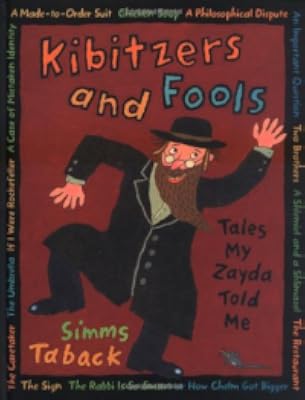
Kibitzers and Fools
by Simms Taback
On This Page
Description
Thirteen brief, illustrated, traditional Jewish tales, each accompanied by an appropriate saying.Tags
Recommendations






Member Reviews
Very funny and entertaining book. Phrases that I use all the time turn out to be another language.
It is cool that English has become the melting pot for taking on the sayings of other languages.
Great stories with a way for kids to relate to them.
It is cool that English has become the melting pot for taking on the sayings of other languages.
Great stories with a way for kids to relate to them.
SUMMARY: A collection of thirteen traditional Jewish tales, all accompanied by an appropriate saying.
REVIEW: Since my mom's side of the family is Jewish, I have a particular fondness for this book. I was not raised specifically in the Jewish culture, but I have heard many of the words and stories recounted in this book during family gatherings over the years. This book is a fun, entertaining collection of traditional Jewish stories that children will definitely enjoy reading about. Of course, these stories contain some of the Jewish words that are both useful AND fun to say, such as "farblondjet," meaning "confused." This book is a wonderful introduction to Jewish culture for young children.
REVIEW: Since my mom's side of the family is Jewish, I have a particular fondness for this book. I was not raised specifically in the Jewish culture, but I have heard many of the words and stories recounted in this book during family gatherings over the years. This book is a fun, entertaining collection of traditional Jewish stories that children will definitely enjoy reading about. Of course, these stories contain some of the Jewish words that are both useful AND fun to say, such as "farblondjet," meaning "confused." This book is a wonderful introduction to Jewish culture for young children.
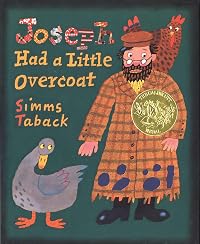
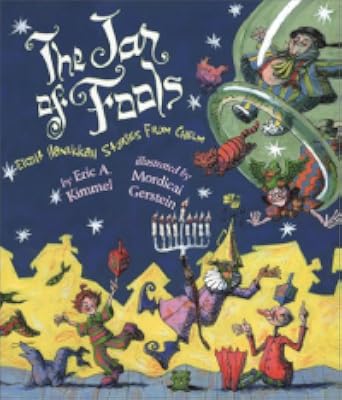
Brimming with humor and bursting with life, this dynamically illustrated collection of anecdotes and short stories about kibitzers, shlemiels, noodniks, meshuganers and other Yiddish types is reminiscent of Taback’s award winning Joseph Had a Little Overcoat.
This book is a set of adapted Jewish folktales. It would be used for the intermediate grades. This is a good example of folktale because it includes a number of Jewish tales with a humorous adaptation. A lot of the tales build upon one another, with definitions of Jewish words or slang included in the margins. The folktales follow oral tradition in that they are the author's understanding of his grandfather's retelling.
The elements of style in this book are numerous. There is purposeful use of juxtaposition, word play, metaphor, rhythm, and analogy. There is a lot of satire and sarcasm in the book, along with silly nonsense words and phrases. The illustrations support the quirky writing style with every detail.
This book could be used show more in a multi-cultural lesson about tradition or Jewish words and values.
This book could be used in lesson about folklore and tales of different cultures. show less
The elements of style in this book are numerous. There is purposeful use of juxtaposition, word play, metaphor, rhythm, and analogy. There is a lot of satire and sarcasm in the book, along with silly nonsense words and phrases. The illustrations support the quirky writing style with every detail.
This book could be used show more in a multi-cultural lesson about tradition or Jewish words and values.
This book could be used in lesson about folklore and tales of different cultures. show less
This book is a collection of short Yiddish stories that contain some great Yiddish expressions. This book can be a great mentor text when teaching figurative language to one's class. It also can make a fine addition to a classroom library. The illustrations are excellent and do a great job at helping communicate the meaning of each expression.
Very short stories with lots of colorful illustrations and Yiddish terms with English translations in parentheses. Each one or two page story is followed by a related saying.
The stories are:
The Sign - what is superfluous in a sign that says "Fresh Fish Sold Here Daily"?
A Made-to-Order Suit - the saying at the end is "A suit of clothing is as good as the tailor."
Chicken Soup - if you have one sick and one healthy chicken, what do you do?
A Philosophical Dispute - does bread ever not fall buttered side down?
The Umbrella
An Important Question - what is life?
A Shlemiel and a Shlimazel - the difference is explained with a bowl of soup
Two Brothers - God's answer to the apparent unfairness of the world
A Case of Mistaken Identity - A man so show more changed that even his name has changed
The Caretaker - The shames becomes successful when he is fired because he is illiterate
The Restaurant - the customer asks the waiter to taste the soup
If I Were Rockefeller - The poor teacher explains why he would be richer than Rockefeller if he were rich like him
The Rabbi Is So Smart or How Chelm Got Bigger - the Rabbi explains why the moon is more important than the sun, how to have enough she-goats, what to do when it's cold outside, and how pushing the mountain next to Chelm should give the townsfolk more room. show less
The stories are:
The Sign - what is superfluous in a sign that says "Fresh Fish Sold Here Daily"?
A Made-to-Order Suit - the saying at the end is "A suit of clothing is as good as the tailor."
Chicken Soup - if you have one sick and one healthy chicken, what do you do?
A Philosophical Dispute - does bread ever not fall buttered side down?
The Umbrella
An Important Question - what is life?
A Shlemiel and a Shlimazel - the difference is explained with a bowl of soup
Two Brothers - God's answer to the apparent unfairness of the world
A Case of Mistaken Identity - A man so show more changed that even his name has changed
The Caretaker - The shames becomes successful when he is fired because he is illiterate
The Restaurant - the customer asks the waiter to taste the soup
If I Were Rockefeller - The poor teacher explains why he would be richer than Rockefeller if he were rich like him
The Rabbi Is So Smart or How Chelm Got Bigger - the Rabbi explains why the moon is more important than the sun, how to have enough she-goats, what to do when it's cold outside, and how pushing the mountain next to Chelm should give the townsfolk more room. show less
Colorful illustrations, humor, and Jewish folktales with a lesson at the end...What's not to like about this book? This book is a lot of fun and offers a glimpse into Jewish tradition.
Members
- Recently Added By
Lists

Best children's picture books
377 works; 85 members
Author Information

42+ Works 8,518 Members
Simms Taback was born on February 13, 1932 in New York City. Before serving two years in the Army, he graduated from Cooper Union for the Advancement of Science and Art in 1953. He worked as an art director at CBS Records and The New York Times and as an advertising art director at William Douglas McAdams. He designed and illustrated the first show more McDonald's Happy Meal box in the 1970s. During his lifetime, he was the illustrator and occasional author of about 50 children's books including There Was an Old Lady Who Swallowed a Fly, Joseph Had a Little Overcoat, which won the Caldecott Medal in 2000, and Postcards from Camp. He died of pancreatic cancer on December 25, 2011 at the age of 79. (Bowker Author Biography) show less
Awards and Honors
Awards
Distinctions
Common Knowledge
- Original publication date
- 2005
- Dedication
- The Starr - Weg Family
The great Yiddish storytellers --- Sholem Aleichem, I.L. Peretz, and Mendele Mocher S'forim. - First words
- Have you ever called someone a klutz?
- Last words
- (Click to show. Warning: May contain spoilers.)Where there's a will there's a way.
Classifications
Statistics
- Members
- 283
- Popularity
- 113,547
- Reviews
- 14
- Rating
- (4.03)
- Languages
- English, French
- Media
- Paper
- ISBNs
- 5
- ASINs
- 4