Mrs. Chicken and the Hungry Crocodile
by Won-Ldy Paye, Margaret H. Lippert
On This Page
Description
When a crocodile captures Mrs. Chicken and takes her to an island to fatten her up, clever Mrs. Chicken claims that she can prove they are sisters and that, therefore, the crocodile shouldn't eat her.Tags
Recommendations









Member Reviews
Mrs. Chicken and the hungry crocodile is a tale of cunning wit! The chicken goes to the river to bath and when she gets there she encounters a crocodile. The crocodile tries to eat the chicken, but the chicken convinces the crocodile that they are sisters. The crocodile not sure what to think of this scheme decides that the chicken can only get fatter, so why not humor her. Both the crocodile and the chicken lay eggs.One night before the eggs are about to hatch the chicken switches her eggs with the crocodile eggs. The crocodiles eggs hatch and they are chickens. The chicken says that she was right, they are sisters, as you can see you have hatched eggs that look like me. When Hen's eggs hatched they looked like crocodiles. The hen show more decided since crocodile didn't think the chicks were cute she would trade children. Crocodile took Hen and chicks back to land and the Chicken never went to the river again! show less
This folktale is a great story of foes becoming friends, sisters in fact. These two unlikely characters find that together they are a better team. This book is great folk tale example and could teach a lesson of friendship or character development to young readers and writers.
Mrs. Chicken learns that while the puddle by her home is familiar and boring, it is much safer than the wild river and what dwells within it. This is a fun folktale from Liberia that teaches some good life lessons. The illustrations are playful, simple, and effective.
I really liked this story. In a class of first or second graders, it would definitely be fun to use theatre to bring it to life. Students could take on the roles of the narrator, the crocodile, the chicken, and the six eggs.
I really liked this story. In a class of first or second graders, it would definitely be fun to use theatre to bring it to life. Students could take on the roles of the narrator, the crocodile, the chicken, and the six eggs.
A witty little story of how Mrs. Chicken fooled Hungry Crocodile into believing they were sisters in order to save her life. After Mrs. Chicken foolishly gets caught by Hungry Crocodile she sets into motion a plot which involves switching their eggs to trick Crocodile into letting her go. After their eggs hatch, Crocodile is convinced they must be sister.s...and who can eat their sister?
When Mrs. Chicken goes to the river to check her reflection, she wonders why her skin looks green and scaly, but she still steps into the water to be grabbed by the crocodile and taken to her house for dinner (main course, chicken). But Mrs. Chicken has a few tricks of her own. She tells the crocodile they are sisters and convinces her by switching eggs. This allows Mrs. Chicken and her chicks to go free. This retelling of a traditional Liberian tale is funny and surprising. The language is accessible and the illustrations are simple and engaging. This book would be appropriate for ages 4 to 8.
I didn't particularly care for this story. I thought the big message of it was manipulation because the chicken told the crocodile that they were sisters and "proved it" by switching their eggs while the crocodile is sleeping. After the crocodile believed they were sisters they switched their babies to the way that it "should have been" (chickens with the chicken and crocodile babies with the crocodile) and the chicken told the crocodile they were never coming back, even though the two were "friends" now. I don't think this sends a good message to children because it's like saying if you just switch things around, you can always be right. Granted, the chicken was just trying to get itself out of trouble, however, I don't think this show more sends a good message to the children.
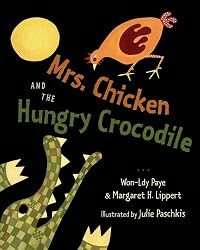
On the brighter side, I do like the illustrations of the book and how the background is always dark and both the chicken and crocodile are bold colors. It makes you focus on them and makes them really stand out. Since the story is based around the two of them, I feel it is appropriate that it is done this way. show less
On the brighter side, I do like the illustrations of the book and how the background is always dark and both the chicken and crocodile are bold colors. It makes you focus on them and makes them really stand out. Since the story is based around the two of them, I feel it is appropriate that it is done this way. show less
A Chicken wanders down to the river to find a bigger refection of herself so she can observe her “Big bright eyes. Short, smooth beak,” and especially her wings. She peres into the river and much to her dismay sees “scaly green legs,” “a long mouth,” and “sharp teeth.” She finds it odd that she sees these things in the river. She continues to examine her refection turning and switching views to make sure her eyes were seeing the scales correctly. On her final attempt to see her wings she steps into the river and “SNAP,” the crocodile grabbed her foot and she squawked “BOK!”
The Crocodile took the chicken back to her home and released the chicken into her house. The chicken flew up to the rafters where she stayed show more knowing that the crocodile wanted to eat her up, which revealed the conflict of the story. The Crocodile said she would fatten up the chicken before eating her. Which bought Mrs. Chicken time to devise a plan.
This African tale is a great way to show children how thinking and using their knowledge can get them out of any situation. show less
The Crocodile took the chicken back to her home and released the chicken into her house. The chicken flew up to the rafters where she stayed show more knowing that the crocodile wanted to eat her up, which revealed the conflict of the story. The Crocodile said she would fatten up the chicken before eating her. Which bought Mrs. Chicken time to devise a plan.
This African tale is a great way to show children how thinking and using their knowledge can get them out of any situation. show less
Members
- Recently Added By
Lists

A Child's Book Tour of West Africa ::: Côte d'Ivoire, Mali, Ghana, Nigeria
59 works; 5 members

Childhood: Books for or about children in different cultures around the wor
345 works; 18 members
Author Information

5 Works 597 Members
17 Works 963 Members
All Editions
Awards and Honors
Awards
Common Knowledge
- Canonical title
- Mrs. Chicken and the Hungry Crocodile
- Original publication date
- 2003
- People/Characters
- Mrs. Chicken; Crocodile
- Important places
- Liberia
- Dedication
- For Matay -- W.P.
For Jocelyn and Dawn -- M.H.L.
For Gus -- J.P. - First words
- One morning, Mrs. Chicken took her bath in a puddle.
- Last words
- (Click to show. Warning: May contain spoilers.)"Big enough for us," Mrs. Chicken tells her children. "And MUCH too small for crocodiles!"
Classifications
Statistics
- Members
- 292
- Popularity
- 110,083
- Reviews
- 35
- Rating
- (3.84)
- Languages
- English
- Media
- Paper
- ISBNs
- 5