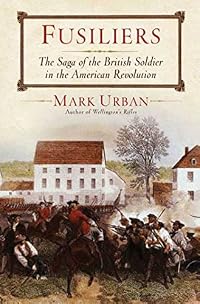
Fusiliers: The Saga of a British Redcoat Regiment in the American Revolution
by Mark Urban
On This Page
Description
A history of a British Army regiment, the Royal Welch Fusiliers, recounts the battles, tactics, leadership, and day-to-day living of soldiers during the American Revolution, from Lexington and Concord to the final battle at Yorktown.Tags
Recommendations























Member Recommendations

Member Reviews
If you want to know what this book is really about all you need to do is read the dedication: "To those who serve honorably in unpopular wars." That said, what Urban does best is to give you the flavor of what service was like in a British regiment of foot serving in the American Revolutionary War, through the lense of the 23rd Welch Fusiliers. This then ties into his wider goal of examining the evolution of the British Army in the second half of the 18th century, as it oscillated from the strict linear tactics of the Seven Years War, to meeting the demands of the American environment for flexibility, to relearning all those lessons again at the beginning of the new, long struggle with France.
Where I mark down the book a little is that show more there are times when Urban glosses over the frictions that provoked colonial fence-sitters into taking up arms against the King's government. Little examples such as the mass expropriations that provoked spontaneous guerrilla war in New Jersey before Trenton & Princeton, or how forcing South Carolinians to void what they thought was parole in the wake of the fall of Charleston drove men into the ranks of the partisans. While it doesn't negate my enjoyment of the book, it does make me want to know more about the author's politics. Let's just say that defending the honor of the British Army from the contempt of Cousin Jonathan is a high priority on Urban's list. show less
Where I mark down the book a little is that show more there are times when Urban glosses over the frictions that provoked colonial fence-sitters into taking up arms against the King's government. Little examples such as the mass expropriations that provoked spontaneous guerrilla war in New Jersey before Trenton & Princeton, or how forcing South Carolinians to void what they thought was parole in the wake of the fall of Charleston drove men into the ranks of the partisans. While it doesn't negate my enjoyment of the book, it does make me want to know more about the author's politics. Let's just say that defending the honor of the British Army from the contempt of Cousin Jonathan is a high priority on Urban's list. show less
An excellent account of one British regiment, the 23rd Royal Welch Fusiliers, in the American Revolution. It covers a wide area of subject matter and I found it quite well written and the maps were a great help. I recommend this book to those interested in the American Revolution, the history of the British Army or in the 1700's.
Fusiliers by Mark Urban is a unit history of the British 23rd Regiment of Foot (a.k.a the Royal Welch Fusiliers), which fought from the Battle of Lexington in 1775 and eventually surrendered at Yorktown in 1781. It's a unique unit in that a) it gave long and varied service in multiple campaigns (Boston, New York, New Jersey, Pennsylvania, Rhode Island, South Carolina, Virginia, et. al.) and b) a large amount of primary source documentation about the unit has survived the years, particularly in the form of officers private correspondence.
As an American reader, I enjoyed learning about troops of "the other side" and discovered some surprises. Contrary to American Revolution mythology, the Royal Welch did manage to adapt their tactics to show more warfare, North American style - e.g. the use of skirmish lines and firing behind concealment as opposed to bunched-together, Napoleonic-style troop blocks, and their skillful employment as snipers hanging from the ratlines of British vessels while fighting the French Navy off Newport, RI. I also learned about the large segment of the Colonists were indifferent if not hostile to the Patriot cause, something my fifth-grade history textbooks certainly did not cover.
The book gives a very well-written and comprehensive overview of many of the major campaigns of the war and a fairly good overview of what life was like for the Redcoat officers and men. show less
As an American reader, I enjoyed learning about troops of "the other side" and discovered some surprises. Contrary to American Revolution mythology, the Royal Welch did manage to adapt their tactics to show more warfare, North American style - e.g. the use of skirmish lines and firing behind concealment as opposed to bunched-together, Napoleonic-style troop blocks, and their skillful employment as snipers hanging from the ratlines of British vessels while fighting the French Navy off Newport, RI. I also learned about the large segment of the Colonists were indifferent if not hostile to the Patriot cause, something my fifth-grade history textbooks certainly did not cover.
The book gives a very well-written and comprehensive overview of many of the major campaigns of the war and a fairly good overview of what life was like for the Redcoat officers and men. show less
Mark Urban's "Fusiliers" is a valuable contribution to the litany of regimental histories which dot the landscape of military history. Whereas the vast majority of Revolutionary War books available in the United States are written from an unabashedly American perspective, "Fusiliers" makes for a refreshing change in tempo as the author states from the beginning his intention to break from the American point of view. With this in mind, the narrative follows the day-to-day existence of the 23rd Royal Welch Fusiliers immediately prior to the outbreak of hostilities in 1775 through the years immediately following the end of the American Revolution. Urban draws in no small part from the existing memoirs and writings of members of the show more regiment, and paints a vivid picture of life within the regiment during the war. While the constant shifts in leadership and composition are covered, the author does not neglect to explain the background details of the Fusiliers' movements and even manages to provide an insightful window into the development of light infantry warfare during the war and its impact upon post-war British infantry doctrine. Readers do not have to fret about reading a constant stream of derisive remarks for the rebel side: Urban is equally critical of both the Americans and the British. There are minor errors sprinkled throughout the book, mostly publisher's mistakes rather than discrepancies in accuracy, but it does not detract from the overall quality of the book. As it is written in very readable prose, it is recommended to anyone looking for a view of British military affairs at the regimental level during the Revolution, and for the advanced enthusiast of the time period. show less
It is an unfortunate aspect of modern book marketing that popular history books apparently need sensational truthy subtitles. "How the British Army Lost America but Learned to Fight" is a completely untrue sentence and shown to be false by the author himself in the last chapter of the book. The actual source of the successful British army in the Peninsular War from 1809 on lies in India.
The author's attempt to both tell the story of the American Revolution from a British point of view and follow the path across America of one regiment, the 23rd Royal Welch Fusiliers, is only partially successful. While the 23rd was present from the start to the bitter end, it often played only a supporting role and its number of personal accounts and show more sources is quite limited. A concentration on Cornwallis' southern campaigns up to the surrender at Yorktown would have made a much stronger book. In the southern campaign, the 23rd was often in the center of the line of battle and shared the deprivations the British endured during their march across the Carolinas. Given the huge territories they crossed, the tiny number that constituted the British army is simply amazing. How could they ever think about subduing a rebellion with such limited forces. The book also serves as a welcome antidote to "The Patriot" movie truthiness. It is interesting to compare the British professional soldier's shock about Patriot/Loyalist atrocities in the light of today's Iraqi Sunni/Shia conflict. Often, the American patriots acted like terrorists, exacting brutal vengeance on people abandoned by the British. War is horrible and civil wars are the worst.
Overall, a good read that does not attain the level of the best military unit narratives of the American Revolution, such as Friederike von Riedesel's recollections about her and her husband's service in a Brunswick regiment in America. show less
The author's attempt to both tell the story of the American Revolution from a British point of view and follow the path across America of one regiment, the 23rd Royal Welch Fusiliers, is only partially successful. While the 23rd was present from the start to the bitter end, it often played only a supporting role and its number of personal accounts and show more sources is quite limited. A concentration on Cornwallis' southern campaigns up to the surrender at Yorktown would have made a much stronger book. In the southern campaign, the 23rd was often in the center of the line of battle and shared the deprivations the British endured during their march across the Carolinas. Given the huge territories they crossed, the tiny number that constituted the British army is simply amazing. How could they ever think about subduing a rebellion with such limited forces. The book also serves as a welcome antidote to "The Patriot" movie truthiness. It is interesting to compare the British professional soldier's shock about Patriot/Loyalist atrocities in the light of today's Iraqi Sunni/Shia conflict. Often, the American patriots acted like terrorists, exacting brutal vengeance on people abandoned by the British. War is horrible and civil wars are the worst.
Overall, a good read that does not attain the level of the best military unit narratives of the American Revolution, such as Friederike von Riedesel's recollections about her and her husband's service in a Brunswick regiment in America. show less
I enjoyed this book more than I thought I would and I learned a great deal. The 400 pages contains 320 pages of text that is full of information. The book is a chronological narrative of the career of the 23rd Royal Welch Fusiliers regiment in the American Revolution. The story begins with a regimental party commemorating the anniversary of Wales patron saint on March 1, 1775. Many of those present are "Old Mindonians" veterans of the battle of Minden fought in Germany in the Seven Years War. Next comes a detailed description of the 23rd's participation in the Battles of Lexington and Concord. Each action in which the 23rd was involved is discussed through the Battle of Yorktown which ended the war. The 23rd was involved in all of the show more major campaigns of the war, except for Saratoga. I have some knowledge of the history of the revolution but the author's account helped to give me an understanding of the course of events that took place.
There was a good discussion of the light infantry tactics developed by William Howe and used by Earl Cornwallis that made the British more effective fighters. They learned how to fight more like the Americans in spread out formations using the natural cover. The author's description of the Southern Campaign under Cornwallis gives high praise to the men of the 23rd. Cornwallis decided to take his troops inland and the men endured great hardship from lack of supplies and the elements including disease.
The Battle of Guilford Courthouse was perhaps the greatest hour for the 23rd as described by the author. The troops had chased General Greene's army from South Carolina to the Dan River on the Virginia border in a three week march. Greene picked out the battlefield in North Carolina and faced 1,900 redcoats with approximately 4,400 men, the majority being militia. The British fought hard for about two hours going through the three lines of American troops driving them from the battlefield. The British had casualties of 532 officers and men, a sizable percentage of their force. The American casualties were less. While Cornwallis won the battle Greene showed that at this pace he would win the war. While the battles in this war did not involve large numbers the fighting was sharp and any casualty was just as wounded or dead as if it were a bigger battle.
One item that I found appalling was the British system of buying commissions. It was practiced throughout the army. If you were able but poor you had to borrow to the hilt to get the position you deserved. If you were rich and had connections you could have your choice with the welfare of the men be damned.
I had grown up watching the "Swamp Fox" and learned here that in real life he was blood thirsty and murdered many suspected Tories. This guerrilla aspect of the war favored the Americans and accounted for the lack of support for the British in the countryside.
The Battle of Yorktown is well covered including the surrender ceremony. Once surrounded the British were done for and since Clinton disliked Cornwallis he took few efforts to rescue him. The book ends with the 23rd's return to England, although many stayed in Canada. At that point there are few left from the party of March 1, 1775.
I did use Encyclopedia of the American Revolution as a reference while reading the book. It is a must have reference for studying this period of history. show less
There was a good discussion of the light infantry tactics developed by William Howe and used by Earl Cornwallis that made the British more effective fighters. They learned how to fight more like the Americans in spread out formations using the natural cover. The author's description of the Southern Campaign under Cornwallis gives high praise to the men of the 23rd. Cornwallis decided to take his troops inland and the men endured great hardship from lack of supplies and the elements including disease.
The Battle of Guilford Courthouse was perhaps the greatest hour for the 23rd as described by the author. The troops had chased General Greene's army from South Carolina to the Dan River on the Virginia border in a three week march. Greene picked out the battlefield in North Carolina and faced 1,900 redcoats with approximately 4,400 men, the majority being militia. The British fought hard for about two hours going through the three lines of American troops driving them from the battlefield. The British had casualties of 532 officers and men, a sizable percentage of their force. The American casualties were less. While Cornwallis won the battle Greene showed that at this pace he would win the war. While the battles in this war did not involve large numbers the fighting was sharp and any casualty was just as wounded or dead as if it were a bigger battle.
One item that I found appalling was the British system of buying commissions. It was practiced throughout the army. If you were able but poor you had to borrow to the hilt to get the position you deserved. If you were rich and had connections you could have your choice with the welfare of the men be damned.
I had grown up watching the "Swamp Fox" and learned here that in real life he was blood thirsty and murdered many suspected Tories. This guerrilla aspect of the war favored the Americans and accounted for the lack of support for the British in the countryside.
The Battle of Yorktown is well covered including the surrender ceremony. Once surrounded the British were done for and since Clinton disliked Cornwallis he took few efforts to rescue him. The book ends with the 23rd's return to England, although many stayed in Canada. At that point there are few left from the party of March 1, 1775.
I did use Encyclopedia of the American Revolution as a reference while reading the book. It is a must have reference for studying this period of history. show less
Mark Urban's glimpse at the 23rd Regt (Royal Welsh Fusiliers) during the American Revolution is interesting. Urban intends to trace the regiment from its callow first day of fighting during the retreat from Concord, and its growth into a reliable well-trained regiment until its surrender at Yorktown.
On many levels, I don't think it is successful. Much of my reading sounded like a travelogue across the battlefields and bivouacs of 18th century Ameria. While the theme was supposed to focus on the 23rd, I just don't think there is enough meat to hold the theme together. There is some detail on the turnover of the officer corps, including some interesting discussion of the nature of the purchase system in the British army. However, there show more isn't the kind of social history of the army one might expect from a book of this nature, especially at the enlisted level. One can get a bit of a regiment-centered view of the war, but in the end I didn't find it to be anything special. show less
On many levels, I don't think it is successful. Much of my reading sounded like a travelogue across the battlefields and bivouacs of 18th century Ameria. While the theme was supposed to focus on the 23rd, I just don't think there is enough meat to hold the theme together. There is some detail on the turnover of the officer corps, including some interesting discussion of the nature of the purchase system in the British army. However, there show more isn't the kind of social history of the army one might expect from a book of this nature, especially at the enlisted level. One can get a bit of a regiment-centered view of the war, but in the end I didn't find it to be anything special. show less
Members
- Recently Added By
Author Information

22 Works 1,869 Members
Mark Urban is the Diplomatic Editor of the BBC's Newsnight and was formerly defence correspondent for the Independent.
Some Editions
Common Knowledge
- Important places
- United Kingdom; USA
- Important events
- American Revolution (1775 | 1783); Battle of Lexington; Battle of Concord; Battle of Yorktown
Classifications
Statistics
- Members
- 271
- Popularity
- 118,730
- Reviews
- 11
- Rating
- (3.81)
- Languages
- English
- Media
- Paper, Ebook
- ISBNs
- 6
- ASINs
- 6