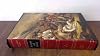
Redcoats and Rebels: The American Revolution Through British Eyes
by Christopher Hibbert
On This Page
Description
This book provides a thorough introduction to the War of American Independence. Told with great authority and clarity the book describes and details the effects of each notable event from 1770 to 1781. The book examines each of the major battles and skirmishes but does not get bogged down in deep analysis of battle formations and strategies. Instead the book concentrates on the war as a whole and its political and ecomonic impacts on Britain and America and consequently how each commander's show more startegy was affected. The book is littered with anecdotes to give the reader a clearer understanding of how the war affected the lives of those involved. show lessTags
Recommendations









Member Recommendations

Member Reviews
Themes: war, American Revolution, liberty, politics, biography, geography
Setting: the new United States of America, 1770s-1780s, Canada, and England
So we've all heard the story about how the patriots wanted freedom from the oppression of that evil King George and how they rose up, demanded their rights, and made the world safe for democracy, right? Not surprisingly, the story is not quite that simple, and this book presents the whole war from the British point of view. We get a good look at what was going on back in Britain, the political maneuvering behind the scenes, the personalities of the British officers involved, and how Britain finally lost the colonies.
Washington is still a central figure here, but we also get to learn about show more Burgoyne, Lord Cornwallis, the Howe brothers, admiral and general, and most of all, Clinton, who was so prickly and hard to get along with that he alienated every single man assigned to work with him. It wouldn't be a huge exaggeration to say that the feuding that went on among the English generals, the politicians back home, and the lack of communication is what really allowed America to win the war. There were other factors, to be sure, but I had no idea what a mess the British were really in.
There are very few saints in this book. Loyalist and rebels alike committed horrible crimes against civilians and the enemy captives. But it was great to read a new perspective on the war for American Independence.
I have to say that I found some interesting parallels as I read this book. As the English troops talked about the difficult terrain, how impossible it was to fight an enemy that they couldn't see through the forests and that fought an unconventional style of warfare they hadn't seen before, it reminded me of the descriptions of the Vietnam War. Like that one, the American war became more and more unpopular back in England, especially among the wealthier aristocratic class. It was the poor and desperate, the foreign mercenaries who were the ones sent to fight this war a continent away.
The other interesting thing that struck me was the repeated refrain that the British politicians back home gave, that American loyalists would be happy to rise up and support the British troops fight to overthrow the rebels. It's a little different, but it did sound like what our government said during the second Gulf War, that the Iraqis would all be happy to get rid of Saddam Hussein, that all we had to do was show up and they would rush to join America get rid of the dictator. Didn't quite work that way the US, and didn't work that way for the British. Let's face it, most people will be happy to join a successful cause after it's obvious who is going to win. But to risk your own life when the issue is still very uncertain - most people will sit it out and let the soldiers do the fighting.
I started this one on tape, but I don't have as much time to listen in the car as I used to, so I switched over to physical book format to finish. Both versions were very enjoyable, although I admit I liked seeing the pictures. I will warn thought that the audio version started out with a 15-20 minute acknowledgment before the story ever got started, so if you listen, you can definitely skip all that and not miss a thing. But the narration was very good. Highly recommended for Americans and British alike. show less
Setting: the new United States of America, 1770s-1780s, Canada, and England
So we've all heard the story about how the patriots wanted freedom from the oppression of that evil King George and how they rose up, demanded their rights, and made the world safe for democracy, right? Not surprisingly, the story is not quite that simple, and this book presents the whole war from the British point of view. We get a good look at what was going on back in Britain, the political maneuvering behind the scenes, the personalities of the British officers involved, and how Britain finally lost the colonies.
Washington is still a central figure here, but we also get to learn about show more Burgoyne, Lord Cornwallis, the Howe brothers, admiral and general, and most of all, Clinton, who was so prickly and hard to get along with that he alienated every single man assigned to work with him. It wouldn't be a huge exaggeration to say that the feuding that went on among the English generals, the politicians back home, and the lack of communication is what really allowed America to win the war. There were other factors, to be sure, but I had no idea what a mess the British were really in.
There are very few saints in this book. Loyalist and rebels alike committed horrible crimes against civilians and the enemy captives. But it was great to read a new perspective on the war for American Independence.
I have to say that I found some interesting parallels as I read this book. As the English troops talked about the difficult terrain, how impossible it was to fight an enemy that they couldn't see through the forests and that fought an unconventional style of warfare they hadn't seen before, it reminded me of the descriptions of the Vietnam War. Like that one, the American war became more and more unpopular back in England, especially among the wealthier aristocratic class. It was the poor and desperate, the foreign mercenaries who were the ones sent to fight this war a continent away.
The other interesting thing that struck me was the repeated refrain that the British politicians back home gave, that American loyalists would be happy to rise up and support the British troops fight to overthrow the rebels. It's a little different, but it did sound like what our government said during the second Gulf War, that the Iraqis would all be happy to get rid of Saddam Hussein, that all we had to do was show up and they would rush to join America get rid of the dictator. Didn't quite work that way the US, and didn't work that way for the British. Let's face it, most people will be happy to join a successful cause after it's obvious who is going to win. But to risk your own life when the issue is still very uncertain - most people will sit it out and let the soldiers do the fighting.
I started this one on tape, but I don't have as much time to listen in the car as I used to, so I switched over to physical book format to finish. Both versions were very enjoyable, although I admit I liked seeing the pictures. I will warn thought that the audio version started out with a 15-20 minute acknowledgment before the story ever got started, so if you listen, you can definitely skip all that and not miss a thing. But the narration was very good. Highly recommended for Americans and British alike. show less
This is definitely not what I was taught about the War with the Americans. I was surprised as to how much opposition there was in England for this war and how much bumbling there was on the part of the British Army - they were in quite a mess. After a few successes ("we cannot afford any future wins") it appears that the British were doomed to fail.
The book was not always easy to read - the British use of double negatives caused me to have to reread many passages both the letters from the era and the writing of the present. Remarks are made in the text as to how many of the British generals took pride in their convoluted language so I think I'm not alone.
Interestingly, the description of the battles was concise and not boring and the show more inclusion of personal accounts adds to the drama. The index is very thorough and accurate - I used it many times to review the introduction of some of the people involved. The author does nice work in the end to include follow-up history of individuals that was not part of the book show less
The book was not always easy to read - the British use of double negatives caused me to have to reread many passages both the letters from the era and the writing of the present. Remarks are made in the text as to how many of the British generals took pride in their convoluted language so I think I'm not alone.
Interestingly, the description of the battles was concise and not boring and the show more inclusion of personal accounts adds to the drama. The index is very thorough and accurate - I used it many times to review the introduction of some of the people involved. The author does nice work in the end to include follow-up history of individuals that was not part of the book show less
I had previous reviewed A Few Bloody Noses; Redcoats and Rebels is another look at the American Revolutionary War from the British perspective. Author Christopher Hibbert is a professional historian with a dozen or so books to his credit, and does a workmanlike job with his material. The chronological history is well done, focusing on grand strategy (insofar as either side had one), brief accounts of major battles, and Parliamentary and public feeling in Britain.
While A Few Bloody Noses author Robert Harvey was pretty blatant in his pro-British stance (and, of course, there’s no reason why he shouldn’t be), Hibbert is almost excessively apologetic, giving a lot of space to the “massacres” of Banastre Tarleton and Charles “No show more Flint” Grey while glossing over equivalent acts by the American side (in fact, most of Tarleton’s dragoons were American loyalists).
Hibbert doesn’t come right out and say British commanders Howe, Clinton, Burgoyne and Cornwallis were incompetent; we’re left to draw that conclusion ourselves. It’s not clear that they were incompetent; just that they were not competent to conduct the kind of war they had to fight. All of the British commanders were certainly tactically competent; with a few exceptions (Concord, Trenton, Princeton, Saratoga, Monmouth, King’s Mountain, Yorktown) they “won” every battle they fought – at least in the European sense of winning – control of the field afterward.
One of Hibbert’s themes is that both London and commanders in the field consistently overestimated the amount of Loyalist support they could expect to receive. It wasn’t so much that there were few Loyalists; in fact, it’s been reasonably argued that the majority of Americans at the time were at least lukewarm Loyalists; it was that the number of Loyalists who were willing to take up weapons and fight was much smaller than the number of rebels who were.
Hibbert also gives a lot of space to foreigners in American service; von Steuben, DeKalb, Lafayette, Pulaski, Kościuszko. There are a half-dozen or so American cities or counties named after Lafayette, including a town right up the road from me; poor Kościuszko just wasn’t pronounceable enough.
There are a number of interesting items for the alternate history fans. Hibbert points out that a sort of “Anaconda” strategy was suggested early on; the Royal Navy and sufficient garrison troops should occupy American ports and just let the interior wither away. I imagine it might have worked; the main objections would have been political, with London wondering why all those troops were sitting at the end of a 3000-mile supply line doing nothing.
Hibbert also gives a lot of space to the invasion of Canada, noting, as many authors have, that it almost worked despite considerable odds. The unstated implication is that if Arnold and Montgomery had succeeding in taking Quebec City, it would have changed history by making the early United States even more of a territorial superpower. I strongly doubt it; even of the assault on Quebec City had succeeded, the Americans were at the end of a long and tenuous supply line while the British could have retaken Canada as soon as the ice on the St. Lawrence broke up in the spring (which is more or less what happened). The temporary capture of Quebec might have delayed an advance down the Richelieu River/Lake Champlain/Hudson line a little longer, but that’s all; the Canadians were not at all enthused about cooperating with the Americans.
Something I hadn’t realized is London actually sent peace commissioners in 1778. The terms were generous; London would recognize Congress, suspend all objectionable acts of Parliament, give up the right of taxation, and admit American representatives to the House of Commons. In return, the Americans would restore all confiscated Loyalist property, honor all English debts, agree that all military commands were held from the King, allow Parliament to regulate trade, and withdraw the Declaration of Independence. Hibbert claims the Declaration of Independence as the sticking point; I’m not sure that it wouldn’t have been the regulation of trade instead. It does make for another interesting alternate history question; if the commissioners had come a little earlier the results might have been interesting indeed. Allowing American parliamentary constituencies might have required wholesale election reform in England as well and the electorate expansion of the 19th century might have come much earlier. Harry Turtledove is welcome to run with it.
A quick read, and a good overview of the Revolutionary period regardless of which side of the pond you’re on. There are a number of decent maps, although they are sometimes a little out of place with regard to the corresponding text and are all campaign rather than tactical. Hibbert only gives text descriptions of battles; some maps would have made the tactics clearer.
I note in closing there’s a sort of Revolutionary revisionism among some of the American left. After all, the war was about taxes, which everybody knows are a Good Thing, and if we hadn’t revolted from Britain we would have gun control and National Health Service now, which everybody also knows are Good Things. Perhaps I can be allowed to present my own alternate history of the roots of the conflict (I stress this has nothing to do with Hibbert and is entirely my own pathetic attempt):
Suppose there are two polities, Blue State and Red State, both ruled by George. George gets both involved in a foreign war, at immense expense, then increases taxes to pay for it. However, all the smart people – the Seven Years War Truthers – know that the war was just to benefit George’s buddies in Big Sugar by giving him an excuse to invade peaceful islands under the excuse they were somehow a threat to Blue State. Blue State farmers aren’t allowed to sell their organic produce wherever they want (to the benefit of George’s Big Agriculture friends), and Blue State artisanal craftspeople are forbidden to trade their works (to the benefit of George’s cronies in Big Ironmongery). Well, of course The People arise, but the Occupy Boston Harbor peaceful protest is met with massacre and oppression by the Red State fascist goons and their running dogs. Alas for the reactionaries; they cannot thwart the march of historical inevitability forever and the People eventually triumph. show less
While A Few Bloody Noses author Robert Harvey was pretty blatant in his pro-British stance (and, of course, there’s no reason why he shouldn’t be), Hibbert is almost excessively apologetic, giving a lot of space to the “massacres” of Banastre Tarleton and Charles “No show more Flint” Grey while glossing over equivalent acts by the American side (in fact, most of Tarleton’s dragoons were American loyalists).
Hibbert doesn’t come right out and say British commanders Howe, Clinton, Burgoyne and Cornwallis were incompetent; we’re left to draw that conclusion ourselves. It’s not clear that they were incompetent; just that they were not competent to conduct the kind of war they had to fight. All of the British commanders were certainly tactically competent; with a few exceptions (Concord, Trenton, Princeton, Saratoga, Monmouth, King’s Mountain, Yorktown) they “won” every battle they fought – at least in the European sense of winning – control of the field afterward.
One of Hibbert’s themes is that both London and commanders in the field consistently overestimated the amount of Loyalist support they could expect to receive. It wasn’t so much that there were few Loyalists; in fact, it’s been reasonably argued that the majority of Americans at the time were at least lukewarm Loyalists; it was that the number of Loyalists who were willing to take up weapons and fight was much smaller than the number of rebels who were.
Hibbert also gives a lot of space to foreigners in American service; von Steuben, DeKalb, Lafayette, Pulaski, Kościuszko. There are a half-dozen or so American cities or counties named after Lafayette, including a town right up the road from me; poor Kościuszko just wasn’t pronounceable enough.
There are a number of interesting items for the alternate history fans. Hibbert points out that a sort of “Anaconda” strategy was suggested early on; the Royal Navy and sufficient garrison troops should occupy American ports and just let the interior wither away. I imagine it might have worked; the main objections would have been political, with London wondering why all those troops were sitting at the end of a 3000-mile supply line doing nothing.
Hibbert also gives a lot of space to the invasion of Canada, noting, as many authors have, that it almost worked despite considerable odds. The unstated implication is that if Arnold and Montgomery had succeeding in taking Quebec City, it would have changed history by making the early United States even more of a territorial superpower. I strongly doubt it; even of the assault on Quebec City had succeeded, the Americans were at the end of a long and tenuous supply line while the British could have retaken Canada as soon as the ice on the St. Lawrence broke up in the spring (which is more or less what happened). The temporary capture of Quebec might have delayed an advance down the Richelieu River/Lake Champlain/Hudson line a little longer, but that’s all; the Canadians were not at all enthused about cooperating with the Americans.
Something I hadn’t realized is London actually sent peace commissioners in 1778. The terms were generous; London would recognize Congress, suspend all objectionable acts of Parliament, give up the right of taxation, and admit American representatives to the House of Commons. In return, the Americans would restore all confiscated Loyalist property, honor all English debts, agree that all military commands were held from the King, allow Parliament to regulate trade, and withdraw the Declaration of Independence. Hibbert claims the Declaration of Independence as the sticking point; I’m not sure that it wouldn’t have been the regulation of trade instead. It does make for another interesting alternate history question; if the commissioners had come a little earlier the results might have been interesting indeed. Allowing American parliamentary constituencies might have required wholesale election reform in England as well and the electorate expansion of the 19th century might have come much earlier. Harry Turtledove is welcome to run with it.
A quick read, and a good overview of the Revolutionary period regardless of which side of the pond you’re on. There are a number of decent maps, although they are sometimes a little out of place with regard to the corresponding text and are all campaign rather than tactical. Hibbert only gives text descriptions of battles; some maps would have made the tactics clearer.
I note in closing there’s a sort of Revolutionary revisionism among some of the American left. After all, the war was about taxes, which everybody knows are a Good Thing, and if we hadn’t revolted from Britain we would have gun control and National Health Service now, which everybody also knows are Good Things. Perhaps I can be allowed to present my own alternate history of the roots of the conflict (I stress this has nothing to do with Hibbert and is entirely my own pathetic attempt):
Suppose there are two polities, Blue State and Red State, both ruled by George. George gets both involved in a foreign war, at immense expense, then increases taxes to pay for it. However, all the smart people – the Seven Years War Truthers – know that the war was just to benefit George’s buddies in Big Sugar by giving him an excuse to invade peaceful islands under the excuse they were somehow a threat to Blue State. Blue State farmers aren’t allowed to sell their organic produce wherever they want (to the benefit of George’s Big Agriculture friends), and Blue State artisanal craftspeople are forbidden to trade their works (to the benefit of George’s cronies in Big Ironmongery). Well, of course The People arise, but the Occupy Boston Harbor peaceful protest is met with massacre and oppression by the Red State fascist goons and their running dogs. Alas for the reactionaries; they cannot thwart the march of historical inevitability forever and the People eventually triumph. show less
This is a readable history of the American Revolution from the British perspective. It delves into the various personalities in British politicians and generals in the fight, and how often they viewed it as a dead-end proposition. There were perhaps no military encounters, outside guerrilla skirmishes, that the rebels could claim as victories, yet the British eventually retired from the conflict. This book helps explain why that was.
I found this book about the British side in the American Revolution interesting and informative. The British generals were not as involved in fighting the war as they were in squabbling with each other and their superiors. All of them seem to have hated being posted in America.
The main problem suffered by the British was every time they made a move about two to three thousand colonists with rifles would show up to oppose them. The British never got the support from the Loyalists they expected to counter the Rebels. The Americans were not good soldiers but they were good marksman. In the South the Americans lost about every battle but won just by staying in existence as an army.
Hibbert's book is full of gems like this and gave me a new show more perspective on the Revolution. This is not a scholarly tome but he seems to use good contemporary sources and The book is well written and moves along at an entertaining pace. I would recommend this as entertaining and informative. show less
The main problem suffered by the British was every time they made a move about two to three thousand colonists with rifles would show up to oppose them. The British never got the support from the Loyalists they expected to counter the Rebels. The Americans were not good soldiers but they were good marksman. In the South the Americans lost about every battle but won just by staying in existence as an army.
Hibbert's book is full of gems like this and gave me a new show more perspective on the Revolution. This is not a scholarly tome but he seems to use good contemporary sources and The book is well written and moves along at an entertaining pace. I would recommend this as entertaining and informative. show less
Hibbert writes clearly and entertainingly. The account is more about the British than the Americans and is complementary to the more numerous accounts that concentrate on Washington and his army.
2481 Redcoats and Rebels: The American Revolution Through British Eyes, by Christopher Hibbert (read 8 Jan 1993) This tells the story of the American Revolution from the British side, to some extent. I found my most frequent mental reference as I read was to my history classes in grade school--I thought, from fifth grade! This, though I have read an eight-volume biography of Washington, which must have covered the war in detail. This was an OK book, though not so absorbing as I expected.
Members
- Recently Added By
Author Information

80+ Works 14,059 Members
Christopher Hibbert: March 5, 1924 -- December 21, 2008 Historian Christopher Hibbert was born as Arthur Raymond Hibbert in Enderby, England in 1924. He dropped out of Oriel College to join the Army. He served with the London Irish Rifles and won the Military Cross. He earned a degree in history in 1948. Before becoming a full-time nonfiction show more writer, he worked as a real estate agent and a television critic for Truth magazine. He wrote more than 60 books throughout his lifetime including The Road to Tyburn (1957), Il Duce: The Life of Benito Mussolini(1962), George IV: Prince of Wales, 1762-1811 (1972), and George IV: Regent and King, 1812-1830 (1973). Hibbert was awarded the Heinemann Award for Literature in 1962 for The Destruction of Lord Raglan. He was a Fellow of the Royal Society of Literature and the Royal Geographical Society, and was awarded an Honorary Doctorate in Literature by the University of Leicester. He died from bronchial pneumonia on December 21, 2008 at the age of 84. (Bowker Author Biography) show less
Common Knowledge
- Original publication date
- 1990
- People/Characters
- Benedict Arnold; Paul Revere; George Washington; Charles Cornwallis, 1st Marquess Cornwallis (as Lord Cornwallis); George III, King of the United Kingdom; Nathanael Greene
- Important events
- American Revolution (1775 | 1783)
- Dedication
- For Bob and Peg Tessier with love
- First words
- The first reports came from Boston, a town of some sixteen thousand inhabitants, many of whom worked in its distilleries, fisheries, ropewalks, and shipyards.
- Last words
- (Click to show. Warning: May contain spoilers.)The ships turned round and sailed away north again, back to New York.
- Blurbers
- Reardon, Patrick T.; Hurwitz, Howard
Classifications
Statistics
- Members
- 693
- Popularity
- 41,489
- Reviews
- 7
- Rating
- (3.78)
- Languages
- English
- Media
- Paper, Audiobook, Ebook
- ISBNs
- 12
- ASINs
- 13