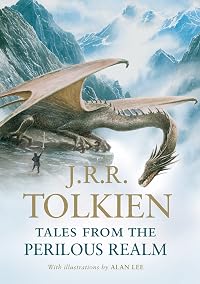
Tales from the Perilous Realm
by J. R. R. Tolkien
On This Page
Description
Never before published in a single volume, Tolkien's four novellas (Farmer Giles of Ham, Leaf by Niggle, Smith of Wootton Major, and Roverandom) and one book of poems (The Adventures of Tom Bombadil) are gathered together for the first time. This new, definitive collection of works — which had appeared separately, in various formats, between 1949 and 1998 — comes with an illuminating introduction from esteemed author and Tolkien expert Tom Shippey as well as Tolkein's most celebrated show more essay, "On Fairy-stories," which astutely addresses the relationship between fairy tales and fantasy.The book is the perfect opportunity for fans of Middle-earth to enjoy some of Tolkien's often overlooked yet most creative storytelling. With dragons and sand sorcerers, sea monsters and hobbits, knights and dwarves, this collection contains all the classic elements for Tolkien buffs of all ages.
. show less
Tags
Recommendations



Member Reviews
I'd read several pieces here before, but not all, and decades ago. The essay "On Fairy-stories" is the best, though here relegated to Appendix. It is the only essay, and several of the remaining short fiction works are worth revisiting.
"On Fairy-stories" discusses the role of fantasy for culture, and how it is misunderstood by many (especially critics?) who take it as juvenile or non-literary or both. Tolkien's position of "sub-creation" strikes me as another expression of Cabell's Romance, and to similar purpose and value. Tolkien rejects much scholarship on fairy-stories, not as invalid but as useless for either enjoying or writing a story about Faerie. Such scholarship is better for answering questions outside the tale, as it is show more irrelevant whether an event "really happened", or whether a scene reflected historical personages or legal doctrines. Rather, the stories arise from story-making (using metaphor "Cauldron of Story") and the aspects of a fantasy story which matter are those which work as story. Tolkien finishes with some reflections on what story is good for, all of these sensible and persuasive and wholly Cabellian. (His epilogue on the eucatastrophe of the Christian story he admits is "dangerous" and also revealing of what aspects of his fiction share in his own Christian beliefs.)
Tokien's dislike of allegory is infamous, and he had his reasons but does not mention them in this essay. Interestingly, the one mention of allegory is approving if incidental, in thinking of Greek myths when illustrating natural phenomena as better understood as allegory, not as myth.
I'm left motivated to read his other essays, perhaps especially those on Beowulf and his thoughts on invented language.
Of the short fiction, most memorable from my first reading was "Leaf by Niggle", and it did not disappoint upon re-reading. I enjoyed both "Farmer Giles" and "Smith of Wootton Major", somewhat moreso than expected even as (perhaps directly following from the fact) I'd not remembered any detail of either's plot nor of character. "Smith" is more poignant and Dunsanian than "Giles", and for me the lost gem.
I also appreciated the Bombadil poems, but in this case very specifically as vague backstory. Some of these seemed shoehorned into the Bombadil character, or their alleged source The Red Book: for example, "The Errantry", quite near to becoming that type of Elizabethan fairy story Tolkien admits to loathing, or several poems which seem something Bombadil might share when entertaining hobbits, not verse telling us of the character or his world. (Shippey confirms several of these suspicions, and Tolkien almost apologises for them in a framing preamble.)
"Roverandom" I need not revisit, it comes across very much as a children's story and not the variety I'm still fond of reading. I don't think I would have much liked it as a child, either.
//
Alan Lee's illustrations (and his afterward) are welcome, but unnecessary. It comes down to whether you admire Lee's interpretation of Tolkien's world, or do not: I do.
Tom Shippey's Introduction valuable and full of spoilers, regrettable the editor did not swap his & Lee's contributions, allowing the reader to proceed from first page to last, as a book naturally suggests. show less
"On Fairy-stories" discusses the role of fantasy for culture, and how it is misunderstood by many (especially critics?) who take it as juvenile or non-literary or both. Tolkien's position of "sub-creation" strikes me as another expression of Cabell's Romance, and to similar purpose and value. Tolkien rejects much scholarship on fairy-stories, not as invalid but as useless for either enjoying or writing a story about Faerie. Such scholarship is better for answering questions outside the tale, as it is show more irrelevant whether an event "really happened", or whether a scene reflected historical personages or legal doctrines. Rather, the stories arise from story-making (using metaphor "Cauldron of Story") and the aspects of a fantasy story which matter are those which work as story. Tolkien finishes with some reflections on what story is good for, all of these sensible and persuasive and wholly Cabellian. (His epilogue on the eucatastrophe of the Christian story he admits is "dangerous" and also revealing of what aspects of his fiction share in his own Christian beliefs.)
Tokien's dislike of allegory is infamous, and he had his reasons but does not mention them in this essay. Interestingly, the one mention of allegory is approving if incidental, in thinking of Greek myths when illustrating natural phenomena as better understood as allegory, not as myth.
I'm left motivated to read his other essays, perhaps especially those on Beowulf and his thoughts on invented language.
Of the short fiction, most memorable from my first reading was "Leaf by Niggle", and it did not disappoint upon re-reading. I enjoyed both "Farmer Giles" and "Smith of Wootton Major", somewhat moreso than expected even as (perhaps directly following from the fact) I'd not remembered any detail of either's plot nor of character. "Smith" is more poignant and Dunsanian than "Giles", and for me the lost gem.
I also appreciated the Bombadil poems, but in this case very specifically as vague backstory. Some of these seemed shoehorned into the Bombadil character, or their alleged source The Red Book: for example, "The Errantry", quite near to becoming that type of Elizabethan fairy story Tolkien admits to loathing, or several poems which seem something Bombadil might share when entertaining hobbits, not verse telling us of the character or his world. (Shippey confirms several of these suspicions, and Tolkien almost apologises for them in a framing preamble.)
"Roverandom" I need not revisit, it comes across very much as a children's story and not the variety I'm still fond of reading. I don't think I would have much liked it as a child, either.
//
Alan Lee's illustrations (and his afterward) are welcome, but unnecessary. It comes down to whether you admire Lee's interpretation of Tolkien's world, or do not: I do.
Tom Shippey's Introduction valuable and full of spoilers, regrettable the editor did not swap his & Lee's contributions, allowing the reader to proceed from first page to last, as a book naturally suggests. show less
Beautiful illustrations to match the delicious stories. Roverandam is sweet, one can imagine Tolkien telling this to his children. Farmer Giles of Ham is the anti-knight in shining armor story; just a farmer who gets things done. The Adventures of Tom Bombadil is a collection of poetry; some cute and silly, some haunting and one just horrifying. Smith of Wooton Major is a lovely tale of Faery which isn't cute or sappy. Leaf by Niggle is by far my favorite. A morality tale to remind us all how to be, and why. Don't skip Tolkien's essay "On Fairy Stories" at the end. It is dense, but will explain exactly why he wrote what he wrote.
Roverandom is a charming fairy tale adventure of a toy dog’s journeys over the ends of a flat earth to the moon and then back to the depths of the ocean. It was written by Tolkien to sooth his young son Michael’s sorrow about a favorite stuffed animal lost on the beach. It’s filled with humor, and with storyteller’s voice making occasional asides to his young audience. It should make for a great read-aloud for young listeners.
Farmer Giles of Ham is a humorous story of the rise of an unlikely hero with a cowardly dog who with a combination of dumb luck and his own shrewdness rises to fame and fortune. The philologist author uses a mixture of Latin and “the vulgar tongue” of English along with a conniving dragon and a not too show more bright giant to provide some extra chuckles to the narrative. This is a novella that could be taken as a parody of a traditional Jack folktale.
The Adventures of Tom Bombadil is a collection of poems from the Middle Earth of The Hobbit and The Lord of the Rings. The first few are about Tom Bobadil’s journeys up and down the river, the others are varied; some are humorous, a few spooky, and others wistfully longing.
Smith of Wootton Major explores a realm of faerie quite different from that of the one inhabited by the elves of Middle earth, as one human is loaned a gift to visit it, one which he must eventually pass on to another recipient.
Leaf by Niggle is again a very different kind of fantasy. Niggle is by nature, a great procrastinator, self-critical, and does many chores and favors for others, even as he grumbles about it. He is an artist, a painter of moderate skill, who starts painting a leaf and then goes on to paint on an enormous canvas the tree on which the leaf is but one of many, then the birds in the tree, and the forest and mountains beyond. But he doesn’t get to finish it. Instead, he’s rushed off by authorities, put on a train to a workhouse where he is put to work doing repairs and digging ditches, only to be taken away on another train to a forest where his unfinished painting has become a real tree.
This fascinating story reminded me very much of The golden key a fairy tale by George MacDonald. MacDonald was an early influence on Tolkien, although later in life Tolkien felt MacDonald was a bit too preachy.
My take on this tale of Tolkien is that it is an imaginary journey through a dissatisfied life through an unmentioned death into purgatory and eventually on to paradise.
“ On Fairy-stories” presents Tolkien’s own thoughts on his chosen realm of fiction and verse. It, and by this the philologist is careful to delineate is not a story about fairies, but one set in the realm of Faire, the realm of the fays, a realm that is both fascinating and occasionally very perilous. He is quite clear that it is not just for the entertainment of young children.
Lee’s soft pencil drawings and his colorful dust jacket illustration of Farmer Giles giving a dragon an offer he couldn’t refuse give a realistic vision of an imaginary world and its inhabitants. show less
Farmer Giles of Ham is a humorous story of the rise of an unlikely hero with a cowardly dog who with a combination of dumb luck and his own shrewdness rises to fame and fortune. The philologist author uses a mixture of Latin and “the vulgar tongue” of English along with a conniving dragon and a not too show more bright giant to provide some extra chuckles to the narrative. This is a novella that could be taken as a parody of a traditional Jack folktale.
The Adventures of Tom Bombadil is a collection of poems from the Middle Earth of The Hobbit and The Lord of the Rings. The first few are about Tom Bobadil’s journeys up and down the river, the others are varied; some are humorous, a few spooky, and others wistfully longing.
Smith of Wootton Major explores a realm of faerie quite different from that of the one inhabited by the elves of Middle earth, as one human is loaned a gift to visit it, one which he must eventually pass on to another recipient.
Leaf by Niggle is again a very different kind of fantasy. Niggle is by nature, a great procrastinator, self-critical, and does many chores and favors for others, even as he grumbles about it. He is an artist, a painter of moderate skill, who starts painting a leaf and then goes on to paint on an enormous canvas the tree on which the leaf is but one of many, then the birds in the tree, and the forest and mountains beyond. But he doesn’t get to finish it. Instead, he’s rushed off by authorities, put on a train to a workhouse where he is put to work doing repairs and digging ditches, only to be taken away on another train to a forest where his unfinished painting has become a real tree.
This fascinating story reminded me very much of The golden key a fairy tale by George MacDonald. MacDonald was an early influence on Tolkien, although later in life Tolkien felt MacDonald was a bit too preachy.
My take on this tale of Tolkien is that it is an imaginary journey through a dissatisfied life through an unmentioned death into purgatory and eventually on to paradise.
“ On Fairy-stories” presents Tolkien’s own thoughts on his chosen realm of fiction and verse. It, and by this the philologist is careful to delineate is not a story about fairies, but one set in the realm of Faire, the realm of the fays, a realm that is both fascinating and occasionally very perilous. He is quite clear that it is not just for the entertainment of young children.
Lee’s soft pencil drawings and his colorful dust jacket illustration of Farmer Giles giving a dragon an offer he couldn’t refuse give a realistic vision of an imaginary world and its inhabitants. show less
Great collection of Tolkien short stories. I had previously read Farmer Giles of Ham, The Adventures of Tom Bombadil, and Smith of Wootton Major, but Roverandom and Leaf by Niggle were new; as well as the essay/lecture Tolkien wrote/gave titled 'On Faery-Stories'. Both Roverandom and Leaf by Niggle were good stories (though Roverandom was better), and the essay was a good scholarly write-up on fantasy/fairy-tales/etc. as of Tolkien's time. Definitely worth a read.
A few decent stories rather in the style of fairy tales, but nothing terribly exciting...and I still don't like Tom Bombadil.
This collection contains some of my favorite poems and stories of Tolkien's, and his creativity with language really shines.
This collection of several of Tolkien’s shorter works includes “Roverandom”, “Farmer Giles of Ham”, and “Tree and Leaf by Niggle” among others. From a story written by Tolkien for one of his sons who had lost a toy dog at the beach to a collection of hobbit songs and poems, this collection ranges from children’s bedtime tales a story that, from the beginning Latin name, is a humorous effort aimed at Tolkien’s Oxford peers. The stories are brief, engaging, and many provide examples of Tolkien’s fictional work outside his writings of Arda.
Members
- Recently Added By
Lists

Favorite Short Fiction
228 works; 99 members

Science Fiction and Fantasy
63 works; 4 members
Author Information

603+ Works 517,571 Members
A writer of fantasies, Tolkien, a professor of language and literature at Oxford University, was always intrigued by early English and the imaginative use of language. In his greatest story, the trilogy The Lord of the Rings (1954--56), Tolkien invented a language with vocabulary, grammar, syntax, even poetry of its own. Though readers have show more created various possible allegorical interpretations, Tolkien has said: "It is not about anything but itself. (Certainly it has no allegorical intentions, general, particular or topical, moral, religious or political.)" In The Adventures of Tom Bombadil (1962), Tolkien tells the story of the "master of wood, water, and hill," a jolly teller of tales and singer of songs, one of the multitude of characters in his romance, saga, epic, or fairy tales about his country of the Hobbits. Tolkien was also a formidable medieval scholar, as evidenced by his work, Beowulf: The Monster and the Critics (1936) and his edition of Anciene Wisse: English Text of the Anciene Riwle. Among his works published posthumously, are The Legend of Sigurd and Gudrún and The Fall of Arthur, which was edited by his son, Christopher. In 2013, his title, TheHobbit (Movie Tie-In) made The New York Times Best Seller List. (Bowker Author Biography) show less
Some Editions
Awards and Honors
Awards
Series
Belongs to Publisher Series
Work Relationships
Is contained in
Common Knowledge
- Original title
- Tales from the Perilous Realm: Roverandom and Other Classic Faery Stories
- Original publication date
- 2008 (collection) (collection)
- People/Characters
- Farmer Giles of Ham; Garm (dog); Chrysophylax (dragon); Tom Bombadil; Niggle; Mr Parish (show all 9); Smith; Alf (Prentice); Nokes
- Epigraph
- Faerie is a perilous land, and in it are pitfalls for the unwary and dungeons for the overbold . . . The realm of fairy-story is wide and deep and high and filled with many things: all manner of beasts and birds are found the... (show all)re; shoreless seas and stars uncounted; beauty that is an enchantment, and an ever-present peril; both joy and sorrow as sharp as swords. In that realm a man may, perhaps, count himself fortunate to have wandered, but its very richness and strangeness tie the tongue of a traveller who would report them. And while he is there it is dangerous for him to ask too many questions, lest the gates should be shut and the keys be lost.
- First words
- Of the history of the Little Kingdom few fragments have survived; but by chance an account of its origin has been preserved: a legend, perhaps, rather than an account; for it is evidently a late compilation, full of marvels, ... (show all)derived not from sober annals, but from the popular lays to which its author frequently refers.
- Last words
- (Click to show. Warning: May contain spoilers.)But old Nokes thumped his stick on the floor and said roundly: "He's gone at last! And I'm glad for one. I never liked him. He was artful. Too nimble, you might say."
- Original language
- English
- Disambiguation notice
- This work contains:
Farmer Giles of Ham
Leaf by Niggle
The Adventures of Tom Bombadil
Smith of Wootton Major
Roverandom
and
On Fairy-stories, as an appendix in some editions
Please do not comb... (show all)ine with other collections having different contents.
Classifications
Statistics
- Members
- 1,713
- Popularity
- 12,956
- Reviews
- 14
- Rating
- (4.14)
- Languages
- 14 — Bulgarian, Chinese, Czech, English, Finnish, German, Hebrew, Lithuanian, Polish, Croatian, Spanish, Swedish, Turkish, Ukrainian
- Media
- Paper, Audiobook, Ebook
- ISBNs
- 49
- UPCs
- 1
- ASINs
- 10