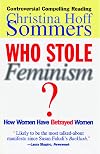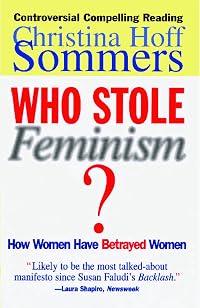
Who Stole Feminism?
by Christina Hoff Sommers
On This Page
Description
In her book, subtitled How Women Have Betrayed Women, philosophy professor Christina Sommers has exposed a disturbing development: how a group of zealots, claiming to speak for all women, are promoting a dangerous agenda that threatens cherished ideals and sets women against men in all spheres of life. In case after case, Sommers shows how these extremists have propped up their arguments with highly questionable but well-funded research, presenting inflammatory and often inaccurate show more information and stifling any semblance of free and open scrutiny. Trumpeted as orthodoxy, their resulting findings on everything from rape, domestic abuse, and economic bias to the supposed crisis in girls' self-esteem perpetuate a view of women as victims of the "patriarchy." show lessTags
Recommendations
































Member Recommendations

Member Reviews
If you are a tat naïve, you would believe that feminism is only about the campaigning battles for women to have the same rights (and responsibilities!) as men. Well: wake up!
I first read this in 2022 (that is, nearly three decades after it was first published) and, oh boy! What a big warning to us all that was... and which wasn't heeded. Contemporary feminism indeed has nothing, but, really, NOTHING, to do with its historical ideological roots. It's no longer about a fight for equity. It's about pitting women against men, by relying on bogus politico-social models, framing us all as some sorts of unified blocks and demographics, with women being 'oppressed' and 'marginalised' by male supremacists (me, and, if you're a man reading show more this, you -yes, *you*!) solidly battling to ensure that the patriarchy remains. Is that male bashing jeremiads and populist bollocks? You bet! And yet, as the saying goes: 'if you're not outraged, you're not paying attention.' Well, eh hi, eh ho, Christina Hoff Sommers was paying attention... As far back as 1994!
She here denounces this new wave of feminism, firmly rooted in radical ideas of the 1970s, and, offshoots of neo-Marxist thinking applied to gender dynamics. She doesn't, though, calls them 'radical feminists', but, 'gender feminists' instead:
'The gender feminists... believe that all our institutions, from the state to the family to the grade schools, perpetuate male dominance.'
Now, of course, one can laugh out loud at this idea that women in the Western world (especially White women) are 'oppressed'. One can laugh out loud at the idea that women had absolutely no responsibility whatsoever in co-creating the patriarchy (then as now). And, one can laugh out loud at the idea that victimising women will contribute in any way to empower them, instead of, well, creating whole generations of self-centred and hypersensitive 'victims', indulging in 'booh-wooh-wooh'. The joke, though, would be on you...
This is not funny, and for a very simple reason: how on earth can such ideologues portray women as 'oppressed', and men as their oppressors, when the reality reflects everything but (not that sexism doesn't exist -it does!- but, to claim that we are living in a patriarchy is as ridiculous as to claim that we are living in a gynocracy -for, yes, there are arguments to be made for that one too...). Well, quite simply: fake it.
What is striking with this book is not only the time the author takes (painstakingly) in debunking false statistics, piling up upon false statistics, and more false statistics (from the supposed 'gender' pay gap to domestic violence and the 'casualties' of the beauty industry); false statistics which, nevertheless, have been peddled by idiotic mediatic outlets more concerned about selling sensationalist headlines than facts (the issues with what has been dubbed 'churnalism' have been outlined enough elsewhere...). What is striking is how such ideologues managed to control the academic fields, in universities especially (where their postmodern disregard for the scientific method makes for a chilling exposé...) and, from there on, disseminate their ideas all over the cultural landscape (medias, politics, gender activism). Women, truly have betrayed women; for, let's not kid ourselves: this is not about men and how men are being perceived in this scaremongering misandrist worldview but, about women themselves, and how, by exposing how they are being lied to, they are being everything but 'empowered'.
No doubt, this book will be dismissed by the male bashing activist who believes that, somehow, she is 'oppressed' by a misogynistic society (and, spoiler alert: the chances for her to be a White middle or upper class 'bourgeoise' are very high indeed...). If you care about science and the scientific method, though, let alone are concerned about how radical populists can easily hijack from academia to the medias and, therefore, the 'official' narrative, then this an absolute must-read.
Eye-opening. show less
I first read this in 2022 (that is, nearly three decades after it was first published) and, oh boy! What a big warning to us all that was... and which wasn't heeded. Contemporary feminism indeed has nothing, but, really, NOTHING, to do with its historical ideological roots. It's no longer about a fight for equity. It's about pitting women against men, by relying on bogus politico-social models, framing us all as some sorts of unified blocks and demographics, with women being 'oppressed' and 'marginalised' by male supremacists (me, and, if you're a man reading show more this, you -yes, *you*!) solidly battling to ensure that the patriarchy remains. Is that male bashing jeremiads and populist bollocks? You bet! And yet, as the saying goes: 'if you're not outraged, you're not paying attention.' Well, eh hi, eh ho, Christina Hoff Sommers was paying attention... As far back as 1994!
She here denounces this new wave of feminism, firmly rooted in radical ideas of the 1970s, and, offshoots of neo-Marxist thinking applied to gender dynamics. She doesn't, though, calls them 'radical feminists', but, 'gender feminists' instead:
'The gender feminists... believe that all our institutions, from the state to the family to the grade schools, perpetuate male dominance.'
Now, of course, one can laugh out loud at this idea that women in the Western world (especially White women) are 'oppressed'. One can laugh out loud at the idea that women had absolutely no responsibility whatsoever in co-creating the patriarchy (then as now). And, one can laugh out loud at the idea that victimising women will contribute in any way to empower them, instead of, well, creating whole generations of self-centred and hypersensitive 'victims', indulging in 'booh-wooh-wooh'. The joke, though, would be on you...
This is not funny, and for a very simple reason: how on earth can such ideologues portray women as 'oppressed', and men as their oppressors, when the reality reflects everything but (not that sexism doesn't exist -it does!- but, to claim that we are living in a patriarchy is as ridiculous as to claim that we are living in a gynocracy -for, yes, there are arguments to be made for that one too...). Well, quite simply: fake it.
What is striking with this book is not only the time the author takes (painstakingly) in debunking false statistics, piling up upon false statistics, and more false statistics (from the supposed 'gender' pay gap to domestic violence and the 'casualties' of the beauty industry); false statistics which, nevertheless, have been peddled by idiotic mediatic outlets more concerned about selling sensationalist headlines than facts (the issues with what has been dubbed 'churnalism' have been outlined enough elsewhere...). What is striking is how such ideologues managed to control the academic fields, in universities especially (where their postmodern disregard for the scientific method makes for a chilling exposé...) and, from there on, disseminate their ideas all over the cultural landscape (medias, politics, gender activism). Women, truly have betrayed women; for, let's not kid ourselves: this is not about men and how men are being perceived in this scaremongering misandrist worldview but, about women themselves, and how, by exposing how they are being lied to, they are being everything but 'empowered'.
No doubt, this book will be dismissed by the male bashing activist who believes that, somehow, she is 'oppressed' by a misogynistic society (and, spoiler alert: the chances for her to be a White middle or upper class 'bourgeoise' are very high indeed...). If you care about science and the scientific method, though, let alone are concerned about how radical populists can easily hijack from academia to the medias and, therefore, the 'official' narrative, then this an absolute must-read.
Eye-opening. show less
"Why are certain feminists so eager to put men in a bad light"? This is one of the first questions asked by Christina Hoff Sommers, philosophy professor & equity-feminist (as she calls herself) in the preface of the book "Who stole feminism?". Sommers makes many interesting points in her book, mainly that gender-feminists are different from equity-feminists: the latter are more mainstream, don't hate men, believe women have come a long way, & oppose the "male hegemony" talk that gender-feminists believe in.
So far, so good....Sommers continues by putting in the spotlight certain studies & reports, all produced by gender-feminists, & proves (or attempts to prove) their fallacy. Good examples of biased studies are the March of Dimes study, show more the "women self-esteem" study, the depression study & some others, which all prove to have fatal flaws in their reasoning. One valid point that Sommers makes is that radical feminism is a little bit like religion- it tends to accept no criticism, & it tends to see all things through a specific, coloured lense. This is the lense through science itself is seen, as is literature, & even art (which thrives, necessarily, through freedom of expression & cannot & should not be stifled, whatever the reason).
Sommers mentions linguistic reform (a funny example is the ludicrous word "ovular" in place of "seminar"), women's studies classes, & - most importantly- the dangerous idea that western civilization itself, & scientific thinking has something inherently "masculine" about it, whereas "feminine" thinking is "emotional" & "connected". What certain gender-feminists propose, in a word, is that there is a "female way of knowing" which seems dangerously close to phallocentric beliefs: "women think differently, are made for different roles, so they should stay home & raise the kids" etc. So, Christina Hoff Sommers has a point: every social movement has to be able to take criticism, both from within & (most importantly) from outside. On the other hand, Sommers mostly mentions only extreme cases of gender-feminism, & I'm sure there are voices of dissent within the feminist movement, which she fails to aknowledge (except in cases such as Camille Paglia's opinions, which are hardly orthodox feminist opinions).
My major complaint with the book is this: at some point, Sommers mentions how Susan Faludi (a good example of her own definition of gender-feminim) has "painted herself into a position that allows no room for criticism". But how guilty is Sommers of the same sin? Her whole book is full of evidence of one, & only one central thesis. Yes, she says she's a feminist, but she never talks about real problems of real women: she mostly points out how far women have come. It's not enough to just mention that equity feminists have different, more mainstream opinions. She should be able to point out how equity feminists go about achieving change, what their activities & plans are when it comes to fighting for even more equality for women. Unfortunately, Sommers never really gets into this issue.
Also, parts of her own statistics & arguments are flawed, as flawed as some of the gender-feminists' reasoning. For example, she mentions "probably 100 women dying from anorexia a year in the US" (as opposed to the much higher numbers that Naomi Wolf had cited in the Beauty Myth- numbers that she later admitted were wrong): 100 women is definitely not the correct number either though, since most women who die of anorexia complications have a different etiology in their death certificates. So, sadly, Sommers also "overlooks evidence that does not fit her puzzle", as she accuses most gender-feminists of doing.
"Who stole feminism" is a well-written, well-researched book, which, yes, has a political goal, & no, does not present the whole picture. I refuse to accept that gender-feminists (as Sommers calls them) have black & white ways of thinking, as I also refuse to accept that the same is true for any group of people. I'm sure there are different ways of thinking within the feminist movement, & I'm also sure that there must also be extreme, radical feminists who tend to alienate maistream women: but these radical feminists do not represent today's women's movement, as Sommers seems to imply, nor do they have nearly as much power as she shows them to. The book is interesting but in parts exaggerated, probably to prove a point & to leave no room for doubt. Sadly, this is exactly what the author accuses the gender-feminists of doing, & she falls into the same trap herself. show less
So far, so good....Sommers continues by putting in the spotlight certain studies & reports, all produced by gender-feminists, & proves (or attempts to prove) their fallacy. Good examples of biased studies are the March of Dimes study, show more the "women self-esteem" study, the depression study & some others, which all prove to have fatal flaws in their reasoning. One valid point that Sommers makes is that radical feminism is a little bit like religion- it tends to accept no criticism, & it tends to see all things through a specific, coloured lense. This is the lense through science itself is seen, as is literature, & even art (which thrives, necessarily, through freedom of expression & cannot & should not be stifled, whatever the reason).
Sommers mentions linguistic reform (a funny example is the ludicrous word "ovular" in place of "seminar"), women's studies classes, & - most importantly- the dangerous idea that western civilization itself, & scientific thinking has something inherently "masculine" about it, whereas "feminine" thinking is "emotional" & "connected". What certain gender-feminists propose, in a word, is that there is a "female way of knowing" which seems dangerously close to phallocentric beliefs: "women think differently, are made for different roles, so they should stay home & raise the kids" etc. So, Christina Hoff Sommers has a point: every social movement has to be able to take criticism, both from within & (most importantly) from outside. On the other hand, Sommers mostly mentions only extreme cases of gender-feminism, & I'm sure there are voices of dissent within the feminist movement, which she fails to aknowledge (except in cases such as Camille Paglia's opinions, which are hardly orthodox feminist opinions).
My major complaint with the book is this: at some point, Sommers mentions how Susan Faludi (a good example of her own definition of gender-feminim) has "painted herself into a position that allows no room for criticism". But how guilty is Sommers of the same sin? Her whole book is full of evidence of one, & only one central thesis. Yes, she says she's a feminist, but she never talks about real problems of real women: she mostly points out how far women have come. It's not enough to just mention that equity feminists have different, more mainstream opinions. She should be able to point out how equity feminists go about achieving change, what their activities & plans are when it comes to fighting for even more equality for women. Unfortunately, Sommers never really gets into this issue.
Also, parts of her own statistics & arguments are flawed, as flawed as some of the gender-feminists' reasoning. For example, she mentions "probably 100 women dying from anorexia a year in the US" (as opposed to the much higher numbers that Naomi Wolf had cited in the Beauty Myth- numbers that she later admitted were wrong): 100 women is definitely not the correct number either though, since most women who die of anorexia complications have a different etiology in their death certificates. So, sadly, Sommers also "overlooks evidence that does not fit her puzzle", as she accuses most gender-feminists of doing.
"Who stole feminism" is a well-written, well-researched book, which, yes, has a political goal, & no, does not present the whole picture. I refuse to accept that gender-feminists (as Sommers calls them) have black & white ways of thinking, as I also refuse to accept that the same is true for any group of people. I'm sure there are different ways of thinking within the feminist movement, & I'm also sure that there must also be extreme, radical feminists who tend to alienate maistream women: but these radical feminists do not represent today's women's movement, as Sommers seems to imply, nor do they have nearly as much power as she shows them to. The book is interesting but in parts exaggerated, probably to prove a point & to leave no room for doubt. Sadly, this is exactly what the author accuses the gender-feminists of doing, & she falls into the same trap herself. show less
I come from a very long line of feminists, so when I hear women my age proudly claim they are defiantly NOT feminists, I am taken aback. Ms. Sommers does an excellent job of showing just why so many young women are running away from the feminist label. They don’t want to be associated with man-haters: women who view every man as a “potential rapist” and every woman as either a “rape survivor” or “potential survivor.” She highlights many of the events from the late eighties and early nineties that ended up giving feminism a very bad name. Rather than trying to promote equal rights for all humanity (the so-called equity feminists), some feminists (gender feminists) are trying to supplant the patriarchy with a matriarchy. To show more do so, they overblow poorly done studies and try to silence maleness wherever it rears its ugly head (pun, unfortunately, intended). She does such a good job of pointing out the hysteria and rancor of this sect of feminists, I had to remind myself constantly that I agree with her thesis-those kinds of feminists are bad for feminism. They take away from the social justice that generations of women have fought for; they stray from the goals of the Seneca Falls Convention and forget that many sisters around the world really are being suppressed; they devalue the terms “sexual harassment” and “rape” by having them apply to everything. I’m grateful she kept repeating the goals of equality through her book or I would have completely forgotten I wasn’t reading the transcripts of a Rush Limbaugh show (a mistake none of us ever wants to make!).
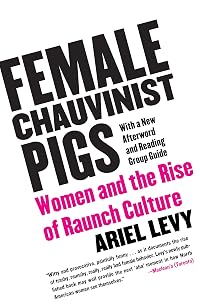
This book was written in 1995, so I was still in junior high and high school when most of these events were unfolding. I participated with my mother in the first Take your Daughters to Work Day (though I have no idea what the boys sat through) and was raised with the constant warnings of possible rape (though I don’t think that was the fault of gender feminists alone-the media has a lot to answer for with that one), but was never issued a rape whistle in freshmen orientation and never got a feminist reprimand for writing a decidedly un-feminist interpretation of a Christina Rossetti poem in college. I wonder how much of her arguments are simply overblown to give evidence to her thesis, how much was relegated only to certain university campuses, and how much has mercifully blown over in the past decade. I would love to see an updated version of this book, but in the mean time, I have a great time with books like The Mommy Myth, Selling Anxiety, and Female Chauvinist Pigs. show less
This book was written in 1995, so I was still in junior high and high school when most of these events were unfolding. I participated with my mother in the first Take your Daughters to Work Day (though I have no idea what the boys sat through) and was raised with the constant warnings of possible rape (though I don’t think that was the fault of gender feminists alone-the media has a lot to answer for with that one), but was never issued a rape whistle in freshmen orientation and never got a feminist reprimand for writing a decidedly un-feminist interpretation of a Christina Rossetti poem in college. I wonder how much of her arguments are simply overblown to give evidence to her thesis, how much was relegated only to certain university campuses, and how much has mercifully blown over in the past decade. I would love to see an updated version of this book, but in the mean time, I have a great time with books like The Mommy Myth, Selling Anxiety, and Female Chauvinist Pigs. show less
Well documented, interesting, thought provoking, and potentially very controversial. Sommers elucidates some of the greater abuses of feminism by what she calls “gender feminists. When she describes faulty research I am wholly on her side. As for the excesses of academe, most of these were new to me. She really tears into FaludiÂs Backlash and WolfÂs Beauty Myth with perhaps too much vigor. The same vigor she applies to trashing Gloria Steinem, who is probably not as far from the norm of mainstream feminism as Sommers implies. The college sections are outrageous, and itÂs fun to read her careful dissections of stupidity, shoddy logic, and illeberalism.
Whereas Sommers is convinced the only way this can go is too far, I hold show more out for a more reasonable outcome. When she describes the inaccuracies or lies in those other two books I am fascinated, but not wholly convinced. She gives them a fair amount of hell for creating conspiracies against women that have no roots. What neither they, nor she, has recognized is that there isnÂt a conspiracy against women, per se, but a conspiracy against everyoneÂs self image: the free market. When Wolf becomes enraged about the wrongs done to women by Weight Watchers or anorexia, she fails to express an equal outrage that men are increasingly in the same boat. The problem isnÂt men trying to force slender physiques down all our throats, but the marketing advantages of body nazism. ItÂs one thing to worry about obesity and attendant ills, quite another to encourage everyone to obsess about their weight. ThereÂs far less money to be made in healthy eating and considered lifestyle (which is good for us) than there is in quick loss programs like Weight Watchers or Optifast (they arenÂt good for us, they actually worsen the problem and make customers more dependent). More and more males are suffering from anorexia. The womenÂs movement did not succeed and removing Âsex object from Âwoman, it couldnÂt when market forces are looking for ways to apply it equally to men. Likewise, many of the formless aspects of the conspiracy Faludi sees are not intentional backlash, but intentional marketing. Designers have become used to the idea that woman will buy what they produce. They create outrageous high fashion lines to give themselves a name, then create more reasonable versions for the stores. If they change the look every year going from short to long, from pants to skirts and back again, they can sell far more clothes than if they only produce a practical business suit. It isnÂt a gender issueÂdesigners have branched out into childrenÂs wear. If theyÂre lucky, theyÂll create a generation of men who are enslaved to fashion as well. As for the stores, clearly there is a reason who MacyÂs went bankrupt that has nothing to do with managing to satisfy their customers.
I go into all of this because Sommers did give credit to market forces for thwarting the aims of gender feminist editors who wanted to remake the romance novel. I consider it a serious flaw that she didnÂt offer the same defense of Faludi and Wolf.
Although I havenÂt read RoipheÂs book, I have increased my estimation of her. The big difference for me was SommerÂs investigation of how increasing rape prevention efforts on campuses already low in rape deprives services in high crime areas. There was a flaw in her logic there, too, though. She looks into the numbers of rapes reported to campus police (acknowledging that rape is under-reported) but she doesnÂt look to see how many rapes are reported to the police of the corresponding city by college students or employees. If I were raped at UNC I wouldnÂt go to the campus police who are rent-a-cops with no legal standing, IÂd go to the Chapel Hill police who can investigate a crime and press charges, if thatÂs what I want.
Rape, particularly, is a complex issue, one where there never seems to be a final truth. There are several examples in my own past where I was coerced into sex. A gender feminist asking me questions would probably come up with a high number of instances where I met her definition of rape. (It seems to me that if you want to call it Âa legal definition you must use the legal definition of the state where the question is asked. Whether or not itÂs a good definition is beside the point.) What the gender feminists wonÂt allow, and what is vital to discussions of rape, is a gray scale. Sommers finds fault with researchers who determine what is rape and what is not without acknowledging how the Âvictim views it. It is bad feminist policy to deny women the right to name their experiences, agreed. On the other hand, there are women who are naive, who suffered childhood abuse, who refuse to acknowledge Ârape just because they were crazy about the guy. For myself, there were times when I had sex and considered myself coerced, but at least half of the coercion was internalized: I didnÂt say Âno and mean it because I didnÂt believe it would help, based on previous experience. It wasnÂt rape to me because there was no specific threat or fear; my fears were generalized, the threats were in my mind. I wouldnÂt dream of pressing charges against those men. IÂm sure that we would not have had sex had I been less timid. In one sense I played a very dangerous game. In order to prove that these men of my affections were worthwhile, I left the decision up to them. If they did not sense my discomfort or reluctance and stop pressing, then we had sex. A woman who is expecting a man to be psychic and empathetic and leaves the decisions to him, will often find the decision goes against her wishes. Gray areas. show less
Whereas Sommers is convinced the only way this can go is too far, I hold show more out for a more reasonable outcome. When she describes the inaccuracies or lies in those other two books I am fascinated, but not wholly convinced. She gives them a fair amount of hell for creating conspiracies against women that have no roots. What neither they, nor she, has recognized is that there isnÂt a conspiracy against women, per se, but a conspiracy against everyoneÂs self image: the free market. When Wolf becomes enraged about the wrongs done to women by Weight Watchers or anorexia, she fails to express an equal outrage that men are increasingly in the same boat. The problem isnÂt men trying to force slender physiques down all our throats, but the marketing advantages of body nazism. ItÂs one thing to worry about obesity and attendant ills, quite another to encourage everyone to obsess about their weight. ThereÂs far less money to be made in healthy eating and considered lifestyle (which is good for us) than there is in quick loss programs like Weight Watchers or Optifast (they arenÂt good for us, they actually worsen the problem and make customers more dependent). More and more males are suffering from anorexia. The womenÂs movement did not succeed and removing Âsex object from Âwoman, it couldnÂt when market forces are looking for ways to apply it equally to men. Likewise, many of the formless aspects of the conspiracy Faludi sees are not intentional backlash, but intentional marketing. Designers have become used to the idea that woman will buy what they produce. They create outrageous high fashion lines to give themselves a name, then create more reasonable versions for the stores. If they change the look every year going from short to long, from pants to skirts and back again, they can sell far more clothes than if they only produce a practical business suit. It isnÂt a gender issueÂdesigners have branched out into childrenÂs wear. If theyÂre lucky, theyÂll create a generation of men who are enslaved to fashion as well. As for the stores, clearly there is a reason who MacyÂs went bankrupt that has nothing to do with managing to satisfy their customers.
I go into all of this because Sommers did give credit to market forces for thwarting the aims of gender feminist editors who wanted to remake the romance novel. I consider it a serious flaw that she didnÂt offer the same defense of Faludi and Wolf.
Although I havenÂt read RoipheÂs book, I have increased my estimation of her. The big difference for me was SommerÂs investigation of how increasing rape prevention efforts on campuses already low in rape deprives services in high crime areas. There was a flaw in her logic there, too, though. She looks into the numbers of rapes reported to campus police (acknowledging that rape is under-reported) but she doesnÂt look to see how many rapes are reported to the police of the corresponding city by college students or employees. If I were raped at UNC I wouldnÂt go to the campus police who are rent-a-cops with no legal standing, IÂd go to the Chapel Hill police who can investigate a crime and press charges, if thatÂs what I want.
Rape, particularly, is a complex issue, one where there never seems to be a final truth. There are several examples in my own past where I was coerced into sex. A gender feminist asking me questions would probably come up with a high number of instances where I met her definition of rape. (It seems to me that if you want to call it Âa legal definition you must use the legal definition of the state where the question is asked. Whether or not itÂs a good definition is beside the point.) What the gender feminists wonÂt allow, and what is vital to discussions of rape, is a gray scale. Sommers finds fault with researchers who determine what is rape and what is not without acknowledging how the Âvictim views it. It is bad feminist policy to deny women the right to name their experiences, agreed. On the other hand, there are women who are naive, who suffered childhood abuse, who refuse to acknowledge Ârape just because they were crazy about the guy. For myself, there were times when I had sex and considered myself coerced, but at least half of the coercion was internalized: I didnÂt say Âno and mean it because I didnÂt believe it would help, based on previous experience. It wasnÂt rape to me because there was no specific threat or fear; my fears were generalized, the threats were in my mind. I wouldnÂt dream of pressing charges against those men. IÂm sure that we would not have had sex had I been less timid. In one sense I played a very dangerous game. In order to prove that these men of my affections were worthwhile, I left the decision up to them. If they did not sense my discomfort or reluctance and stop pressing, then we had sex. A woman who is expecting a man to be psychic and empathetic and leaves the decisions to him, will often find the decision goes against her wishes. Gray areas. show less
Sommers shows with grace what Feminism used to be in comparison to more of Feminism's more recent defenders and how the goal of Feminism has changed over time. As well as the arguments and the unfortunate misinformation used to spread ideas. An example in the book is the now debunked 150,000 women die annually from anorexia, which the real data showed that around 150,000 women suffered from it.
Ratings
Members
- Recently Added By
Author Information

8 Works 1,506 Members
Christina Hoff Sommers is a resident scholar at the American Enterprise Institute in Washington, D.C. She has a PhD in philosophy from Brandeis University and was formerly a professor of philosophy at Clark University. Somers has written for numerous publications and is the author of Who Stole Feminism? How Women Have Betrayed Women. She is show more married with two sons and lives in Chevy Chase, Maryland. show less
Work Relationships
Has as a commentary on the text
Common Knowledge
- Canonical title
- Who Stole Feminism?
Classifications
- Genres
- Nonfiction, Sexuality and Gender Studies, General Nonfiction, Philosophy
- DDC/MDS
- 305.420973 — Society, government, & culture Social sciences, sociology & anthropology Social group - Age, Gender, Ethnicity Women Social role and status of women Standard subdivisions History, geographic treatment, biography North America
- LCC
- HQ1154 .S613 — Social sciences The family. Marriage, Women and Sexuality The Family. Marriage. Women Women. Feminism
- BISAC
Statistics
- Members
- 478
- Popularity
- 63,967
- Reviews
- 5
- Rating
- (3.55)
- Languages
- English
- Media
- Paper, Audiobook, Ebook
- ISBNs
- 7
- ASINs
- 5