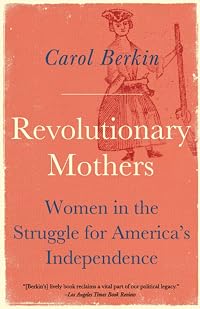
Revolutionary Mothers: Women in the Struggle for America's Independence
by Carol Berkin
On This Page
Description
The American Revolution was a home-front war that brought scarcity, bloodshed, and danger into the life of every American. The author shows that women played a vital role throughout the struggle: we see women boycotting British goods in the years before independence, writing propaganda that radicalized their neighbors, raising funds for the army, and helping finance the fledgling government. We see how they managed farms, plantations, and businesses while their men went into battle, and how show more they served as nurses and cooks in the army camps; risked their lives carrying intelligence, participating in reconnaissance missions, or seeking personal freedom from slavery; served as spies, saboteurs, and warriors; and lived with the daily knowledge that their husbands could be hanged as traitors if the revolution did not succeed. show lessTags
Recommendations

Member Reviews
Carol Berkin examines the roles women played in the American Revolutionary War. She looks at their contributions through the lens of allegiance, class, and origin. The book is well-organized into groups involved in the war, such as active participants, camp followers, generals’ wives, spies, and exiled women. She looks at the Revolution from the viewpoints of English, American, and even Hessian women. She reserves separate chapters for informative stories of tribal and enslaved women.
She articulates the fears and challenges these women faced. They transcended their traditional roles – which were severely restrictive from a modern standpoint. Many women took over the running households and properties, and some descended into poverty show more and starvation.
She relies on letters, diaries, news articles, and published material from the time period and cites all sources. I very much enjoyed reading about these women. This book offers are more well-rounded picture of the people and culture of Revolutionary times. show less
She articulates the fears and challenges these women faced. They transcended their traditional roles – which were severely restrictive from a modern standpoint. Many women took over the running households and properties, and some descended into poverty show more and starvation.
She relies on letters, diaries, news articles, and published material from the time period and cites all sources. I very much enjoyed reading about these women. This book offers are more well-rounded picture of the people and culture of Revolutionary times. show less
I am so happy that someone wrote a book about the founding mothers of the United States. This history book has several sections devoted to the wives of famous patriots, the wives of loyalist men, slave women, Native American women, camp followers, and general's wives. We read about their contributions to our society before the war broke out, during the war and after the war.
It was interesting that although these women managed their husbands' businesses while they were gone from home fighting, they were still considered to just be helpmates for their husbands. The women's roles were preached to them by ministers and lawmakers and they followed what they were told to do. When the colonial men decided to free themselves from English rule, show more it was up to the women to handle the practical aspects of freedom. Many had to learn how to spin and weave fiber into clothing when English resources were cut off. They also had to ensure that their families had the food and products they wanted without buying goods from England. If the women had failed in this endeavor, I doubt their would have been a Revolutionary War. I was sad to read that at the end of the war, the only achievement that the ladies accomplished was that they would be entitled to the same education as the men.
This is a short, 166 page book but it contains a ton of history. I highly recommend it. show less
It was interesting that although these women managed their husbands' businesses while they were gone from home fighting, they were still considered to just be helpmates for their husbands. The women's roles were preached to them by ministers and lawmakers and they followed what they were told to do. When the colonial men decided to free themselves from English rule, show more it was up to the women to handle the practical aspects of freedom. Many had to learn how to spin and weave fiber into clothing when English resources were cut off. They also had to ensure that their families had the food and products they wanted without buying goods from England. If the women had failed in this endeavor, I doubt their would have been a Revolutionary War. I was sad to read that at the end of the war, the only achievement that the ladies accomplished was that they would be entitled to the same education as the men.
This is a short, 166 page book but it contains a ton of history. I highly recommend it. show less
Much praise is given to Carol Berkin for this important addition to our American Revolutionary War history shelves. It is a fascinating history of women that may surprise some readers and raise questions for others. Often overlooked and forgotten, the women who lived and died while the struggle for our independence was fought are recognized in REVOLUTIONARY MOTHERS: WOMEN IN THE STRUGGLE FOR AMERICAN INDEPENDENCE.
Some may be surprised to learn that Martha Washington and many other officers wives accompanied their husbands in battle. British and Hessian officers adopted a temporary substitute wife, while the average soldier, had numerous women to pick from the hoards of camp followers who tagged along. What Berkin points out is that it show more was only natural for women to follow men into battle, because men needed someone to care for them. Whether to do laundry, cook, nurse the sick or carnal pleasure, the men were better soldiers with their women along, and their leaders knew it.
Whether the women were involved in actually fighting, which they were or travelling along side their spouse, women of all races had numerous roles to satisfy. Chapters detail the various roles women played in Colonial Society and during and after the war. There were those who were left home, others who followed, some were General’s wives, or loyalists in exile, Indian Women, African American Women and many women became spies or couriers.
This book evokes a penchant to read more about forgotten and omitted women who have historical relevance. The endnotes and bibliography offer a place to begin. Readers will no doubt recognize famous men from this war, but those who find it difficult to name any famous women, will devour with fervor, REVOLUTIONARY MOTHERS: WOMEN IN THE STRUGGLE FOR AMERICAN INDEPENDENCE.
Wisteria Leigh
December 2013 show less
Some may be surprised to learn that Martha Washington and many other officers wives accompanied their husbands in battle. British and Hessian officers adopted a temporary substitute wife, while the average soldier, had numerous women to pick from the hoards of camp followers who tagged along. What Berkin points out is that it show more was only natural for women to follow men into battle, because men needed someone to care for them. Whether to do laundry, cook, nurse the sick or carnal pleasure, the men were better soldiers with their women along, and their leaders knew it.
Whether the women were involved in actually fighting, which they were or travelling along side their spouse, women of all races had numerous roles to satisfy. Chapters detail the various roles women played in Colonial Society and during and after the war. There were those who were left home, others who followed, some were General’s wives, or loyalists in exile, Indian Women, African American Women and many women became spies or couriers.
This book evokes a penchant to read more about forgotten and omitted women who have historical relevance. The endnotes and bibliography offer a place to begin. Readers will no doubt recognize famous men from this war, but those who find it difficult to name any famous women, will devour with fervor, REVOLUTIONARY MOTHERS: WOMEN IN THE STRUGGLE FOR AMERICAN INDEPENDENCE.
Wisteria Leigh
December 2013 show less
As I've been gathering and reading books on Women in the American Revolution, Berkin's work (this book and others) consistently show up in the bibliographies. I had to read it. I'm very glad I did. Berkin clearly knows her history and how to impart the information. Each chapter centers on a different group of women - including First Nations and African-American. Berkin gives an excellent overview of the many different roles women played in this war - some good, some bad, some for Britain, so for the USA. I highly recommend this work as a starting point for more in depth research or reading about Women in the Revolution. I'm also eager to get my hands on more books by Berkin. She has several I mostly eagerly want to read.
Another one from the DAR book club list. A good, basic primer on women‘s roles and some of their accomplishments during the Revolutionary War. Patriot women, Loyalist women, African-American women, Native-American women are discussed. Some thumbnail sketches of individuals. The author is an academic and it shows in her writing style and approach. But this is a short book.
Examines the role of women in the Revolution, an aspect of the conflict that got almost no serious historical attention until recently. Not only does this book show how women played an important role in the war, it shows the position(s) held by various groups of women in that time and place. It also added to my overall knowledge of the Revolution. Written in a very readable style.
This is a very interesting, easy read. Berkin easily breathes life into historical subjects. If you ever have the opportunity to hear her speak, take advantage of it!
Members
- Recently Added By
Lists

Best U.S. History Books (1754-1828)
363 works; 18 members

Women and American History
19 works; 1 member
Author Information

46+ Works 2,385 Members
Carol Berkin is a professor of American history and deputy executive officer in the history Ph.D. program at the City University of New York and Baruch College. She is the author of numerous scholarly works and history textbooks, and has appeared in more than a dozen documentaries on PBS, the History Channel, the Discovery Channel, and the show more Learning Channel. She was the commentator for the History Channel's Founding Fathers and Founding Brothers, and appears in the PBS series Ben Franklin. Professor Berkin lives in New York City show less
Awards and Honors
Notable Lists
Common Knowledge
- Important events
- American Revolution (1775 | 1783)
- Dedication
- For my brother, Mark Berkin, and my sister, Sylvia Berkin Rose
- First words
- For many Americans the Revolution is their last great romance with war. (pg. ix)
- Last words
- (Click to show. Warning: May contain spoilers.)With it, a second war for independence was begun. (pg. 161)
Classifications
Statistics
- Members
- 450
- Popularity
- 67,897
- Reviews
- 8
- Rating
- (3.85)
- Languages
- English
- Media
- Paper, Audiobook, Ebook
- ISBNs
- 5
- ASINs
- 3