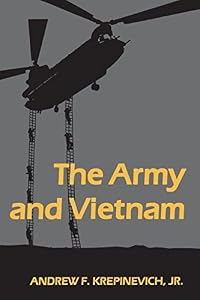
The Army and Vietnam
by Andrew F. Krepinevich Jr.
On This Page
Description
Many senior army officials still claim that if they had been given enough soldiers and weapons, the United States could have won the war in Vietnam. In this probing analysis of U.S. military policy in Vietnam, career army officer and strategist Andrew F. Krepinevich, Jr., argues that precisely because of this mindset the war was lost before it was fought. The army assumed that it could transplant to Indochina the operational methods that had been successful in the European battle theaters of show more World War II, an approach that proved ill-suited to the way the Vietnamese Communist forces fought. Theirs was a war of insurgency, and counterinsurgency, Krepinevich contends, requires light infantry formations, firepower restraint, and the resolution of political and social problems within the nation. To the very end, top military commanders refused to recognize this. Krepinevich documents the deep division not only between the American military and civilian leaders over the very nature of the war, but also within the U.S. Army itself. Through extensive research in declassified material and interviews with officers and men with battlefield experience, he shows that those engaged in the combat understood early on that they were involved in a different kind of conflict. Their reports and urgings were discounted by the generals, who pressed on with a conventional war that brought devastation but little success. A thorough analysis of the U.S. Army's role in the Vietnam War, The Army and Vietnam demonstrates with chilling persuasiveness the ways in which the army was unprepared to fight--lessons applicable to today's wars in Afghanistan and Iraq. show lessTags
Recommendations




































Member Reviews
An important but flawed book that should be read by anyone serious about understanding the Vietnam war. The author is primarily concerned with what is called the "Army concept" which is the US Armies idea of why it exists and what future wars it existed to fight in the 1960's. That war was a conventional war against the Soviet Union in central Europe. Instead the war it fought was a counterinsurgency war in Vietnam. The author's case is that the US Army took it's conventional mindset and fought the Vietnam War using that instead of counterinsurgency methods. That a policy of attrition was used which left the population to be dominated by the Viet Cong. I think that case is mostly proven.
My criticism is three fold.
Firstly it doesn't show more cover the policy of Containment, the grand strategy of the US during the Cold War. Without discussing this policy it makes decisions made regarding Vietnam seem without context and irrational.
Secondly the book finishes in 1968, it is a common thing in books on the war but wrong. There is still 7 years of war to be fought and nothing within that time is important or can change anything?
Thirdly why are the Communists invisible? Nothing that America does has any effect on the Communist war effort. That is simply not true, the Communists were forced to change constantly because of the American forces and that includes at a strategic level.
I think the book is an important critic of the US Army and government in Vietnam, it is important to question assumptions, but it is far from the final answer on the war. Finally the story is that this book destroyed the authors career in the US Army, it's rare to read the sentence that destroyed a career but here it is on page 262:
"That this strategic war of annihilation against North Vietnam still evokes support in some Army quarters reinforces the notion that for some the learning process proceeds at a glacial pace, if at all."
No employer is going to be happy with that sentence! show less
My criticism is three fold.
Firstly it doesn't show more cover the policy of Containment, the grand strategy of the US during the Cold War. Without discussing this policy it makes decisions made regarding Vietnam seem without context and irrational.
Secondly the book finishes in 1968, it is a common thing in books on the war but wrong. There is still 7 years of war to be fought and nothing within that time is important or can change anything?
Thirdly why are the Communists invisible? Nothing that America does has any effect on the Communist war effort. That is simply not true, the Communists were forced to change constantly because of the American forces and that includes at a strategic level.
I think the book is an important critic of the US Army and government in Vietnam, it is important to question assumptions, but it is far from the final answer on the war. Finally the story is that this book destroyed the authors career in the US Army, it's rare to read the sentence that destroyed a career but here it is on page 262:
"That this strategic war of annihilation against North Vietnam still evokes support in some Army quarters reinforces the notion that for some the learning process proceeds at a glacial pace, if at all."
No employer is going to be happy with that sentence! show less
Andrew Krepinevich, among other critics of the so-called “Army Concept,” has refuted Harry Summers’ plan (see Summers' On Strategy) for isolating South Vietnam from the North. Krepinevich asserts the following about Summers’ plan. Summers’ idea had already been proposed (as the EL PASO Plan) by the military, and discarded, because of the enormous support and logistical requirements. This barrier force, like that along the DMZ, would have been subjected to an enormous amount of harassing fire, requiring a great deal of support to maintain its position. Also, the North Vietnamese could have gone around this barrier by entering Thailand. This would have lengthened the North Vietnamese supply lines into the South, but South show more Vietnam would not have been completely isolated from the North. And, until the Tet Offensive in 1968, the primary opponents were the Viet Cong already operating in South Vietnam, who relied mainly on supplies and support provided from within South Vietnam, rather than relying primarily on external aid.
Krepinevich also argues that instead of focusing too much on the counterinsurgency component of the war effort, the U.S. military failed to concentrate on it enough. He contends that mere lip service was given to the civilian leadership’s demands for greater counterinsurgency effort, and that the early efforts (like the CAP – Combined Action Platoons program, for example) were highly successful, but were discarded shortly after implementation because they were a longer-term solution requiring more time and patience than the military establishment was willing to invest in this type of program. Rather than adapting its doctrine and operations to meet the changing threat of the insurgency, the U.S. military, Krepinevich says, was too inflexible, and wanted to use its conventional approaches and doctrine. Using the same military doctrine that had prevailed in Korea and World War Two, and was designed to match the Soviet conventional threat in Europe, instead of adopting a new low-intensity conflict doctrine is what caused the military failure in Vietnam. Failing to commit enough of our effort on counterinsurgency, rather than too much on it, as Summers asserts, was one of the major causes of U.S. failure in Vietnam, according to Krepinevich.
Review copyright 2009 J. Andrew Byers show less
Krepinevich also argues that instead of focusing too much on the counterinsurgency component of the war effort, the U.S. military failed to concentrate on it enough. He contends that mere lip service was given to the civilian leadership’s demands for greater counterinsurgency effort, and that the early efforts (like the CAP – Combined Action Platoons program, for example) were highly successful, but were discarded shortly after implementation because they were a longer-term solution requiring more time and patience than the military establishment was willing to invest in this type of program. Rather than adapting its doctrine and operations to meet the changing threat of the insurgency, the U.S. military, Krepinevich says, was too inflexible, and wanted to use its conventional approaches and doctrine. Using the same military doctrine that had prevailed in Korea and World War Two, and was designed to match the Soviet conventional threat in Europe, instead of adopting a new low-intensity conflict doctrine is what caused the military failure in Vietnam. Failing to commit enough of our effort on counterinsurgency, rather than too much on it, as Summers asserts, was one of the major causes of U.S. failure in Vietnam, according to Krepinevich.
Review copyright 2009 J. Andrew Byers show less
Pages 131-275 were assigned reading for Vietnam Case Study in S&W at the NWC. I skimmed this section, but then came back and referenced this reading multiple times for the final exam when I answered the question about irregular warfare. Krepinevich is very critical of Army strategy in Vietnam and senior Army officers.
From the syllabus: Krepinevich shows how the U.S. Army began fighting the war by attempting to apply conventional doctrine in Vietnam.
From the syllabus: Krepinevich shows how the U.S. Army began fighting the war by attempting to apply conventional doctrine in Vietnam.
This was the counter factual history that was a huge influence on the scholar soldiers of the Middle East wars.
Ratings
Members
- Recently Added By
Author Information

14 Works 448 Members
Andrew F. Krepinevich is the president of the Center for Strategic and Budgetary Assessments, an independent policy research institute. A graduate of West Point and Harvard, he has served as a consultant on military affairs for the Department of Defense and the CIA, among other institutions. He currently serves on the Defense Policy Board and the show more Transformation Advisory Group of Joint Forces Command. show less
Awards and Honors
Awards
Classifications
- Genres
- History, Nonfiction, General Nonfiction
- DDC/MDS
- 959.704 — History & geography History of Asia Southeast Asia: Myanmar, Thailand, Laos, Cambodia, Vietnam Vietnam 1949-
- LCC
- DS558 .K74 — History of Europe, Asia, Africa and Oceania Asia History of Asia Southeast Asia French Indochina Vietnam. Annam Vietnamese Conflict
- BISAC
Statistics
- Members
- 155
- Popularity
- 210,624
- Reviews
- 4
- Rating
- (3.56)
- Languages
- English
- Media
- Paper, Ebook
- ISBNs
- 3
- ASINs
- 1