On This Page
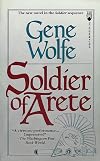
Description
The second volume of Gene Wolfe's powerful story of Latro, a Roman mercenary who, while fighting in Greece, received a head injury that deprived him of his short-term memory. In return it gave him the ability to converse with supernatural creatures, gods and goddesses who invisibly inhabit the ancient landscape. At the Publisher's request, this title is being sold without Digital Rights Management Software (DRM) applied.Tags
Recommendations




















Member Reviews
Latro continues his journey across ancient Greece in search of his memory in Gene Wolfe’s second entry in the “Soldier” series _Soldier of Arete_. As implied in my review of [b:Soldier of the Mist|322067|Soldier of the Mist|Gene Wolfe|http://d.gr-assets.com/books/1173746321s/322067.jpg|1408393] I am finding this series to be the easiest for me to ‘get into’ of all of Gene Wolfe’s work that I’ve read thus far. I think it’s because many of the elements Wolfe employs in nearly all of his fiction really seem to make sense here. Latro is naïve and ‘unreliable’ as a narrator, but he’s suffering from memory loss due to brain trauma…I can accept that a lot easier than I can the apparent naïvete of characters like show more Severian (an apprentice torturer and would-be saviour), Silk (an annoying man-child saint)or Able (a young boy transported to a fantasy world, but a boy who seems to have grown up in some kind of very sheltered ‘Leave it to Beaver’ childhood…he certainly never seemed to have the experience I would expect of even a ten-year-old from the modern era). When those characters ‘leave something out’ of the tale they are telling it seems willful to me, Wolfe purposely obfuscating the narrative via his narrative tool, but when Latro does it I can accept it as a natural part of the story due to the fact that he just can’t help it, he really does try to be the best reporter of the events going on around him that he can. Of course this is all really just smoke and mirrors: Latro is just as much the ‘narrative tool’ of Wolfe as the others and giving me a ‘plausible’ excuse for accepting unreliability from him as a character perhaps doesn’t really mean that he has any significant difference from Wolfe’s other protagonists, he is still performing the same ‘sleight of hand’, but somehow it does make a difference to me. I'm willing to accept Latro for who he is and I find that much more difficult with Wolfe's other protagonists.
Wolfe’s ever-present erudition is also on full display in this volume (as in the previous) and we are immersed into the world of ancient Greece at the time of the Graeco-Persian wars. As is usual with Wolfe he pulls no punches and much is left for the reader to make sense of on their own, though Latro’s own need to explain some things to himself in his scrolls, as well as my own interest in the civilizations of this era, made the often frustrating obfuscation and explanation-by-way-of-implication endemic to Wolfe less of an issue for me here. Be warned that spoilers for [b:Soldier of the Mist|322067|Soldier of the Mist|Gene Wolfe|http://d.gr-assets.com/books/1173746321s/322067.jpg|1408393] follow.
The previous volume ended in a cliffhanger: upon leaving the besieged city of Sestos Latro was tricked into a battle that seemed likely to kill him. Although he managed to survive (he is touched by the gods after all) and met a dying soldier who seemed to recognize him, calling out the name “Lucius” only to expire before he could enlighten him beyond this, Latro seems to be no closer to finding his home and identity than he was before. Latro is once again thrown into companionship with some old friends (and enemies) and this time journeys across Thrace, through Athens, and finally to Sparta guided both by the hands of the gods and those in whose company he finds himself. It becomes even more obvious here that Latro is a pawn, both of the gods and the other people with whom he must live. I’m still not sure what the end game of the former group is, or why they view Latro as such an important tool. The human players are much easier to read as they jockey for political and personal power and see Latro’s abilities (both as a soldier and as one who can see the invisible world) as useful tools for reaching their objectives.
It is interesting to see that a character like Latro, one who loses the memory of each day as it recedes into the past, is actually still capable of growth. I would definitely say that the Latro of Arete is a slightly different man from the Latro of Mist and the sorrow and perplexity of his condition are truly beginning to weigh on him. It is also touching to see the way in which many of the people around him truly care for this man (though he would be, and is, horrified at their pity of him) and much of the manipulation of Latro is done with the best of intentions, “for his own good”. Deep down in his heart, though, Latro appears to know better what it is that he needs and how he ought to live and thus, in the end, he makes his own decisions about what he shall do and where he shall go…perhaps to his own detriment, but even a man with no memory wants to feel that he has made his own choices, however well-intentioned the choices made on his behalf by others.
The ending of this volume is an even bigger cliffhanger than the one in Mist and the last chapter is even told in slightly confusing poetic prose by a character other than Latro…a flourish of Wolfe’s that no doubt left the readers at the time of publication thoroughly frustrated (these readers would be forced to wait 17 years for the final volume of the series, a volume that they perhaps never even expected to appear). While this could be validly considered a typically Wolfean ending to a series loaded with ambiguity I am glad that I have the third volume at hand and can see where Latro finds himself in the final fragment of his story without further delay. show less
Wolfe’s ever-present erudition is also on full display in this volume (as in the previous) and we are immersed into the world of ancient Greece at the time of the Graeco-Persian wars. As is usual with Wolfe he pulls no punches and much is left for the reader to make sense of on their own, though Latro’s own need to explain some things to himself in his scrolls, as well as my own interest in the civilizations of this era, made the often frustrating obfuscation and explanation-by-way-of-implication endemic to Wolfe less of an issue for me here. Be warned that spoilers for [b:Soldier of the Mist|322067|Soldier of the Mist|Gene Wolfe|http://d.gr-assets.com/books/1173746321s/322067.jpg|1408393] follow.
The previous volume ended in a cliffhanger: upon leaving the besieged city of Sestos Latro was tricked into a battle that seemed likely to kill him. Although he managed to survive (he is touched by the gods after all) and met a dying soldier who seemed to recognize him, calling out the name “Lucius” only to expire before he could enlighten him beyond this, Latro seems to be no closer to finding his home and identity than he was before. Latro is once again thrown into companionship with some old friends (and enemies) and this time journeys across Thrace, through Athens, and finally to Sparta guided both by the hands of the gods and those in whose company he finds himself. It becomes even more obvious here that Latro is a pawn, both of the gods and the other people with whom he must live. I’m still not sure what the end game of the former group is, or why they view Latro as such an important tool. The human players are much easier to read as they jockey for political and personal power and see Latro’s abilities (both as a soldier and as one who can see the invisible world) as useful tools for reaching their objectives.
It is interesting to see that a character like Latro, one who loses the memory of each day as it recedes into the past, is actually still capable of growth. I would definitely say that the Latro of Arete is a slightly different man from the Latro of Mist and the sorrow and perplexity of his condition are truly beginning to weigh on him. It is also touching to see the way in which many of the people around him truly care for this man (though he would be, and is, horrified at their pity of him) and much of the manipulation of Latro is done with the best of intentions, “for his own good”. Deep down in his heart, though, Latro appears to know better what it is that he needs and how he ought to live and thus, in the end, he makes his own decisions about what he shall do and where he shall go…perhaps to his own detriment, but even a man with no memory wants to feel that he has made his own choices, however well-intentioned the choices made on his behalf by others.
The ending of this volume is an even bigger cliffhanger than the one in Mist and the last chapter is even told in slightly confusing poetic prose by a character other than Latro…a flourish of Wolfe’s that no doubt left the readers at the time of publication thoroughly frustrated (these readers would be forced to wait 17 years for the final volume of the series, a volume that they perhaps never even expected to appear). While this could be validly considered a typically Wolfean ending to a series loaded with ambiguity I am glad that I have the third volume at hand and can see where Latro finds himself in the final fragment of his story without further delay. show less
I absolutely loved Soldier of the Mist, the first book in this series, and I really liked this one as well. Wolfe's writing is first-class and his storytelling is original and captivating. The only reason I am rating it lower than the first book, is that the storyline itself was a bit more confusing and hard to follow (though the enigmatic storyline is something I also appreciate), and that Latro's inability to remember is treated more as a storytelling device, rather than part of the story in this book. It is still a masterfully told story and a compelling vision of life in ancient times, seen through the eyes of a man that sees spirits, ghosts, gods and goddesses as part of reality.
No surprise that the trilogy was not completed.: Soldier of the mist was a great book, and this was a good sequel, but you can see the problem with writing it. Unless you have a brilliant memory the plot becomes more and more difficult to follow, the memories more difficult to call up, like Latro we are referring to our journal to see what went before, and I think Wolfe, brilliant writer that he is, realised the limitations of this style of writing and decided to abandon number three. Confusing and difficult to read, this book is not a patch on the first!
The adventures of the absent-minded hero continue as he tries to find his way home but the gods keep complicating things.
Awkward narration by a character who forgets each night and remembers things only through what he wrote down and his companions. Somewhat interesting story but confusing and disappointing ending.
Soldier of Arete
Members
- Recently Added By
Lists

Best Historical Fiction
620 works; 261 members

Unreliable Narrators
170 works; 43 members
Author Information

315+ Works 43,639 Members
Gene Wolfe was born in New York City on May 7, 1931. He dropped out of Texas A&M University during his junior year and was drafted into the Army to fight in the Korean War. After the war, he received a degree in mechanical engineering from the University of Houston. He worked as an industrial engineer for Procter and Gamble, where he developed the show more machine that cooks the dough used to make Pringles potato chips. He was an editor of the trade journal Plant Engineering from 1972 to 1984 before retiring to become a full-time writer. He wrote more than 30 books during his lifetime including The Fifth Head of Cerberus, Peace, The Book of the New Sun, and The Land Across. He received the Campbell Memorial Award, the Edward E. Smith Memorial Award, the Locus Award four times, and the Nebula Award and the World Fantasy Award two times each. In 1996, he was given the World Fantasy Award for Lifetime Achievement. He was inducted into the Science Fiction Hall of Fame in 2007 and was named a Grand Master by the Science Fiction and Fantasy Writers of America in 2012. He died after a long battle with heart disease on April 14, 2019 at the age of 87. (Bowker Author Biography) show less
Awards and Honors
Awards
Series

Belongs to Publisher Series
Présence du futur (528-529)
Work Relationships
Is contained in
Contains
Common Knowledge
- Canonical title*
- Soldat d'Aretê Il soldato dell'arete
- Original title
- Soldier of Arete
- Original publication date
- 1989
- People/Characters
- Latro
- Important places
- Ancient Greece
- Epigraph
- And there came one to Xenophon as he was offering sacrifice, and said, "Gryllus is dead." And Xenophon took off the garland that was on his head, but ceased not his sacrifice. Then the messenger said, "His death was noble." A... (show all)nd Xenophon returned the garland to his head again; and it is the tale that he shed no tears, but said, "I knew that I begat him mortal."
—Diogenes Laertius - Dedication
- This book
is dedicated
to the old colonel,
the most underrated
of ancient authors
and the least heeded:
Xenophon the Athenian - First words
- Foreword
This scroll is in poor condition and contains various lacunae.
1: I Will Make a New Beginning
On this fresh scroll, which the black man found in the city. - Last words
- (Click to show. Warning: May contain spoilers.)Permit us to voyage in safety, O lovely Ino, to that great city, Syracuse, the precinct of Ares.
- Blurbers
- Anderson, Poul
- Original language
- English
*Some information comes from Common Knowledge in other languages. Click "Edit" for more information.
Classifications
- Genres
- Fiction and Literature, Fantasy, General Fiction, Historical Fiction
- DDC/MDS
- 813.54 — Literature & rhetoric American literature in English American fiction in English 1900-1999 1945-1999
- LCC
- PS3573 .O52 .S64 — Language and Literature American literature American literature Individual authors 1961-
- BISAC
Statistics
- Members
- 540
- Popularity
- 55,187
- Reviews
- 9
- Rating
- (4.02)
- Languages
- 5 — English, French, Italian, Polish, Spanish
- Media
- Paper, Audiobook, Ebook
- ISBNs
- 10
- ASINs
- 3